



Realism Rating: Appraisal and Auction

Key takeaways
- The value of realist art varies greatly depending on the artist, the subject, and historical significance, with major works by Courbet or Millet regularly exceeding one million euros.
- Scenes of peasant life constitute the most active segment of the realist market, sought after by European, American, and Asian collectors, with prices ranging from 5,000 to 60,000 euros for second-tier artists.
- The artist’s reputation, subjects with strong social content, large format, and impeccable documentation (Salon, provenance) are the key criteria determining the market value of a realist painting.
The reality of everyday life and the rejection of the ideal: the value of realism varies greatly depending on the artist, the subject, and the historical significance of the painting.
Below you’ll find all our valuation guides dedicated to realism—realist paintings, drawings, and sculptures from the 19th century. Each guide details the price ranges observed at auction and the factors that determine a work’s value before it is entrusted to our state-certified auctioneers.
Guides on this art movement
See all guides >
Rating and value of drawings and paintings by Johan Christia...
Johan Christian Dahl is a Norwegian painter associated with the Romantic movement. His paintings command high prices at auction.
Learn more >

Estimate and value of paintings, drawings by Hans Thoma
Discover the prices and values of works by Hans Thoma (1839–1924), a German Symbolist painter. Appraisals, art market trends, and expert advice.
Learn more >

Rating and value of drawings and paintings by Horace Vernet
Horace Vernet was a French Romantic and Orientalist painter who produced numerous paintings that are highly valued and command high prices.
Learn more >

Rating and value of drawings and paintings by Arnold Böcklin
Arnold Böcklin was a 19th-century Symbolist painter who produced numerous paintings that are highly prized and valuable.
Learn more >

Rating and value of drawings and paintings by Édouard Pignon
Édouard Pignon is a French painter of the New School of Paris who produced a vast number of paintings that are highly valued and command high prices.
Learn more >

Rating and value of drawings and paintings by Nicolas Eekman
Nicolas Eekman is an original painter from Brussels whose style defies categorization. His work is reminiscent of the School of Paris and is highly va...
Learn more >

Rating and value of drawings and paintings by André Planson
André Planson is a 20th-century painter inspired by Fauvism, whose works command high prices and are highly valued at auction.
Learn more >

Rating and value of sculptures and bronzes by Charles Delhom...
Charles Delhommeau is a French animal sculptor who has created numerous works that command high prices at auction.
Learn more >

Rating and value of drawings and paintings by Johan Barthold...
Johan Barthold Jongkind - Rating, Value, Analysis - Auctie's
Learn more >

Rating and value of drawings and paintings by Paul Guigou
Paul Guigou is a landscape painter associated with the Barbizon School whose paintings command high prices and are highly valued.
Learn more >

Rating and value of drawings and paintings by Jean Syndon
Jean Syndon was a 19th-century painter—a realist and Orientalist—who signed his paintings under several names. The value of his works is on the rise.
Learn more >

Rating and value of drawings and paintings by Jules Jacques...
Jules Jacques Veyrassat was a 19th-century painter associated with the Barbizon School whose works command high prices and are highly valued.
Learn more >
Understanding the Value of a Realist Painting
What Is Market Value in the Realist Art Market?
The market value of a realist painting refers to the benchmark value assigned to it by the secondary market at a given moment, based on the combination of factors that make each work unique: the artist’s identity, the subject matter, the format, the condition, the strength of the documentation, and the current state of international demand.
It is not a fixed figure: it evolves over time in response to auctions, retrospective exhibitions, and shifting trends in the art market.
Emerging in the 1840s around Gustave Courbet, Jean-François Millet, and Honoré Daumier, Realism was a movement that marked a radical break with the academic idealism that had dominated French painting since David.
Where academicism elevates and embellishes, Realism looks things in the face: the peasant condition in its daily harshness, manual labor in its material reality, and the weathered faces of the working classes without the slightest concession to flattery.
This critical and documentary ambition, which earned the Realists resounding scandals at the Salon, is precisely what gives their work today a power and relevance that appeal to collectors around the world.
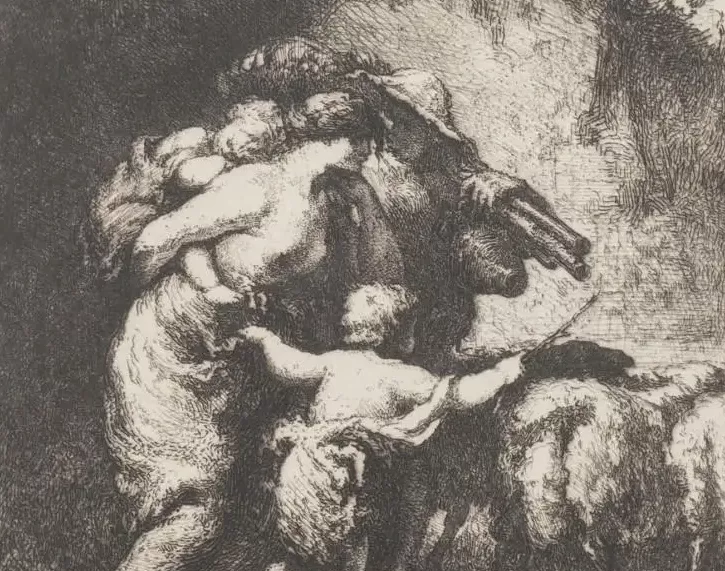
Realism, Naturalism, and Academicism: What Are the Differences in the Market?
Realism, naturalism, and academic art are three contemporary or closely related movements that share an interest in depicting the observable world, but whose aesthetics and market dynamics differ significantly.
Academicism, championed by Bouguereau, Cabanel, and Meissonier, accepts reality on the condition that it be embellished: its works, long disparaged as too conventional, have undergone a spectacular reassessment since the 1980s, driven by American and Gulf collectors who see their technical virtuosity as a value in itself.
Naturalism, which succeeded Realism in the 1870s–1890s, continued Realism’s social concerns while tempering them with a sensitivity to light and atmosphere that at times brought it closer to nascent Impressionism.
Jules Bastien-Lepage, Léon Lhermitte, and Pascal Dagnan-Bouveret were its leading figures. These three movements appealed to partially distinct communities of collectors, and their market values evolved relatively independently on the secondary market.
Movement | Period | Representative Artists | Level of Demand |
Realism | 1840–1875 | Gustave Courbet, Jean-François Millet, Honoré Daumier, Rosa Bonheur | Very high, both institutional and private |
Naturalism | 1870–1900 | Jules Bastien-Lepage, Léon Lhermitte, Pascal Dagnan-Bouveret, Jules Breton | Active, European and American collectors |
Realist Academicism | 1850–1900 | Ernest Meissonier, William-Adolphe Bouguereau, Alexandre Cabanel | Very active, strong international demand |
English Social Realism | 1848–1880 | Ford Madox Brown, Luke Fildes, Hubert von Herkomer | Steady, British and American markets |
Russian Realism (Peredvizhniki) | 1870–1900 | Ilya Repin, Vasily Surikov, Ivan Shishkin, Nikolai Guié | Very active, with demand from Russia and internationally |
American Realism | 1860–1900 | Winslow Homer, Thomas Eakins, John Singer Sargent | Very high, with remarkable auction results |
Estimate in less than 24h
The Criteria That Determine the Market Value of a Realist Painting
The market value of a realist painting is determined by a hierarchy of criteria that the auctioneer weighs according to the nature of the work.
The artist’s identity takes precedence over everything else: a certified painting by Courbet or Millet will always fetch exceptional prices, whereas a work of the same formal quality by a less famous contemporary artist will be valued at a much lower level.
The subject matter plays a significant role in realism, even more so than in other art movements: peasant scenes with strong social content, realistic nudes, and portraits of identifiable ordinary people are consistently valued higher than less socially engaged subjects.
The observed price ranges illustrate the breadth of this market. A peasant scene by a well-documented second-tier artist can range from 5,000 to 60,000 euros depending on its size and visual impact. A genre scene or depiction of working-class life by an identified naturalist ranges from 3,000 to 40,000 euros.
A signed realistic portrait ranges from 2,000 to 30,000 euros. Major compositions by Courbet, Millet, or Daumier regularly exceed one million euros when they are well-documented and in good condition.
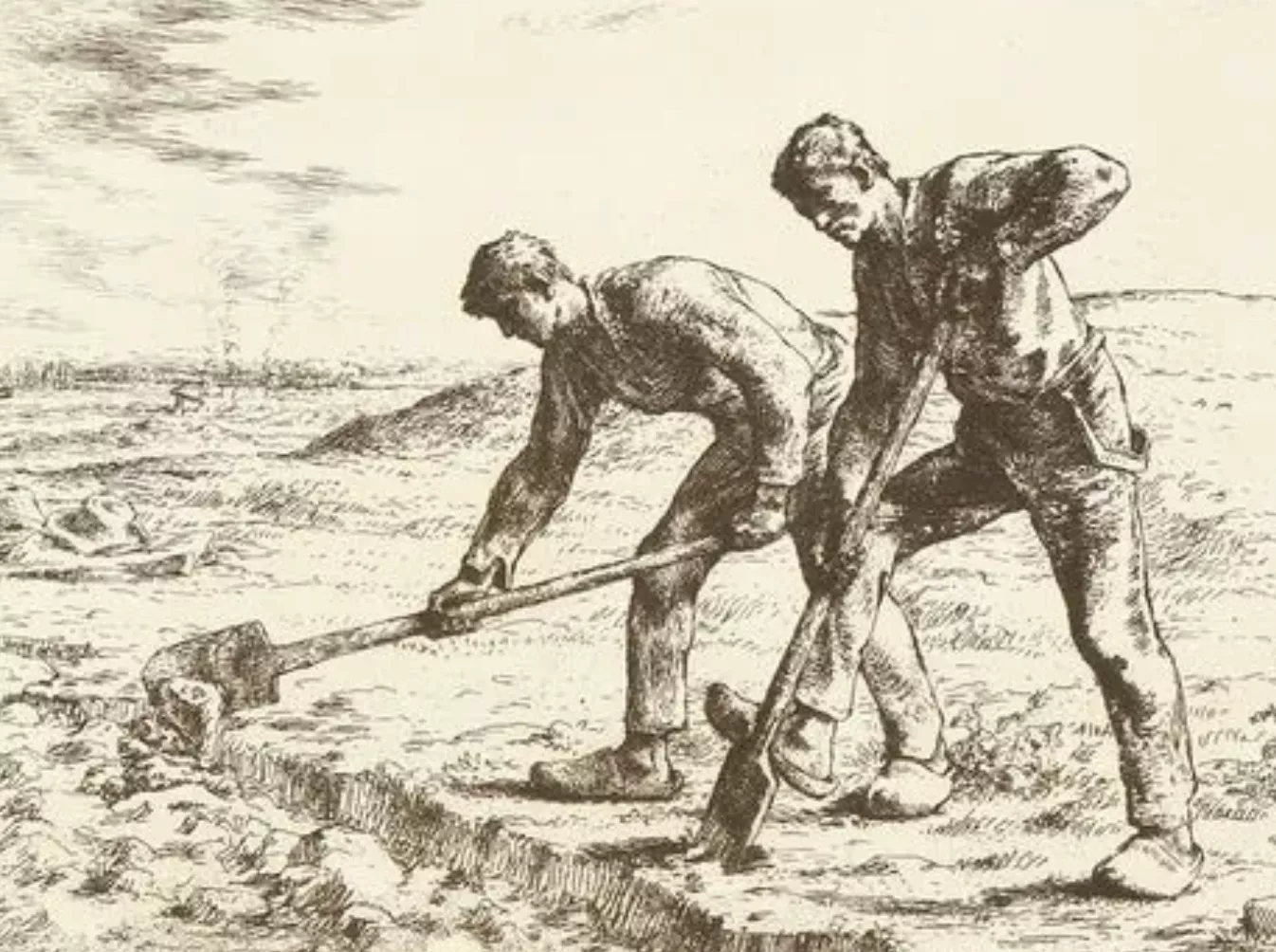
Genre scenes, peasant life, working-class conditions: all subjects evaluated
The hierarchy of realistic subjects and its impact on valuation
In the world of Realism, the subject matter is a key determinant of value. The movement developed its own distinct iconography, deeply rooted in the depiction of labor and the working classes, with certain themes enjoying structurally stronger demand than others on the secondary market.
Scenes of peasant life, inherited from Millet and the Barbizon School, constitute the most active and liquid segment of the realist market: they appeal to both traditional European collectors and new American and Asian buyers, for whom they embody a romanticized vision of 19th-century rural Europe.
Scenes depicting working-class life and industrial labor constitute a second major focus, particularly sought after by museums and collectors attuned to the political dimension of realism.
These works, which are rare on the market because they have often been held in public collections since the 19th century, fetch high prices when they appear at public auctions. Realist portraits of ordinary people, market scenes, and peasant interiors round out this body of work, for which there is steady and well-established demand.
Subject / Theme | Characteristics | Indicative Price Range | Market Demand |
Scene of Peasant Life (Major Artist) | Central motif of Realism; strong social and symbolic content | €50,000 — several million | Very high, institutional |
Scene of Peasant Life (second-tier artist) | Recognizable subject matter, variable quality of execution | €5,000 — €60,000 | Active, broad buyer base |
Working-class conditions and industrial labor | Rare on the market, strong social commitment | €20,000 — €300,000+ | Strong market, dedicated collectors |
Portrait of an identified popular figure | Depiction of the common people without idealization | €3,000 — €35,000 | Regular, portrait collectors |
Genre scene (interior, market, cabaret) | Everyday life of the bourgeoisie or working class | €2,000–25,000 | Active, accessible, highly liquid |
Realistic nudes | Bodies without idealization, a controversial subject in the 19th century | €8,000 — €100,000+ | Strong market, for discerning collectors |
Signed naturalist landscape | Light, atmosphere, nature observed directly | €1,500 — €20,000 | Active, accessible entry-level collection |
Large-format oil-on-canvas paintings: the most sought-after realist works at auction
In realism, the large format is a statement of intent in and of itself. By choosing to paint peasants, stone-breakers, or gleaners in formats usually reserved for history painting, Courbet and Millet created an aesthetic and political scandal whose impact their works still carry today.
When these large-format realist works come to market with impeccable provenance, they spark international competition among museums and major collectors, which can lead to spectacular auction results.
Medium-sized realist works form the core of the market accessible to private collectors. Figure studies, interior scenes, landscapes, and portraits of reasonable dimensions regularly appear at auction houses in Paris and across Europe, at price levels that still offer genuine opportunities for discerning collectors.
Size is in itself a factor in determining value: given equal quality and documentation, a large-scale realist work will always command a higher price than a small-scale study, as it demonstrates greater ambition and a higher level of technical investment on the part of the artist.
Estimate in less than 24h
Get a Free Appraisal of a Realistic Painting
A certified appraisal by a licensed auctioneer in less than 24 hours
Appraising a realist painting requires a comprehensive understanding of the history of the movement, the techniques specific to 19th-century oil painting, and the current state of a market that is rapidly evolving due to international demand.
Realism is a European movement with very distinct national expressions: what applies to a French peasant scene does not follow the same market criteria as a composition by the Russian Peredvizhniki or an American genre painting.
A licensed auctioneer has the training and experience necessary to navigate this complexity, and their expertise is backed by their professional liability.
Auctie’s offers this expertise free of charge, with a certified response within 24 hours. Whether you wish to appraise an inherited painting, prepare an estate, insure a work at its fair market value, or consider putting it up for sale, the process is the same: submit your piece to a trained eye capable of accurately determining its value in today’s market.
What You Need to Provide for an Online Appraisal
For a realistic oil painting, please provide clear photographs of the front and back of the artwork, a photo of the signature if visible, the precise dimensions of the painting and the stretcher, and any known provenance information: a collector’s label on the back, an old purchase invoice, or a reference in an auction catalog or specialized publication.
The condition of the stretcher and canvas, visible on the reverse, can provide valuable information about the piece’s age and authenticity. Mention of any participation in the Official Salon—based on a Salon label on the reverse or a reference in digitized Salon catalogs—is particularly valuable because it establishes a definitive date and serves as an initial form of public documentation.
For works on paper, preparatory drawings, or oil sketches on cardboard, the condition of the support is a key factor. In case of doubt regarding attribution or condition, a physical examination of the piece can be arranged at a later date at no additional cost.
Attribution, Provenance, and Authenticity: The Pillars of Valuation
Signature, Art Show, and Catalogue Raisonné: The Impact on Value
The authentication of a realist painting relies on several complementary levels of analysis. The signature is the first point of entry, but it is never sufficient on its own: forgeries and misattributions are common in a market that places a high value on big names.
Stylistic comparison with the artist’s documented works, analysis of materials and pigments, examination of the stretcher and canvas, and consultation of available archives are the essential steps in any serious appraisal.
For 19th-century works, participation in the official Salon is an irreplaceable source of documentation. The Salon catalogs, which have been digitized and are accessible online, make it possible to trace a work’s presence in official exhibitions and thereby establish its date and contemporary recognition.
For artists who have one, the catalogue raisonné is the definitive reference. Courbet’s, compiled by Robert Fernier; Millet’s, by Alexandra Murphy; and Loys Delteil’s corpus of Daumier’s drawings are all authoritative on the international market and serve as attribution tools that auctioneers systematically consult.
Level of Documentation | Impact on market value |
Work listed in the catalogue raisonné | Maximum assurance; very significant premium on value |
Work exhibited at the Salon Officiel (digitized booklet) | Certain dating and contemporary public documentation; strong impact |
Work published in specialized literature or exhibited in a retrospective | Strong scholarly endorsement; significant appreciation in value |
Work accompanied by a written appraisal from a recognized specialist | Good guarantee; reassures the buyer and facilitates the sale |
Work with a legible signature and documented provenance | Solid foundation; reliable estimate and a narrow price range possible |
Work without documentation or signature | Greater uncertainty; estimate based on stylistic and material analysis |
Provenance and Condition: Their Impact on Value
The provenance of a realist painting is a decisive factor in building trust in the market. A piece whose history can be traced through a well-identified historic private collection, a renowned 19th-century gallery, or a documented historical public auction enjoys additional legitimacy that buyers directly value.
For realist works with strong social content, a provenance linked to a committed collector or institution can add an extra symbolic dimension that enhances the piece’s appeal.
Condition is the other key factor. A realistic oil-on-canvas painting may have survived 150 years with overpainting, re-stretching, abrasive cleaning, or excessive cracking that alters the pictorial surface and, consequently, the work’s value.
Examination under raking light and ultraviolet light reveals these interventions and allows for a precise assessment of their impact. For large-scale realistic compositions, whose paint layer is often thick and applied with a palette knife, the integrity of this layer is an essential criterion for valuation: a work by Courbet whose original impasto has been smoothed out by a clumsy re-stretching loses part of its formal identity.
Selling a Realistic Painting at Auction with Auctie's
From the reserve price to the final bid: how the price is determined
Auction is the most advantageous method of sale for high-quality realistic paintings. It yields a public price certified by a court-appointed officer, resulting from the direct interplay of supply and demand at a given moment.
The reserve price, set in consultation with the seller, is a carefully calibrated signal sent to the market: it must attract early bidders without undervaluing the piece.
For realist works, for which international demand is sometimes highly concentrated among a few specialized collectors, the quality of the catalog entry and the distribution of the catalog prior to the sale are decisive factors in achieving a strong result.
Auction dynamics can lead, for well-documented, high-quality pieces, to final prices far exceeding the initial estimates.
This phenomenon is particularly common for large-scale rural scenes by identified artists, beautifully executed realistic nudes, and portraits of ordinary people with strong visual impact.
The auctioneer plays a vital role in facilitating the auction: he is familiar with active buyers in the realism segment and knows how to structure a session that fosters productive competition among bidders.
Hôtel Drouot and Online Auctions: Reaching the Right Bidders
Auctie’s holds its auctions at Hôtel Drouot, the leading auction house in continental Europe, founded in 1852 and frequented by a dense network of dealers, collectors, and enthusiasts of the 19th-century art market.
For a realist painting, Drouot offers optimal visibility among specialists in the period: enthusiasts of Courbet and Millet, collectors of peasant scenes and naturalism, and dealers specializing in 19th-century social art. The catalog is distributed prior to the auction, allowing potential buyers to plan their bids before the auction begins.
The auctions are also accessible online in real time, which expands the reach of each sale beyond national borders. A Russian collector specializing in European Realism, an American museum seeking a genre scene by Meissonier, or a British art lover passionate about Social Realism can bid from their office.
For realist paintings—whose most active collectors are often based outside France—this international dimension is often decisive in securing the optimal hammer price.
Estimate in less than 24h
Estate Planning, Inheritance: Valuing an Inherited Realist Painting
Inventory and Distribution of an Estate
Realist paintings frequently appear in the estates of families whose collections were assembled during the second half of the 19th century or the first half of the 20th century.
These works, often hung for decades in family homes without their current owners knowing their exact value, can represent a significant portion of the estate’s assets.
Underestimating their value exposes heirs to inaccurate tax filings and an inequitable distribution; overestimating them can lead to costly and difficult-to-resolve disputes over the division of the estate.
Auctie’s regularly works alongside notaries to compile comprehensive estate inventories that include 19th-century paintings. Each piece is appraised individually: precise description, technique and medium, dimensions, condition, attribution, and estimated market value as of the reference date.
The resulting report is an official document that is legally enforceable and may be included in the estate file without reservation.
Confidentiality of the process and preservation of anonymity
The circumstances leading to the appraisal of a realist painting are often personal and sensitive: estate settlement, divorce, estate reorganization, or the decision to sell after a long period of ownership.
Auctie’s handles each case with absolute discretion. The owner’s identity is never disclosed to third parties without their explicit consent, and the works may be offered for sale under complete anonymity if the owner so desires.
This guarantee is a fundamental commitment of Auctie’s, valid at every stage of the relationship, from the initial contact through to the receipt of the proceeds from the sale.
Entrust the appraisal of your realistic painting to Auctie’s
A realistic painting deserves an appraisal commensurate with its complexity. The diversity of national expressions within the movement, the wide range of subjects and their varying political significance, the challenges of attribution in a market that highly values big names, and the sensitivity of a market undergoing gradual revaluation: these are all dimensions that only a licensed auctioneer, well-versed in the specifics of this segment, can assess with the precision they require.
Auctie’s guides you from the initial appraisal through to the final auction, with the rigor of a state-certified expert and the discretion your financial decisions deserve. The appraisal is free, confidential, and non-binding, and you’ll receive a response in less than 24 hours.
Discover in the same theme
Rating and value of drawings and paintings by Horace Vernet
Horace Vernet was a French Romantic and Orientalist painter who produced numerous paintings that are highly valued and command high prices.
Learn more >

Rating and value of paintings by Isaak Brodsky
Isaak Brodsky is a painter of Russian social realism, who has produced numerous paintings that are highly rated and valued at auction.
Learn more >

Value and quotation of works, paintings by Yves Brayer
Yves Brayer, a painter of 20th-century figurative art, is a figure forgotten by the general public but sought-after at auction. Estimated in 24h.
Learn more >
Estimate in less than 24h
Frequently asked questions
-
What criteria determine the value of a realistic painting?The value of a realistic painting depends primarily on the artist’s reputation, the subject depicted (with peasant and working-class scenes being the most sought-after), the format, the condition, and the quality of the documentation. The subject plays a particularly important role: a peasant scene by a major artist can fetch several million euros, while a portrait of a well-known figure by a second-tier artist will sell for between 3,000 and 35,000 euros.
-
How can I get a free estimate for a realistic painting?Auctie's offers a free, no-obligation appraisal by a certified auctioneer within 24 hours. Simply submit clear photographs of the front and back of the artwork, a photo of the signature, the exact dimensions, and any known provenance information (collector’s label, old invoice, catalog references). If there is any doubt regarding the attribution, a physical examination can be arranged at no additional cost.
-
Is this the right time to sell a realistic painting?Yes, the market for Realism is currently experiencing structurally strong, international demand. Scenes of rural life and peasant life attract collectors from Europe, the United States, and Asia, while compositions depicting working-class life are of great interest to museums. This diverse and stable demand offers regular sales opportunities with genuine prospects for strong auction results.
-
What are the price ranges for the different types of realistic paintings?Peasant scenes by major artists regularly fetch over one million euros when they are well documented. For second-tier artists, peasant scenes range from 5,000 to 60,000 euros, scenes of working-class life between 20,000 and 300,000 euros, and realistic portraits between 3,000 and 35,000 euros. Signed naturalistic landscapes are more affordable, ranging from 1,500 to 20,000 euros.
-
How does the auction of a realistic painting work at Auctie's?As a licensed auction house, Auctie's guides you through the entire process, from appraisal to the final bid. Following a free appraisal by an expert auctioneer, we handle the valuation of your artwork, its catalog listing, and the organization of the public auction for buyers and collectors from around the world, maximizing your visibility and bid competition.
