



Estimate and value of paintings, drawings by Hans Thoma

Key takeaways
- Hans Thoma’s oil paintings sell for between €500 and €50,000 at auction, with record prices exceeding €50,000 for his Symbolist works.
- Works from his mature Symbolist period (1880–1900), featuring mythological figures and landscapes of the Black Forest, command the highest estimates on the market.
- The artist (1839–1924) is represented in major German public collections, ensuring the rarity and authenticity of the pieces remaining on the auction market.
Hans Thoma’s paintings and drawings sell for up to €50,000 at auction. An appraisal allows us to accurately determine the current market value of your Hans Thoma artwork and, if applicable, optimize the sale of the piece.
If you own a work by Hans Thoma and would like to know its value, our state-certified auctioneers will provide a free appraisal based on authenticity, market value, and recent market results.
The Artist’s Market Value and Reputation
On the auction market, works by Hans Thoma remain relatively rare but attract sustained interest from European collectors, particularly German-speaking ones.
His Symbolist compositions and landscapes of the Black Forest command the highest prices on the market. The prices his works fetch at auction range from €500 to €50,000, depending on the medium and the period.
For example, an oil on canvas signed by Thoma can fetch tens of thousands of euros at auction, as evidenced by his Easter triptych, *Ostertriptychon*, which sold for €50,400, originally estimated at €45,000.
Ranking of value from the most basic to the most prestigious
Technique used | Result |
|---|---|
Print—multiple | From €50 to €2,000 |
Drawing - watercolor | From 100 to 15,000 € |
Oil on canvas | From 500 to 50,000 € |
Estimate in less than 24h
Placing the Artist in Context
Period
Hans Thoma (1839–1924) was born in Bernau im Schwarzwald, in the Baden Black Forest. A painter whose work represents a unique synthesis of late German Romanticism, Courbetian realism, and figurative Symbolism; his career spanned the second half of the 19th century and the turn of the 20th, a period of profound transformation within the German avant-garde.
His training followed an exceptional path: he studied at the School of Arts and Crafts in Karlsruhe, then at the Academies of Fine Arts in Düsseldorf and Munich, before a pivotal stay in Paris in 1868, where his encounter with the work of Gustave Courbet and the Barbizon masters had a lasting influence on his approach to light and painterly texture.
His long period in Frankfurt (1876–1899), spent in the circle of Wilhelm Leibl and the German Realist school, coexisted with a growing mythological and allegorical dimension that gradually came to the fore. In 1899, he was appointed director of the Kunsthalle in Karlsruhe and professor at the city’s School of Fine Arts, crowning a career that was as much institutional as it was artistic.
Artistic Trends
Thoma’s work is characterized by a gradual stylistic evolution rather than by sharp breaks. Trained in the German academic tradition, he first absorbed the lessons of peasant realism before, beginning in the 1870s, allowing a dimension that was both intimate and symbolic to emerge—one that his contemporaries would long struggle to identify.
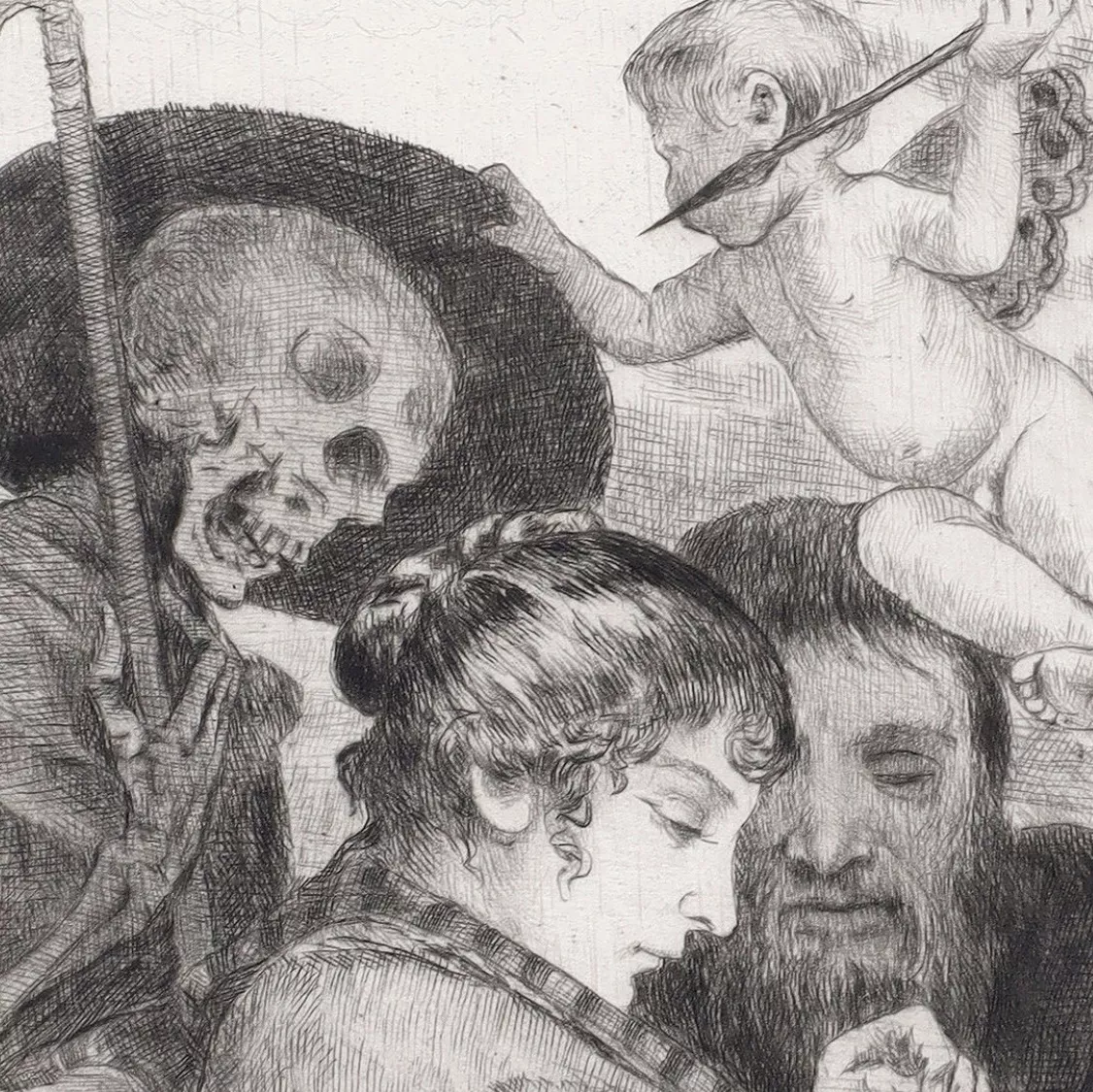
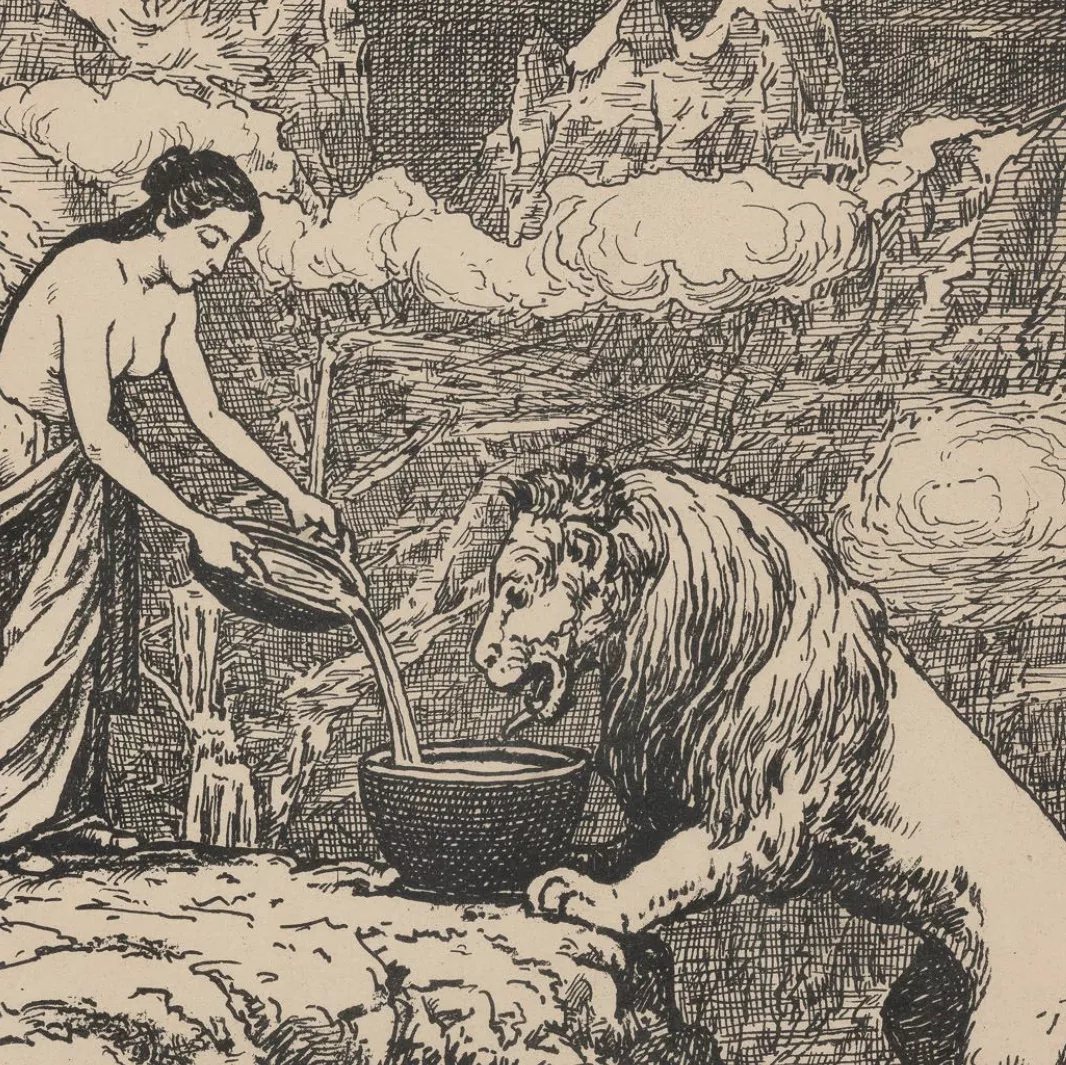
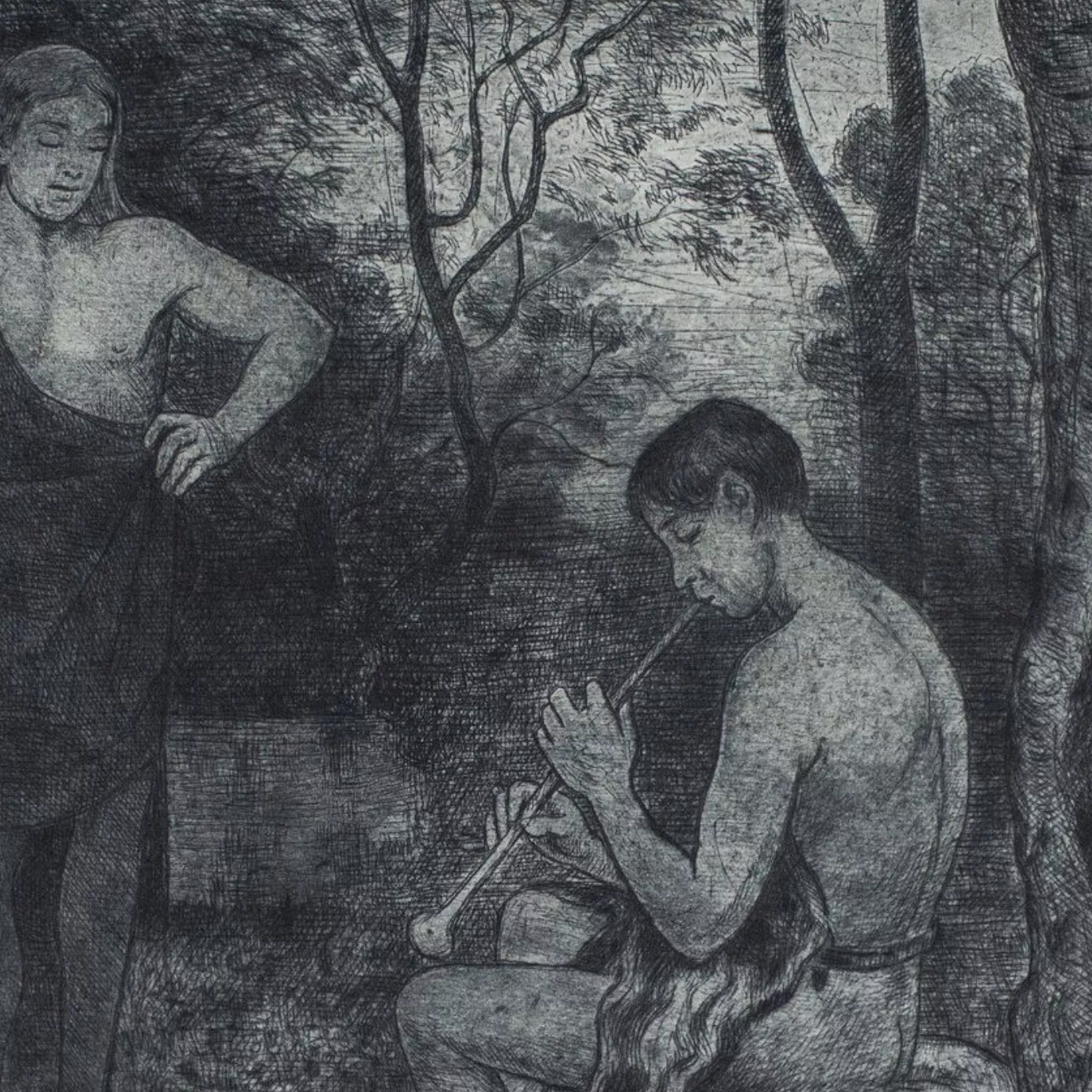
His Symbolist style is the result of an original synthesis between the German Romantic legacy (with its landscapes inhabited by legends and mythological figures) and a post-Courbetian sensibility toward materiality and diffused light. His allegorical figures—his depictions of Pan, the Fates, or the Virgin Mary set within the landscapes of the Black Forest—reflect a worldview in which the sacred and the rustic coexist without contradiction.
His contribution to late 19th-century German art is considered decisive: he embodied a third path between academic “pompierism” and nascent Expressionism, which earned him considerable popular veneration in Germany long before he gained recognition in scholarly circles.
The Life of Hans Thoma
Cultural Background
Hans Thoma was the son of a miller from the Black Forest. These peasant and artisanal roots permeate his entire body of work: his landscapes are not those of a detached observer, but of a man who knows the terrain, the seasonal light of the Upper Rhine, and the sounds of the Baden-German forests.
This deep connection to his roots would become one of the key ways in which late-19th-century nationalist critics interpreted his work, casting him as a “painter of the German people”—an ambiguous label he would never fully shake off.
His stay in Paris in 1868 marked a turning point. His association with Courbet and the Barbizon landscape painters paved the way for a sensitive realism, distinct from the historicist grandiloquence then dominant in German art academies.
Upon his return to Germany, he settled in Frankfurt, where his work was long met with incomprehension by the market and official critics before gradually finding its audience.
Artistic and Intellectual Circle
In 1875, Thoma met Arnold Böcklin, the Swiss Symbolist painter from Basel, whose influence profoundly shaped his turn toward mythological allegory. This encounter served as both an intellectual validation and a stylistic impetus: the two artists shared a conception of painting as a space for poetic resistance against the triumphant materialism of their era.
In Frankfurt, he frequented the circle of Wilhelm Leibl, a leading figure of German Realism, with whom he maintained a complex intellectual relationship: Thoma absorbed the constructive rigor of Leiblism while simultaneously diverging from it to substitute a dreamlike and symbolic dimension unique to his worldview.
His move to Karlsruhe in 1899, where he directed the Kunsthalle until 1920, established him as a leading figure in the art of southwestern Germany. His eightieth birthday, celebrated in 1919 in Karlsruhe, was the subject of a national celebration, a testament to a reputation that extended far beyond specialized circles.

Market Segmentation and Artist Rankings
Prices of Works
The market for Thoma’s works shows a clear price stratification based on medium: oil paintings sell for between €500 and €50,000, drawings and watercolors between €100 and €15,000, and prints and multiples between €50 and €2,000.
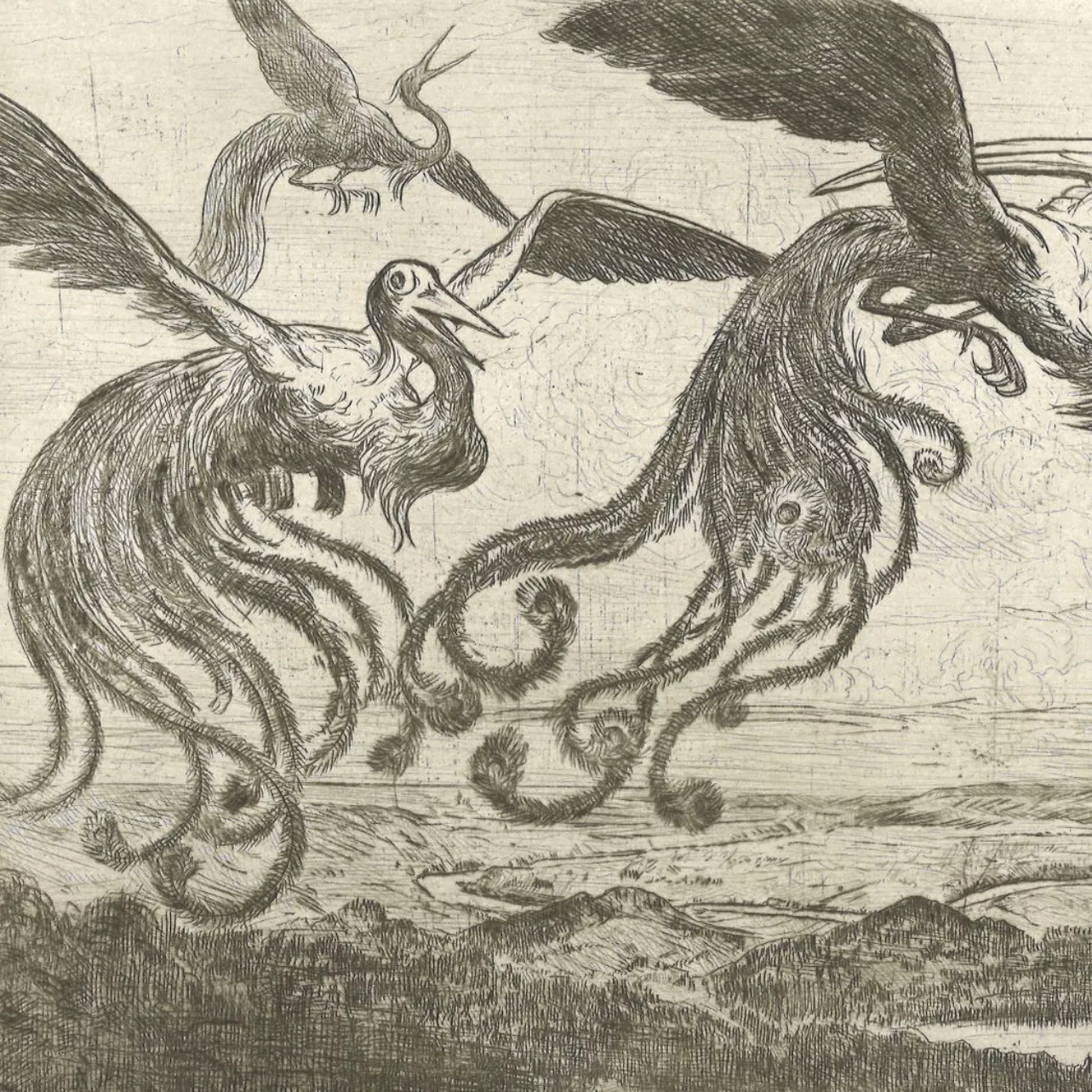
The Symbolist and allegorical compositions of his mature period (landscapes populated by mythological figures, scenes from the Black Forest imbued with invisible presences) command the highest estimates at auction.
Pure landscape paintings and commissioned portraits fetch more affordable prices, even though their execution is often remarkable.
Factors Influencing Value
His status as a central figure in German-speaking Symbolist art is the primary driver of critical and market legitimacy: his work is represented in major German public collections (the Alte Nationalgalerie in Berlin, the Staatliche Kunsthalle Karlsruhe, Schack-Galerie in Munich), which makes high-quality pieces remaining on the market relatively rare and provides sustained support for estimates.
His stylistic affinity with Arnold Böcklin—whose works command considerable prices at auction—is a recurring factor in valuations cited by experts and auctioneers. More broadly, he belongs to the group of German and Dutch Symbolists such as Max Klinger and Jan Toorop.
Collectors with an appreciation for European Symbolism often seek to build a collection that combines works by both artists, which sustains demand for thematically related pieces.
Thoma’s institutional standing (director of the Kunsthalle in Karlsruhe, professor of fine arts, and a revered figure in his own lifetime) facilitates the authentication of his works and reassures buyers.
Documentation from exhibitions held during his lifetime—notably the major retrospectives of 1899 and 1919—constitutes a provenance element of the utmost importance.
FAQ – How Do You Appraise a Work by Hans Thoma?
1) Which periods of the artist’s career are most sought after?
The mature Symbolist period (1880s–1900) forms the core of specialized collectors’ searches. It was during these two decades that Thoma produced his most allegorically rich compositions, in which natural landscapes and mythological elements merge.
Works from his Frankfurt period—still influenced by Leibl’s realism but already imbued with poetic tension—are also highly prized. His early works and late pieces from after 1910 are primarily studies or commissioned works.
2) What are the most highly valued subjects in Thoma’s work?
Compositions in which mythological figures (Pan, the Fates, nymphs, or angels) are set against landscapes of the Black Forest or the Upper Rhine consistently fetch the highest estimates.
His painting *Flora* (1882, sold for €50,000 at Ketterer) and his series of landscapes featuring figures serve as benchmarks for experts. Portraits, with the exception of those of his wife and close relatives, are generally less sought after.
3) How can a work by Hans Thoma be authenticated?
Authentication relies on several converging factors: cross-referencing with the archives of the Hans-Thoma-Museum in Bernau im Schwarzwald, the leading institution for the artist’s catalog raisonné; analysis of the signature (Thoma generally signed with his full name or the initials “H.T.” in his characteristic handwriting); and documented provenance, particularly the catalogs of exhibitions held during his lifetime, which serve as indisputable references.
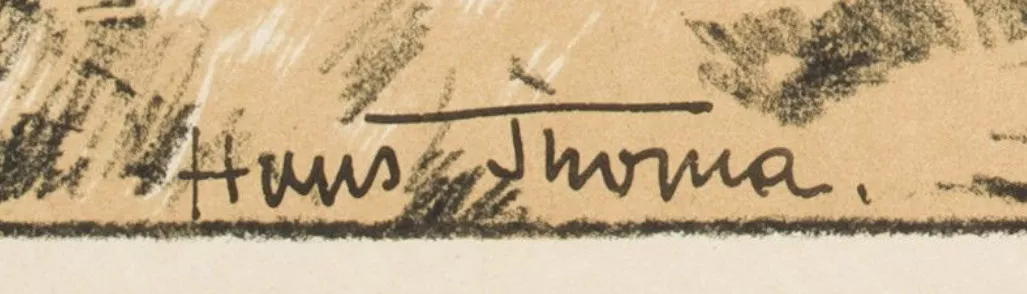
His Signature
Not all of Hans Thoma’s works are signed, particularly his studies and preparatory works.
When present, his signature appears in two main forms: “Hans Thoma” written out in full, in cursive script slanting to the right with an ornate capital “T”; or the initials “H.T.” accompanied by the date and sometimes the location. The location of the signature varies: lower right or lower left for oil paintings, and sometimes on the back for studies.
Get Your Hans Thoma Artwork Appraised
If you own a work by Hans Thoma, an appraisal will help you determine its current market value.
Using our online form, our experts and certified auctioneers will conduct a free appraisal and provide you with a reliable estimate of your artwork’s market value.
If you’re considering selling it, we’ll guide you through the process to ensure you get the best possible price.
Estimate in less than 24h
Discover in the same theme

Rating and value of works, sculptures, bronzes by Charles Va...
Charles Valton was a 19th-century animal sculptor who worked with Barye, producing works that are quite highly rated at auction.
Learn more >

Value and quotation of works, paintings by Jules Adler
Jules Adler, a 20th-century naturalist painter, produced a number of drawings and oil paintings that are both valuable and stable.
Learn more >

Rating and value of paintings by Alexei Savrassov
Alexei Savrassov was a 19th-century Russian landscape painter who produced many highly-rated and valuable paintings.
Learn more >
Nos records d'enchères à l'hôtel Drouot

Estimated 10.000 - 15.000 €
Ebridge Ayer BURBANK(1858-1949), Young African-American boy, Oil on panel.

Estimated 20.000 - 30.000
EXCEPTIONAL LARGE OVAL DISH IN VINCENNES SOFT PASTE PORCELAIN FROM THE "BLEU CÉLESTE" SERVICE OF KING LOUIS XV AT THE CHÂTEAU DE VERSAILLES

Estimated 20.000 - 30.000
MANUFACTURE ROYALE DE SÈVRES, 18th century "L'Empereur de la Chine" - Portrait of the Emperor Qianlong, Hard porcelain bisque, 1775

Estimated 1.500 - 3.000
HERMÈS, "Kelly" 32 saddle bag in black box calf

Estimated Between €5,000 and €8,000
KRACHKOWSKY (1854-1914), Before the storm, oil on canvas

Estimated 40.000 - 80.000
Alexandre ROUBTZOFF (1884-1949), Portrait of Arbia, oil on canvas

Secure site, anonymity preserved

Auctioneer approved by the State

Free and certified estimates
Frequently asked questions
-
Who is Hans Thoma, and what is his place in 19th-century art?Hans Thoma (1839–1924) was a German painter from the Black Forest and a central figure in German-language Symbolism. He blended late German Romanticism, Courbetian realism, and figurative Symbolism, forging a “third way” between pompier academicism and nascent Expressionism. Trained in Karlsruhe, Düsseldorf, and Munich, his stay in Paris in 1868 with Courbet and the Barbizon School had a lasting influence on his sensitivity to light and texture. Appointed director of the Kunsthalle in Karlsruhe in 1899, he became a leading figure in the art of southwestern Germany.
-
What is the price range for Hans Thoma's paintings at auction?Hans Thoma’s paintings and drawings sell for between 500 and 50,000 €, depending on the medium and the period. Oil paintings on canvas range from €500 to €50,000, drawings and watercolors from €100 to €15,000, and prints from €50 to €2,000. The Symbolist and allegorical compositions from his mature period—particularly those combining mythological figures with landscapes of the Black Forest—command the highest estimates.
-
How can you authenticate a work by Hans Thoma?The authentication of a work by Hans Thoma is based on several factors: cross-referencing with the archives of the Hans-Thoma-Museum in Bernau im Schwarzwald, the leading institution for the catalogue raisonné; analysis of the characteristic signature (usually “Hans Thoma” or the initials “H.T.”); and documented provenance, particularly the catalogs of exhibitions held during his lifetime. Our state-certified auctioneers provide a free, no-obligation appraisal based on authenticity and recent market trends.
-
Is this a good time to sell a work by Hans Thoma?Yes, now is a good time to sell a work by Hans Thoma. His works remain relatively rare on the market but continue to attract sustained interest from European collectors, particularly German-speaking ones. His enduring institutional recognition (his presence in major German public collections) and his status as a central figure in German-language Symbolism lend stability and market legitimacy to high-quality pieces.
-
How does the appraisal process work at Auctie's?The appraisal is free and non-binding. Simply fill out our online form with photos and information about your artwork. Our experts and state-certified auctioneers will analyze the artwork’s authenticity, market value, and recent market trends to provide you with a reliable appraisal within 48 hours. If you decide to sell, we’ll guide you through the entire process—from the appraisal to the auction—to ensure you get the best possible price.
