



Orientalist Paintings: Appraisals and Auctions

Southern Lights, souk scenes, and painted journeys: the value of Orientalist paintings varies greatly depending on the artist, the subject, and the quality.
Below you’ll find all our valuation guides dedicated to Orientalist paintings—Orientalist paintings and drawings from the 19th and early 20th centuries. Each guide details the price ranges observed at auction and the factors that determine a work’s value before it is entrusted to our state-certified auctioneers.
Guides on this art movement
See all guides >
Rating and value of aquarelles and paintings by William Call...
William Callow is a painter who primarily created watercolors that command high prices at auction. 100% free appraisal
Learn more >

Rating and value of drawings and paintings by Hassan El Glao...
Hassan El Glaoui is a Moroccan figurative painter who has produced numerous works that command high prices at auction.
Learn more >

Rating and value of paintings by Marie-Dominique Siciliano
Marie-Dominique Siciliano is an Orientalist painter who worked in Marseille; while his market value is still relatively low, his work is available on...
Learn more >

Rating and value of drawings and paintings by Henri Martin
Henri Martin was a 19th-century Post-Impressionist painter whose works command high prices at auction.
Learn more >

Rating and value of drawings and paintings by Jean Syndon
Jean Syndon was a 19th-century painter—a realist and Orientalist—who signed his paintings under several names. The value of his works is on the rise.
Learn more >

Rating and value of paintings by Giuseppe de Nittis
Giuseppe de Nittis is an Italian artist of 19th-century modernity who lives in Paris. His works are highly valued.
Learn more >

Rating and value of paintings by Emilio Sivilla Torres
Emilio Sivilla Torres was a Spanish Orientalist painter who produced views of Tangier that can be highly valued.
Learn more >

Rating and value of paintings by Nicola Forcella
Nicola Forcella was an Italian Orientalist painter who produced most of his paintings in Cairo. Today, his works are highly valued.
Learn more >

Rating and value of paintings by Roger Marcel Limouse
Roger Marcel Limouse is a Post-Impressionist and Post-Fauvist painter who has produced canvases that are highly valued at auction.
Learn more >

Rating and value of paintings by Auguste Émile Pinchart
Auguste Emile Pinchart was a late 19th-century painter of Orientalist genre scenes, whose works are highly prized.
Learn more >

Rating and value of paintings by Marie Aimée Lucas Robiquet
Marie Aimée Lucas Robiquet is an Orientalist artist who produced a large body of work that is highly valued and appreciated.
Learn more >

Rating and value of paintings by Marguerite Delorme
Marguerite Delorme is an Orientalist artist who produced paintings that are highly valued at auction. 24-hour estimate!
Learn more >
Understanding the Value of an Orientalist Painting
What Is Market Value in the Orientalist Painting Market?
The market value of an Orientalist painting refers to the benchmark value assigned to it by the secondary market at a given moment, based on the artist’s identity, the subject matter, the format, the condition of the work, and current international demand.
This market is one of the most dynamic and globalized in 19th-century painting: driven for several decades by growing demand from collectors in the Gulf, the Maghreb, and the Middle East, it has experienced a spectacular resurgence that contrasts with the relative critical indifference to which Orientalism was subjected during the 20th century.
Emerging in the early 19th century in the wake of Bonaparte’s Egyptian campaign and the subsequent conquest of Algeria, Orientalism brought together generations of European artists fascinated by the Maghreb, Egypt, and the Middle East—regions they discovered through travel, official missions, or long-term residencies.
This fascination with geographical and cultural otherness has produced a body of work of exceptional richness, whose subjects—dazzling light, monumental architecture, and exoticized scenes of daily life—continue to captivate an audience of collectors particularly drawn to the works’ dual documentary and dreamlike qualities.
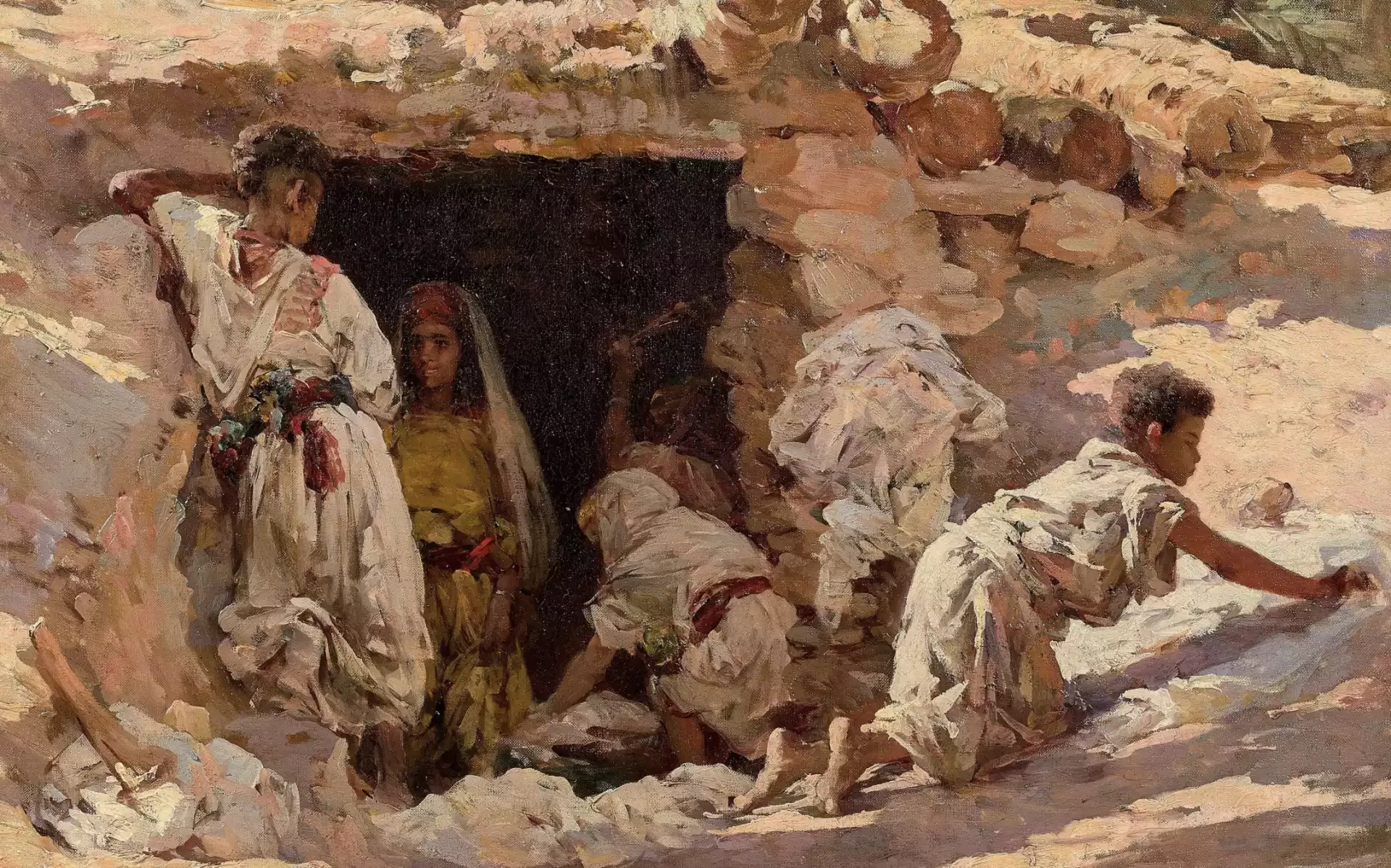
Why Orientalism Still Appeals to the Art Market
Orientalism stands out from other 19th-century art movements due to the broad geographic reach of its collectors.
While traditional European and North American art lovers remain active, the most dynamic demand today comes from collectors hailing from the very regions these paintings depict: buyers from the Maghreb, the Gulf, and the Middle East, for whom these works constitute a visual heritage of their own history, perceived and valued from a different perspective than that of the early 19th-century Western collectors.
This dual perspective—exotic for some, heritage-based for others—explains the vigor and resilience of this market.
The movement spans more than a century and encompasses a wide variety of aesthetic styles. The romantic Orientalism of the early 19th century, championed by Delacroix upon his return from a trip to Morocco, emphasizes dramatic intensity and color.
Academic Orientalism of the second half of the century, embodied by Jean-Léon Gérôme and Eugène Fromentin, sought an almost photographic precision in architectural and sartorial details.
Late Orientalism, which continued into the first third of the 20th century with artists such as Jacques Majorelle and Étienne Dinet, introduced a brighter color palette, influenced by advances in modern painting.
Period | Period | Key Artists | Market Demand Level |
Romantic Orientalism | 1820–1860 | Eugène Delacroix, Théodore Chassériau, Alexandre-Gabriel Decamps | Very strong, both institutional and private |
French Academic Orientalism | 1860–1900 | Jean-Léon Gérôme, Eugène Fromentin, Benjamin-Constant | Exceptional, very high auction prices |
British Orientalism | 1850–1900 | John Frederick Lewis, David Roberts, Frederick Goodall | Very active, strong demand from the Anglo-Saxon world and the Gulf region |
Spanish and Italian Orientalism | 1860–1910 | Mariano Fortuny, Francesco Ballesio, Ettore Simonetti | Steady, active Mediterranean market |
Late Orientalism (Maghreb) | 1900–1940 | Jacques Majorelle, Étienne Dinet, Paul-Élie Dubois | Very active, growing demand from the Maghreb |
Russian and Central European Orientalism | 1870–1910 | Vasily Vereshchagin, Ludwig Deutsch, Rudolf Ernst | Very strong, international |
Estimate in less than 24h
The criteria that determine the market value of an Orientalist painting
The market value of an Orientalist painting is determined by a hierarchy of criteria that the auctioneer carefully weighs.
The artist’s identity takes precedence over everything else: a certified Gérôme or Ludwig Deutsch commands extraordinary prices, whereas a work of the same formal quality by a less well-documented contemporary artist will be valued at a significantly lower level.
The subject matter also plays a decisive role, even more so than in other 19th-century art movements: lively market scenes, portraits of figures in richly detailed traditional costumes, and views of monumental architecture are consistently valued higher than landscapes devoid of figures.
The price ranges observed on the secondary market illustrate this disparity. An Orientalist drawing or watercolor by a well-documented artist can range from 2,000 to 25,000 euros. A medium-sized oil on canvas by a second-tier Orientalist ranges from 8,000 to 80,000 euros, depending on the subject and the quality of execution.
Large compositions by recognized masters—such as Gérôme, Deutsch, Fortuny, or Benjamin-Constant—frequently exceed 200,000 euros and can reach several million for the most exceptional pieces, particularly Gérôme’s harem scenes or large-scale depictions of Oriental architecture.
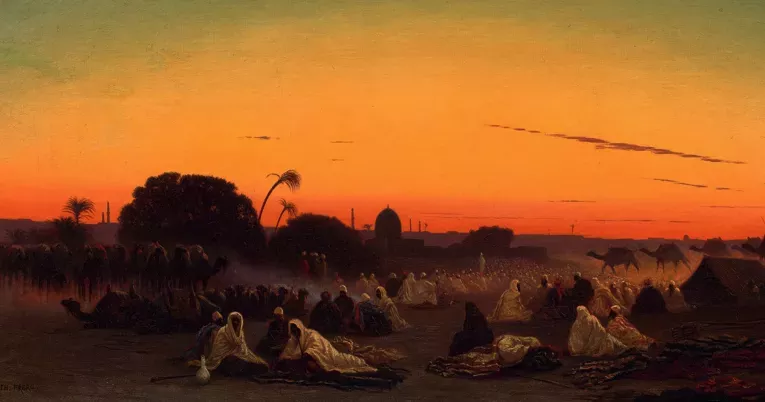
Market scenes, desert landscapes, and portraits: the subjects sought
The hierarchy of Orientalist subjects and its impact on market value
Orientalism has developed a rich iconographic repertoire, with certain motifs enjoying structurally stronger demand than others on the secondary market.
Market and souk scenes, teeming with figures, richly detailed merchandise, and contrasting light, constitute one of the most active segments: they combine technical virtuosity with immediate narrative clarity, two qualities highly sought after by collectors.
Desert landscapes and oasis views, which are more contemplative, appeal to connoisseurs drawn to the almost abstract quality of these light-drenched compositions.
Portraits of figures in traditional dress—whether horsemen, merchants, or women—hold a prominent place in the market hierarchy, particularly when the depiction of textiles, jewelry, and weapons reflects meticulous observation.
Architectural scenes—mosques, medinas, and inner courtyards adorned with zellige tiles—are also in high demand, especially among collectors from the regions depicted, who recognize in them a familiar architectural heritage rendered with a pictorial virtuosity often absent from period photographs.
Subject / Theme | Characteristics | Approximate Price Range | Market Demand |
Market or souk scene (major artist) | Numerous figures, details of merchandise, contrasting light | €30,000 — several million € | Very strong, international |
Harem scene (renowned artist) | Iconic subject matter, stylized sensuality, technical refinement | €50,000 — several million € | Exceptional, highly competitive |
Arab horsemen and equestrian scenes | Movement, costumes, detailed weapons | €15,000 — €300,000 | Very active, specialized collectors |
Desert landscape or oasis | Light, vast expanses, contemplative quality | €5,000 — €80,000 | Active market, broad buyer base |
Oriental portrait (identified figure or archetype) | Traditional costume, jewelry, direct gaze | €8,000 — €150,000 | Strong demand, portrait collectors |
Oriental architecture (medina, mosque, courtyard) | Architectural detail, zellige tiles, perspective | €10,000 — €200,000 | Very active, in demand in the Maghreb and the Gulf |
Orientalist watercolors and drawings | Spontaneity, insight into the artist’s travel sketchbook | €2,000 — €25,000 | Growing market, accessible entry point for collectors |
Arab horsemen, harem scenes, and souks: the most sought-after pieces
Scenes of Arab horsemen—whether depicting battles, fantasias, or simple rest stops—are among the subjects most sought after by specialized collectors.
They demand considerable technical mastery from the artist—capturing the horse’s movement and rendering the harnesses and traditional weapons with precision—which distinguishes the great masters of the genre, such as Adolf Schreyer and Eugène Fromentin, from the countless imitators of varying quality.
When well-documented, these works command prices that rival those of the most prominent market scenes.
Harem scenes, an iconic subject of the Orientalist imagination, remain among the most sought-after pieces on the market when signed by recognized masters such as Gérôme or Benjamin-Constant.
Their value stems as much from the virtuosity of their execution—the rendering of fabrics, skin tones, and richly decorated interiors—as from their status as icons in the history of the genre. Finally, souk scenes—with their narrative richness and the diversity of details they incorporate, such as crowds, market stalls, architecture, and animals—often constitute the most ambitious and accomplished compositions in an artist’s body of work, which explains their dominant position in the hierarchy of the Orientalist art market.
Estimate in less than 24h
Get a Free Appraisal of an Orientalist Painting
A certified appraisal by a licensed auctioneer in less than 24 hours
Appraising an Orientalist painting requires in-depth knowledge of this transnational movement, its various national schools, and the current state of a particularly active international market.
A certified auctioneer has the necessary training and experience to accurately situate a work within this complex landscape, whether identifying the school of origin for a little-documented artist or assessing the place of a composition within the body of work of a recognized master.
Auctie’s offers this expertise free of charge, with a certified response within 24 hours. Whether you wish to appraise an inherited painting, prepare an estate, insure a work at its fair market value, or consider putting it up for sale, the process is the same: submit your piece to a trained eye capable of accurately determining its value in a rapidly expanding market.
What You Need to Provide for an Online Appraisal
For an Orientalist oil on canvas, please provide clear photographs of the front and back of the artwork, a photo of the signature if visible, the precise dimensions of the composition and the stretcher, and any known provenance information: a collection or gallery label on the back, an old purchase receipt, or a reference in an auction catalog or specialized publication.
Mention of any stay the artist may have made in the region depicted—as evidenced by travel journals or documented correspondence—can shed valuable light on the work’s authenticity and the context in which it was created.
For watercolors and drawings—often taken from travel sketchbooks—the condition of the paper must be precisely documented: pinholes, foxing, creases, or tears. In case of doubt regarding attribution or condition, a physical examination of the piece can be arranged at a later date at no additional cost.
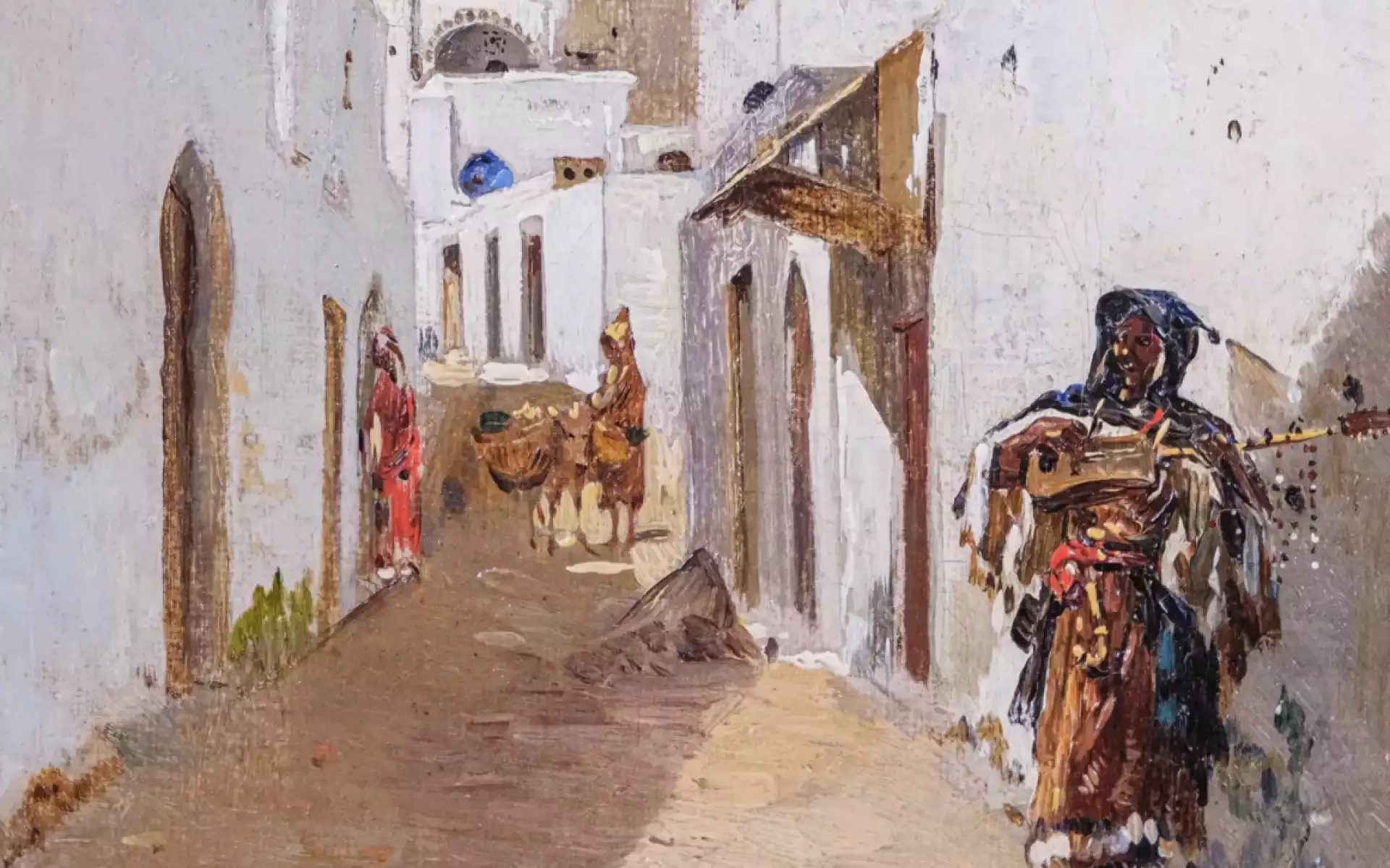
Signature, Provenance, and Authenticity: The Pillars of Valuation
Signature, Attribution, and Authentication: Their Impact on Value
The authentication of an Orientalist painting relies on a set of converging clues. The signature is the first point of reference, but it is never sufficient on its own: the fame and high market value of certain masters of the genre have led, in recent decades, to a resurgence of forgeries and misattributions, particularly for the most sought-after artists such as Gérôme, Deutsch, or Fortuny.
Comparing the signature with documented examples of the artist’s work, conducting an in-depth stylistic analysis, examining the materials and support, and consulting available archives are essential steps in any serious appraisal.
For the movement’s major artists, catalogs raisonné or reference corpora serve as the definitive authority in the market. Gerald Ackerman’s work on Jean-Léon Gérôme constitutes the definitive reference for this artist, as do his studies on the Orientalists of the Vienna School, Ludwig Deutsch, and Rudolf Ernst.
A work listed in one of these reference collections enjoys the highest level of scholarly credibility, which directly translates into its market value and greatly facilitates its sale.
Level of Documentation | Impact on Value |
Work listed in the catalogue raisonné or in a reference corpus | Maximum assurance; very significant premium on value |
Work published in specialized literature or featured in a retrospective exhibition | Strong scholarly endorsement; significant increase in value |
Work accompanied by a written appraisal from a recognized specialist in the Orientalist genre | Good guarantee; reassures the buyer and facilitates the sale |
Work with a legible signature and documented provenance | Solid foundation; reliable estimate and a narrow price range possible |
Work without documentation or signature | Increased uncertainty; estimate based on stylistic and material analysis |
Provenance and Condition: Their Impact on Value
The provenance of an Orientalist painting is a decisive factor in building trust in this market, which is particularly sensitive to issues of attribution.
A work whose history can be traced through a historic private collection, a recognized specialized gallery, or a documented historical public auction enjoys a legitimacy that buyers directly factor into their bids.
For works whose artist actually traveled to the region depicted, documentation attesting to this stay—such as sketchbooks, correspondence, or mentions in contemporary exhibitions—significantly enhances the piece’s credibility and appeal, distinguishing it from works produced in a studio without direct observation.
Condition is the other key factor. Orientalist oil-on-canvas paintings, often executed with a meticulous attention to detail that involves thin, layered paint applications, may exhibit craquelure, retouching, or abrasive cleaning that compromises the precision of the original execution—a central element of these works’ value.
Examination under raking light and ultraviolet light reveals these interventions and allows for an assessment of their impact. For large compositions, where the meticulousness of architectural and sartorial details constitutes the essence of their aesthetic appeal, the integrity of the pictorial surface is an absolutely central criterion for valuation.
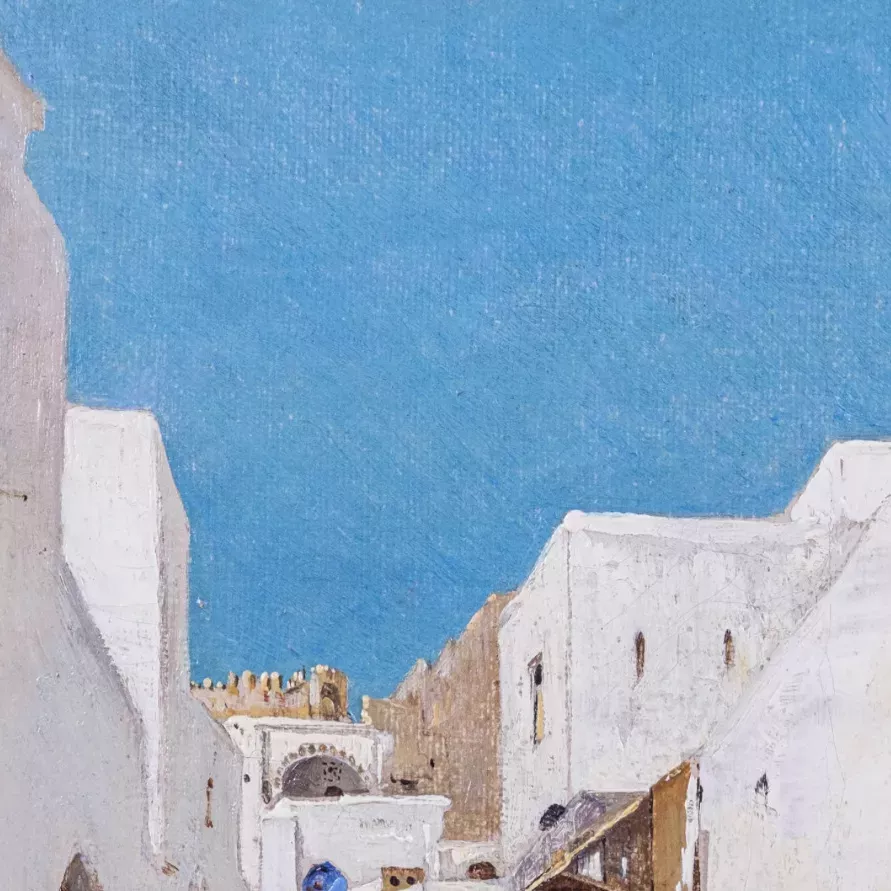
Sell an Orientalist painting at auction with Auctie's
From the reserve price to the final bid: how the price is determined
Auctions are the most advantageous method of sale for high-quality Orientalist paintings in a market where international demand—particularly strong from the Maghreb and the Gulf—can generate intense competition among multiple collectors interested in the same piece.
The reserve price, set in consultation with the seller, must be calibrated with particular attention to the current state of a rapidly growing market: a reference that is too old could lead to undervaluing a piece whose market value may have risen significantly in recent years.
For high-quality, well-documented Orientalist paintings, competition among several enthusiastic collectors can result in final hammer prices far exceeding initial estimates.
This phenomenon is particularly common for market and harem scenes by the great masters, as well as for Oriental architectural subjects sought after by collectors from the Maghreb and the Gulf for their cultural heritage value.
The auctioneer plays a vital role in facilitating this process by curating a sale that creates the conditions for productive competition among bidders.
Hôtel Drouot and Online Auctions: Reaching the Right Bidders
Auctie’s holds its auctions at Hôtel Drouot, the leading auction venue in continental Europe, founded in 1852 and frequented by a dense network of dealers, collectors, and specialists in Orientalist art.
For an Orientalist painting, Drouot offers optimal visibility among traditional European connoisseurs of this genre, complemented by online promotion that significantly broadens the reach of each auction on an international scale.
Auctie’s auctions are also accessible online in real time, allowing a Moroccan collector passionate about Majorelle, a buyer from the Gulf seeking a large-scale Orientalist architectural painting by Gérôme, or an Egyptian collector drawn to Ludwig Deutsch’s scenes of Cairo, to bid directly from their home countries.
For Orientalist art—for which the most dynamic demand comes precisely from the regions depicted in these paintings—this international dimension is now almost always decisive in securing the best hammer price.
Estimate in less than 24h
Estate Planning, Inheritance: Valuing an Inherited Orientalist Painting
Inventory and Distribution of an Estate
Orientalist paintings frequently appear in the estates of families whose collections were assembled during travels, missions, or stays in North Africa and the Middle East in the 19th and early 20th centuries.
These works, which have hung in family homes for generations, can represent a significant portion of the estate’s assets, especially since the value of this segment has risen sharply in recent decades—a fact that heirs are sometimes unaware of.
Auctie’s regularly works alongside notaries to compile comprehensive estate inventories that include Orientalist artworks.
Each piece is appraised individually: precise description, technique and medium, dimensions, condition, attribution, and estimated market value as of the reference date. The resulting report is an official, legally binding document that can be included in the estate file without reservation.
Confidentiality of the process and preservation of anonymity
The circumstances leading to the appraisal of an Orientalist painting are often personal and sensitive: estate settlement, divorce, estate reorganization, or the decision to sell after a long period of ownership.
Auctie’s handles each case with absolute discretion. The owner’s identity is never disclosed to third parties without their explicit consent, and the works may be offered for sale under complete anonymity if the owner so desires.
This confidentiality is a fundamental commitment of Auctie’s, applicable at every stage of the relationship, from the initial contact through to the receipt of the proceeds from the sale.
Entrust the appraisal of your Orientalist painting to Auctie's
An Orientalist painting deserves an appraisal that reflects the richness and diversity of this transnational movement.
The multitude of national schools, the sensitivity of valuations to issues of attribution in a market rife with forgeries, and the strength of an ever-evolving international demand: these are all dimensions that only a licensed auctioneer, well-versed in the specifics of this segment, can assess with the precision they require.
Auctie’s guides you from the initial appraisal through to the final auction, with the rigor of a state-certified expert and the discretion your financial decisions deserve. The appraisal is free, confidential, and non-binding, and you’ll receive a response within 24 hours.
Discover in the same theme

Rating and value of paintings by Hippolyte Lazerges
Hippolyte Lazerges was a painter of religious and Orientalist subjects who produced paintings of high value.
Learn more >

Ratings and values of paintings by Alessio Issupoff
Alessio Issupoff was a 20th-century Russian realist painter who produced valuable drawings and oil paintings.
Learn more >

Rating and value of works, paintings and drawings by Jacques...
Jacques Majorelle is a twentieth-century Orientalist painter who produced many paintings and drawings that are appreciated and sought-after at auction...
Learn more >
Estimate in less than 24h
Frequently asked questions
-
Quelles sont les fourchettes de prix pour un tableau orientaliste ?La cote varie considérablement selon l'artiste, le sujet et la qualité. Un dessin ou une aquarelle orientaliste d'un artiste documenté se situe entre 2 000 et 25 000 euros. Une huile sur toile de format moyen d'un orientaliste de second rang oscille entre 8 000 et 80 000 euros. Les grandes compositions des maîtres reconnus comme Gérôme ou Deutsch dépassent fréquemment 200 000 euros et peuvent atteindre plusieurs millions pour les pièces exceptionnelles.
-
Comment faire estimer gratuitement un tableau orientaliste chez Auctie's ?Auctie's propose une estimation gratuite et sans engagement, certifiée par un commissaire-priseur agréé par l'État, avec une réponse en moins de 24 heures. Il suffit de fournir des photographies nettes du recto et du verso, un cliché de la signature, les dimensions précises et tout élément de provenance connu (étiquettes de collection, factures anciennes, références de catalogues). En cas de doute sur l'attribution ou l'état de conservation, un examen physique peut être organisé sans coût supplémentaire.
-
Est-ce le bon moment pour vendre un tableau orientaliste ?Oui, le marché de l'orientalisme est l'un des plus dynamiques et mondialisés du XIXe siècle. Porté depuis plusieurs décennies par une demande croissante émanant de collectionneurs du Golfe, du Maghreb et du Moyen-Orient, il a connu une revalorisation spectaculaire. Cette double lecture des œuvres — exotique pour les collectionneurs occidentaux et patrimoniale pour ceux des régions représentées — explique la vigueur et la résilience exceptionnelle du marché.
-
Quels sujets orientalistes sont les plus recherchés et valorisés ?Les scènes de marché et de souk animées, les scènes de harem des maîtres reconnus, et les architectures orientales (mosquées, médinas) sont systématiquement mieux valorisées. Les cavaliers arabes en costumes détaillés, les portraits de personnages en costume traditionnel avec bijoux finement rendus, et les paysages désertiques comptent aussi parmi les sujets très demandés. Les scènes dépourvues de figures sont moins recherchées que celles riches en détails narratifs et en figures humaines.
-
Comment fonctionne la vente aux enchères d'un tableau orientaliste chez Auctie's ?Auctie's, maison de ventes aux enchères, accompagne le vendeur de l'estimation initiale gratuite jusqu'à l'adjudication. Après estimation certifiée par un expert, le tableau est confié à un commissaire-priseur agréé par l'État pour la mise en vente. Le processus assure une transparence totale et une expertise professionnelle sur chaque étape, permettant au vendeur d'atteindre la meilleure valeur marchande pour son œuvre.
