



Rating and value of paintings by Hippolyte Lazerges

Key takeaways
- Prices for Lazerges' paintings range from €100 to €74,700 depending on the technique and subject matter, with religious subjects commanding the highest estimates.
- In 2022, the oil-on-canvas painting "Sleeping Beauty" sold for €22,400, exceeding its initial estimate of €9,500 to €14,100.
- A 19th-century Orientalist artist (1817–1887), Lazerges is distinguished by his refined academic technique and his intimate portrayal of Algeria, far removed from contemporary exotic clichés.
If you own a painting by or after Hippolyte Lazerges, and would like to know its value, our state-approved experts and auctioneers will offer you their appraisal services.
Our specialists will carry out a free appraisal of your painting, and provide you with an accurate estimate of its value on the current market.
Then, should you wish to sell your work, we will direct you to the best possible arrangement to obtain the optimum price.
Rating and value of the artist Hippolyte Lazerges
The artist Hippolyte Lazerges leaves behind a very singular body of work, often described as Orientalist. He is also steeped in Romanticism. He studied at the Ecole Supérieure des Beaux-Arts in Paris.
His works are now fetching higher prices under the auctioneers' gavels. His paintings are particularly prized, especially by French and English buyers. The price at which they sell on the art market ranges from €100 to €74,700, a substantial gap but one that says a lot about the value that can be attributed to Lazerges' paintings.
In 2022, a predominantly blue oil on canvas, Sleeping Beauty, sold for €22,400 while it was estimated at between €9,500 and €14,100.Order of value from a single work to the most prestigious
Order of value from a single work to the most prestigious
Technique used | Result |
|---|---|
Portrait | From €100 to €22,380 |
Orientalist painting | From 420 to 53 360€ |
Religious subject | From 150 to 74 700€ |
Estimate in less than 24h
Style and technique of artist Hippolyte Lazerges
In his orientalist paintings, Hippolyte Lazerges deploys a careful, refined technique, combining a keen sense of detail with meticulous observation of light and atmosphere.
His palette, although dominated by warm tones evoking the heat and light of Algeria, is perfectly mastered.
The artist uses bright light to accentuate the play of shadows and reflections, treating his subjects with great realistic precision, typical of the academic approach.
However, unlike other artists of his time, Lazerges seems more sensitive to the emotional subtleties of his figures, whether portraits or genre scenes.
His rendering of fabrics and textures, particularly oriental garments, is remarkable for the finesse of his brushstrokes, while his landscapes, often bathed in light, are an invitation to escape.
Inspired by the great masters of academicism, he manages to infuse his works with a more personal dimension, capturing not only exterior details but also an atmosphere imbued with mystery.
In his portraits, the artist seeks to reveal the soul of the figures, often caught in moments of calm or reflection, which marks a contrast with the more dynamic and picturesque scenes of other artists such as Jean-Léon Gérôme.
Thus, Lazerges achieves a subtle balance between academic rigor and a quest for intimacy in his Orientalist works.
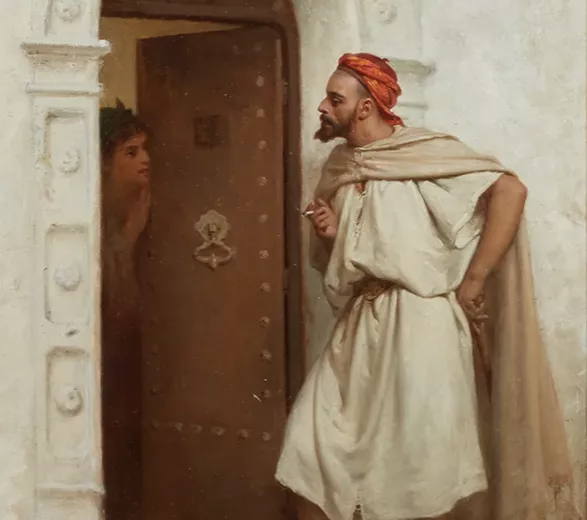
Hippolyte Lazerges, his life, his work
Hippolyte Lazerges (1817-1887) is a little-known yet fascinating figure of the 19th century, whose life unfolds between France and Algeria. Born in France, he spent a large part of his childhood in Algeria, a context that would profoundly influence his work.
It was during his return to France, after being called up for military service, that he enrolled at the École des Beaux-Arts and followed the teachings of François Bouchot and David d'Angers.
His early years were marked by poverty and a lack of family support, but his talents began to be recognized, not least thanks to his first official commissions for the state and for churches.
However, it was during his returns to Algeria that his work really took shape, nourished by total immersion in Oriental culture and landscapes.
His paintings, particularly his portraits and genre scenes, draw directly on the colors, lights and characters of the city of Algiers, which he depicts with great meticulousness.
Through works such as Le Marché à Alger or Le Bédouin, Lazerges asserts himself as an artist of orientalism, both a precise observer and a sensitive poet of the Algeria he knows well.
His paintings are not simply realistic representations, but works in which the subject matter blends with a more intimate, almost spiritual vision of this land he cherishes.
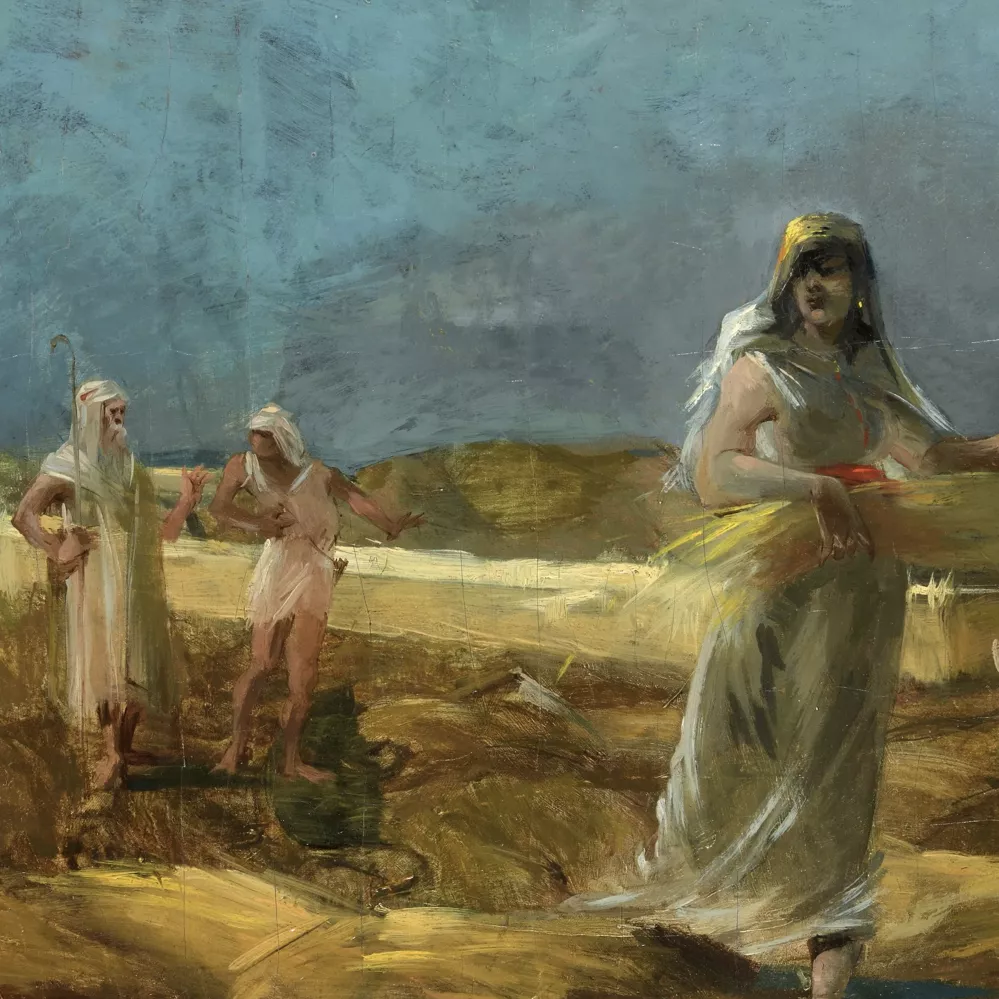
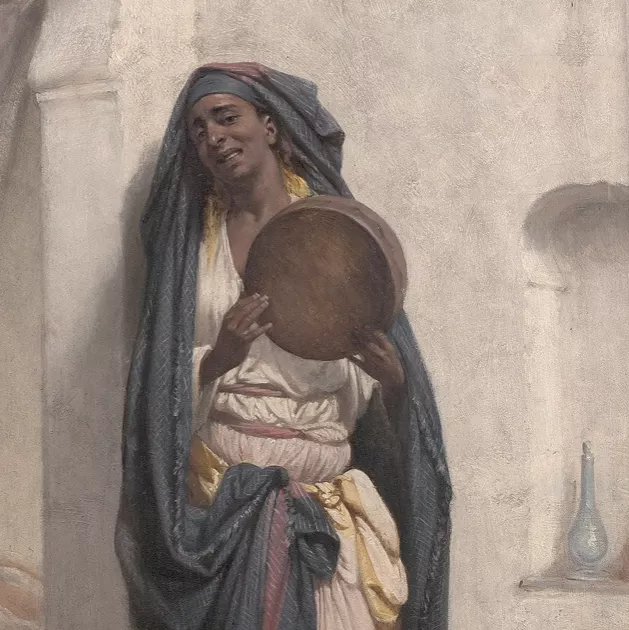
Focus on Le marché à Alger, Hippolyte Lazerges
The work Le Marché à Alger by Hippolyte Lazerges stands out as a true immersion in the vibrant tumult of Orientalism, finely capturing the soul of an Algerian market.
The lively, colorful scene transports us straight to the heart of Algiers, where crowds intertwine among the stalls.
The mastery of light, the intensity of color, and the depiction of textures - whether of the merchants' clothing or the objects in the market - testify to the meticulousness of an artist attentive to rendering the unique atmosphere of this city he knows intimately.
The movement is palpable, as if the characters, frozen on the canvas, were going to come to life at every moment. The way Lazerges manages to convey the warmth of the place, both physical and social, is masterful.
This painting, while a realistic representation, is also charged with an almost mystical aura. The figures, sometimes rooted in everyday reality, seem to melt into a larger space, a place both historical and timeless.
Through this work, Lazerges delivers an intimate and poetic vision of a world that was dear to him, and in so doing, he inscribes his unique outlook in the great tradition of Orientalism.
The legacy of Lazerges on his period
The legacy left by Hippolyte Lazerges is distinguished by his ability to transcend the conventions of his time to offer a poetic and vivid vision of the Orient.
Far from simply documenting colonial Algeria, his work invites us into a sensory immersion, where light, color and form seem to respond to each other in complex harmony.
He doesn't just depict scenes of everyday life, but manages to elevate them, capturing not just landscapes or figures, but the soul of this unique environment.
From his Orientalist works, Lazerges offered a subtle interpretation of the tensions between the Western gaze and Eastern reality.
Beyond his pictorial contributions, his influence extends to the way he integrated the social and cultural aspect of his subjects into his creations, while cultivating a deeply human approach imbued with respect.
The artist, while remaining faithful to an academic technique, established himself as a witness of his time, inscribing his name among the artists essential to the understanding of nineteenth-century Orientalism.
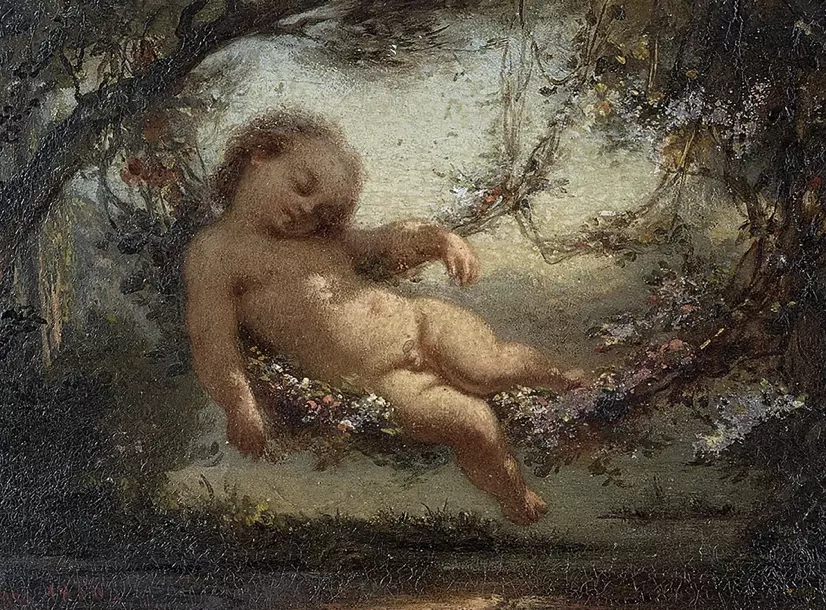
Hippolyte Lazerges' place in Orientalism
In Orientalist painting, Hippolyte Lazerges occupies a special place, marked by his ability to capture the complex reality of the Orient while interpreting it with a unique artistic sensibility.
His work is distinguished by a more subtle approach, far removed from the stereotypes imposed by a Western gaze often obsessed with exoticism.
Lazerges manages to go beyond the idea of an Orient frozen in a fantasized vision, offering a more intimate, almost documentary reinterpretation of everyday life.
Through her genre scenes, vibrantly sincere portraits and light-filled landscapes, the artist draws on her own experiences and sojourns in Algeria to transcribe a deeper, more nuanced reality.
He pays meticulous attention to the gestures and expressions of his subjects, endowing them with a palpable humanity, far removed from the sometimes fixed objectification of other contemporary artists.
His mastery of detail and light, inherited from academic painting, blends with a freer, more personal approach to Mediterranean landscapes.
While other artists of his time, such as Eugène Delacroix or Jean-Léon Gérôme, depicted the Orient with a more theatrical or decorative touch, Lazerges sought to reveal the essence of Eastern reality through a more introspective and less spectacular vision.
His works, whether portraits, market scenes or daily life in the backstreets of Algiers, are testimonies to a world in transformation, far from exotic clichés, offering a respectful perspective on the culture he represents.
Far from being a mere pictorial transposition, his paintings express a genuine dialogue between East and West, ensuring Lazerges a distinct place within the Orientalist movement, one marked by a quest for authenticity and truth.
He made a lasting mark on this period alongside artists such as Jacques Majorelle, Émile Aubry or Charles Théodore Frère.
Recognizing the artist's signature
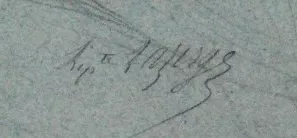
Hippolyte Lazerges' paintings are generally not signed, but an inscription may be mentioned on the frame or on the back of the canvas. However, with or without an inscription, it is important for you to have the work appraised to ensure its originality and to be able to date it.
Knowing the value of a painting
If you happen to own a painting by Lazerges or after the artist, don't hesitate to request a free valuation using our form on our website.
A member of our team of experts and chartered auctioneers will contact you promptly to provide you with an estimate of the market value of your work, not forgetting to pass on ad hoc information about it.
If you wish to sell your work, you will also be accompanied by our specialists in order to benefit from alternatives for selling it at the best possible price, taking into account market inclinations.
Estimate in less than 24h
Discover in the same theme

Rating and value of works, paintings and engravings by Henri...
Henri Motte is a 19th-century neoclassical painter and engraver. His works are quoted and have value at auction. Estimate in 24h.
Learn more >

Rating and value of paintings by Fernand Cormon
Fernand Cormon was a realist painter of the 19th century. A teacher at the Beaux-Arts, he produced many highly-rated works.
Learn more >

Rating and value of paintings by Auguste Émile Pinchart
Auguste Emile Pinchart was a late 19th-century painter of Orientalist genre scenes, whose works are highly prized.
Learn more >
Works from the same period sold at auction

Estimated 10.000 - 15.000 €
Ebridge Ayer BURBANK(1858-1949), Young African-American boy, Oil on panel.

Estimated 200 - 400
Joseph Gabriel TOURNY (Paris 1817-1880 Montpellier) Portrait of a painter with a moustache, in bust form, Pastel on paper, oval format

Estimated 3.000 - 5.000
Guillaume FOUACE (1837-1895), Still life with oysters, Oil on canvas

Estimated 800 - 1.200
Carolus DURAN (1837-1917) Portrait of a bearded man with a hat, Charles Drouet, Oil on canvas

Estimated 1.500 - 2.500
Henri PONTOY (1888-1968) Animated view of a kasbah in the Atlas Mountains

Estimated 3.000 - 4.000
Henri PONTOY (1888-1968), Fantasia at the foot of the Atlas, Oil on canvas

Secure site, anonymity preserved

Auctioneer approved by the State

Free and certified estimates
Frequently asked questions
-
Who was Hippolyte Lazerges, and what was his artistic background?Hippolyte Lazerges (1817–1887) was a French painter who trained at the École des Beaux-Arts in Paris under François Bouchot and David d'Angers. Having spent much of his life between France and Algeria, he established himself as a major figure in 19th-century Orientalism, distinguished by a subtle and intimate approach to his subjects, far removed from the exotic stereotypes of his time.
-
What is the price range for Hippolyte Lazerges' paintings?Hippolyte Lazerges’ works sell for between €100 and €74,700, depending on the type and quality. Orientalist paintings range from €420 to €53,360, while religious subjects can fetch up to €74,700. In 2022, an oil on canvas titled *Sleeping Beauty* sold for €22,400, exceeding its initial estimate of €9,500 to €14,100.
-
How can you authenticate a painting by Hippolyte Lazerges?Lazerges’ paintings are generally unsigned, although an inscription may appear on the frame or on the back of the canvas. To verify the authenticity and date of the work, it is essential to have the painting appraised by a qualified professional. Auctie's offers a free, no-obligation appraisal conducted by its experts and state-certified auctioneers.
-
How does the appraisal process for a painting work at Auctie's?The appraisal is free and non-binding. Simply fill out a form on the Auctie's website with photos and information about your artwork. A certified expert or auctioneer will contact you promptly to provide an estimate of its market value and relevant information about the painting within 48 hours.
-
Is this a good time to sell a painting by Hippolyte Lazerges?Yes, this is a good time to sell a work by Lazerges. The prices of his paintings are rising steadily on the art market, particularly among French and British collectors. The market for 19th-century academic Orientalism remains vibrant and recognizes the distinctive value of his compositions.
