



Rating and value of paintings by Marie Denise Villiers

Key takeaways
- The works of Marie Denise Villiers, a leading figure in neoclassical portraiture (1774–1821), are seeing their prices rise steadily on the art market.
- Her oil-on-canvas paintings are fetching top estimates, ranging from €200 to €592,800, notably *The Emigration of Bison*, which sold for €592,800 in 2019.
- Her neoclassical portraits of women, characterized by technical virtuosity in the rendering of drapery and psychological subtlety, remain particularly sought after by French collectors.
If you own a work by or after the artist Marie Denise Villiers, and would like to know its value, our state-approved experts and auctioneers will offer you their appraisal services.
Our specialists will carry out a free appraisal of your work, and provide you with an accurate estimate of its value on the current market.
Then, should you wish to sell your work, we will direct you to the best possible arrangement to obtain the optimum price.
Rating and value of the artist Marie Denise Villiers
Marie Denise Villiers is an important artist of 19th century animal painting. She is part of the realist movement as well as other movements. At present, the prices of her works are rising under the auctioneers' gavels.
Her oils on canvas are particularly prized, especially by French buyers, and the price at which they sell on the art market ranges from €200 to €592,800, a considerable delta but one that speaks volumes about the value that can be attributed to the works of Marie Denise Villiers
In 2019, the oil on canvas Bison Emigration (America), dating from 1897 sold for €592,800, whereas it was estimated at between €269,000 and €449,500, twice the low estimate.
Order of value from a simple work to the most prestigious
Technique used | Result |
|---|---|
Estamp - multiple | From €20 to €9,900 |
Sculpture - volume | From 90 to 37,090€ |
Drawing - watercolor | From €100 to €300,600 |
Oil on canvas | From €200 to €592,800 |
Estimate in less than 24h
Style and technique of artist Marie Denise Villiers
Marie Denise Villers (1774 - 1821)was a French neoclassical artist who specialized in portraiture. Her works are mainly executed in oil on canvas, a favored medium for ceremonial portraiture and psychological study.
She does her preparatory drawing work in black stone, pencil and red chalk, which allows precise modeling before moving on to color. She uses glazes and thin layers, inherited from the academic tradition.
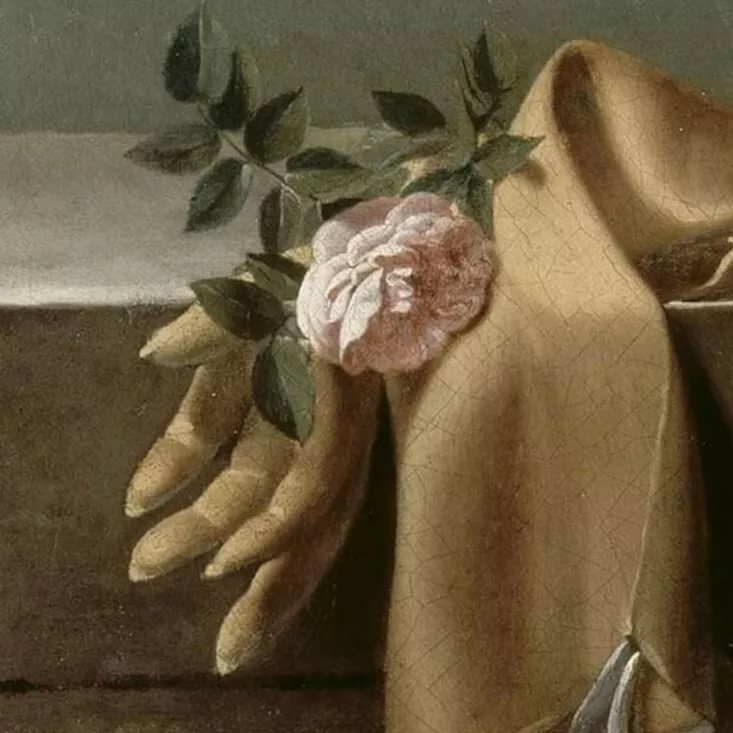
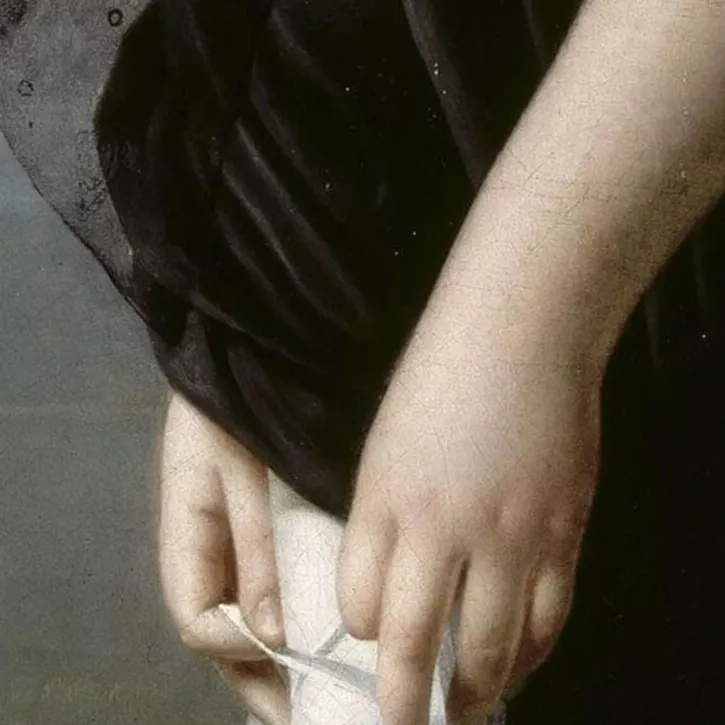
The finish is smooth and polished, with no visible marks, and very gentle transitions between light and shadow. She pays meticulous attention to textile textures and accessories (veils, ribbons, transparent fabrics), which are often treated with virtuosity.
Her portraits are often composed in three-quarter view or seated indoors, with an architectural or symbolic background. Villiers places particular importance on the geometric construction of space, inherited from neoclassical principles.
The staging is systematically studied to associate the model's psychology with social codes (gestures, gaze, posture). Her palette is clear and balanced, dominated by bright pastel tones (whites, pinks, blues, soft ochres).
She uses subtle contrasts between skin tones and fabrics, reinforcing the visual hierarchy. Light is used as a structuring element, highlighting the hands and faces of the figures, much like Louise Adélaïde Desnos.
She strives for a precise likeness, with a slight idealism that softens the features. Her portraits are imbued with sensitivity and intimacy, particularly in her depictions of women.
There is a definite effort to suggest an inner life and go beyond mere likeness. She is part of the neoclassical tradition of late 18th-century French portraiture, following in the footsteps of David and Gérard, but with a more sensitive and intimate approach.
Her work is characterized by a balance between academic rigor and psychological expressiveness.
.
The life of Marie Denise Villiers
Marie Denise Villiers (1774 - 1821) was born into a family of painters. Her sisters, including Marie-Victoire Lemoine, were also painters. The family was part of an active female artistic network at the end of the 18th century.
It is thought that she probably trained alongside Anne Vallayer-Coster, head of Queen Marie-Antoinette's painting cabinet, and Jacques Louis David, although no formal documentation survives.
She had access to artistic training through her family background, a rare privilege for a woman at the time.
She debuted at the Paris Salon in 1799, when the Revolution had opened up the official scene more to women artists. She exhibited neoclassical portraits, in which she stood out for her psychological finesse and virtuosity of drapery and fabric.
Young Woman Drawing (1801) is one of her major works now housed at MoMA, which was long attributed to Jacques-Louis David, revealing both the invisibilization of women artists at the time but also the stylistic proximity that may have existed between her and her master.
She is renowned for the technical quality and delicacy of her female portraits, which are part of the neoclassical vogue. Her career illustrates the increasing role of women painters in post-revolutionary Salons, despite institutional resistance.
She gains a reputation in the private circles of bourgeois and aristocratic patrons. The artist married Michel-Maximilien Villiers, an architect, reinforcing her integration into Parisian artistic and intellectual circles.
Her life remained discreet, and little documented apart from her Salon appearances and her works. She continued to produce portraits until the 1810s, and died in Paris in 1821, aged 47.
Marie Denise Villiers was long overshadowed, not least because of the erroneous attribution of her major painting (Jeune femme dessinant) to her master David. She was rediscovered in the 20th century by art historians and research into neoclassical women painters.
Henceforth, she is considered an important figure in female neoclassical portraiture, testifying to the place of women in the official circuits of the nascent 19th century.
Focus on Jeune femme dessinant, Marie Denise Villiers
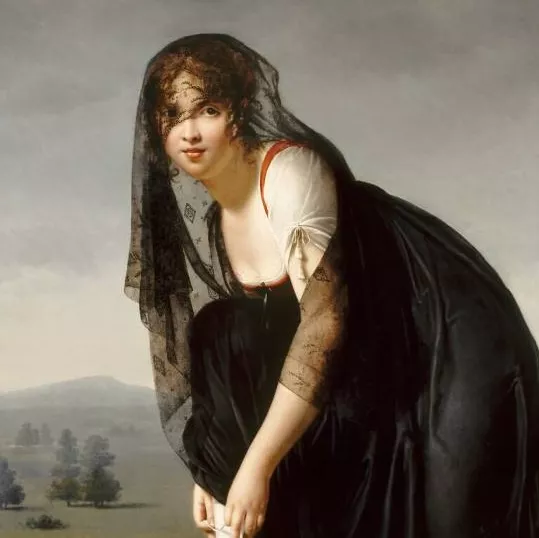
Jeune femme dessinant is a vertical-format oil on canvas by Marie-Denise Villiers, incorrectly attributed to Jacques-Louis David and now in the Metropolitan Museum of Art (New York).
It depicts a young woman seated by a broken window, holding a pencil and drawing pad. The female figure occupies the main space, in three-quarter view, and is turned slightly towards the viewer.
In the background, we can guess an architecture with a large, partially broken bay window, opening onto a blurred urban landscape. According to some interpretations, the bay window is meant to suggest fragility or a metaphor for the feminine and artistic condition.
The armchair and accessories create an intimate, domestic setting, contrasting with the neoclassical monumentality. Skin tones are softly modeled, with very subtle transitions between light and shadow.
The white drapery is luminous, virtuously rendered, contrasting with the warm browns of the decor. The workmanship is smooth and polished, inherited from Davidian neoclassicism, with no visible impastos.
The artist uses glazes to achieve a transparent rendering of the fabrics. The palette is clear and refined, with whites, beiges and ochres enhanced by touches of blue and pink. The light contrast highlights the young woman's face and hands, and the light coming from the window creates a soft yet dramatic atmosphere that is accentuated by the broken glass.
This work can be read as a self-portrait of the artist, but also as an allegory of the woman artist. The practice of drawing becomes the central subject, with the affirmation of women's access to artistic creation.
The broken window has often been interpreted as a metaphor for the social obstacles faced by women painters. The sensitivity of this work also contrasts with the more rigid official portraits of the same period.
This work was long attributed to David, proof of their stylistic proximity. It was reattributed to Marie Denise Villiers in the 20th century, also becoming a symbol of the recognition of women artists, as may have happened to Constance Mayer or Louise Hersent.
This work is today considered her masterpiece, and a key piece in the rediscovery of female neoclassical painters.
.
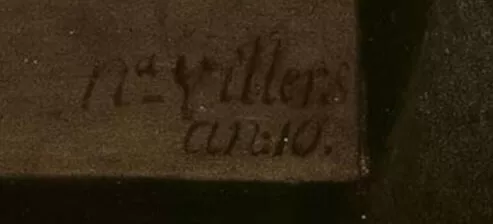
Recognizing the signature of Marie-Denise Villiers
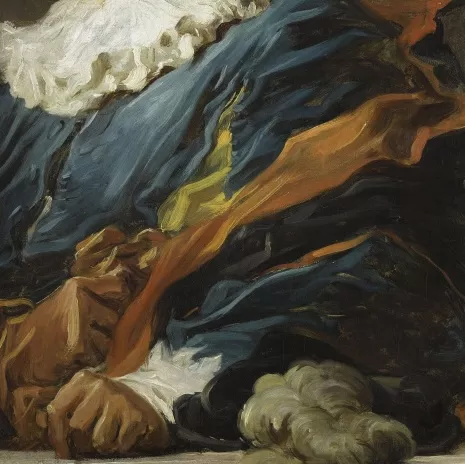
The artist often signs her full name in small at the bottom of her paintings. Copies may exist, which is why expertise remains important.
Knowing the value of a work
If you happen to own a work by or after Marie-Denise Villiers, don't hesitate to request a free appraisal using our form on our website.
A member of our team of experts and certified auctioneers will contact you promptly to provide you with an estimate of the market value of your work, as well as ad hoc information about it.
If you are considering selling your work, you will also be accompanied by our specialists in order to benefit from alternatives for selling it at the best possible price, taking into account market inclinations.
Estimate in less than 24h
Discover in the same theme

Rating and value of works, paintings, drawings by Étienne Pr...
Berne Bellecour is a successful 19th-century painter of military art. His quotation is stable and the value of his paintings high.
Learn more >

Rating and value of furniture, desks, chests of drawers by P...
Paul Sormani was a 19th-century cabinetmaker who produced a number of pieces of furniture that are highly valued at auction. Estimate in 24h
Learn more >

Rating and value of paintings by Gaston La Touche
Gaston La Touche is a 19th-century painter who produced works that are highly valued at auction. 24h estimate.
Learn more >
Paintings from the same period sold at auction

Estimated 2000€ - 5000€
French school circa 1820, entourage of François, baron...

Estimated 1500€ - 2000€
French neoclassical school, circa 1800 Head of expression of...

Estimated 4000€ - 8000€
French school circa 1800, follower of Joseph Vernet...

Estimated 800€ - 1200€
Attributed to Jean-François Garneray (Paris 1755-1837 Auteuil) Portrait of...

Estimated 400€ - 600€
Francois Alexandre Pernot (Wassy 1793-1865 Wassy) View of...

Estimated 150€ - 300€
COROT Jean-Baptiste Camille (1796-1875) Reading under the...

Secure site, anonymity preserved

Auctioneer approved by the State

Free and certified estimates
Frequently asked questions
-
Who is Marie Denise Villiers, and what is her artistic background?Marie Denise Villiers (1774–1821) was a French Neoclassical painter who specialized in portraiture; she was born into a family of artists. She trained under masters such as Anne Vallayer-Coster and Jacques-Louis David, and exhibited at the Paris Salon beginning in 1799. Her major work, *Young Woman Drawing*, was long attributed to David, which attests not only to the stylistic proximity between the two artists but also to the invisibility of women painters at the time. She is now recognized as an important figure in early 19th-century neoclassical portraiture of women.
-
What are the price ranges for Marie Denise Villiers' works, broken down by medium?The prices of Marie Denise Villiers’s works vary considerably depending on the medium: prints sell for between €20 and €9,900, sculptures between €90 and €37,090, drawings and watercolors between €100 and €300,600, and oil paintings on canvas between €200 and €592,800. In 2019, her oil on canvas *Émigration de bisons* (1897) sold for €592,800, far exceeding its initial estimate. Oils on canvas remain the most sought-after works, particularly among French buyers.
-
How can you authenticate a work by Marie Denise Villiers?To authenticate a work by Marie Denise Villiers, we recommend that you submit your piece for a free, no-obligation appraisal via our online form. A state-certified expert or auctioneer from our team will contact you promptly to examine the artwork, verify its signature (usually written in small letters at the bottom of the painting), and provide you with a detailed estimate of its market value within 48 hours. This process is essential because copies exist, and only a professional appraisal can provide reliable authentication.
-
Is this a good time to sell a work by Marie Denise Villiers?Yes, this is an excellent time to sell a work by Marie Denise Villiers. The prices of her paintings are rising steadily at auction, and her work has been experiencing a significant resurgence in popularity since the 20th century, thanks in particular to research on female Neoclassical painters. Demand remains particularly strong among French buyers, and the market now recognizes the value and historical significance of this long-overshadowed artist.
-
How does the sale of a work of art work at Auctie's?Auctie's guides you from the appraisal to the final sale of your artwork. The process begins with a free, no-obligation appraisal conducted by our state-certified experts and auctioneers, with a response within 48 hours. If you decide to sell, our specialists will advise you on the best options and sales strategies to achieve the highest possible price, taking market trends into account. We handle every aspect of the sale, from cataloging to the auction itself.
