



Rating and value of aquarelles and paintings by William Callow

Key takeaways
- William Callow’s watercolors and paintings fetch up to €105,000 at auction, with prices ranging from a few hundred to tens of thousands of euros depending on the subject and format.
- Views of Venice constitute the most valuable segment of the market, while scenes from the Rhine and Normandy form a secondary market, with English landscapes fetching more modest prices.
- Condition, a dated signature, documented provenance, and size (larger than 30 × 45 cm) are the main factors determining the value of a work by Callow.
William Callow’s watercolors and paintings fetch up to €105,000 at auction. An appraisal allows you to accurately determine the current market value of your William Callow artwork and, if applicable, optimize the sale of the piece.
If you own a work by William Callow and would like to know its value, our state-certified auctioneers will provide a free appraisal based on authenticity, market rating, and recent market results.
Market Value and Appraisal of Artist William Callow
William Callow is a renowned figure in British Victorian watercolor painting. His views of Venice, the Rhine, and Normandy are particularly prized by Anglo-Saxon collectors and the international market.
Prices for his works range from a few hundred euros for an unsigned study to tens of thousands of euros for a large Venetian watercolor with a distinguished provenance.
In 2005, his watercolor *Entrance to the Court of the Ducal Palace, Venice* sold for €105,000 at Sotheby’s London, despite an estimate of between €60,000 and €80,000. His value on the secondary market remains strong.
Ranking by value, from the most basic to the most prestigious
Technique used | Result |
|---|---|
Print - multiple | From €10 to €440 |
Oil on canvas | From 469 to 1,860 € |
Drawing - watercolor | From €400 to €105,000 |
Estimate in less than 24h
Where Is William Callow?
Period
William Callow (1812–1908) was a British watercolorist born in Greenwich. With a lifespan of ninety-five years and a career spanning more than seven decades, he was an active participant in virtually the entire 19th century, from the Regency to the reign of Edward VII.
His career spanned the golden age of English watercolor painting—shaped by the great tradition of Turner, Constable, and Bonington—and the emergence of painters’ societies that shaped the British art market.
Movements
Callow is firmly rooted in the tradition of British topographical and picturesque watercolor, a legacy of the great travelers of the Grand Tour. His training with the Fielding brothers, followed by his extended stay in Paris, brought him into contact with French Romantic movements, though he never broke with the naturalistic empiricism of the English school.
His membership in the Society of Painters in Watercolors (Old Watercolor Society), to which he was elected in 1838 and where he served as secretary and trustee, conferred upon him lasting institutional legitimacy.
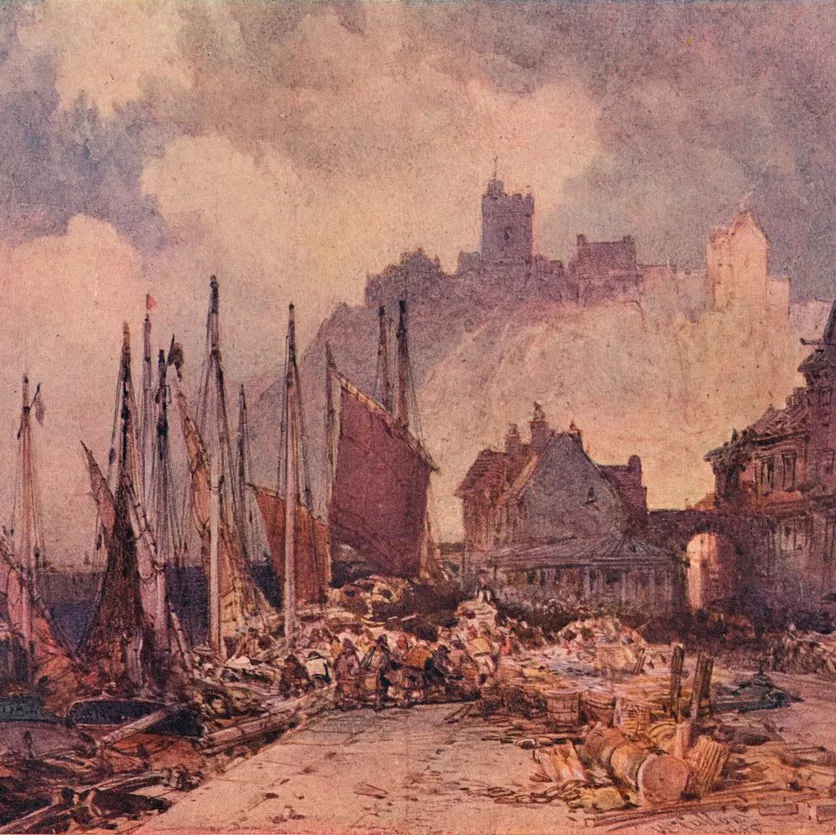
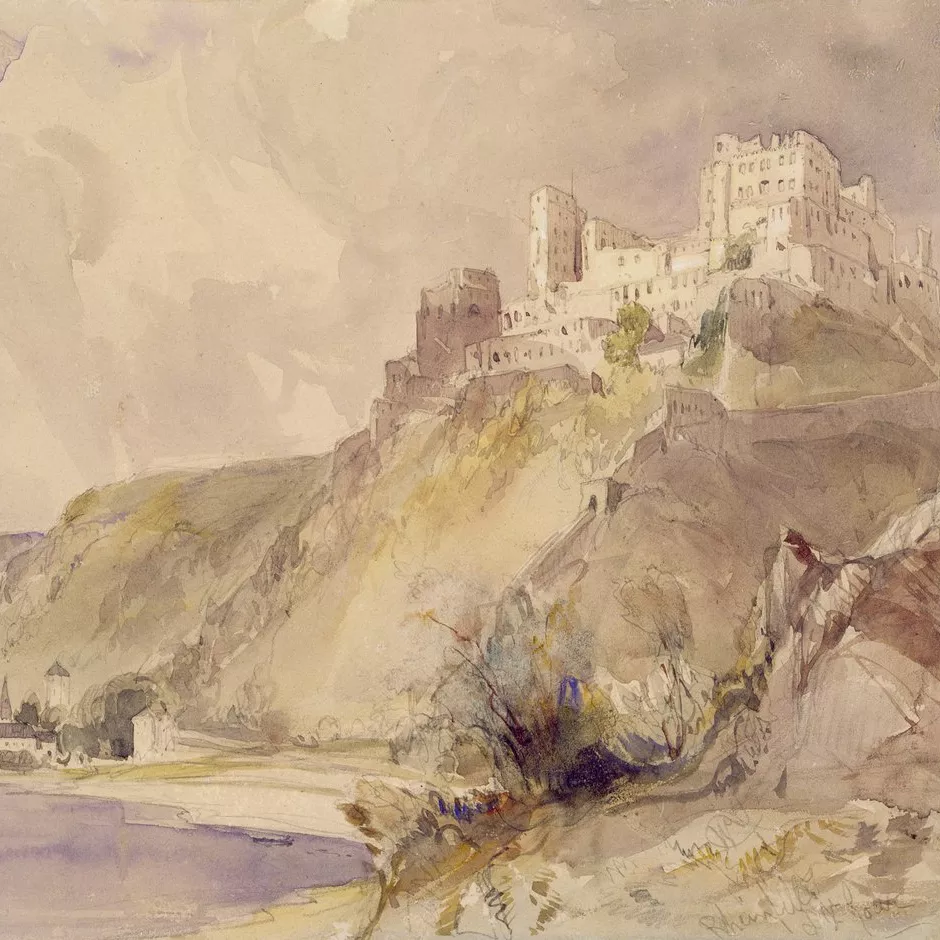
The Life of William Callow
Cultural Context
Born in Greenwich on July 28, 1812, William Callow grew up in Regency England, a period marked by a keen interest in continental travel and picturesque landscapes. At the age of thirteen, he entered the Fielding brothers’ studio, a renowned London school where students were taught watercolor, engraving, and aquatint.
In 1829, Thales Fielding secured him a position as an engraver in Paris. His stay in France would last more than ten years. There, Callow exhibited a view of Richmond Hill at the 1831 Salon, met his friend Charles Bentley, and was offered private lessons with the family of Louis-Philippe I.
He gave lessons to the Duke of Nemours and Princess Clémentine, thereby gaining access to the highest echelons of Parisian society.
He returned permanently to England in 1841 and settled in Great Missenden, Buckinghamshire, in 1854, where he lived until his death in 1908.
Artistic Circle and Training
Callow’s training was both technical and shaped by his travels. The Fielding brothers taught him the art of wash painting and the discipline of plein air painting. His friendship with Charles Bentley, a painter who also specialized in coastal and harbor scenes, fostered his love for reflections on water and maritime atmospheres.
It was John Frederick Lewis, a friend and fellow artist, who encouraged him to join the Society of Painters in Watercolors in 1838. This membership marked her definitive entry into the British institutional art world, granting her access to the Society’s annual exhibitions and the clientele of collectors who attended them.

Market Segmentation and the Artist’s Market Value
The market for William Callow shows a clear polarization between his Venetian watercolors—which command the highest auction prices—and the rest of his body of work: Rhine landscapes, views of Normandy, and English landscapes. This hierarchy by subject has remained consistent since the 1980s.
Of approximately 987 results listed on Artnet, 918 are works on paper (drawings and watercolors), compared to only 68 oil paintings. The relative scarcity of the oil paintings creates a scarcity premium that can push their estimates higher than those of watercolors from the same period.
The market is primarily driven by British auction houses (Christie’s, Sotheby’s, Bonhams), which organize specialized sales of Victorian painting. Demand from Australia and the United States is also strong, fueled by Callow’s presence in public collections such as that of the National Gallery of Victoria in Melbourne.
Factors
The subject matter is the primary determinant of value: a large-format view of Venice from the 1850–1880 period will always command a significant premium. Scenes from the Rhine and Normandy constitute the second-largest market, while English landscapes appeal to a more local audience.
Condition is critical for watercolors. Paper yellowed by light or water stains can cut the value in half or by two-thirds. Original presentation under UV-protective glass is a major asset.
Provenance plays an increasingly important role: a work that has been sold at public auction by a major auction house, accompanied by its catalog, benefits from a traceable history that reassures institutional buyers and knowledgeable collectors.
Signature and date: Callow regularly signed “W Callow” followed by the year. The absence of a signature complicates attribution and weighs on the estimate, though it does not disqualify the work.
Size: Large watercolors (larger than 30 x 45 cm) consistently reach the upper end of the estimate range, as international demand favors prestigious pieces suitable for adorning a collection space.
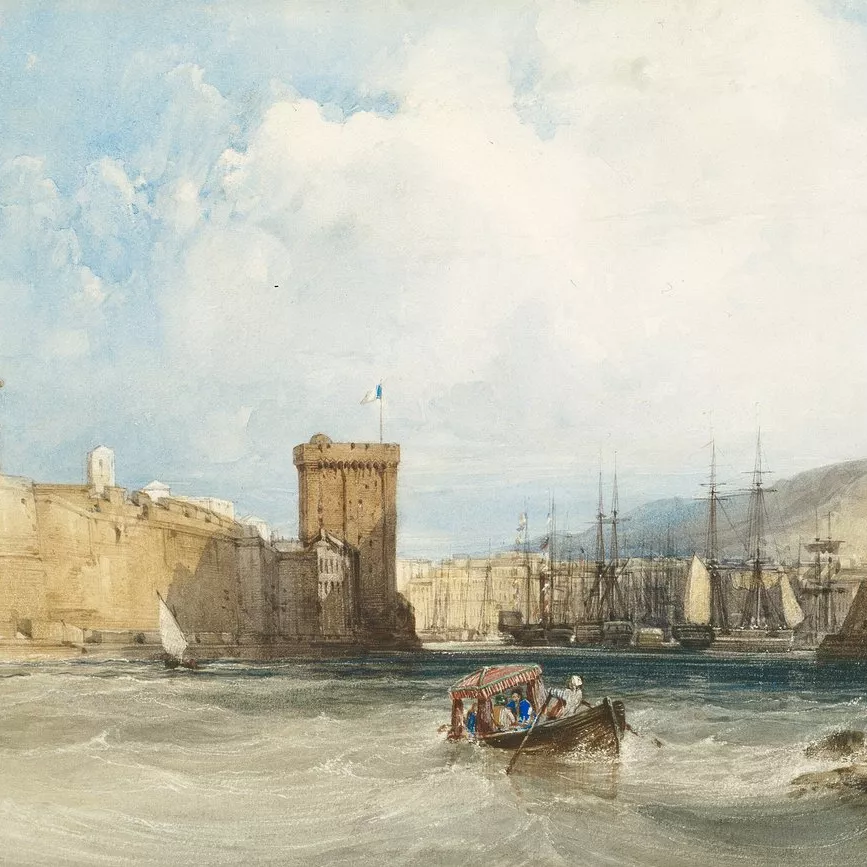
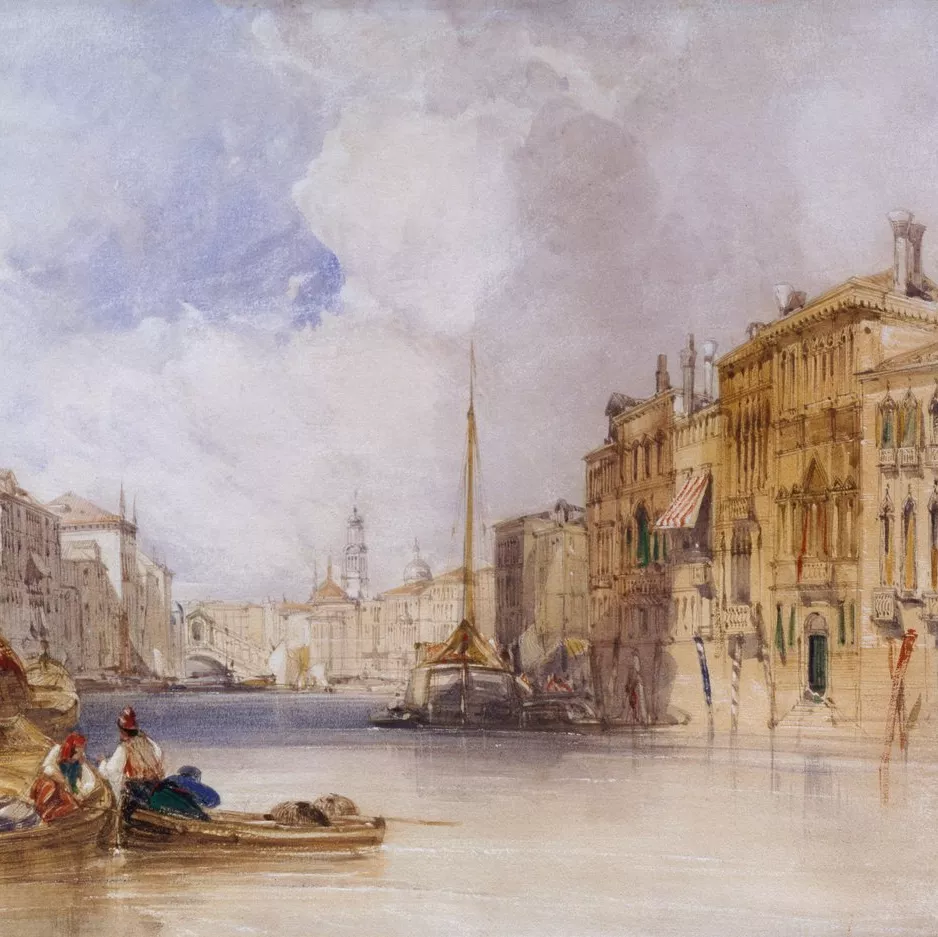
FAQ - How do you appraise a work by William Callow?
1) What types of works by William Callow are available on the market?
The vast majority of works available at auction are watercolors on paper, signed and dated. There are also preparatory drawings, sometimes unsigned, as well as, more rarely, oil paintings on canvas or panel. Engravings based on Callow’s works exist but are of secondary interest to the market.
2) Which subjects fetch the highest auction prices?
Views of Venice clearly dominate, followed by scenes of the Rhine and the Normandy coast. A watercolor depicting the Doge’s Palace, the Riva degli Schiavoni, or San Giorgio Maggiore will consistently fetch a higher price than a landscape of the English countryside, assuming equal quality and size.
3) How can you identify an authentic work by William Callow?
The signature “W Callow” accompanied by the year—most often in brown or black watercolor—is the primary indicator. A stylistic comparison with reference works held at the Victoria and Albert Museum in London or the National Gallery of Victoria in Melbourne helps confirm the attribution. In case of doubt, it is recommended to seek an expert opinion from a specialist in British Victorian painting.
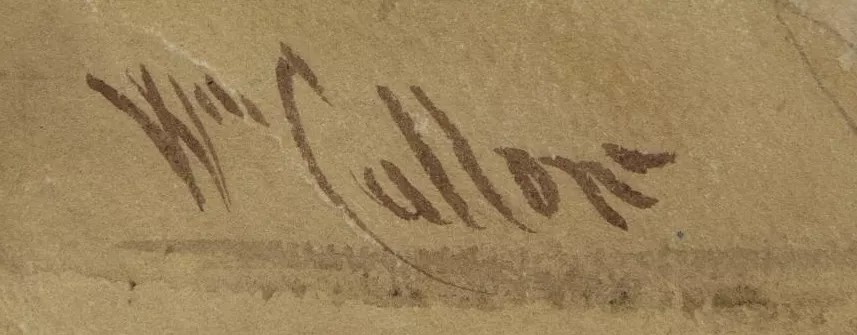
His Signature
William Callow’s works are generally signed “W Callow” along with the year of creation, in brown or black watercolor, in the lower left or lower right corner of the composition. Some early studies or preparatory works are unsigned.
Gallery or exhibition labels on the back of the work, or handwritten notes regarding provenance, provide useful additional information for authentication.
Get an Appraisal for Your Property
If you own a work by William Callow, please feel free to request a free appraisal by filling out our online form.
A member of our team—composed of experts and certified auctioneers—will contact you to provide an estimate of your artwork’s market value.
If you’re considering selling your artwork, our specialists will also guide you through the various options available to help you achieve the best possible price, taking into account market trends and the unique characteristics of each piece.
Estimate in less than 24h
Discover in the same theme

Agathon Léonard porcelain biscuit rating and value
Agathon Léonard was an Art Nouveau sculptor who created porcelain biscuit for the Manufacture de Sèvres, which are listed at auction.
Learn more >

Rating and value of paintings by Alphonse Osbert
Alphonse Osbert was a 19th-century Symbolist painter who produced paintings that are highly valued at auction.
Learn more >

Rating and value of paintings by Conrad Wise Chapman
Conrad Wise Chapman was a 19th-century American landscape and military painter who produced works of high value.
Learn more >
D'autres tableaux impressionnistes vendus aux enchères

Estimated 6.000 - 8.000
Mikhail Markianovich GUERMACHEFF (1867 - 1930) House under the snow, oil on canvas

Estimated 2.000 - 4.000
Jean DUFY (1888-1964) Vase of anemones, Watercolor

Estimated 600 € - 800 €
Henri ZUBER (1844-1909), Bridge at Artemare. Oil on canvas.

Secure site, anonymity preserved

Auctioneer approved by the State

Free and certified estimates
Frequently asked questions
-
Who is William Callow, and what is his historical context?William Callow (1812–1908) was a leading British watercolorist of the Victorian era, born in Greenwich. He lived through nearly the entire 19th century and was part of the great tradition of English watercolor painting alongside Turner and Constable. Elected to the Society of Painters in Watercolors in 1838, he enjoyed lasting institutional recognition and received training from the Fielding brothers, supplemented by a long stay in Paris where he was exposed to French Romantic movements.
-
In what price range are William Callow's works sold?William Callow’s watercolors and paintings range in price from a few hundred euros for an unsigned sketch to as much as €105,000 for a large Venetian watercolor with a distinguished provenance. Watercolors account for the majority of the market, with prices ranging from €400 to €105,000, while oil paintings on canvas range from €469 to €1,860. Value depends heavily on the subject, size, and condition.
-
How can you authenticate a work by William Callow?Authentication begins with verifying the “W Callow” signature accompanied by the year, typically rendered in brown or black watercolor at the bottom of the composition. A stylistic comparison with reference works and an examination of the provenance help to support an attribution. In case of doubt, we recommend obtaining an appraisal from our certified auctioneers who specialize in British Victorian painting: please fill out our free appraisal form.
-
Which items fetch the highest bids?Views of Venice clearly dominate the market and command the highest prices, particularly those depicting the Doge’s Palace or the Riva degli Schiavoni. Scenes of the Rhine and the Normandy coast constitute a second active market, while English landscapes appeal to a more local clientele. Given equal quality and size, a Venetian watercolor will consistently command a higher price than a countryside landscape.
-
How does Auctie's go about appraising a work by William Callow?Auctie's offers a free, no-obligation online appraisal: fill out our form with a photo and description. A state-certified auctioneer or an expert specializing in Victorian paintings will contact you to assess the authenticity, market value, condition, and provenance of your artwork. You’ll receive a detailed response within 48 hours, based on recent market trends.
