



Rating and value of paintings by Nicola Forcella

Key takeaways
- Nicola Forcella, an Italian Orientalist painter (1850–?), commands high prices, with his oil-on-canvas works selling for between €60,000 and €75,000.
- His paintings of Cairo’s souks and bazaars represent the premium segment, while portraits and genre scenes make up a broader and more accessible market.
- The 75 lots sold at public auctions confirm strong collector demand for Orientalist art, with a structural discount for attributed but unsigned works.
If you own a work by artist Nicola Forcella or based on his work and would like to know its value, our state-approved experts and auctioneers will guide you.
Our specialists will carry out a free appraisal of your work, and provide you with an accurate estimate of its value on the current market.
Then, if you wish to sell your work, we'll direct you to the best possible arrangement to obtain the optimum price.
Artist's rating and value
A major marine painter, Nicola Forcella has established himself as a major figure on the art market. His works are highly regarded on the market and highly prized by collectors.
Only oils on canvas can be found, which are sold for between €60 and €75,000, a relatively substantial range but one that says a lot about the price these works can fetch.
A work signed or attributed to Forcella can fetch thousands of euros at auction, as evidenced by his painting Dans le souk aux cuivre, which fetched €75,000 in 2007, whereas it was estimated at between €25,000 and €35,000.
Order of value from the most basic to the most prestigious
Technique used | Result |
|---|---|
Drawing - watercolor | From €60 to €1,300 |
Painting | From €60 to €75,000 |
Estimate in less than 24h
The artist's work and style
Nicola Focella is an Italian painter associated with the Neapolitan veduta and townscape tradition of the late 19th and early 20th centuries. Her work is situated in a luminous naturalism, without adherence to the modern avant-garde.
Secondary figures such as fishermen and strollers are often present, depending on the scale. Forcella carefully observes the actual site, with topographical fidelity. The urban landscape is treated as a living space, animated but ordered. There is no excessive dramatization.
His compositions are classical and balanced, with a construction in successive planes. The foreground is animated, the middle ground architectural or maritime, and the background atmospheric. He uses diagonals (quays, streets, shorelines) to energize the space.
The perspective is mastered, conforming to academic rules. Depth is clearly legible and undistorted. The perspective serves the clarity of the scene rather than spectacular effect. Light is the central element of the pictorial language. Atmospheric effects are achieved through gentle transitions between sky, sea and architecture.
His palette is dominated by azure blues for the sky and sea, ochres and beiges for the architecture, and discreet greens for the vegetation. The colors are bright but controlled, without excessive saturation. The chromatic harmony aims at an impression of serenity.
Forcella works almost exclusively with oil on canvas, his touch fine and even, sometimes slightly vibrant in areas of light. There is no marked impasto, the material remains measured.
The career of Nicola Forcella
Nicola Forcella (1850 - ?) was an Orientalist painter born in Castellaneta, Puglia, Italy. The sources indicate a birth in the 19th century (there are discrepancies between the records, particularly as regards the exact year). His date of death is not stabilized in current sources and often indicated as unknown.
He was trained in the sphere of Italian artistic education, with an explicit reference to the Accademia di Belle Arti in Naples in the sales notices. He settled and worked in Egypt, where he acquired a notable reputation as an Orientalist painter.
He taught at the Khedivial School of Applied/decorative Arts in Cairo. He was awarded the Imperial Order of the Medjidié, an Ottoman distinction mentioned in several sources. His brother, Paolo, is said to have accompanied him to Egypt (sources differ on his date of birth).
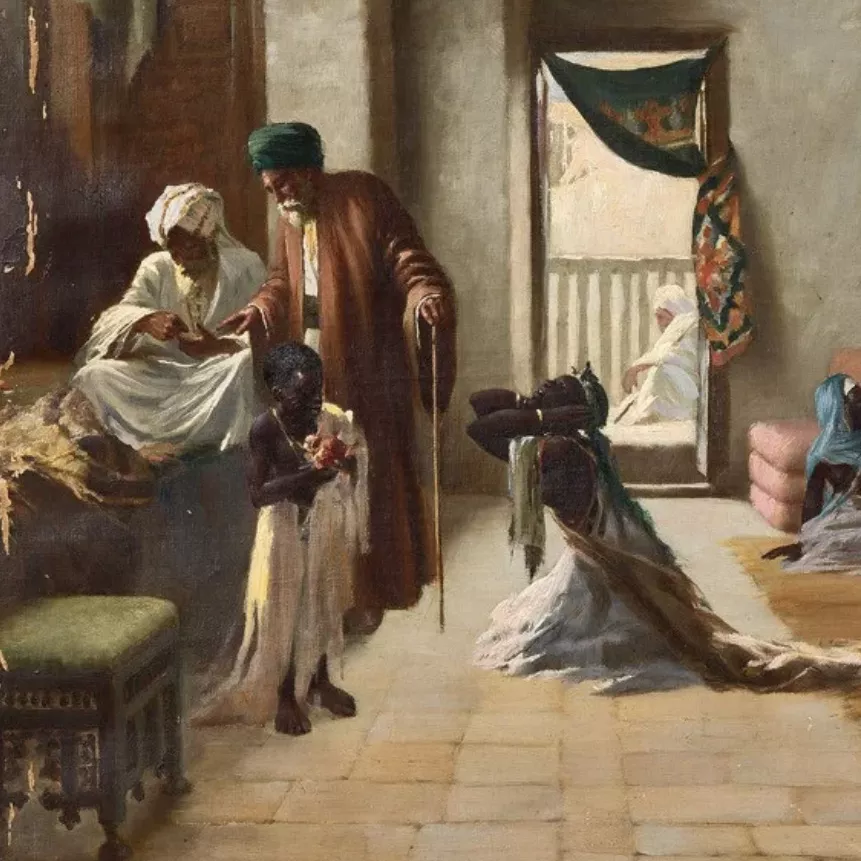
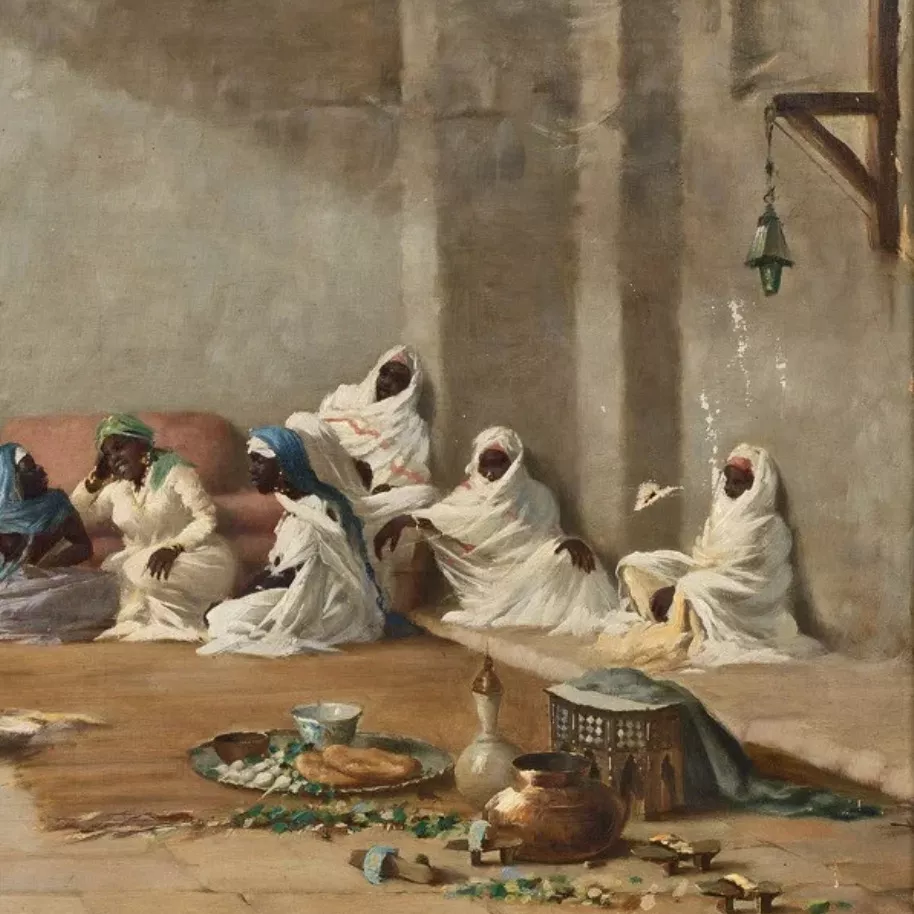
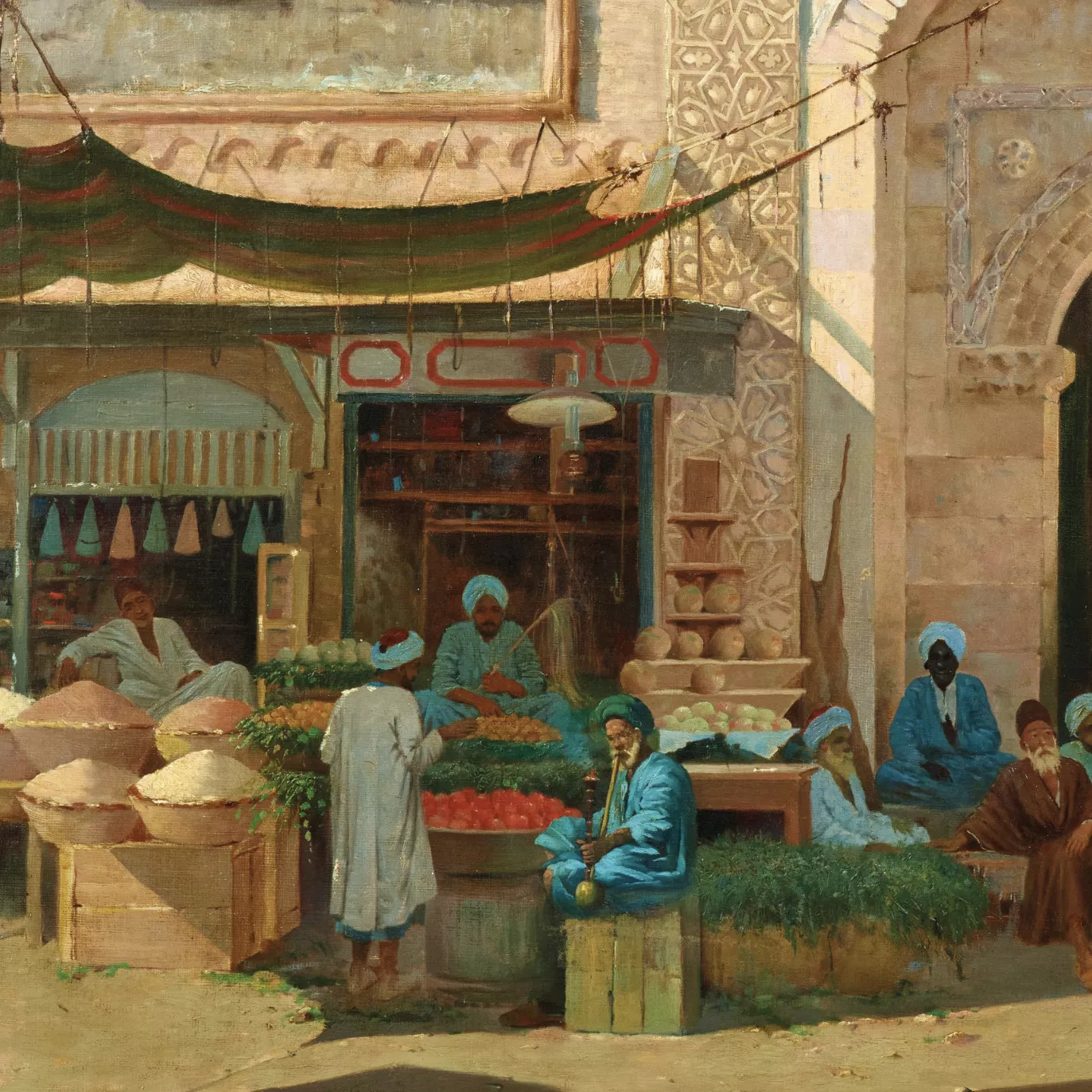
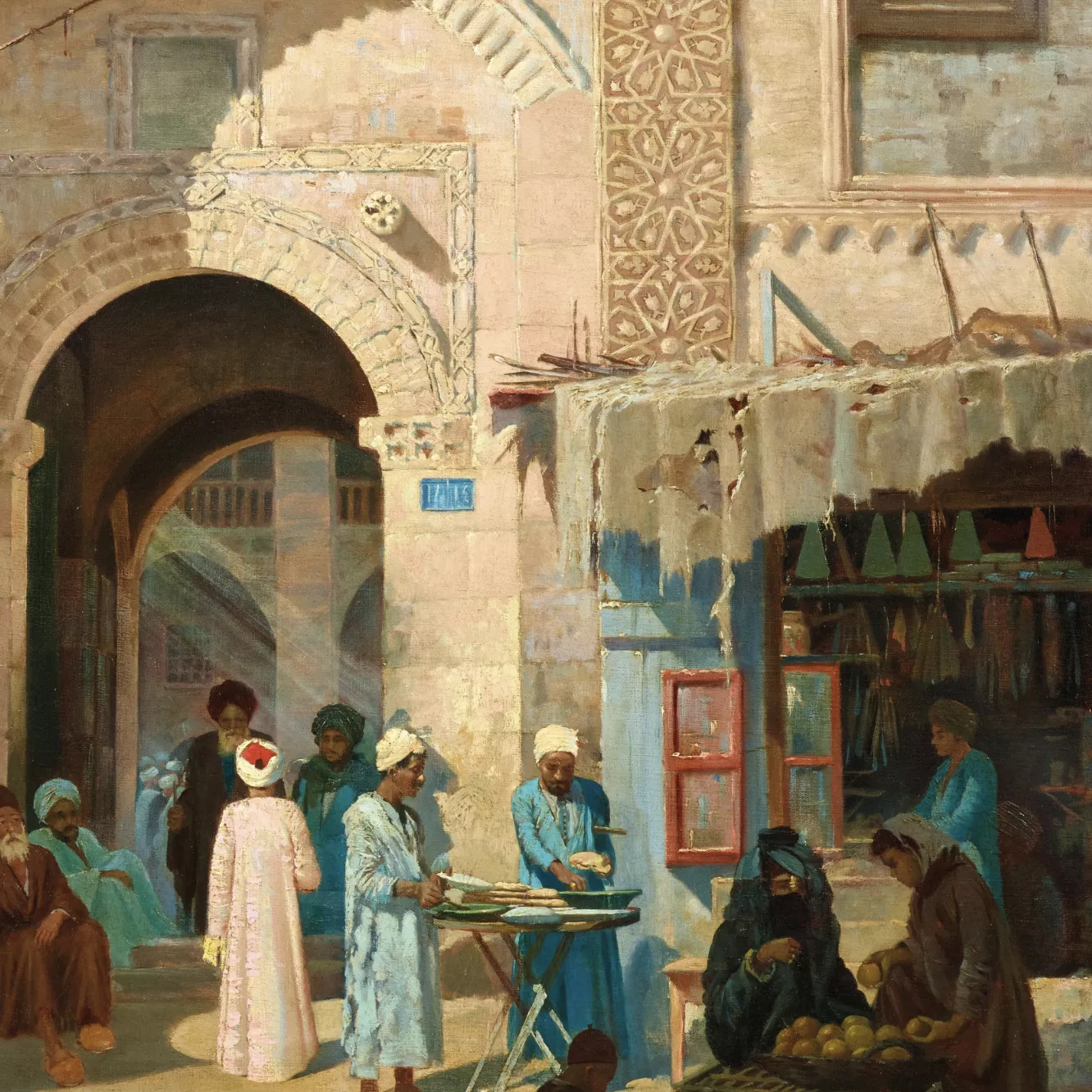
His repertoire focuses on souk and trade scenes, genre scenes and portraits and figures. Some compositions explicitly incorporate the figure of the European tourist in the souk, which also documents Orientalism as a social phenomenon.
His works are identified in public sales and on the Orientalism market, with localized titles, confirming his inclusion in an Orientalist collecting circuit.
Market segmentation and artist's rating
There have been 75 public sales for the artist. Scenes of the souk, bazaar and streets of Cairo constitute a " premium " segment, as this is the most immediately legible Orientalist iconography, with strong decorative desirability.
Portraits depicting, for example, men in turbans or young women constitute a very active segment, often with medium formats, and a broader market of collectors.
Interiors and genre scenes (religious teaching, conversations, baths) belong to an intermediate segment, and value is dependent on compositional quality and condition. Oils on canvas are the dominant and most valued medium.
Works on paper (watercolor, gouache, drawing) are part of an entry-level market, more volatile, often more decorative than heritage, even if rarity can create exceptions. The market is highly sensitive to the mention " attributed to ", with a structural discount compared to a signed and documented work.
The top market estimate level typically concerns large souk scenes (format, complexity, decorative potential), even if the final result depends on condition, provenance and competition in the room.
For Forcella, the variable to consider is both subject (souk, portrait or genre), format and attribution status. For a tighter range, you need to work by homogeneous comparables, with a comparison by close subjects, mediums and dimensions, incorporating attribution status.
It fits into an intermediate segment like Étienne Dinet, Alexandre Iacovleff or Maxime Noiré.
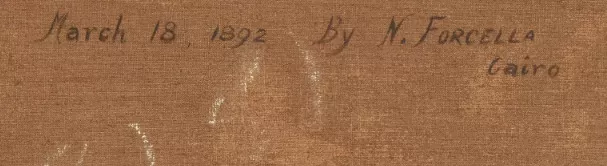
His signature
Nicola Forcella's works are not all signed.
If you think you own one, it's best to have it appraised to be sure of the painting's originality.
Expertise your property
If you own a work by Nicola Forcella, feel free to request a free appraisal by filling in our online form.
A member of our team of experts and licensed auctioneers will contact you to provide an estimate of the market value of your work.
If you are considering selling your work, our specialists will also guide you through the various alternatives available to obtain the best possible price, taking into account market trends and the specific features of each work.
Estimate in less than 24h
Discover in the same theme

Value and quotation of works, paintings by Jules Adler
Jules Adler, a 20th-century naturalist painter, produced a number of drawings and oil paintings that are both valuable and stable.
Learn more >

Rating and value of furniture, desks, chests of drawers by P...
Paul Sormani was a 19th-century cabinetmaker who produced a number of pieces of furniture that are highly valued at auction. Estimate in 24h
Learn more >

Rating and value of paintings by Martin Drölling (father)
Martin Drölling was a 19th-century painter, famous for painting with the hearts of the Kings of France. His paintings are highly prized.
Learn more >
D'autres tableaux orientalistes vendus aux enchères

Estimated 15.000 - 20.000 €
Jacques MAJORELLE (1886-1962) - Fishermen embarking, Abidjan, Ivory Coast - Oil on canvas.

Estimated 40.000 - 80.000
Alexandre ROUBTZOFF (1884-1949), Portrait of Arbia, oil on canvas

Estimated 5.000 - 8.000
Alexandre ROUBTZOFF (1884-1949), The Sidi Makhlouf Mosque, oil on canvas

Estimated 2.000 - 4.000
Henri PONTOY (1888-1968), The Telouet kasbah in the Ounila valley, Oil on canvas

Estimated 1.500 - 2.500
Henri PONTOY (1888-1968) Animated view of a kasbah in the Atlas Mountains

Estimated 3.000 - 4.000
Henri PONTOY (1888-1968), Fantasia at the foot of the Atlas, Oil on canvas

Secure site, anonymity preserved

Auctioneer approved by the State

Free and certified estimates
Frequently asked questions
-
Who is Nicola Forcella, and what is his artistic background?Nicola Forcella (1850–?) was an Italian Orientalist painter born in Calabria who trained at the Accademia di Belle Arti in Naples. He settled in Egypt, where he gained a notable reputation as an Orientalist painter and taught at the Khedivial School in Cairo. His work, which focuses on scenes of souks, portraits, and figures, follows the tradition of Neapolitan veduta and luminous naturalism, without aligning with modern avant-garde movements.
-
What is the market value and price range of Nicola Forcella's works?Nicola Forcella’s oil-on-canvas paintings—his primary medium—generally sell for between €60,000 and €75,000, with notable exceptions fetching higher prices depending on quality, subject matter, and provenance. Drawings and watercolors range from €60 to €1,300. Souk scenes represent the premium segment, while portraits and figures constitute a broader, more active market.
-
How can a work attributed to Nicola Forcella be authenticated?To verify the authenticity of a work attributed to Nicola Forcella, we recommend a free appraisal by our certified auctioneers and experts. It is particularly important to have unsigned works appraised, as sources differ regarding the signature on certain pieces. You can request an appraisal by filling out our online form.
-
Is this a good time to sell a work by Nicola Forcella?Yes, now is a good time to sell a work by Nicola Forcella. The artist has established himself as a major figure in the Orientalist art market; his works command high prices and are highly sought after by collectors. The Orientalist art market remains dynamic, and scenes of souks, in particular, are highly sought after.
-
How does the appraisal process work at Auctie's, and how do I sell my artwork?The appraisal is free and non-binding. After you fill out our online form, an expert or auctioneer will contact you and provide you with an accurate appraisal within 48 hours. If you decide to sell, our specialists will guide you toward the best auction strategy, taking into account market trends and the specific characteristics of your artwork.
