



Rating and value of paintings by Marguerite Delorme

Key takeaways
- Marguerite Delorme (1876–1946), a leading figure in 20th-century Orientalism, is known for her respectful, non-exotic approach to scenes of North African life.
- The artist’s works sell for between €10 and €3,700 depending on the medium: prints (€10–450), watercolors (€180–1,600), and oil paintings (€40–3,700).
- His paintings tend to be medium to large in size, characterized by an earthy color palette (ochres, reds, deep blues) and a diffused light that gracefully envelops the figures.
If you own a work by or after the artist Marguerite Delorme, and would like to know its value, our state-approved experts and auctioneers will offer you their appraisal services.
Our specialists will carry out a free appraisal of your work, and provide you with a precise estimate of its value on the current market.
Then, if you wish to sell your work, we will direct you to the best possible arrangement to obtain the optimum price.
Rating and value of the artist Marguerite Delorme
Considered one of the most important protagonists of Orientalism in the 20th century, Marguerite Delorme leaves behind a unique artistic repertoire imbued with the colonialist artistic spirit.
This legacy consists of paintings that are mostly oils on canvas. At present, the prices of her works are rising under the auctioneers' gavel.
Her paintings and other works are particularly prized, especially by French and Moroccan buyers, and the price at which they sell on the art market ranges from €10 to €3,700, a considerable delta but one that speaks volumes about the value that can be attributed to Marguerite Delorme's works.
In 2018, a polychrome composition entitled Marrakech, vue de l'Atlas, de la terrasse de l'hôtel Tazi, printemps, dating from 1940 sold for €2,000.
Order of value from a simple work to the most prestigious
Technique used | Result |
|---|---|
Estamp - multiple | From €10 to €450 |
Drawing - watercolor | From €180 to €1,600 |
Painting | From €40 to €3,700 |
Estimate in less than 24h
Style and technique of the artist Marguerite Delorme
Marguerite Delorme (1878 - 1946) belongs to a generation of artists who, unlike some of their Romantic predecessors, traveled to their main sources of observation : Morocco, Algeria, Tunisia, Egypt...) and painted from direct observation.
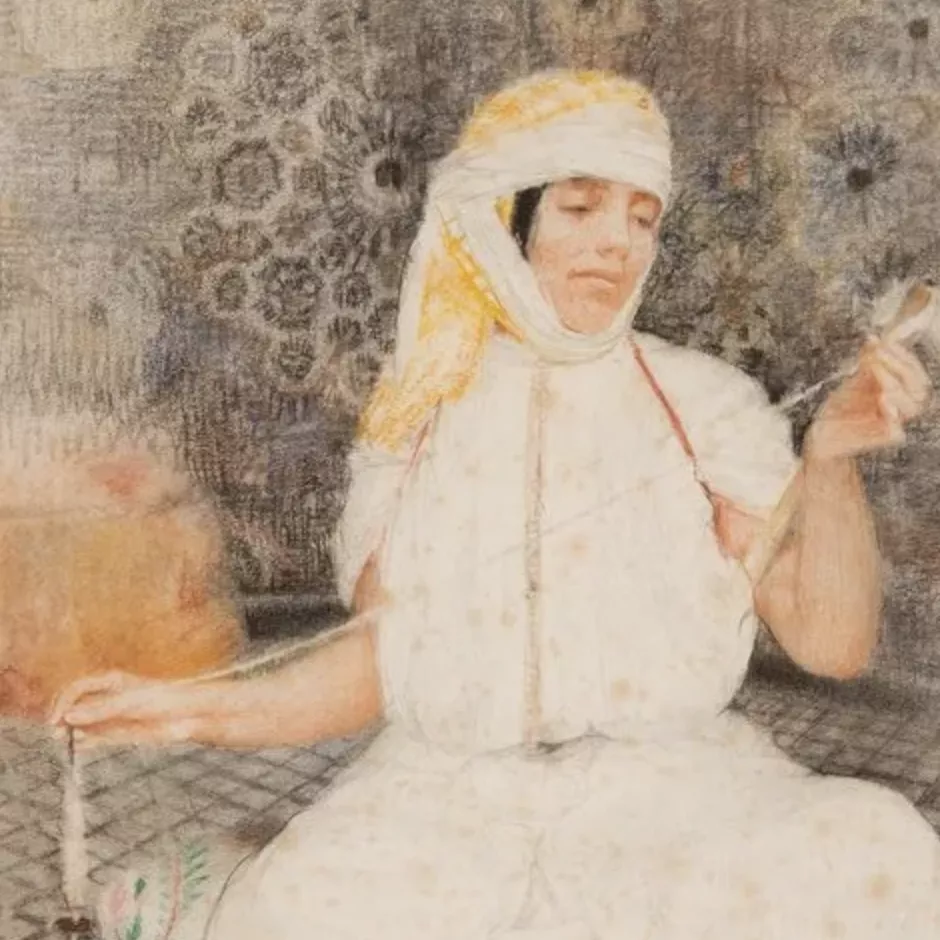
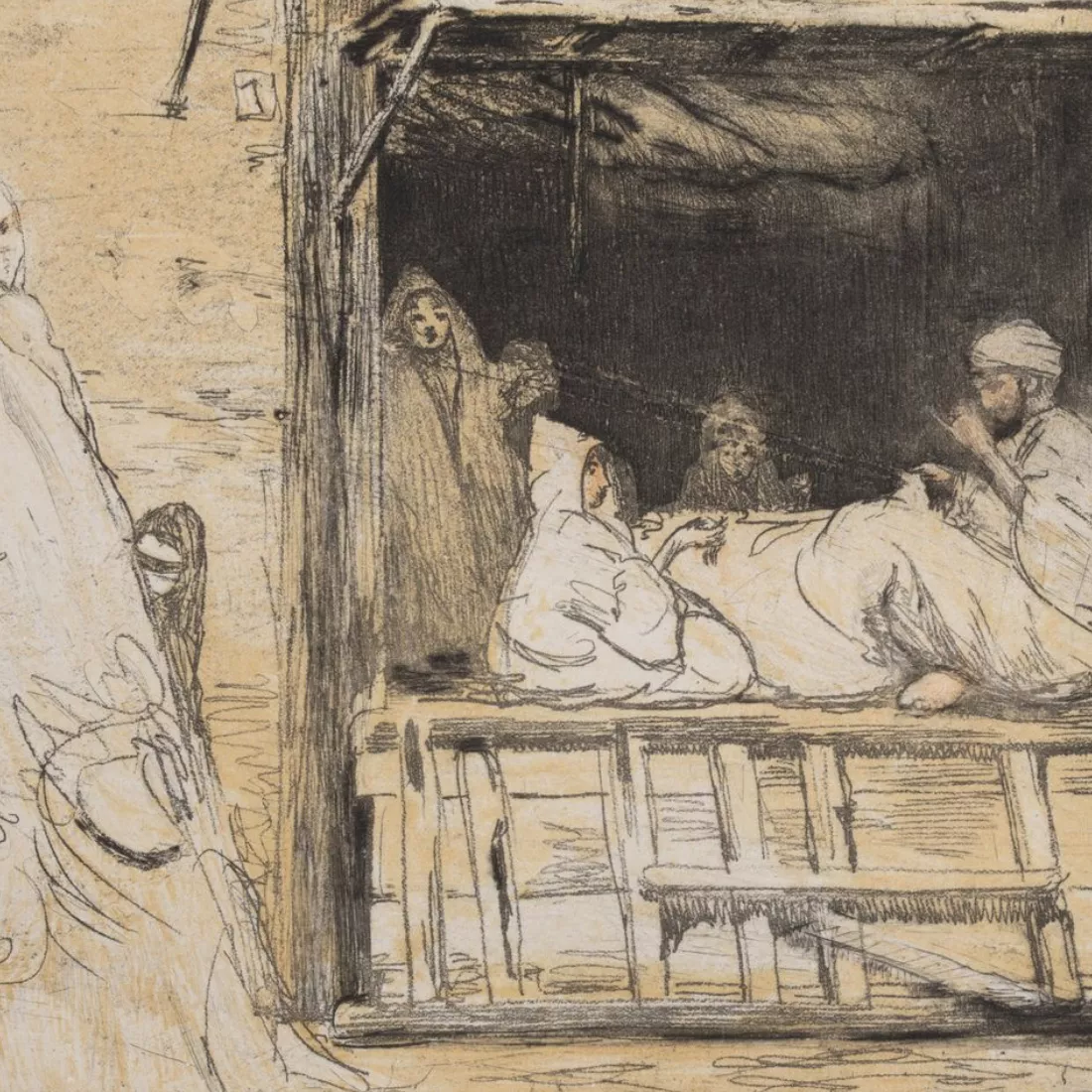
His style is distinguished by great attention to reality, expressions and postures, costumes and light, without falling into excessive exotic imagery.
The artist approaches sensitive ethnographic painting, often focused on genre scenes. Her drawing is firm and descriptive, inherited from her academic training (pupil of Tony Robert-Fleury and Eugène Carrière).
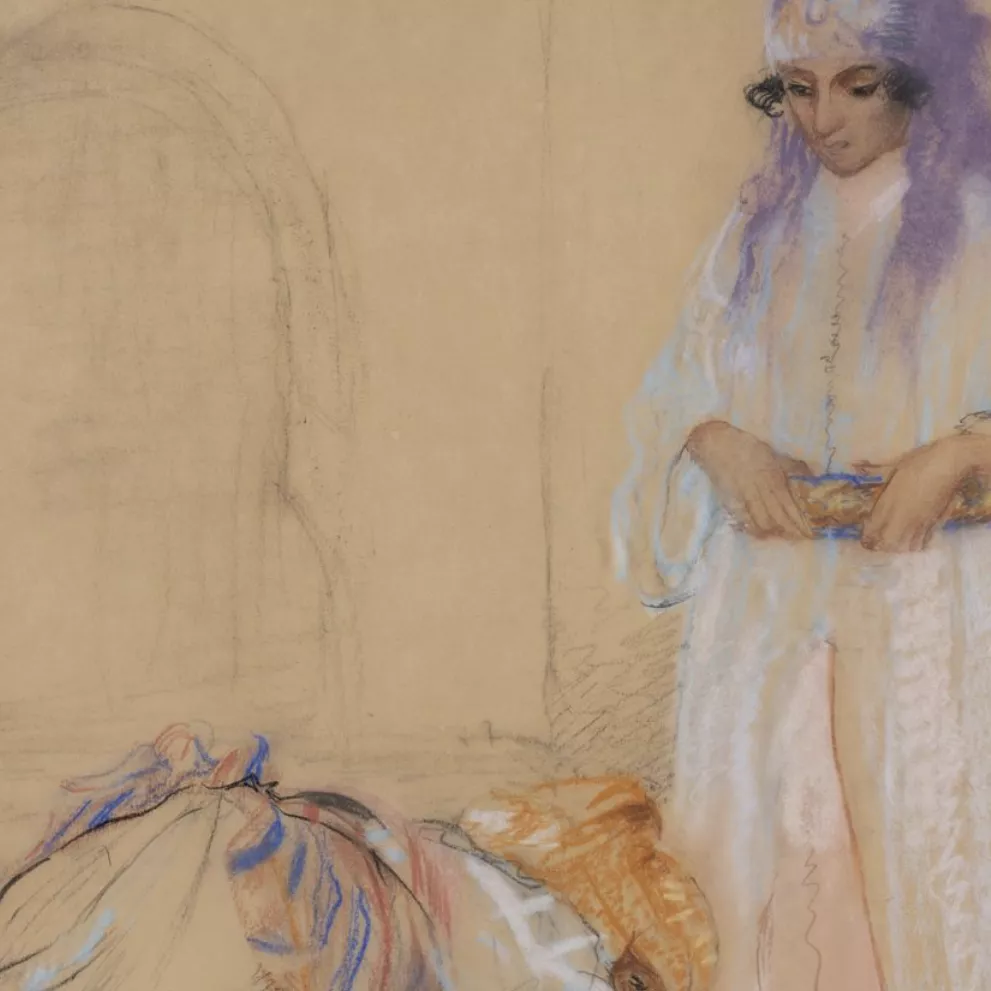
Contours are marked but without harshness, and compositions are often balanced and centered on a figure or group, in legible spaces. She favors a medium to large format, suitable for life scenes or full-length portraits.
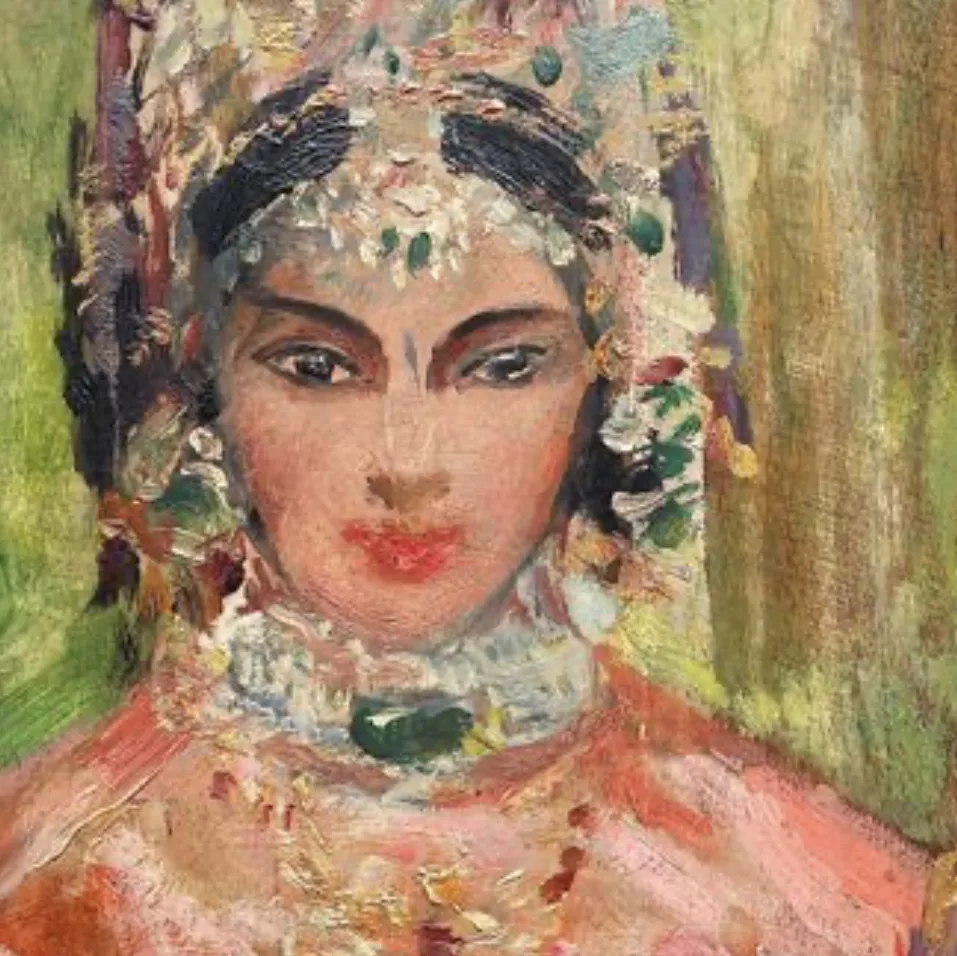
Her paintings are marked by a warm, earthy palette : ochres, burnished reds, muted greens, and deep blues, evoking the natural tones of Maghreb architects, fabrics and skins.
Marguerite Delorme treats light with great accuracy : no spectacular chiaroscuro but a diffuse, solar light that envelops the subject. Color is applied flexibly, in layers superimposed on each other in broad, melting strokes.
Delorme specialized in portraits of women and children, street scenes, markets, domestic life and the Arab-Berber world. The figures she depicts are often calm, dignified, absorbed in a task and never caricatured or decorative.
She depicts ordinary moments such as a young woman weaving, a child at the threshold of a house or an old man sitting in silence.
While Delorme is part of the Orientalist tradition, she also distinguishes herself from it through a sober approach, without fetishizing the picturesque.
Her gaze and tone are respectful, attentive, almost fraternal, giving her canvases a poetic and human quality, more than a colonial one. She also transcribes a form of orientalism of presence, less fantasized and more embodied.
The life of Marguerite Delorme
Marguerite Delorme (1876 - 1946) was a 20th-century French Orientalist artist. She was born in Paris in 1876, into a cultured family. Trained at the Académie Julian, she received rigorous academic instruction, notably from Tony Robert-Fleury and Eugène Carrière.
She was one of the women artists who, at the end of the 19th century, gained access to professional training despite the limitations imposed by official institutions. She began exhibiting in the 1890s, and took part in numerous Parisian Salons, notably the Salon des Artistes Français, where she was regularly rewarded.
She was soon noticed for her genre scenes and portraits, first in France and then in the colonies. Delorme received several medals and public commissions, confirming her institutional recognition in the first decades of the 20th century.
From the 1910s, she traveled to the Maghreb countries (Algeria, Tunisia, Morocco, but also Egypt). Her work from this period focuses on scenes of everyday life, with a sincere attention to the people she meets, especially women and children.
Marguerite Delorme never married, and devoted her entire life to painting. She lived between Paris and North Africa, alternating between exhibitions, residencies and commissioned work.
She is a rare figure of a female Orientalist painter active in the field, and embodies a singular position in a genre dominated by male artists.
The artist continued to exhibit until the end of her life, and died in 1946 in Paris. Her work fell into relative obscurity after the Second World War, like many Orientalist artists.
Marguerite Delorme is being rediscovered today in the context of a renewed interest in women artists and alternative Orientalists. She is recognized for the finesse of her eye and the quality of her technique, even if she is less famous than other orientalists such as Henri Pontoy, Jacques Majorelle or Charles Théodore Frère.
Focus on Jeune Marocaine assise devant la porte, Marguerite Delorme, circa 1925
This medium-format oil on canvas by Marguerite Delorme, circa 1925, depicts a young girl in traditional dress, seated on the floor in front of a white door with carved motifs.
The figure is positioned front-on, legs bent, and hands resting on knees, with a discreet, non-frontal gaze. She is dressed in a colorful cafta, often in shades of blue or brown, and wears a light veil over her hair.
Her attitude is calm, without affectation or anecdote, in a posture of expectation or repose, marked by dignity. The artist's touch is supple, the underlying design rigorously constructed, with a use of colors that are sober and warm (ochre, Sienna, grayish blue and cream).
The soft light aims to create vibrations on the folds of the garment and emphasizes the texture of the stone and wood of the door. There is no complex background, everything is concentrated on the dialogue between the figure, the material of the wall and the projected shadow.
The work avoids any racy orientalism, as there is no theatrical staging, no sensual poses or overly busy décor. The painting captures a moment in life with an affectionate, restrained gaze, typical of Delorme's orientalism of presence.
The motif of the closed door and seated figure evokes an inner world preserved, silent and respected by the artist.
Young Moroccan woman seated in front of the door is one of the most repeated subjects in his exhibitions of the 1920s-1930s, in several variants. It perfectly illustrates Delorme's accurate, human and delicate tone in his North African scenes.
This painting remains a strong example of the possibility of non-exotic, eye-level Orientalism.
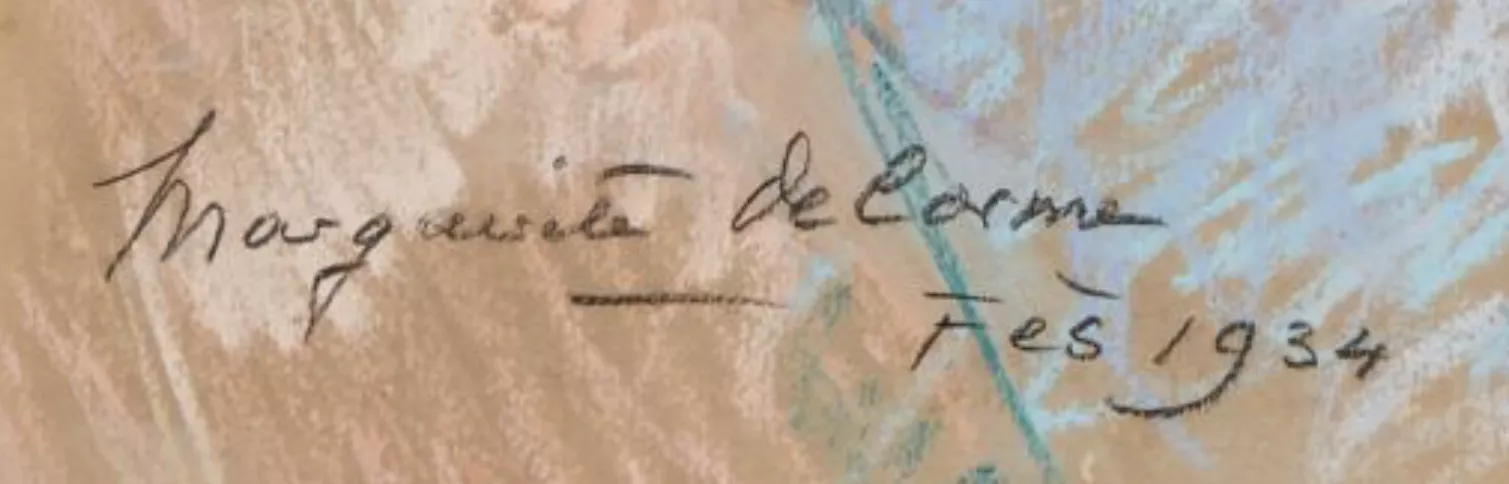
Recognizing Marguerite Delorme's signature
Marguerite Delorme's paintings are often signed at the bottom left of the painting.
Knowing the value of a work
If you happen to own a work by or after Marguerite Delorme, don't hesitate to request a free appraisal using our form on our website.
A member of our team of experts and certified auctioneers will contact you promptly to provide you with an estimate of the market value of your work, as well as ad hoc information about it.
If you are considering selling your work, you will also be accompanied by our specialists in order to benefit from alternatives for selling it at the best possible price, taking into account market inclinations.
Estimate in less than 24h
Discover in the same theme

Value and quotation of works, paintings by Bengt Lindstrom
Bengt Lindstrom, a 20th-century Swedish painter, breathed new life into Nordic painting. His works are listed. Estimated in 24 hours.
Learn more >

Rating and value of works, drawings, paintings by Michel Kik...
Michel Kikoine is an expressionist painter of the Paris School who produced sought-after and valuable drawings and oils on canvas.
Learn more >

Rating and value of paintings and drawings by Léon Bazile Pe...
Léon Bazile Perrault is a French painter of firework art who produced numerous works of high value.
Learn more >
D'autres tableaux orientalistes vendus aux enchères

Estimated 15.000 - 20.000 €
Jacques MAJORELLE (1886-1962) - Fishermen embarking, Abidjan, Ivory Coast - Oil on canvas.

Estimated 40.000 - 80.000
Alexandre ROUBTZOFF (1884-1949), Portrait of Arbia, oil on canvas

Estimated 5.000 - 8.000
Alexandre ROUBTZOFF (1884-1949), The Sidi Makhlouf Mosque, oil on canvas

Estimated 2.000 - 4.000
Henri PONTOY (1888-1968), The Telouet kasbah in the Ounila valley, Oil on canvas

Estimated 1.500 - 2.500
Henri PONTOY (1888-1968) Animated view of a kasbah in the Atlas Mountains

Estimated 3.000 - 4.000
Henri PONTOY (1888-1968), Fantasia at the foot of the Atlas, Oil on canvas

Secure site, anonymity preserved

Auctioneer approved by the State

Free and certified estimates
Frequently asked questions
-
Who is Marguerite Delorme, and what is her artistic background?Marguerite Delorme (1876–1946) was a 20th-century French Orientalist painter who trained at the Académie Julian under academic masters such as Tony Robert-Fleury and Eugène Carrière. She stood out for her understated and humanistic approach to Orientalism, having traveled and painted en plein air in the Maghreb and Egypt, far from European clichés. Rediscovered today for her technical finesse and respectful perspective, she embodies a rare example of a female Orientalist painter active in the field.
-
What is the price range for Marguerite Delorme's works?Prices for Marguerite Delorme’s works on the current market range from €10 to €3,700. Prints and multiples sell for €10 to €450, drawings and watercolors for €180 to €1,600, and paintings for €40 to €3,700. For example, a composition titled *Marrakech, vue de l'Atlas* from 1940 sold for 2,000 € in 2018.
-
How can I have a work by Marguerite Delorme authenticated and appraised?To find out the value of a work by Marguerite Delorme, you can request a free estimate using the form on the Auctie's website. A state-certified expert or auctioneer will contact you shortly to provide an estimate of your work’s market value, with no obligation on your part.
-
What is the current market situation for Marguerite Delorme's works?Prices for Marguerite Delorme’s works are rising at auction. Her paintings and drawings are particularly sought after by French and Moroccan buyers, amid a resurgence of interest in women artists and in an alternative, non-exotic form of Orientalism. Now is therefore the perfect time to sell if you own a work by this artist.
-
How does the sale of a work of art work at Auctie's?Auctie's guides you through the process, from the free appraisal to the auction. After our experts have evaluated your artwork, we will advise you on the best options for selling it at the optimal price, taking into account current market trends in Orientalism and the demand for this artist.
