



Rating and value of paintings and drawings by Charles Théodore Frère

Key takeaways
- Works by Charles Théodore Frère, a 19th-century Orientalist painter, sell for between €40 and €153,700, with stable market values and strong upside potential.
- Oil-on-canvas paintings fetch prices ranging from €90 to €153,700, while drawings and watercolors range from €40 to €24,600.
- His paintings are experiencing a resurgence of interest among French and international collectors, driven by the technical quality and evocative atmosphere of his Oriental scenes.
If you own a work by or after Charles Théodore Frère, and would like to know its value, our state-approved experts and auctioneers will offer you their appraisal services.
Our specialists will carry out a free appraisal of your work, and provide you with an accurate estimate of its value on the current market.
Then, should you wish to sell your work, we will direct you to the best possible arrangement to obtain the optimum price.
Rating and value of the artist Charles Théodore Frère
Charles Théodore Frère leaves behind a body of work that is both realistic and orientalist. From then on, prices for his works rose under the auctioneers' gavels. His paintings are highly prized, especially by French buyers. The price at which they sell on the art market ranges from €40 to €153,700, a very substantial range but one that speaks volumes about the value that can be attributed to the works of Charles Théodore Frère. In 2018, his oil on canvas Grande caravane de la Mecque sold for 150,000€ while it was estimated at between 150,000 and 200,000€. His quotation is stable and his works have strong upside potential.
Order of value from a single work to the most prestigious
Technique used | Result |
|---|---|
Drawing - watercolor | From €40 to €24,600 |
Oil on canvas | From €90 to €153,700 |
Estimate in less than 24h
Style and technique of artist Charles Théodore Frère
Charles Théodore Frère was a painter who belonged both to the realist movement and produced orientalist works (characterized by inspiration from the Orient or the Far East, for him it was mainly Algeria), drawing much inspiration from Delacroix. He produced drawings, oils on canvas, and a few prints that circulate very little on the art market.
Understanding Orientalism in painting
Orientalism in painting is an artistic genre that developed in Europe, mainly in the 19th century, in response to the infatuation with the cultures and landscapes of the Middle East, North Africa, and Asia.
This movement is intimately linked to European colonial expansion and the fascination that artists, writers, and intellectuals of the time harbored for distant and exotic lands.
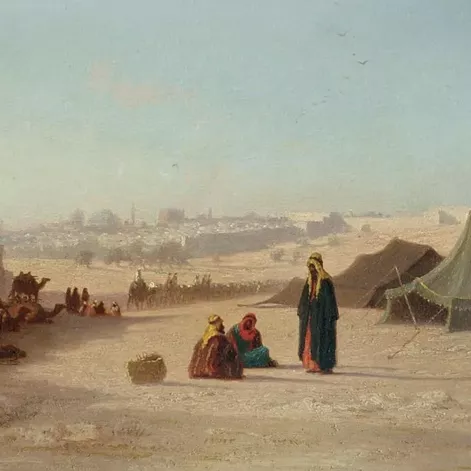
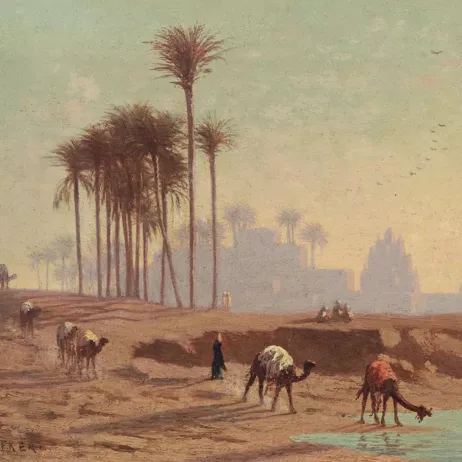
The painting Arab Wedding in Cairo commented
Orientalism in painting is characterized by an idealized, sometimes fantasized, representation of the Orient, resulting in works where themes, colors, and compositions seek to capture a romanticized vision of these regions.
Orientalist artists drew their inspiration from travelogues, literary texts, and tales of crusades that fed the collective European imagination.
Recurring themes included harem scenes, markets, desert landscapes, religious rituals, and portraits of men and women dressed in traditional costumes.
These representations, often made without direct contact with the cultures depicted, contributed to the creation of a stereotyped and homogenized image of the East. This has led to works that, while technically remarkable, convey a Eurocentric and sometimes reductive vision of Eastern societies.
The best-known artists of the Orientalist movement include Jean-Léon Gérôme, Eugène Delacroix, and John Frederick Lewis. Gérôme, for example, was famous for his meticulous, detailed depictions of oriental scenes, which often combined historical and contemporary elements.
His works, such as The Slave Market or The Moorish Bath, are emblematic of orientalism in painting and perfectly illustrate the European obsession with exotic themes.
Eugène Delacroix, meanwhile, was deeply influenced by his trip to Morocco in 1832, which is reflected in works such as Femmes d'Alger dans leur appartement, where he blends bright colors and dynamic composition to evoke the daily life of women in a harem.
Orientalism in painting is not just a celebration of the exotic; it was also a reflection of power relations between the West and the East.
Orientalist representations were often marked by an implicit attitude of superiority on the part of the West, which saw itself as the center of civilization in the face of an East perceived as frozen in time, mysterious and sometimes barbaric. This vision helped justify, in the eyes of many Europeans, colonial domination of these regions.
However, it's important to note that Orientalism in painting was not always uniformly criticized. Some works have been hailed for their aesthetic beauty and technical virtuosity.
In addition, some artists have attempted to represent Oriental cultures with a certain respect and genuine curiosity, even if their works remain marked by the prejudices of their time.
Today, Orientalism is subject to critical reappraisal, particularly through the lens of postcolonial studies. Orientalist works are examined not only for their artistic merit, but also for the way in which they have helped to shape and perpetuate stereotypes about the Orient.
This critique invites a broader reflection on the role of art in the construction of otherness, and on the power dynamics underlying cultural representations.
The success of Orientalist paintings on the auction market
On the art market, Orientalist paintings are enjoying renewed interest from collectors and great success generally among bidders. Artists such as Max Moreau, Émile Deckers, or Alexandre Roubtzoff are experiencing an increase in their quotations.
Beyond the historical appeal that these works may represent, their success can also be explained by technical factors. Indeed, if we consider that Orientalism began at the end of the 18th century, it reached its apogee during the Empire and after.
This attraction for the Orient was reinforced by historical events such as the Egyptian campaign, and the imperial propaganda that followed. Many artists, such as Charles Théodore Frère, sought new inspiration beyond Europe and the Western context.
Once this framework had been established, artists were able to showcase through Orientalism the painting techniques they had mastered through academic canons, working to the maximum of their abilities on light.
The life of Charles Théodore Frère
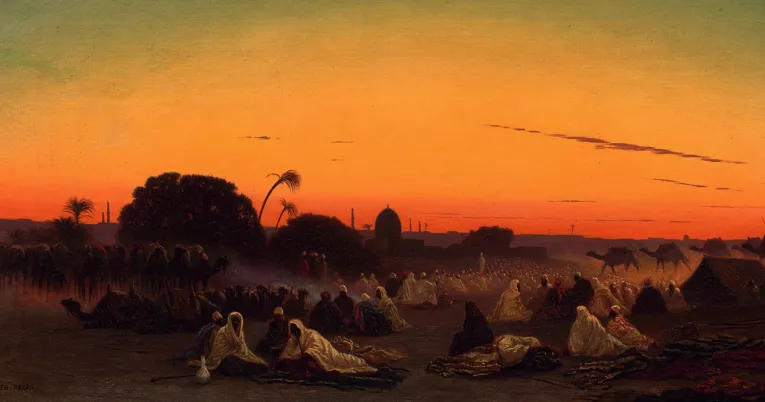
Charles Théodore Frère (1814 - 1888), was a 19th-century French Orientalist painter.
The son of a music publisher, he studied with Jules Coignet.
He traveled first in France and then in North Africa, which led him to orientalist painting. He settled in Algiers and followed the Army's advance to Constantine, drawing inspiration from the conflict in a number of paintings.
He quickly achieved success, painting canvases for the King of Wurtenberg. After Algiers, he chose to work in Cairo, where he was supervised by the King.
From 1869, he traveled alongside Empress Eugénie and Jean-Léon Gérôme for the inauguration of the Suez Canal.
Although little known today, he was admired by great artists such as Claude Monet and Eugène Boudin.
Charles Théodore Frère's imprint on his period
Charles Théodore Frère established himself as a singular figure in the artistic panorama of the 19th century, dedicating most of his work to the representation of the Orient.
His travels to Algeria, Egypt, and other regions of the Middle East profoundly influenced his art, leading him to capture with great precision landscapes, street scenes, and moments of daily life in these distant lands.
Although he does not enjoy the same recognition today as his contemporaries such as Jean-Léon Gérôme or Eugène Delacroix, Frère is enjoying a particular resurgence of interest on the art market.
In fact, his paintings are highly sought after by private collectors, which is reflected in auction results where his works regularly fetch considerable sums.
This success can be explained by the exceptional quality of his work, which blends meticulous attention to detail with an evocative atmosphere, transporting viewers to an Orient that is both realistic and enchanting.
This phenomenon demonstrates that, although less well known to the general public, Charles Théodore Frère has carved out a special place for himself among Orientalist artists, continuing to attract the attention of art lovers the world over.
Recognizing the artist's signature
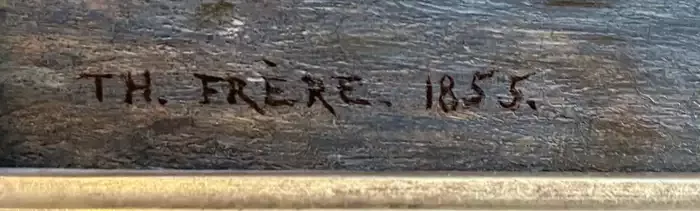
Not all works by Charles Théodore Frère are signed. They may be at the bottom of the painting, but if you think you own one, it's best to have it appraised to be sure of its originality.
Knowing the value of a work
If you happen to own a work by or after Charles Théodore Frère, don't hesitate to request a free appraisal using our form on our website.
A member of our team of experts and chartered auctioneers will contact you promptly to provide you with an estimate of the market value of your work, as well as ad hoc information about it.
If you wish to sell your work, you will also be accompanied by our specialists in order to benefit from alternatives for selling it at the best possible price, taking into account the inclinations of the market.
.Estimate in less than 24h
Discover in the same theme

Rating and value of works, paintings, sculptures by Edgar De...
Edgar Degas was a 19th-century painter, sculptor and draughtsman. His works are highly valued at auction. Estimates in 24h.
Learn more >

Rating and value of sculptures and bronzes by Antonin Mercié
Antonin Mercié is a 19th-century neoclassical sculptor whose works are highly prized at auction.
Learn more >

Rating and value of paintings by Cornelius Krieghoff
Cornelius Krieghoff is a Dutch-Canadian realist painter who has produced works that are highly rated and valued at auction.
Learn more >
Other Orientalist paintings sold at auction

Estimated 18000 € - 20000 €
Paul JOUVE (1878-1973): "Panther on the march

Estimated 15.000 - 20.000 €
Jacques MAJORELLE (1886-1962) - Fishermen embarking, Abidjan, Ivory Coast - Oil on canvas.

Estimated 40.000 - 80.000
Alexandre ROUBTZOFF (1884-1949), Portrait of Arbia, oil on canvas

Estimated 5.000 - 8.000
Alexandre ROUBTZOFF (1884-1949), The Sidi Makhlouf Mosque, oil on canvas

Estimated 3.000 - 5.000
Raphaël DELORME (1885-1962), Le Bain au Harem, oil on isorel

Estimated 20.000 - 30.000
Chaffic ABBOUD (1926-2004) "La visite", Oil on canvas

Secure site, anonymity preserved

Auctioneer approved by the State

Free and certified estimates
Frequently asked questions
-
Who was Charles Théodore Frère, and what was his artistic background?Charles Théodore Frère (1814–1888) was a 19th-century French Orientalist painter and a student of Jules Coignet. He established himself as a major figure in Orientalist painting by traveling to Algeria, Egypt, and the Middle East, accurately capturing the landscapes and daily life of these regions. Admired by Claude Monet and Eugène Boudin, he worked for the King of Württemberg and traveled alongside Empress Eugénie during the opening of the Suez Canal in 1869.
-
What are the prices and price range for works by Charles Théodore Frère?Prices for works by Charles Théodore Frère vary considerably depending on the medium: drawings and watercolors range from €40 to €24,600, while oil paintings on canvas fetch prices ranging from €90 to €153,700. In 2018, his oil on canvas “Grande caravane de la Mecque” sold for €150,000, close to its high estimate of €200,000. His market value remains stable with strong upside potential.
-
How can you authenticate a work by Charles Théodore Frère?To authenticate a work by Charles Théodore Frère, we recommend that you request a free appraisal from Auctie's using our online form. A state-certified expert or auctioneer will examine your artwork and provide you with an accurate estimate, along with comprehensive information on its authenticity and provenance. You will receive a response within 48 hours, with no obligation on your part.
-
Is this the right time to sell a work by Charles Théodore Frère?Yes, this is an excellent time to sell a work by Charles Théodore Frère. His paintings are experiencing a resurgence of interest in the art market and are highly sought after by private collectors, particularly French buyers. His market value is stable with prospects for growth, reflecting the growing success of the Orientalist movement at auction.
-
How does the appraisal and sale of a work of art take place at Auctie's?Appraisals at Auctie's are free and non-binding: fill out our online form, and an expert will contact you shortly to appraise your artwork. If you’d like to sell it, our specialists will then guide you every step of the way—from appraisal to auction—offering you the best options to achieve the highest possible price based on current market trends.
