



Rating and value of Russian paintings and drawings by Franz Roubaud

Key takeaways
- Franz Roubaud (1856–1928), a Russian battle painter, sees his signed works fetch tens of thousands of euros at auction, with stable market values.
- Oil-on-canvas paintings sell for between €200 and €306,500, while watercolor drawings range from €80 to €83,920, such as “"Oriental Horse Market," which sold for €200,000 in 2021.
- A specialist in military painting trained in Munich, Roubaud produced only drawings and oil paintings on canvas; no prints or lithographs have ever appeared on the auction market.
If you own a work by artist Franz Roubaud or based on his work and would like to know its value, our state-approved experts and auctioneers will guide you.
Our specialists will carry out a free appraisal of your work, and provide you with a precise estimate of its value on today's market.
Then, if you wish to sell your work, we will direct you to the best possible arrangement to obtain the optimum price.
Artist's rating and value
A major painter of the armies associated with the Russian wars and battles of the early 20th century, Franz Roubaud established himself as a major artist of his time. A French painter born in the Russian Empire, he produced mainly battle scenes associated with the great conflicts of his time.
On the art market, his works sell for very good prices and keep a stable quotation. For example, a work signed by the artist's hand can fetch tens of thousands of euros at auction, as evidenced by his oil on canvas Marché aux chevaux oriental, which fetched €200,000 in 2021, whereas it was estimated at between €60,000 and €100,000.
Order of value from the most basic to the most prestigious
Technique used | Result |
|---|---|
Drawing - watercolor | From €80 to €83,920 |
Oil on canvas | From €200 to €306,500 |
Estimate in less than 24h
The artist's work and style
Roubaud has created a powerful iconography that has done much to anchor the Russian battles of the early 20th century in the collective imagination.
His work has helped to popularize and visually convey history, enabling a wide audience to become familiar with the events and characters of the Russian imperial era.
He produced drawings and oil on canvas, no prints or lithographs have so far circulated on the auction market. He has, however, remained just as famous for his watercolor talents.
The life of Franz Roubaud
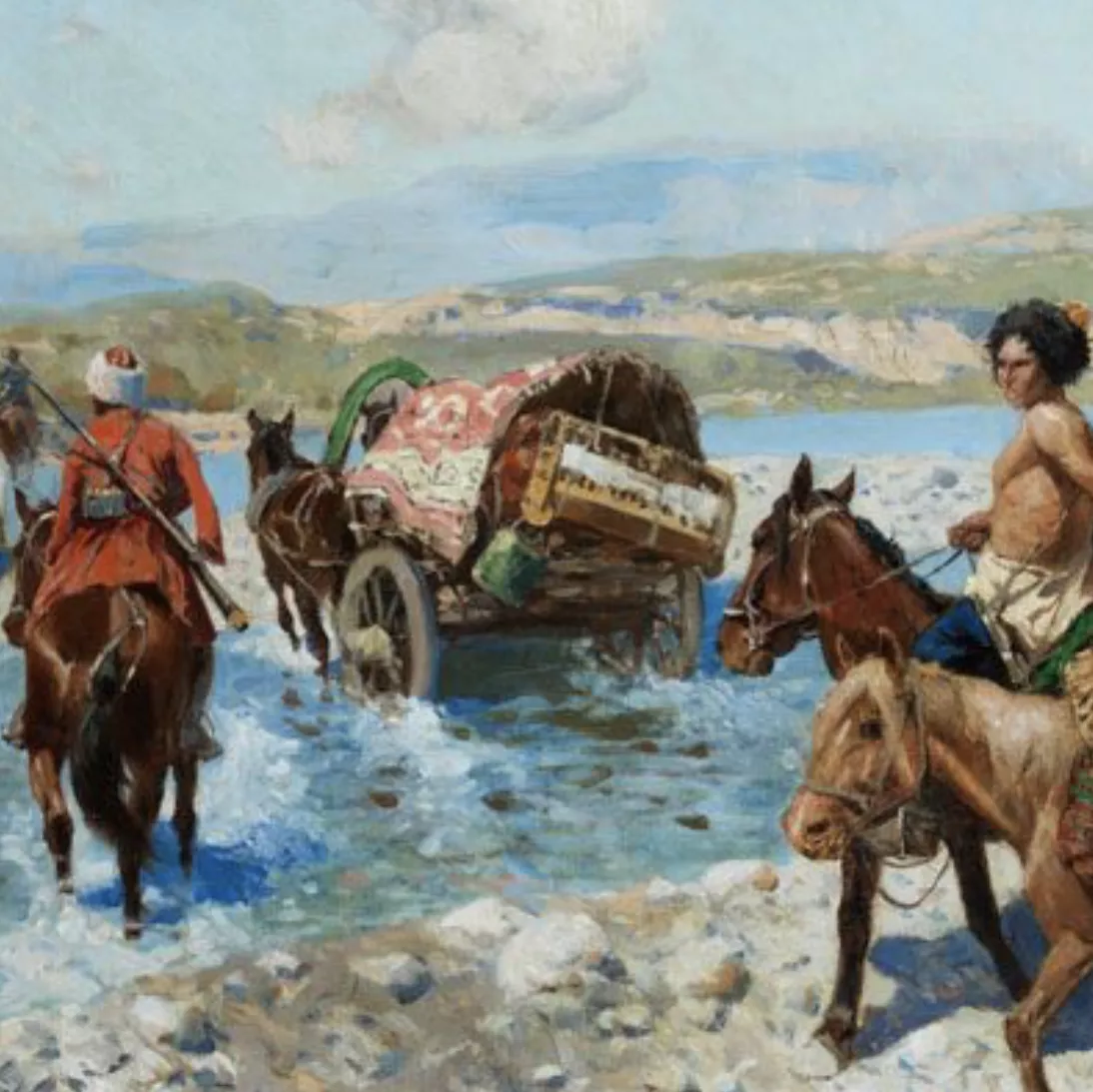
Franz Alexeïevitch Roubaud (1856-1928) was a French-born Russian and German painter who produced numerous paintings depicting battle scenes of the Russian Empire, as well as some orientalist works that are equally sought-after.
Originating from a bookseller father and a seamstress mother, both French, he was born in the Russian Empire in Odessa, his parents having moved there to work. Roubaud attended the city's art school. In 1877, he left for Germany, where he studied at the Munich Academy of Fine Arts.
It was there, thanks to one of his teachers, that he specialized in military painting, a genre he maintained throughout his career. He then chose to return to his native St. Petersburg, where he obtained a position at the Imperial Academy of Fine Arts.
There he received panoramic commissions to depict historical battles, which were to make him successful and famous. In 1889, he was ennobled by the Russian Empire, enabling him to receive commissions from Emperors Alexander III and Nicholas II.
He exhibited at the Great Berlin Art Exhibition in 1895, where he won a gold medal. At the St. Petersburg Academy, he became a permanent professor between 1903 and 1912. After this date, he relocated to Munich, where he finished his career.
Like other Russian artists, including Mikhaïl Guermatcheff, Ivan Aïvazovsky or Constantin Makovskij, he is not very famous in France but does however attract many collectors every year.
Understanding the scope of your production
War painting in Russia
In the late 19th and early 20th centuries, painting of war and battle scenes in Russia was distinguished by a rich and diverse output, marked by the work of many artists who were highly rated and important on the art market.
These paintings, often grandiose and impressive in both size and craftsmanship, offer a unique perspective on the conflicts that shaped the history of the Russian Empire and the wars of the early 20th century, while reflecting the national aspirations and artistic sensibilities of the time.
Franz Alexeyevich Roubaud, for example, is one of the most emblematic painters of this period. Trained by a specialist at the Munich Academy of Fine Arts, he quickly turned to military painting. His works, including the Panorama of the Battle of Borodino, have become essential references for Russian military painting.
These panoramas allow viewers to be plunged into the heart of historical events, thanks to a circular composition that surrounds the observer. Roubaud's attention to detail, historical accuracy and technical mastery lend his works an authenticity and depth that leave no one indifferent.
Other Russian painters of the same period, such as Vasily Vereshchagin and Nikolai Samokish, also made their contribution to the art of war. Vereshchagin, in particular, is known for his uncompromising depictions of the horrors of war, depicting the violence and massacres of that era.
His paintings, often marked by great emotional intensity, illustrate the suffering of soldiers and the tragic consequences of battle. Far from glorifying conflict, Vereshchagin takes a more critical approach, denouncing the violence and absurdity of war through realistic, poignant scenes.
Nikolai Samokish, meanwhile, specializes in equestrian scenes and cavalry charges. His talent lies in his ability to capture the movement and energy of battles, offering dynamic, vibrant compositions. Samokish's paintings are highly regarded for their realism and sense of detail, particularly in the rendering of horses and military uniforms.
These battle works, although often commissioned to celebrate the Empire's military victories, do more than simply glorify war. They also offer a more nuanced reflection on the complexity of conflict.
Artists manage to illustrate not only the courage and heroism of soldiers, but also the suffering, loss and chaos inherent in each battle. Thus, beyond their historical value, these paintings are also important testimonies to military events and the reality of war.
The aesthetics and composition of these works are also essential elements in their appreciation. The way the artists work and manage to juxtapose colors, light and shadows on the same plane, or the balance of proportions and perspective, contribute to the visual power of each painting.
For example, the skilful use of light to accentuate the dramatic tension or oppressive atmosphere of a battle scene is a feature often noted in works from this period.
Finally, the technique employed and the state of preservation of the paintings play a crucial role in their assessment. The specific techniques used by these artists, such as oil on canvas or impasto, influence not only the visual appearance of the work, but also its longevity. A well-preserved period frame or quality restorations can also add to a painting's value.
In sum, paintings of Russian battle scenes in the late 19th and early 20th centuries are not just visual representations of historical conflicts; they are works of art in their own right, imbued with sensitivity and depth. They capture the emotions, tensions and complex realities of war, while contributing to Russia's art history and cultural heritage.
Focus on an Orientalist painting by Franz Roubaud
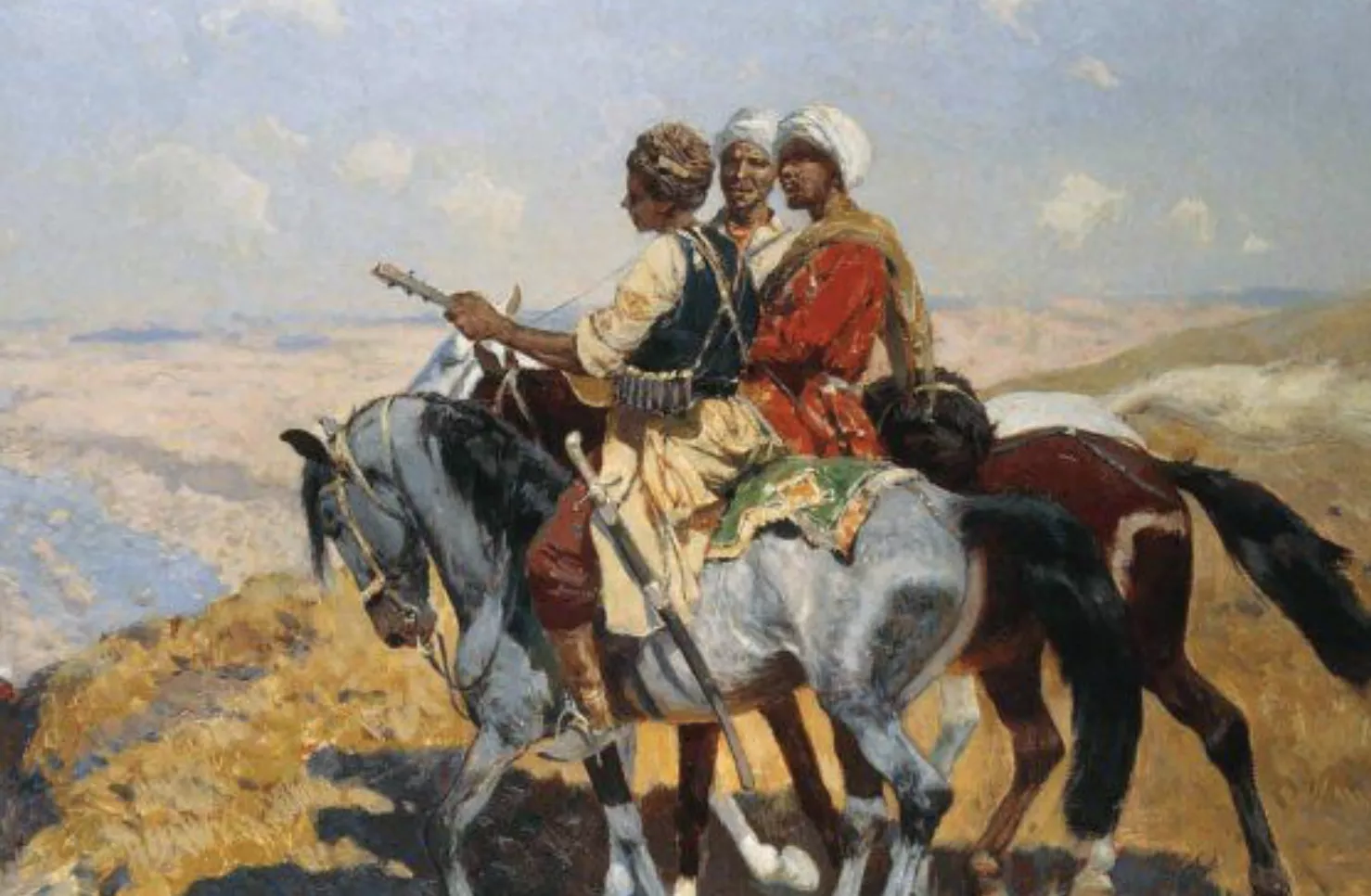
Franz Roubaud, usually known for his large battle scenes, here shows us another facet of his talent with this quieter, more intimate painting.
It shows a rider, dressed in warm colors, close to his horse, in a setting that evokes the Orient with typical architecture in the background.
The painter captures a moment of calm, far removed from the clashes and turmoil of the wars he so often depicted.
Here, the focus is on details: the carefully knotted turban, the folds of the garment, and the golden desert light that enhances the scene. The horse, a faithful companion, is depicted with the same meticulousness, conveying the close bond between man and animal.
The arch in the background adds a touch of mystery, evoking distant lands and ancient stories. Everything in this painting exudes serenity and harmony, each element in its place to create a peaceful, balanced scene.
With this work, Roubaud shows that he is not only the painter of great battles, but also of simple moments and everyday scenes, where mood and detail count as much as action.
The artist's imprint on his era
Franz Roubaud marked his era through his impact on the propaganda of the imperial regime. He helped to forge the Russian imperial legend alongside other military painters producing under the Empire.
Today, some of his works are exhibited in many museums in Russia and Europe, but private collectors play a big role in preserving his work.
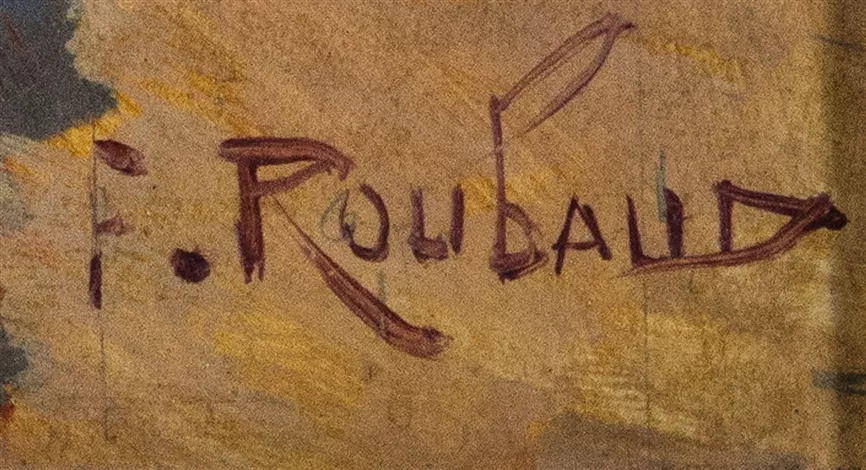
His signature
Not all Franz Roubaud's works are signed.
Although there are variations, here is a first example of his signature:
Expertise your property
If you own a work by Franz Roubaud, don't hesitate to request a free appraisal by filling in our online form.
A member of our team of experts and certified auctioneers will contact you to provide an estimate of the market value of your work.
If you are considering selling your work, our specialists will also guide you through the various alternatives available to obtain the best possible price, taking into account market trends and the specific features of each work.
Estimate in less than 24h
Discover in the same theme

Rating and value of works, drawings, paintings by Étienne Bo...
Étienne Bohot was a 19th-century painter influenced by Romanticism, who produced drawings and oils on canvas that are highly prized at auction.
Learn more >

Rating and value of sculptures and bronzes by Pierre-Nicolas...
Pierre-Nicolas Tourgueneff was a French sculptor specializing in military scenes, who produced many highly-rated works.
Learn more >

Rating and value of paintings by Marie-Dominique Siciliano
Marie-Dominique Siciliano is an Orientalist painter who worked in Marseille; while his market value is still relatively low, his work is available on...
Learn more >
Other Russian paintings sold at auction

Estimated 3000-5000€
Alexandre Roubtzoff, Gammarth (small format)

Estimated Between €800 and €1,500
Alexandre ROUBTZOFF (1884-1949), View of Notre Dame de Paris, oil on canvas

Estimated Between €5,000 and €8,000
KRACHKOWSKY (1854-1914), Before the storm, oil on canvas

Estimated 40.000 - 80.000
Alexandre ROUBTZOFF (1884-1949), Portrait of Arbia, oil on canvas

Estimated 20.000 - 30.000
Alexandre ROUBTZOFF (1884-1949), Portrait of Marie-Madeleine Leroy, oil on canvas

Estimated 5.000 - 8.000
Alexandre ROUBTZOFF (1884-1949), The Sidi Makhlouf Mosque, oil on canvas

Secure site, anonymity preserved

Auctioneer approved by the State

Free and certified estimates
Frequently asked questions
-
Who is Franz Roubaud, and what is his historical context?Franz Roubaud (1856–1928) was a painter of Russian, German, and French descent who established himself as one of the greatest military painters of his time. Trained at the Academy of Fine Arts in Munich, he specialized in battle scenes from the Russian Empire and Orientalist works. Ennobled by the Empire in 1889, he received commissions from Emperors Alexander III and Nicholas II, and exhibited his works in Europe’s greatest museums, notably the Panorama of the Battle of Borodino.
-
What are the auction estimates and values of Franz Roubaud's paintings?Roubaud’s works maintain stable values and sell for very good prices on the art market. His drawings and watercolors are estimated at between €80 and €83,920, while his oil-on-canvas paintings fetch prices ranging from €200 to €306,500. For example, his oil on canvas “Oriental Horse Market” sold for €200,000 in 2021, exceeding its initial estimate of €60,000 to €100,000.
-
How can you authenticate a work by Franz Roubaud?To authenticate a work by Franz Roubaud, we recommend that you request a free appraisal from our state-certified auctioneers and experts. You can request an appraisal online using our form, and a specialist will contact you to evaluate your artwork and provide you with an accurate estimate of its market value, with no obligation.
-
Is this the right time to sell a work by Franz Roubaud?Yes, this is an excellent time to sell a work by Roubaud. The artist’s market value remains stable, and his paintings continue to be in high demand among collectors, particularly his battle scenes and Orientalist works. Although not widely known in France, Roubaud attracts many collectors each year, and his paintings of Russian battles enjoy sustained interest from the international market.
-
How does the appraisal and sale of a work of art take place at Auctie's?Appraisals at Auctie's are free and non-binding: simply fill out an online form, and a certified expert or auctioneer will contact you to evaluate your artwork and provide you with an accurate estimate. If you’d like to sell, our specialists will guide you through the various options available and support you through the auction process to secure the best possible price, taking market trends into account.
