



Ratings and values of sculptures, bronzes and marbles by Égide Rombaux

Key takeaways
- Sculptures by Rombaux (1865–1942), a Belgian Symbolist and Art Nouveau sculptor, sell for between €310 and €69,000, depending on the technique and size.
- Marble represents the high-end segment (€1,300 to €60,000), while bronze—the dominant medium—ranges from €310 to €52,000 and enjoys excellent liquidity.
- The most highly valued works feature a legible signature, an original patina, a medium-to-large size (40–80 cm), and Symbolist attributes.
If you own a work by or after the artist Égide Rombaux, and would like to know its value, our state-approved experts and auctioneers will offer you their appraisal services.
Our specialists will carry out a free appraisal of your work, and provide you with an accurate estimate of its value on the current market.
Then, should you wish to sell your work, we'll direct you to the best possible arrangement to obtain the optimum price.
Rating and value of the artist Égide Rombaux
Égide Rombeaux is a Belgian sculptor associated with the transition between Symbolism, Art Nouveau and Art Deco. At present, prices for his works are exploding under auctioneers' hammers.
His sculptures are particularly prized above all by French buyers, and the price at which they sell on the art market ranges from €310 to €69,000, a considerable delta but one that speaks volumes about the value that can be attributed to Rombaux's works.
An ivory and bronze statue, Jeune femme, dating from 1900, sold for €69,000 while it was estimated at €20,000 to €25,000. The artist's quotation is high and varies according to the quantity of works present on the auction market.
Order of value ranging from a single work to the most prestigious
Technique used | Result |
|---|---|
Baked clay | From 550 to 21 500€ |
Bronze | From €310 to €52,000 |
Marble | From €1,300 to €60,000 |
Estimate in less than 24h
Style and technique of the artist Égide Rombaux
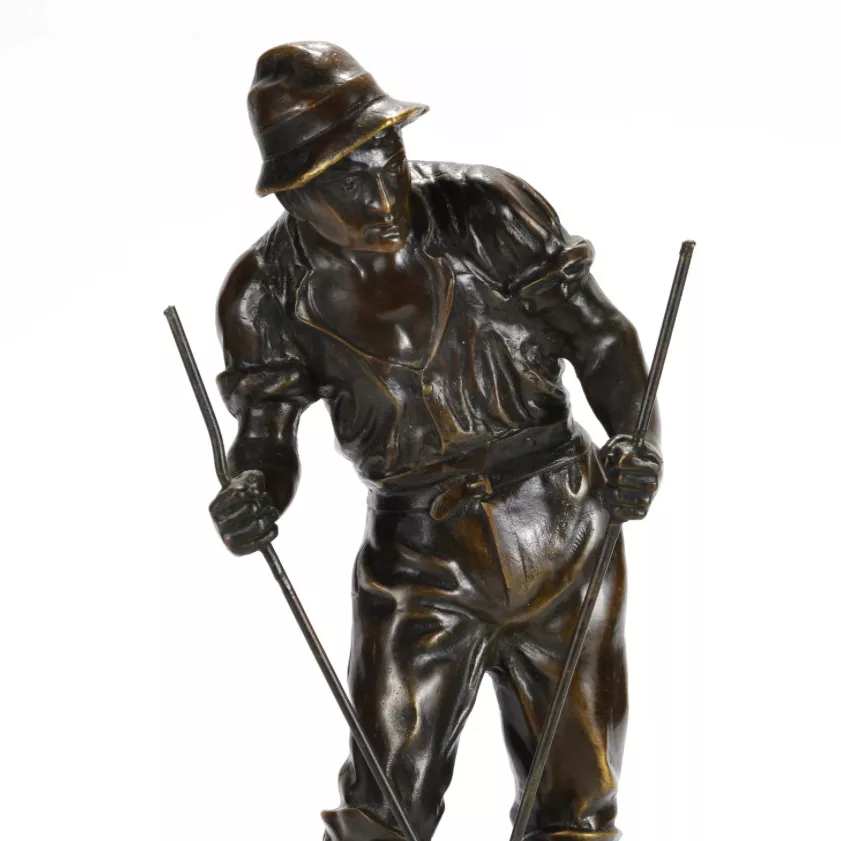
Égide Rombaux (1865 - 1942) was a Belgian sculptor associated with the transition between Symbolism, Art Nouveau and Art Deco. His work reveals a search for harmony between controlled naturalism and decorative stylization.
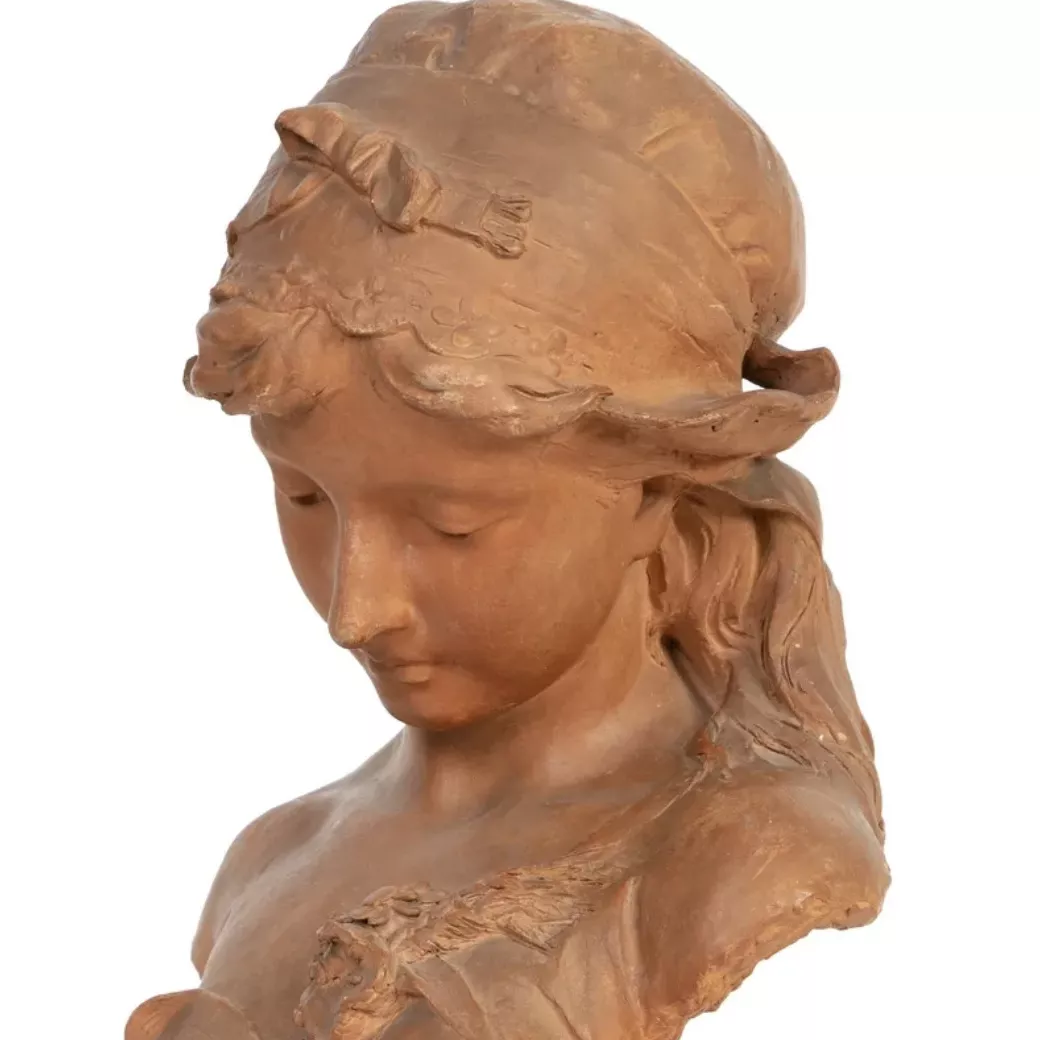
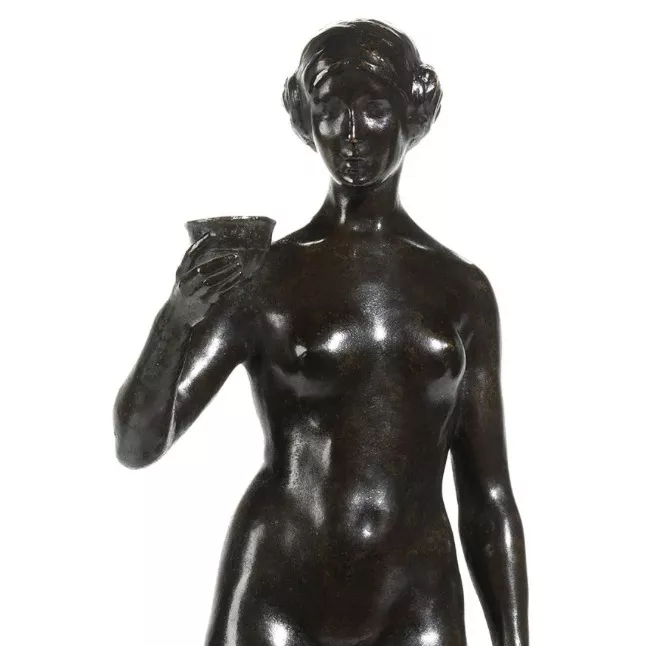
He places great importance on the female figure, undulating movement and the poetic dimension. The figures are slender, the silhouettes fairly vertical, and the attitudes slightly inclined.
The draperies are fluid, often treated in long, sinewy lines, reminiscent of Art Nouveau language. Mythological, allegorical or nature-related themes (nymphs, dancers, muses) are frequent.
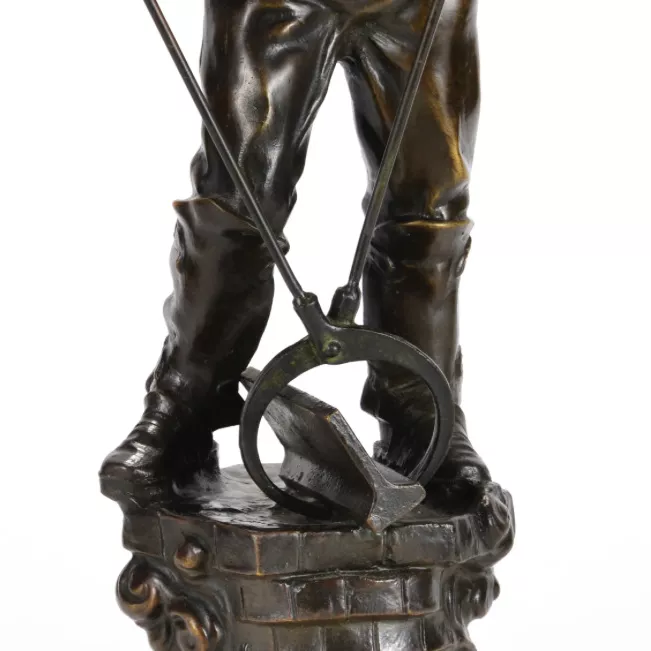
He uses a variety of materials, including marble, bronze and sometimes ivory for smaller pieces. For marble, the surface is finely polished, creating a tactile softness. The patinas are nuanced for bronzes (dark brown, greenish brown, and sometimes a slightly reddish patina).
The modeling is supple and continuous, without breaks, favoring full volumes. Rombaux doses the musculature with subtlety, and a legible but never ostentatious anatomy. He emphasizes the gradual transition between planes (face, neck, shoulders, hips).
His body of work shows a preference for vertical composition, with the figure rising like a living column. He uses a relatively unobtrusive base, to accentuate the body's presence. The sculptures are conceived as elegant silhouettes in space, sometimes with a slight wiggle that creates an internal rhythm.
He is also influenced by symbolism, objects and accessories are integrated into his sculptures to reinforce the dreamlike character (flowers, allegorical attributes, floating fabrics) ; but also Art Nouveau with undulating lines, continuous curves and the fusion of body and movement.
Rombaux moves away from strict academic realism, opting instead for a harmonious stylization of gentle abstraction. The sculpture aims less at exact representation than at the expression of a sensation.
The life of Égide Rombaux
Égide Rombaux (1865 - 1942) was born in Brussels. He came from a craft background conducive to the practice of decorative arts. The artist trained at the Royal Academy of Fine Arts in Brussels, where he studied sculpture in both an academic and symbolist tradition.
He was a pupil of several sculptors active in the Belgian stylistic renewal of the late 19th century, and was quickly noticed at national exhibitions and Belgian salons for the quality of his modeling and the poetic sensitivity of his subjects.
He was awarded several prizes and scholarships that enabled him to perfect his technique, notably during study stays abroad. His first public recognition is linked to his female and allegorical figures, characteristic of Belgian Symbolist sculpture.
He becomes one of the major figures of sculpture in Belgium in the Art Nouveau / Art Deco transition, and practices both public commissions (statues, memorials) and salon sculpture (bronzes, marbles, plasters).
His reputation is built on his ability to combine sober naturalism, elegant stylization and a sense of undulating movement. He regularly worked on religious, funerary and decorative commissions.
He is a professor at the Académie des Beaux-Arts in Brussels, where he passes on his sense of modelling and modernized classicism. He is an authority on juries and official Belgian exhibitions. He played a part in structuring a Belgian sculptural identity at the turn of the 20th century, between symbolism and modernity.
His works from around 1900 - 1930 show an advanced mastery of vertical composition and fluid drapery, and developed an immediately recognizable sculptural vocabulary with slender silhouettes, idealized faces and curved lines.
His large-scale marbles and bronzes confirmed his position as a major sculptor of his time in Belgium. He continued to produce well into the last years of his life, although the artistic context was changing with the rise of the avant-garde.
He died in 1942, leaving an important body of work preserved in various Belgian museums and public collections.
His works are exhibited at the Royal Museum of Fine Arts of Belgium and in various regional museums. Today, his work is considered one of the most refined testimonies of Belgian sculpture between Symbolism and Art Nouveau.
It is an essential reference for the study of the stylistic transition between the end of the 19th century and the first decades of the 20th century in European sculpture.
.Market segmentation and artist's rating
Sculptures in bronze dominate the artist's market, but there are also marble sculptures (a high-end and rare segment), and studio plaster casts which constitute the entry segment with a moderate valuation.
Small statuettes (less than 40 cm) are accessible with high liquidity. Medium-sized statuettes (40 - 80 cm) form the core of the market, and are sought-after for the quality of their modeling. Large compositions (over 80 cm) or monuments are highly rare and belong to a specialized market.
He works with allegorical female figures, nymphs, dancers and symbolist compositions, and Art Nouveau pieces with undulating drapery or sinuous poses (Agathon Léonard, Édouard Marcel Sandoz, Camille Alaphilippe). Valuation criteria are the legible signature " E. Rombaux ", the mention of the founder, the preserved antique patina.
Other factors such as museum provenance or historical Belgian collection, as well as the larger format and the presence of symbolist attributes (lyre, flowers, drapery) are also likely to come into play.
Sales take place predominantly in Belgium and France, but there is additional interest in the Dutch, German and British markets for Symbolist sculpture.
Egide Rombaux's listing is established but moderate, with a clear structure. Medium bronze is the safest and most liquid segment. Marble is at the top of the market, rare and sought-after.
The market is also particularly sensitive to the quality of the drapery, the poetic presence of the figure and the original patina. Prices remain attractive compared to contemporary French sculptors of the same movement, which may represent an opportunity for a specialized collector.
Recognizing Égide Rombaux's signature
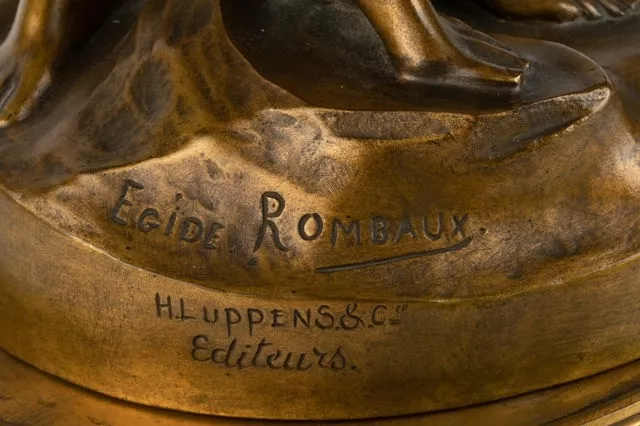
Égide Rombaux signs his works most of the time. If you think you own one, it's best to have it appraised. Some sculptures bear the signature " E. Rombaux " with the founder's stamp. There are also copies, which is why expertise is important.
Knowing the value of a work
If you happen to own a work by Égide Rombaux or after the artist, don't hesitate to request a free appraisal using our form on our website.
A member of our team of experts and chartered auctioneers will contact you promptly to provide you with an estimate of the market value of your work, as well as ad hoc information about it.
If you are considering selling your work, you will also be accompanied by our specialists in order to benefit from alternatives for selling it at the best possible price, taking into account market inclinations.
Estimate in less than 24h
Discover in the same theme

Value and quotation of works by Jean Léon Gérôme : paintings...
Jean Léon Gérôme, a 19th-century painter and sculptor, is one of the most renowned artists of the Second Empire. His works are highly prized.
Learn more >

Rating and value of paintings by Alphonse Osbert
Alphonse Osbert was a 19th-century Symbolist painter who produced paintings that are highly valued at auction.
Learn more >

Rating and value of paintings by Maxime Maufra
Maxime Maufra was a French post-Impressionist marine painter who produced many works of great value.
Learn more >
D'autres bronzes anciens vendus aux enchères

Estimated Between €5,000 and €8,000
Agathon LEONARD (1841-1923), Dancer with scarf, bronze lamp, ed. Susse frères

Estimated 3.000 - 5.000
Raoul LARCHE (1860-1912) The fisherman, Bronze with green patina

Estimated 600 - 800
Hercules Farnese, bronze, reproduction after Glycon of Athens

Estimated 1.500 - 3.000
Jules FRANCESCHI (1825-1893) Hébé et l'aigle de Jupiter, gilded bronze

Estimated 800 - 1.500
Henry Étienne DUMAIGE (1830-1888), bronze print

Estimated 1.500 - 3.000
Antoine Louis BARYE (1796-1875) Eagle and heron, bronze print with shaded brown-green patina

Secure site, anonymity preserved

Auctioneer approved by the State

Free and certified estimates
Frequently asked questions
-
Who is Égide Rombaux, and what is his artistic background?Égide Rombaux (1865–1942) was a leading Belgian sculptor active during the transition from Symbolism to Art Nouveau and Art Deco. Trained at the Royal Academy of Fine Arts in Brussels, he is known for his slender female figures, his mastery of fluid drapery, and his incorporation of allegorical elements. He taught in Brussels and remains a key figure in Belgian sculpture at the turn of the 20th century.
-
What are the price ranges for Rombaux sculptures based on the technique used?Rombaux's sculptures sell for between €310 and €69,000, depending on the technique and size. Terracotta works range from €550 to €21,500, bronzes from €310 to €52,000, and marble sculptures (high-end segment) from €1,300 to €60,000. These price variations depend on the size, the signature, the original patina, and the provenance of the work.
-
How do you have a Rombaux sculpture appraised and authenticated?You can request a free, no-obligation appraisal from Auctie's by filling out the form on our website. A certified expert or auctioneer will examine your piece, verify the “E. Rombaux” signature, check for the foundry’s stamp, and confirm its authenticity. You’ll receive an accurate estimate of its market value within 48 hours.
-
Is this the right time to sell a sculpture by Rombaux?Yes, this is a good time to sell. Rombaux’s market values are well-established and stable, with strong demand from French and Belgian collectors. The market is showing growing interest in Symbolist and Art Nouveau sculpture, and his prices remain attractive compared to those of contemporary French sculptors working in the same style.
-
How does the process of selling a sculpture through Auctie's work?Auctie's supports you every step of the way: from requesting a free estimate to receiving a detailed appraisal by a certified auctioneer, and then organizing the auction. Our specialists advise you on the best strategies for achieving the highest possible price, taking into account market trends and the nature of your artwork.
