



Value and quotation of works, paintings by Henri Pontoy

Key takeaways
- Henri Pontoy (1888–1968), a leading figure in 20th-century Orientalism, created works that are particularly prized by French and Moroccan collectors.
- His paintings, mostly oil-on-canvas works, sell for between €20 and €120,000, with a composition of Fez selling for €70,000 in 2020.
- The artist masterfully uses light and warm colors to capture daily life in North Africa and sub-Saharan Africa, distinguishing himself through his authentic approach to Orientalism.
If you own a work by or after the artist Henri Pontoy, and would like to know its value, our state-approved experts and auctioneers will offer you their appraisal services.
Our specialists will carry out a free appraisal of your work, and provide you with a precise estimate of its value on the current market.
Then, if you wish to sell your work, we will direct you to the best possible arrangement to obtain the optimum price.
Rating and value of the artist Henri Pontoy
Considered one of the protagonists of Orientalism in the 20th century, Henri Pontoy leaves behind a unique artistic repertoire imbued with the colonialist artistic spirit.
This legacy consists of paintings that are predominantly oils on canvas. At present, the prices of his works are flying off the auctioneers' hammers.
His paintings and other works are particularly prized, especially by French and Moroccan buyers, and the price at which they sell on the art market ranges from €20 to €120,000, a considerable delta but one that speaks volumes about the value that can be attributed to Henri Pontoy's works.
In 2020, a polychrome composition depicting Fez dating from 1937 sold for 70,000€.
Order of value from a simple work to the most prestigious
Technique | Estimation |
|---|---|
Drawing - watercolor | From 20 to 16 270€ |
Estamp | From 40 to €1,100 |
Oil on canvas | €250 to €120,000 |
Estimate in less than 24h
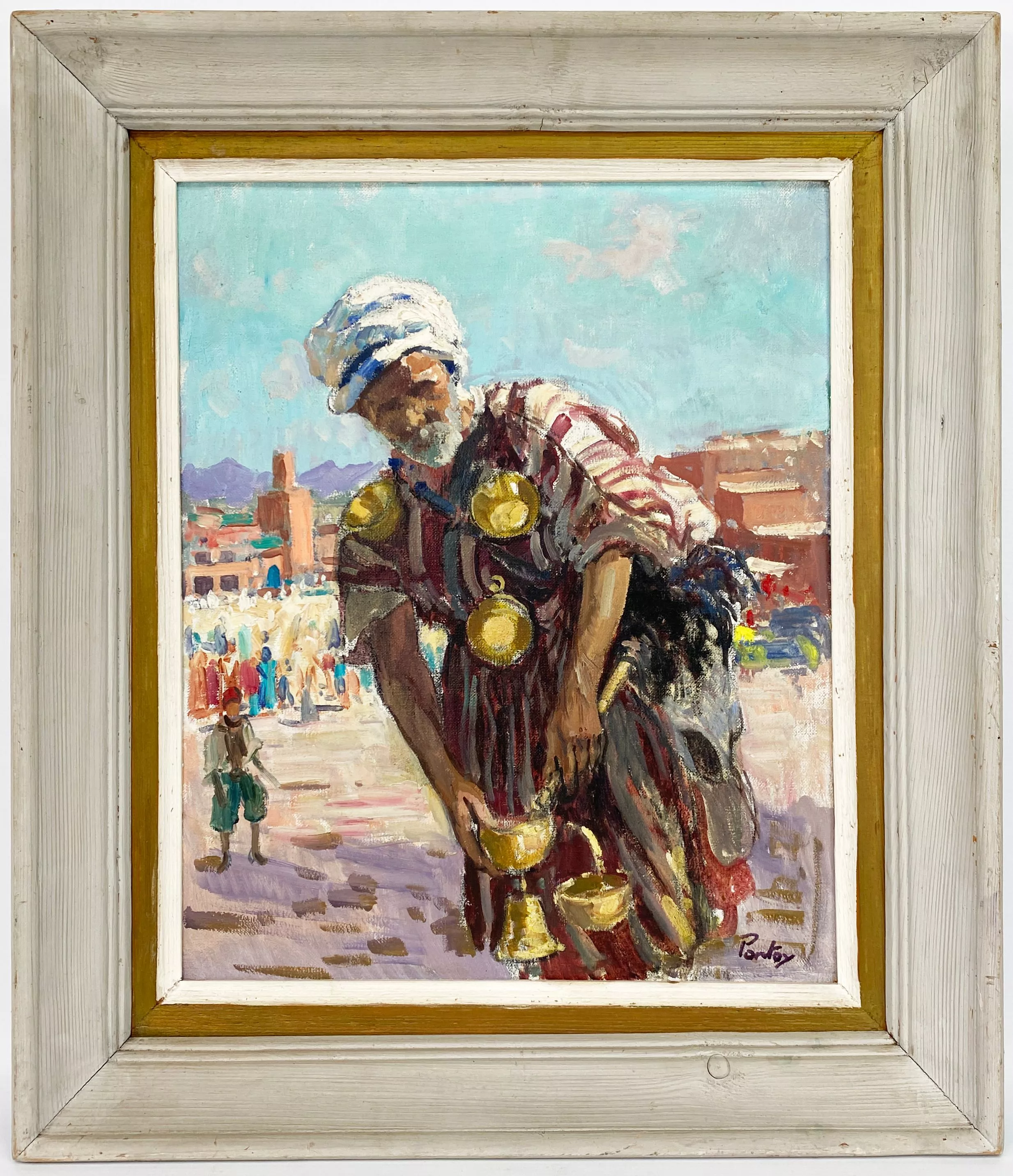
Style and technique of artist Henri Pontoy
Henri Pontoy is part of the Orientalist movement, very much in vogue in the 20th century, which consists of depicting oriental scenes from various countries, particularly those of North Africa. His colors are warm, and he emphasizes the representation of light.
He worked both in Arab countries ; notably Morocco and Algeria, but also in black Africa, in Guinea and Cameroon, with Jacques Majorelle. Stylistically, he is close to other orientalists such as Émile Deckers.
The life of Henri Pontoy, from Paris to Black Africa
Henri Pontoy (1888-1968) is an important figure in twentieth-century French art. Trained at the École des Beaux-Arts in Paris, his teacher was Luc-Olivier Merson, a renowned artist of the time.
At the beginning of his career, Pontoy devoted himself mainly to etching, a technique he quickly mastered, and which enabled him to be exhibited at the Salon des Artistes Français.
However, it was with painting that he would truly make a name for himself, thanks in particular to his works shown at the Salon d'Automne, an unmissable event for artists of his time.
One of the highlights of his career was when he won a grant from the Société Coloniale des Artistes Français, enabling him to travel to North Africa.
Fascinated by these new horizons, he resided in Morocco and Algeria, where he received several awards for his work. During this period, he meets Jacques Majorelle, famous for his paintings depicting landscapes and scenes of Moroccan life.
The two artists struck up a friendship and traveled together across North Africa, soaking up the atmosphere, colors and light so characteristic of these regions.
After the Second World War, still in search of inspiration, Pontoy left for Black Africa with Majorelle. They traveled through Guinea and Cameroon, discovering new landscapes and fascinating cultures that influenced their work.
This journey greatly enriched Pontoy's work, enabling him to explore new color palettes and capture scenes of African life with a unique sensibility.
Henri Pontoy, throughout his career, has been a true adventurer of art. From his early days in Paris to his African expeditions, he has captured in his work the beauty and essence of the places he has traversed, leaving behind an artistic legacy rich in diversity and emotion.
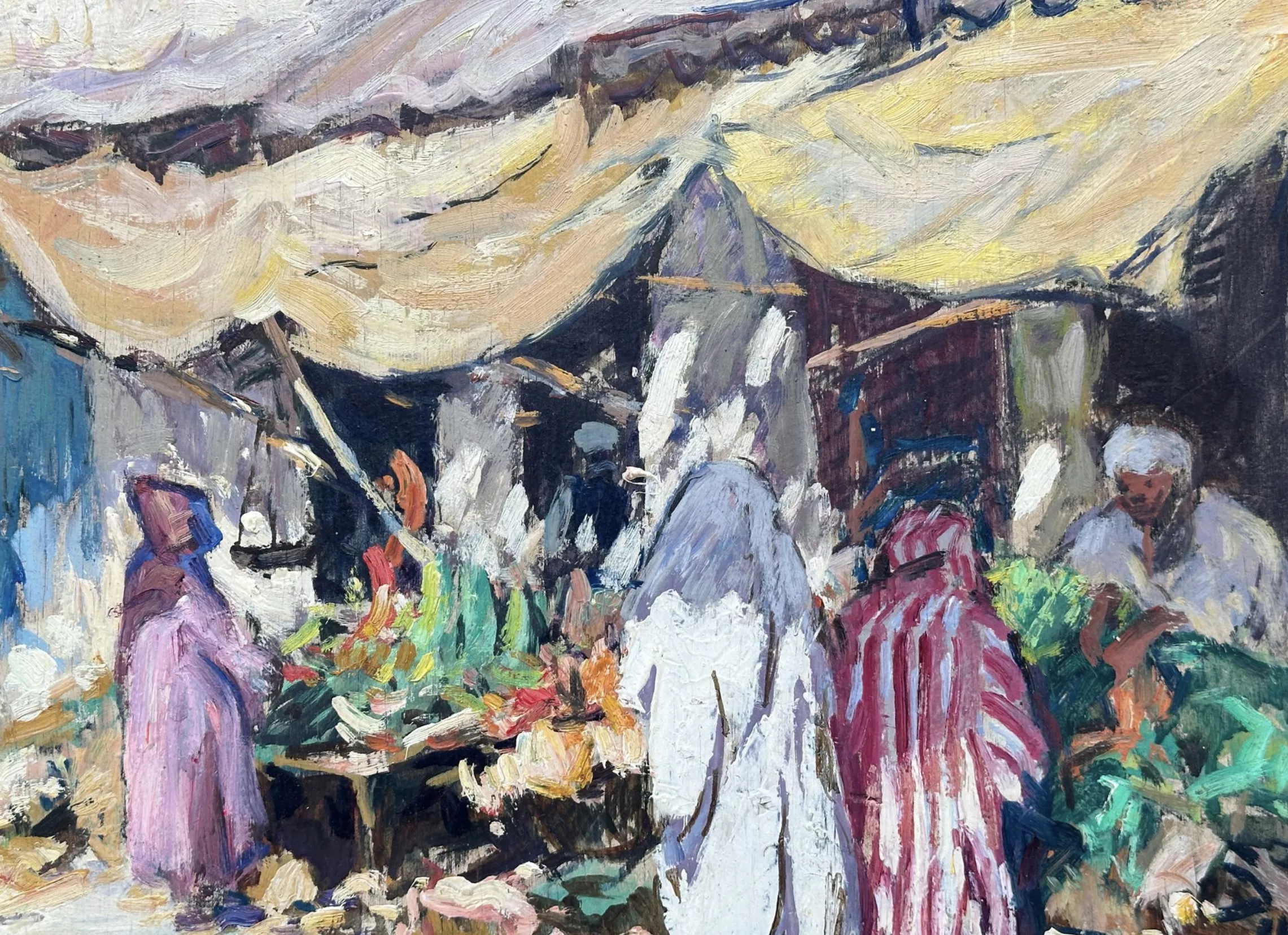
Focus on Souk in Morocco, Henri Pontoy
Henri Pontoy, an iconic 20th-century artist, sensitively captured scenes of everyday life through his unique style, strongly influenced by his travels in North Africa.
This painting is a vibrant depiction of a local market, probably in Algeria or Morocco, the places from which the artist drew much of his inspiration.
The touches of vivid color and the movement of the brushstrokes evoke a lively atmosphere, rich in human interaction. Light seems to filter through hanging fabrics, lending a warm, welcoming ambience to the scene.
The human figures, though deliberately blurred and sketched, evoke silhouettes dressed in colorful djellabas, a vision true to the essence of traditional markets in these regions.
Pontoy, influenced by his classical training and travels, here uses a striking contrast of light and dark tones to emphasize the interplay of light and shadow, and suggest an intense heat, typical of the Mediterranean climate.
The composition seems to capture an ephemeral moment of everyday life, imbued with simple beauty, where the viewer is invited to feel the energy and dynamism of this market scene.
This painting perfectly illustrates Pontoy's ability to pay homage to North African culture while incorporating impressionist techniques, making his works timeless testaments to his travels and love for these lands.
Pontoy and Orientalism
Henri Pontoy follows in the footsteps of the great Orientalist painters of the early 20th century, a fascinating artistic movement that emerged in the 19th century under the influence of European colonization and expansion in North Africa and the Middle East.
Inspired by his travels to Morocco, Algeria, and later Black Africa, Pontoy was captivated by the visual richness and cultural diversity of the regions he traversed.
Like Jacques Majorelle, with whom he shared many of his travels, Pontoy developed an aesthetic eye for the Orient, nourished by a fascination for desert landscapes, bustling souks, traditional dress, and the brilliant light that bathes these territories.
His work, though marked by an impressionist approach and a mastery of the interplay of light and color, avoids falling into the clichés of the genre.
Contrary to some Orientalists who depicted the Orient as a frozen, mysterious and exotic world, Pontoy manages to capture the vitality and everydayness of the scenes he paints.
His paintings are not just a fantastical projection of the Orient, but a sincere tribute to the local people and their environments. In this, he stands out among the Orientalists of his time, managing to balance aesthetic admiration with lived reality.
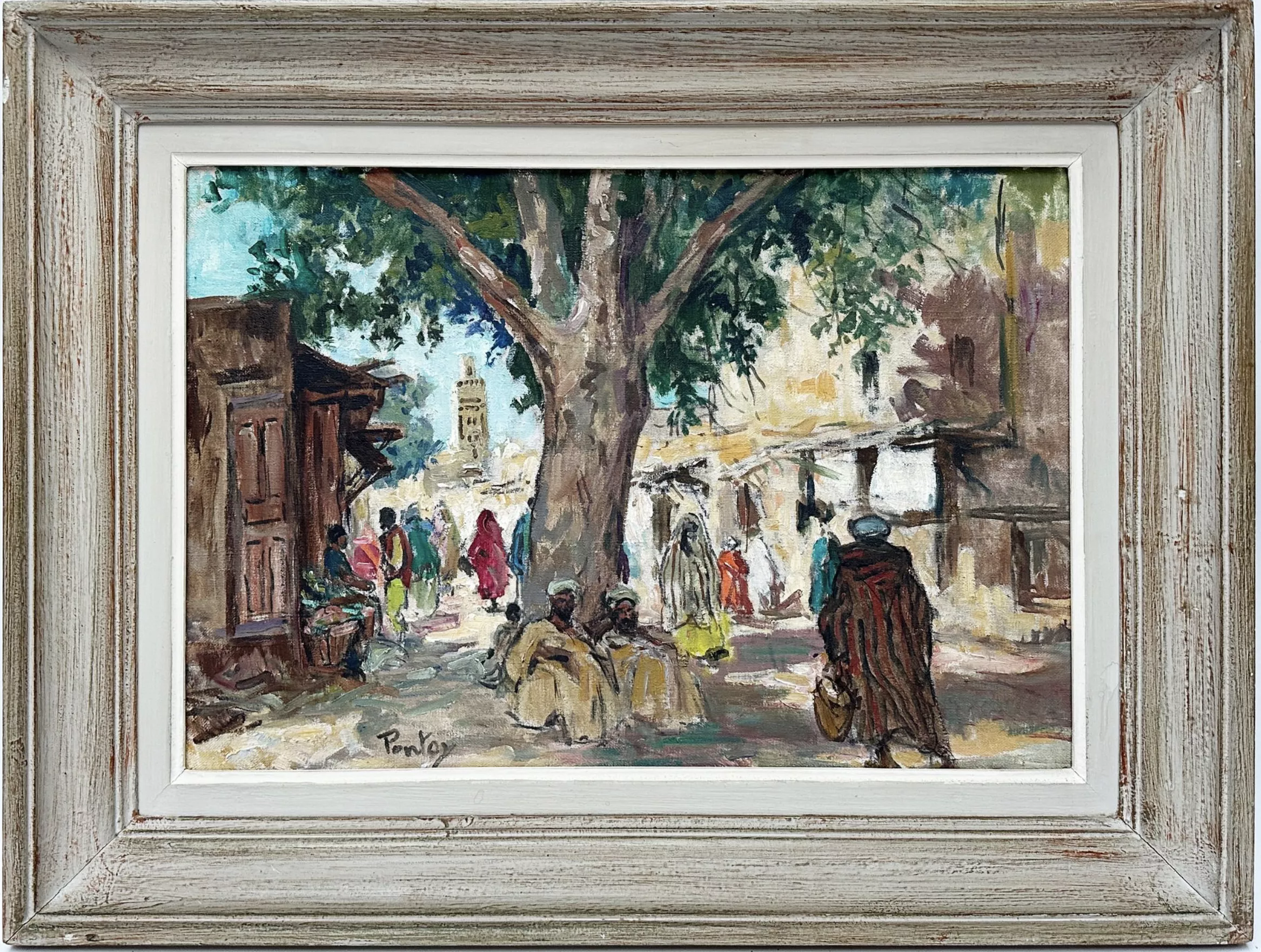
Focus on a street scene by Pontoy
In this painting by Henri Pontoy, the artist once again transports us to the heart of everyday life in a North African town, probably a Moroccan or Algerian village, bathed in soft morning light.
The composition centers on an imposing tree, an almost protective figure under which men, seated in a relaxed posture, seem to be chatting in the shade, a moment of calm in contrast to the activity going on further away.
In the background, colorful silhouettes cross a street lined with earth-toned houses, their gait evoking the peaceful nonchalance characteristic of these places.
The verticality of the tree, which dominates the scene, leads the eye to the minaret rising in the distance, a subtle reminder of the omnipresence of Islamic culture in these landscapes.
Pontoy's palette is, once again, vibrant, blending deep greens with the browns and ochres of the buildings and land, and punctuated by the colorful flashes of the characters' clothing, which provide a striking visual contrast.
This painting perfectly embodies Pontoy's fascination with street scenes, where human interaction and architecture merge in pictorial harmony.
The swift, fluid brushstrokes lend the work a dynamism that suggests life in motion, while capturing a moment of serenity, almost contemplative.
The artist, true to his Orientalist approach, reveals here an authentic scene, far from any idealization, where beauty lies in the simplicity of moments shared under the benevolent shade of an ancestral tree.
Pontoy's imprint on his period
Henri Pontoy is one of the last artists representing the Orientalist movement. He collaborated with Jacques Majorelle, who needs no introduction.
He worked enormously on color tones and light. Today, his works have a stable value on the auction market, and he is part of an artistic movement that is still much sought-after by collectors, and which is particularly highly rated today.
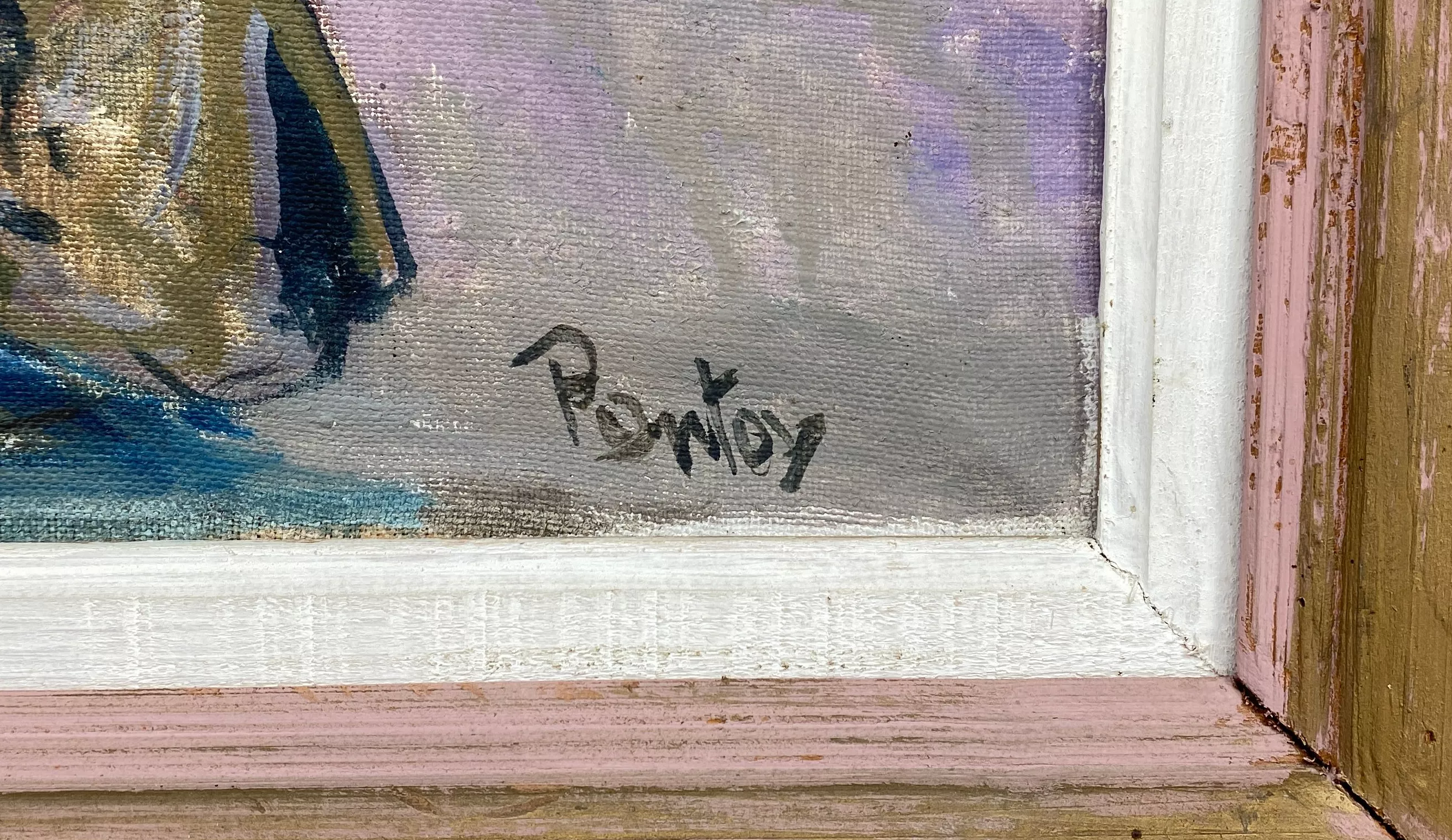
Recognizing Pontoy's signature
Henri Pontoy's paintings are often signed in the lower left-hand corner of the canvas. He signs " Pontoy " often in a dark tone.
Knowing the value of a work
If you happen to own a work by or after Henri Pontoy, don't hesitate to request a free valuation using our form on our website.
A member of our team of experts and licensed auctioneers will contact you promptly to provide you with an estimate of the market value of your work, not forgetting to pass on ad hoc information about it.
If you are considering selling your work, you will also be accompanied by our specialists in order to benefit from alternatives for selling it at the best possible price, taking into account market inclinations.
Estimate in less than 24h
Discover in the same theme

Rating and value of works, mirrors by Line Vautrin
Line Vautrin is a unique artist famous for her mosaic and bronze mirrors. These valuable objects are highly prized at auction.
Learn more >

Rating and value of works, serigraphs, paintings by Alain Ja...
Alain Jacquet is a Figuration Nouvelle artist who introduced Pop Art. His works are quoted and successful at auction.
Learn more >

Rating and value of works, drawings, paintings by Jean Hélio...
Jean Hélion is a twentieth-century abstract painter who produced drawings and oil paintings that are quoted on the auction market.
Learn more >
Other works from the same period sold at auction

Estimated 18000 € - 20000 €
Paul JOUVE (1878-1973): "Panther on the march

Estimated 15.000 - 20.000 €
Jacques MAJORELLE (1886-1962) - Fishermen embarking, Abidjan, Ivory Coast - Oil on canvas.

Estimated 40.000 - 80.000
Alexandre ROUBTZOFF (1884-1949), Portrait of Arbia, oil on canvas

Estimated 5.000 - 8.000
Alexandre ROUBTZOFF (1884-1949), The Sidi Makhlouf Mosque, oil on canvas

Estimated 3.000 - 5.000
Raphaël DELORME (1885-1962), Le Bain au Harem, oil on isorel

Secure site, anonymity preserved

Auctioneer approved by the State

Free and certified estimates
Frequently asked questions
-
Who is Henri Pontoy, and what is his artistic background?Henri Pontoy (1888–1968) was a leading figure in 20th-century Orientalism. Trained at the École des Beaux-Arts in Paris, he gained international renown for his depictions of landscapes and scenes of daily life in North Africa and Sub-Saharan Africa, particularly in Morocco and Algeria, where he traveled with the painter Jacques Majorelle. His style combines classical academic training with an Impressionist approach, demonstrating a particular mastery of the play of light and warm colors.
-
What is the price range for Henri Pontoy's works on the market?The prices of Henri Pontoy’s works vary considerably depending on the medium and quality. Drawings and watercolors range from €20 to €16,270, prints from €40 to €1,100, while oil paintings on canvas—his most prestigious works—range from €250 to €120,000. For example, a polychrome composition depicting Fez from 1937 sold for €70,000 in 2020.
-
How can you authenticate a work by Henri Pontoy and determine its exact value?To authenticate a work by Henri Pontoy and obtain an accurate estimate, we recommend that you submit a request for a free, no-obligation appraisal with Auctie's. Our state-certified auctioneers and experts will examine your artwork and provide you with a detailed assessment of its current market value within 48 hours.
-
Is this the right time to sell a work by Henri Pontoy?Yes, now is a good time to sell a work by Henri Pontoy. His paintings command stable and rising prices on the auction market, and the Orientalist style he represents is currently highly sought after and valued by French and Moroccan collectors. Demand for his works remains strong, and prices continue to rise.
-
How does the process of selling a work of art at Auctie's work?At Auctie's, we support sellers every step of the way, from the free appraisal to the final sale. After an initial, no-obligation evaluation by our experts, we offer you the best options for selling your artwork at the best possible price, taking into account market trends and the preferences of potential buyers.
