



Rating and value of paintings by Marie Aimée Lucas Robiquet

Key takeaways
- Marie Aimée Lucas Robiquet (1858–1959) was a leading French Orientalist painter whose works sell for between €150 and €287,000, depending on the medium and size.
- Her oil-on-canvas paintings, particularly prized by French and American collectors, are her most highly valued works, fetching up to €287,000 in 2021.
- The artist is distinguished by her empathetic and documentary approach to Saharan scenes, with remarkable attention to detail in the fabrics, lighting, and everyday gestures of Berber women.
If you own a work by artist Marie Aimée Lucas Robiquet or after, and would like to know its value, our state-approved experts and auctioneers will offer you their appraisal services.
Our specialists will carry out a free appraisal of your work, and provide you with a precise estimate of its value on the current market.
Then, if you wish to sell your work, we will direct you to the best possible arrangement to obtain the optimum price.
Rating and value of artist Marie Aimée Lucas Robiquet
Considered one of the most important protagonists of Orientalism in the 20th century, Marie Aimée Lucas Robiquet leaves behind a unique artistic repertoire imbued with the colonialist artistic spirit.
This legacy consists of paintings that are mostly oils on canvas. At present, the prices of her works are rising under the auctioneers' gavel.
Her paintings and other works are particularly prized, especially by French and American buyers, and the price at which they sell on the art market ranges from €150 to €287,000, a considerable delta but one that speaks volumes about the value that can be attributed to the works of Marie Aimée Lucas Robiquet.
In 2021, a polychrome composition entitled L'enrichissement par le savoir sold for €275,000, while it was estimated at between €200,000 and €400,000.
Order of value from a simple work to the most prestigious
Technique used | Result |
|---|---|
Estamp - multiple | From 150 to 930€ |
Drawing - watercolor | From €220 to €4,000 |
Oil on canvas | 40 to €287,000 |
Estimate in less than 24h
Style and technique of artist Marie Aimée Lucas Robiquet
Marie Élisabeth Aimée Robiquet (1858 - 1959)was a French Orientalist artist trained in the academic tradition, active between the late 19th and early 20th centuries.
In her work, she adopted precise execution, solid drawing and great attention to volume. Her brushwork is sometimes freer in the backgrounds, adopting a fluid, almost impressionistic line, especially in her desert landscapes or North African skies.
She plays on contrasting effects between sharp figures and more sketchy backgrounds, with the aim of energizing her scenes. Her palette is warm and luminous, suited to oriental scenes. She is known for her use of sandy tones, ochres, burnt reds and off-whites, well-suited to the Saharan ambience.
Marie Aimée Lucas Robiquet excels in low-angled light effects, typical of the South, and in rendering dust, wind and veiled sun. Fabrics and finery are often treated with chromatic attention to detail: turbans, haiks and burnous are painted with a wealth of textures.
The figures (Berber women, children, horsemen, beggars) are not idealized but treated with respect, in an almost ethnographic vein. She differs from male orientalists in that her approach is more empathetic, less sexualized and closer to the observation of everyday life.
She often focuses on simple gestures, moments of rest or market scenes, in the manner of a travel diary. Her compositions are often centered and stable, mostly in horizontal format, with a clear vanishing point that organizes the space.
The drawing remains precise, especially for faces and hands, which reinforces the documentary aspect of her works. She carefully prepared her large-scale backgrounds, with undercoats in medium tones that give warmth to the whole.
The artist also practiced pen and charcoal drawing in preparation, although few sketches are preserved today. She was influenced by the École d'Alger (established by Dinet, Fromentin and Girardet), but differed from it in her feminine outlook.
Her painting is sometimes compared to that of Lucien Simon or Étienne Dinet, but remains less narrative and more focused on human presence. His style evolves little over the decades, retaining a classic aesthetic constancy while absorbing a few modern accents in the touch.
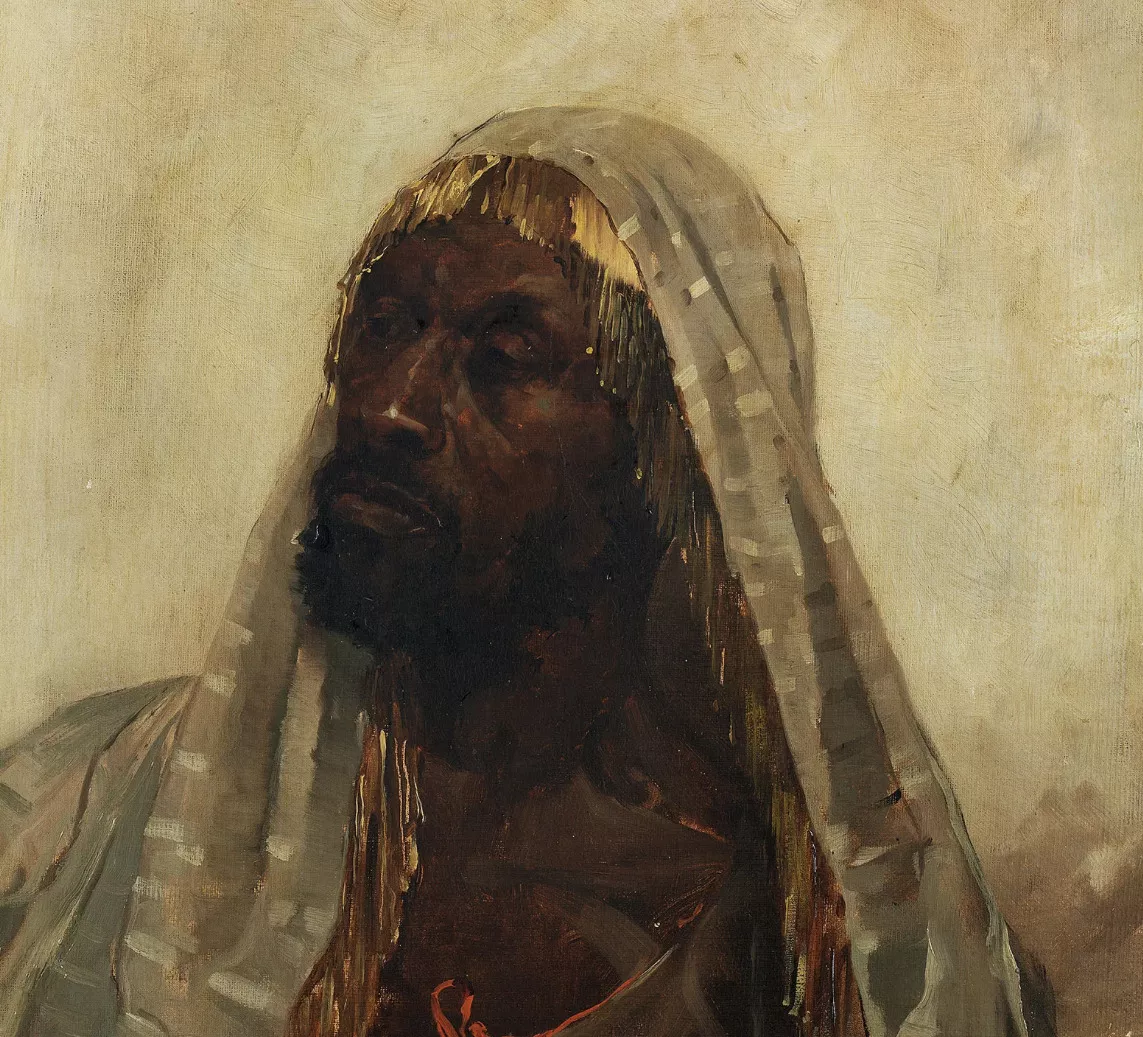
The life of Marie Aimée Lucas Robiquet
Marie Aimée Lucas Robiquet was born into a middle-class family in Avranches, Normandy, in 1858. Little precise information is available about her early years, but she received extensive artistic training, probably in Paris.
She was taught by private artists or in women's studios, as was common for women of her time. She began exhibiting at the Salon de la Société des artistes français in the 1880s.
She quickly made a name for herself with her genre scenes and portraits, before turning to Orientalism, which was very much in vogue at the time. At a time when women artists were still not very visible, she succeeded in making a name for herself thanks to the quality of her workmanship and the originality of her vision.
She made several trips to Algeria, the Sahara and Tunisia, probably from the 1890s onwards. These sojourns enabled her to paint from the motif, which distinguishes her work from studio orientalism.
She immersed herself in local life, capturing scenes of markets, rest and daily life, which she rendered with a rare sense of observation. She exhibited regularly at the Salon until the 1920s, receiving several mentions and honors.
Her works were also shown abroad, notably in England and Belgium, at international exhibitions. Although she received little media attention, she was appreciated by colonial art lovers and private collectors.
She continued to paint well into old age, although her output declined after the First World War. She died at over 100, making her a figure straddling three generations of artists.
Her name then fell into oblivion, before being rediscovered thanks to recent interest in Orientalist women. Her work is now being revalued in exhibition catalogs and at auctions, where her paintings are sought after.
She is considered one of the rare women who approached the Orient with seriousness, respect and artistic commitment, alongside others such as Marguerite Delorme, escaping the dominant stereotypes. Her paintings can be found in several public and private collections, notably in France and North Africa.
Focus on Market scene in the Sahara, circa 1900 - 1910
This title is used generically by the artist, who names several of his canvases in this way. The dimensions vary from version to version, but they are often large (approx. 80 x 120 cm).
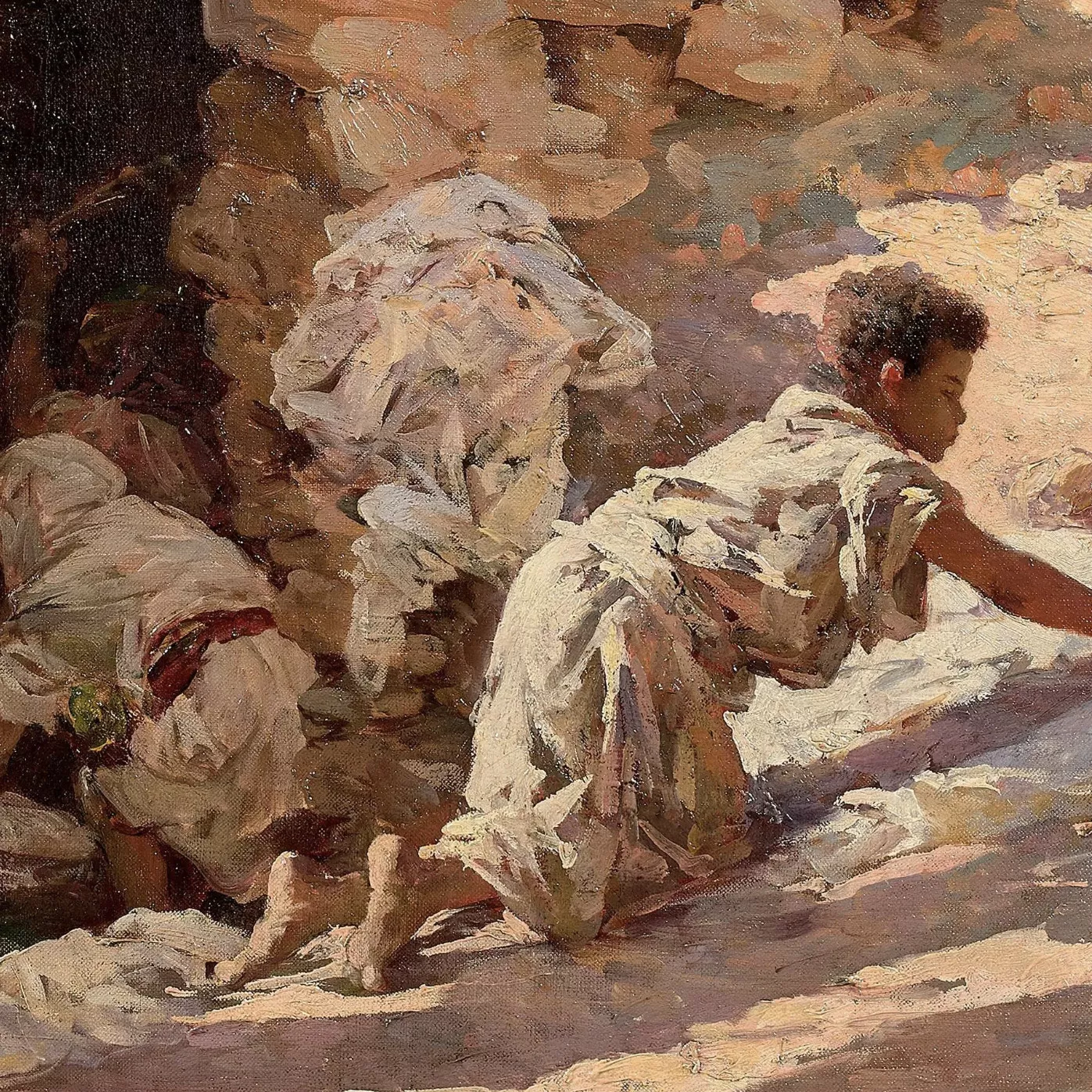
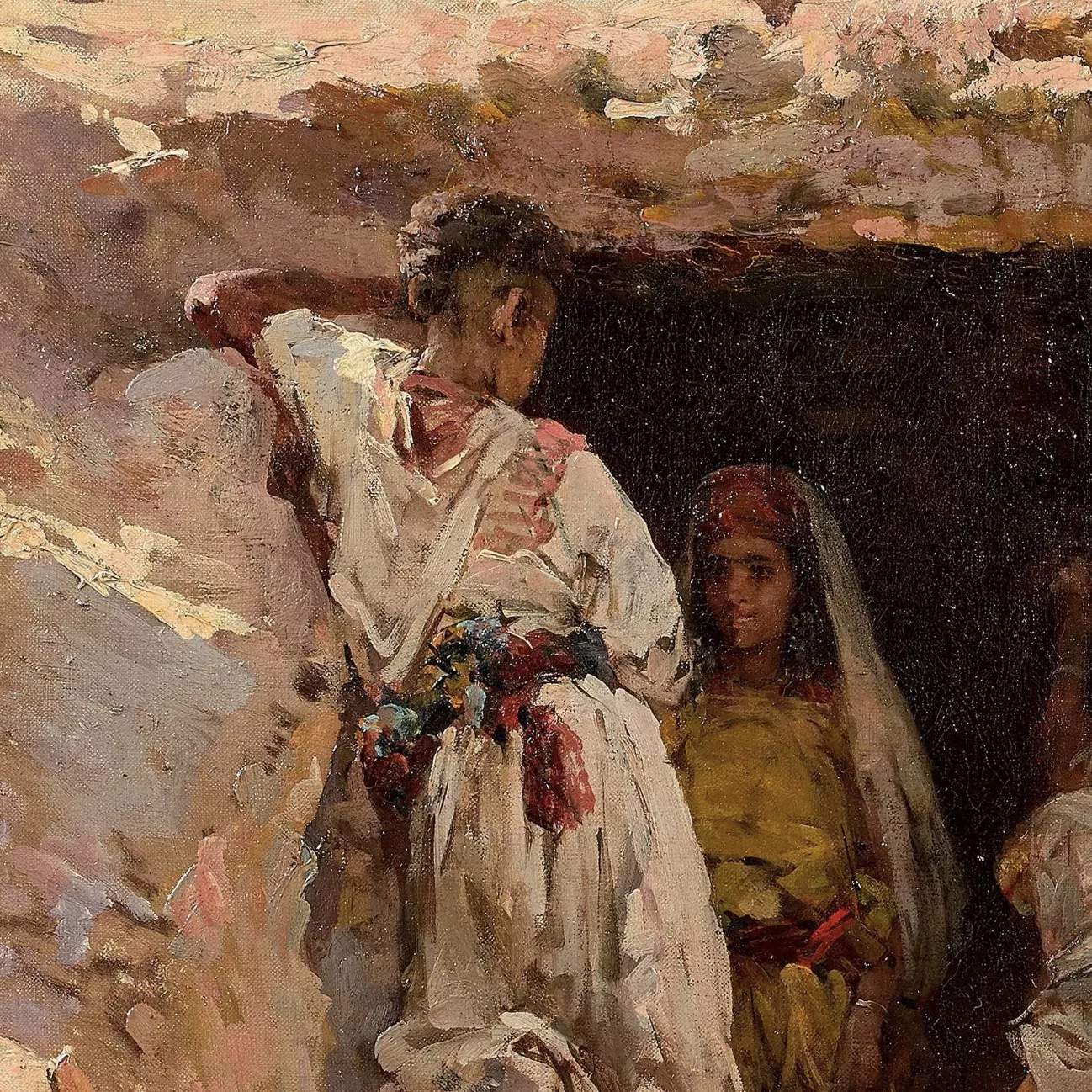
The scene depicts a group of women and children in a Saharan market, at the foot of prisé buildings or palm trees. The scene is dominated by figures dressed in white, ochre or blue haïks, djellabas or burnous, depicted in attitudes of discussion or expectation.
There is no forced exoticism : the scene seems to be taken from life, from a close-up, almost documentary point of view. She uses sandy, luminous tones, dominated by golden ochres, reddish browns and chalky whites.
She also uses a backlighting effect, where zenithal light emphasizes the dryness of the air and the contours of the clothes. The sky is often rendered in vaporous washes, without excessive detail, to let the composition breathe.
The details of faces and hands are finely modeled, but without mannerism the treatment remains sober. The ground is often rendered in cross-hatched or crossed strokes, blending dust, sand and discreet shadows.
Contrary to other Orientalist painters, Lucas Robiquet avoids harem scenes or colonial fantasies. Instead, she paints the everyday lives of women, often ignored by the male gaze. The work is distinguished by a benevolent neutrality, an attentive look at simple gestures : it's a testimony more than a fiction.
The absence of hierarchy in the composition (no central character is heroicized) gives an egalitarian and appeased character to the scene. This work perfectly illustrates the artist's commitment to a field vision, based on direct experience and not on stereotypes.
Contemporary collectors value these canvases for their technical quality, documentary authenticity and rare position as a woman artist in the Eastern field.
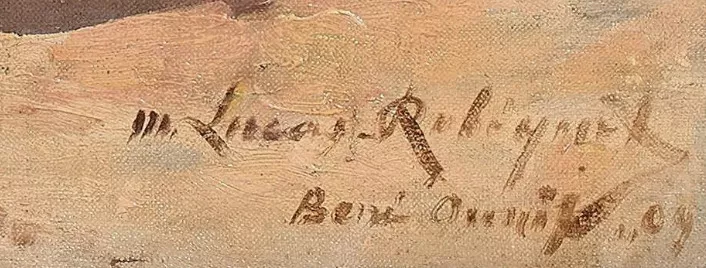
Recognizing Marie Aimée Lucas Robiquet's signature
Marie Aimée Lucas Robiquet's paintings are often signed at the bottom of the painting.
Knowing the value of a work
If you happen to own a work by or after Marie Aimée Lucas Robiquet, don't hesitate to request a free appraisal using our form on our website.
A member of our team of experts and certified auctioneers will contact you promptly to provide you with an estimate of the market value of your work, as well as ad hoc information about it.
If you are considering selling your work, you will also be accompanied by our specialists in order to benefit from alternatives for selling it at the best possible price, taking into account market inclinations.
Estimate in less than 24h
Discover in the same theme

Rating and value of works, drawings, paintings by Yannis Gai...
Yannis Gaitis is a 20th-century Greek artist who produced highly-acclaimed oil paintings and drawings ranging from the figurative to the abstract.
Learn more >

Rating and value of paintings by François Eberl
François Eberl was an Austro-Hungarian painter of the École de Paris, who produced many highly valued thematic paintings.
Learn more >

Rating and value of Jacques Duval-Brasseur's furniture and s...
Jacques Duval-Brasseur is an iconic French designer of the 1970s. His works are highly valued at auction.
Learn more >
D'autres tableaux orientalistes vendus aux enchères

Estimated 15.000 - 20.000 €
Jacques MAJORELLE (1886-1962) - Fishermen embarking, Abidjan, Ivory Coast - Oil on canvas.

Estimated 40.000 - 80.000
Alexandre ROUBTZOFF (1884-1949), Portrait of Arbia, oil on canvas

Estimated 5.000 - 8.000
Alexandre ROUBTZOFF (1884-1949), The Sidi Makhlouf Mosque, oil on canvas

Estimated 2.000 - 4.000
Henri PONTOY (1888-1968), The Telouet kasbah in the Ounila valley, Oil on canvas

Estimated 1.500 - 2.500
Henri PONTOY (1888-1968) Animated view of a kasbah in the Atlas Mountains

Estimated 3.000 - 4.000
Henri PONTOY (1888-1968), Fantasia at the foot of the Atlas, Oil on canvas

Secure site, anonymity preserved

Auctioneer approved by the State

Free and certified estimates
Frequently asked questions
-
Who was Marie Aimée Lucas Robiquet, and what is her significance in art history?Marie Aimée Lucas Robiquet (1858–1959) was a leading French Orientalist artist, trained in the academic tradition. Known for her empathetic and documentary-style approach to the East, based on her stays in Algeria and Tunisia, she distinguished herself from her male Orientalist counterparts through her respectful portrayal of the daily lives of Berber women, far removed from exotic clichés. Her works, exhibited at the Salon and abroad, were long forgotten before being rediscovered thanks to the recent interest in female Orientalist artists.
-
What is the price range for works by Marie Aimée Lucas Robiquet?The prices of Marie Aimée Lucas Robiquet’s works vary considerably depending on the medium and the piece’s prestige. Multiple prints sell for between €150 and €930, watercolor drawings for between €220 and €4,000, while oil-on-canvas paintings—her most prominent works—command prices ranging from €40 to €287,000. A notable example: in 2021, the painting “Enrichment Through Knowledge” sold for €275,000.
-
How can you authenticate a work by Marie Aimée Lucas Robiquet?To authenticate a work by Marie Aimée Lucas Robiquet, Auctie's offers a free, no-obligation appraisal request via its online form. A certified expert or auctioneer will examine the artwork and provide you with an accurate estimate of its market value, along with information regarding its authenticity and condition, within 48 hours.
-
Is this the right time to sell a work by Marie Aimée Lucas Robiquet?Yes, now is a good time to sell a work by this artist. Demand for her paintings is growing, particularly among French and American collectors, thanks to the recent rediscovery of female Orientalist painters and a renewed interest in the documentary and respectful approach she brought to her subjects. Auction prices are on the rise.
-
How does the sales process work at Auctie's?Auctie's guides you from the appraisal to the auction. After requesting a free appraisal, if you decide to sell, our specialists will advise you on the best options for achieving the highest possible price based on market trends. As a licensed auction house, we manage the entire process of selling your artwork.
