



Rating and value of paintings and drawings by Constantin Korovine

Key takeaways
- Works by Constantin Korovine, a Russian Post-Impressionist painter, sell for between €50 and €1,649,740, depending on the technique and provenance.
- In 2020, a 1923 composition sold for €1,101,830 at Sotheby’s, far exceeding its estimate of €224,840 to €337,290.
- Oil-on-canvas works represent his primary medium, priced between €191 and €1,649,740, while watercolor drawings range from €50 to €70,750.
If you own a work by or after the artist Constantin Korovine, and would like to know its value, our state-approved experts and auctioneers will offer you their appraisal services.
Our specialists will carry out a free appraisal of your work, and provide you with a precise estimate of its value on the current market.
Then, if you wish to sell your work, we will direct you to the best possible arrangement to obtain the optimum price.
Rating and value of the artist Constantin Korovine
Korivine is a painter of Russian origin who is relatively unknown to the general public. He leaves behind a unique artistic repertoire characteristic of Russian post-impressionism.
This legacy consists of paintings that are predominantly oils on canvas. At present, the prices of his works are flying off the auctioneers' hammers.
His paintings and other works are particularly prized, especially by European and American buyers, and the price at which they sell on the art market ranges from €50 to €1,649,740, a considerable delta but one that speaks volumes about the value that can be attributed to Korovine's works.
In 2020, a green-dominated polychrome composition dating from 1923 sold for €1,101,830 at Sotheby's, while it was estimated at between €224,840 and €337,290.
Order of value from a simple work to the most prestigious
Technique used | Result |
|---|---|
Drawing - watercolor | From €50 to €70,750 |
Oil on canvas | From €191 to €1,649,740 |
Estimate in less than 24h
Style and technique of artist Constantin Korovine
Constantin Korovine anchors his painting in a free, vibrant facture, where the brushstroke fragments into colorful bursts, capturing the fleeting variations of light.
Heir to the teachings of his master Vasily Polenov, he pushed back the rigors of drawing in favor of an immediate, almost instinctive execution, which reflects his attachment to impressionist principles.
But far from a simple optical transcription, his palette, dense and saturated, pushes color to a dramatic intensity that heralds the exuberance of postimpressionism.
His brush, lively and free of academic constraints, models forms through juxtapositions of pure hues, lending his compositions a thrilling energy.
In his theatrical scenes as in his urban landscapes, he favors an open composition, where movement takes precedence over rigorous construction.
His art, nourished by the artistic effervescence of Moscow and French pictorial research, thus finds a balance between spontaneity and chromatic mastery, delivering a vision of the world where light, omnipresent, seems to animate the very matter of painting.
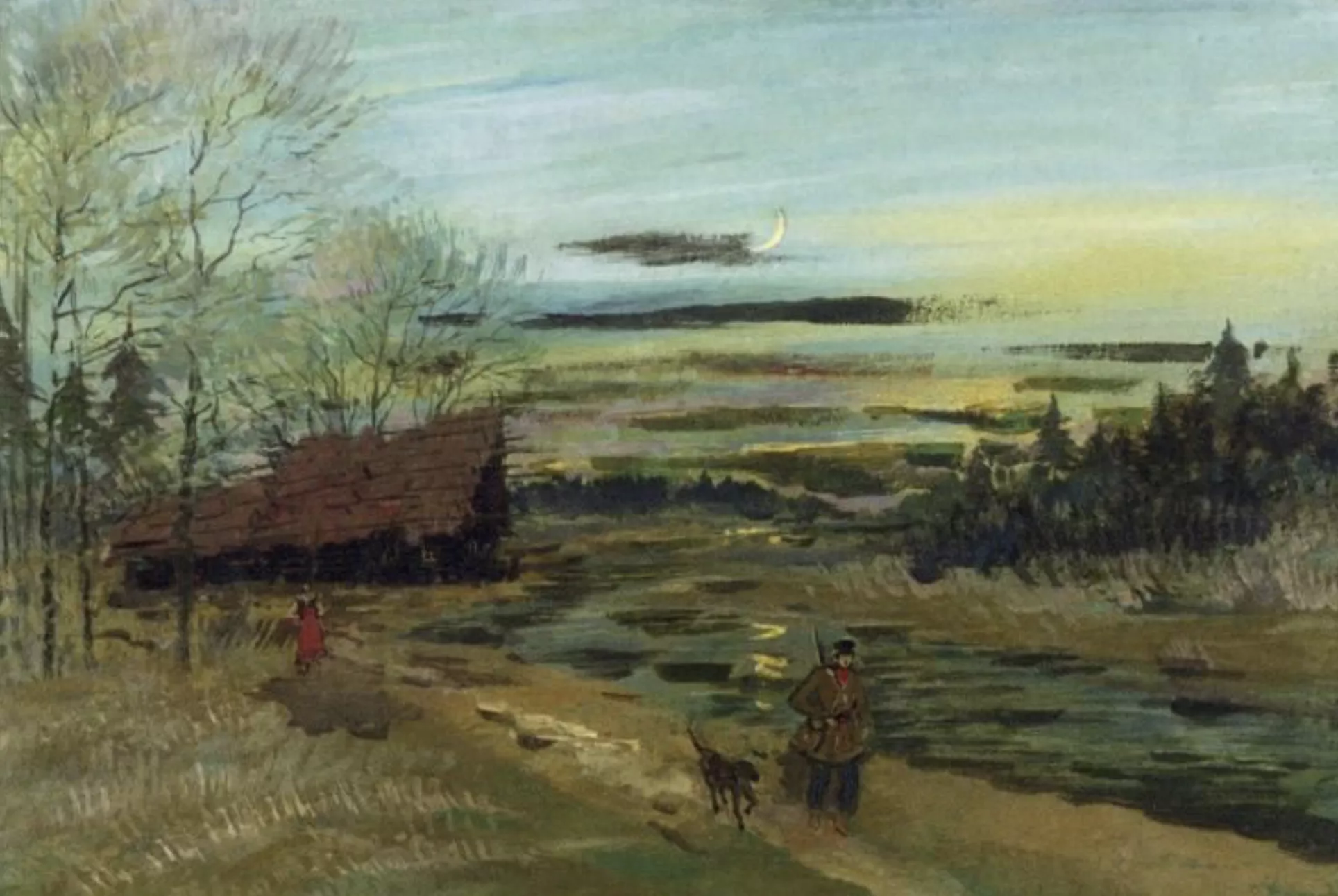
The life of Constantin Korovine
Constantin Korovine was born in 1861 in a Russia in the throes of change, into a cultured family where artistic influence was evident from childhood.
Trained at the Moscow School of Painting, Sculpture and Architecture, he was initiated into academic principles while absorbing the effervescence of the realist and impressionist currents that were then transforming the European pictorial scene.
A student of Vasily Perov and Savrassov, he developed an approach in which light and chromatic vibration prevailed over descriptive rigor.
From the 1880s, he frequented the Cercle des Ambulants before evolving towards a freer aesthetic, marked by French influences, notably those of Monet and Renoir, whom he discovered during his stays in Paris.
His bold use of hues and atmospheric treatment of matter placed him at the heart of the renewal of Russian painting, prefiguring the rise of modernism.
Close to Serge de Diaghilev, he took part in the Ballets Russes, creating sets in which color became a narrative element in its own right.
Insettled in France from the 1920s, he continued his plastic research, but saw his work gradually eclipsed by the triumphant avant-garde.
He died in 1939, leaving behind a body of work in which the dissolution of form and the explosion of the light spectrum heralded the boldness of the Post-Impressionist currents.
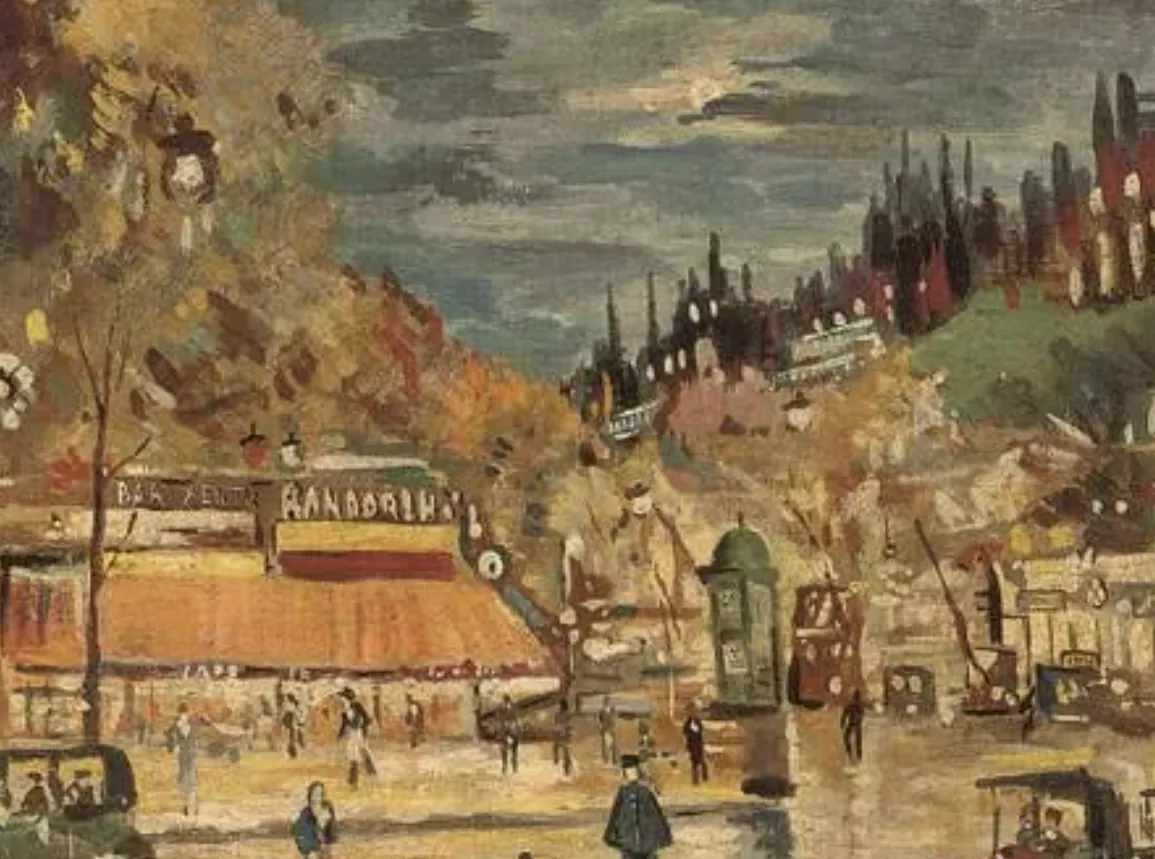
Focus on Twilight in Winter, Constantin Korovine
In Twilight in Winter, Constantin Korovine deploys a vibrant palette where shades of blue, gray and ochre intertwine in a thick, almost moving pictorial material.
The landscape, a snowy Russian village bathed in fading light, is imbued with an atmosphere both silent and quivering.
The rapid, sometimes cross-hatched brushstrokes fragment volumes and sculpt space into broad planes of color, giving the whole an internal dynamic akin to Impressionist research.
The reflections of sky on snow, treated in subtle gradations, establish a chromatic dialogue where air and earth seem to merge.
Through this pictorial treatment, Korovine does not limit himself to a faithful transcription of the motif, but seeks to capture the very essence of the landscape, its very breathing.
The snow, far from being a simple uniform surface, is charged with colored vibrations, absorbing and restoring the nuances of the sky.
The light, diffused, spreads in irregular strokes that blur contours and dilute forms, suggesting the imperceptible shift from day to night.
This effect of dissolution, achieved through the superimposition of thin layers of paint and a nervous gesture, lends the scene an atmospheric dimension where perception prevails over strict representation.
The choice of an open composition, where the gaze is not held back by any central element, accentuates the sensation of immensity and silence. The absence of human figures, or their barely sketched presence, reinforces the impression of solitude in the face of sovereign nature.
Yet there's nothing hostile about this winter landscape: it vibrates with an inner warmth, perceptible in the orange glow of a snow-covered roof or the soft purple shadows that envelop the houses.
By combining the instability of the brushstroke with a subtle chromatic harmony, Korovine goes beyond the simple framework of the landscape to turn it into a veritable sensory space, where the eye oscillates between the visible and the intangible.
Korovine's imprint on his period
Constatin Korovine stands out as a transitional figure between the realism inherited from the 19th century and the impressionism tinged with symbolism that marked the Russian avant-gardes.
At a time when Russian painting oscillated between rigorous academicism and modernist audacity, he infused landscape art with a new sensory dimension, where light and color became the true structures of the painting.
With his fluid, vibrant brushstrokes, he liberated landscape representation from any formal rigidity, paving the way for a more intuitive, atmospheric approach that would influence generations of painters, from Sergei Vinogradov to Igor Grabar via Iacovleff.
His contribution was not limited to easel painting alone: as a theater set designer, he revolutionized scenography with his pictorial treatment of sets, where space is diluted into vast swathes of color, abolishing the boundary between foreground and depth.
This dissolution of forms, this primacy given to luminous effect over the precision of drawing, already heralds the research of the Russian Futurists, while retaining a distinctly Slavic sensibility, where the landscape is imbued with a diffuse melancholy.
By combining the Impressionist heritage with a highly personal expressiveness, Korovine inscribes his work in a pivotal moment in the history of Russian painting, where the quest for a national art meets Western influences in a subtle and ephemeral balance.
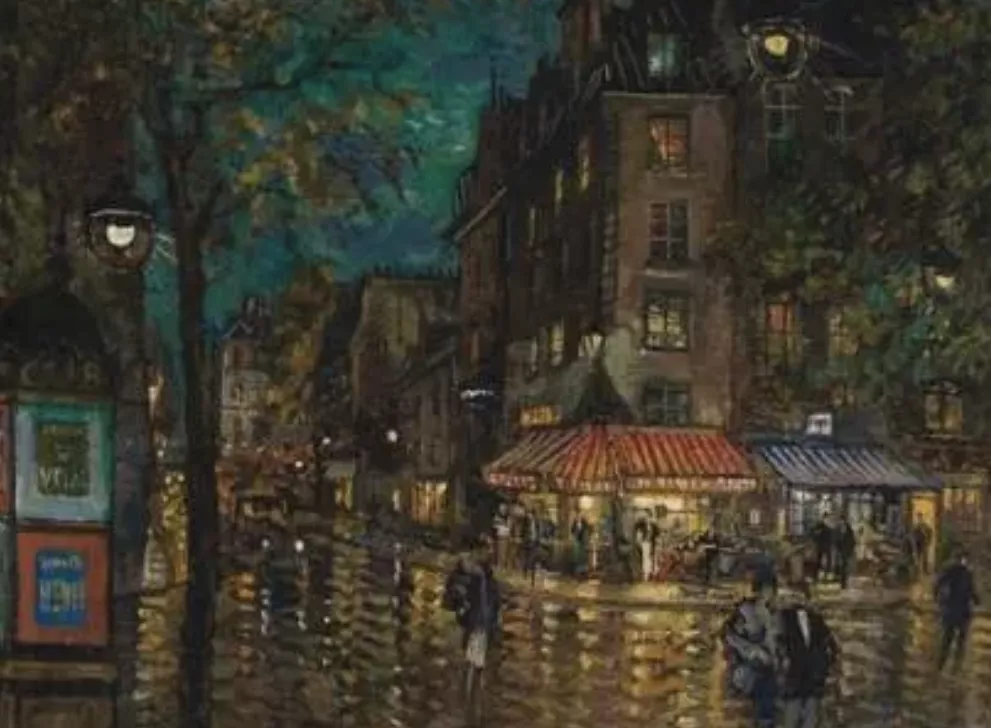
Konstantin Korovin's stylistic influences
Konstantin Korovin's training is part of a dual lineage, between the rigorous academicism of the Moscow School and the effervescence of the modernist currents gaining ground in Europe at the end of the 19th century.
As a pupil of Vasili Polenov and Alexei Savrassov, he inherited a landscape tradition in which the faithful transcription of nature takes precedence over subjective expressivity.
However, his eye quickly turned away from descriptive realism to feed on the innovations of the French Impressionists, whom he discovered during his stays in Paris.
At Monet, Renoir and Pissarro, he retains the dissolution of contours, the use of juxtaposed pure colors and the immediate capture of light variations.
But far from simply borrowing, he adapts these principles to a specifically Russian sensibility, where the more diffuse Nordic light imposes a muted chromatic range, often punctuated by bright touches.
The influence of Whistler, notably in his misty harmonies and fluid-line compositions, also shines through in some of his late works.
Parallel to this, his work for the theater brought him closer to the visionary sets of Léon Bakst and Alexandre Benois, where color becomes a dramaturgical element in its own right.
Between poetic realism and impressionism transfigured by a palette with Slavic resonances, Korovine stands at the crossroads of Western influences and a changing national tradition, building a bridge between the past and the burgeoning modernity of Russian art.
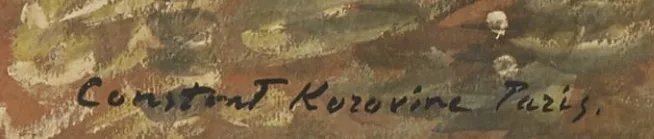
Recognizing Korovine's signature
Constantin Korovine's paintings are often signed in the lower left-hand corner of the canvas. He often signs Korovine in a dark tone.
Knowing the value of a work
If you happen to own a work by or after Constantin Korovine, don't hesitate to request a free appraisal using our form on our website.
A member of our team of experts and licensed auctioneers will contact you promptly to provide you with an estimate of the market value of your work, not forgetting to send you ad hoc information about it.
If you are considering selling your work, you will also be accompanied by our specialists in order to benefit from alternatives for selling it at the best possible price, taking into account market inclinations.
Estimate in less than 24h
Discover in the same theme

Rating and value of furniture, tables, armchairs by Eugène P...
Discover the story of the major cabinetmaker of the Art Deco movement: Eugène Printz.
Learn more >

Rating and value of works, drawings, paintings by Étienne Di...
Étienne Dinet was an Orientalist painter of the early 20th century who produced many oil on canvas paintings listed at auction. Estimated in 24h.
Learn more >

Rating and value of Steph Simon furniture, tables and stools
Steph Simon Editions is a furniture publishing gallery that has marketed prized works that have a high auction value.
Learn more >
Works from the same period sold at auction

Estimated 3000-5000€
Alexandre Roubtzoff - View of Tunis (small format)

Estimated 3000-5000€
Alexandre Roubtzoff, Gammarth (small format)

Estimated Between €800 and €1,500
Alexandre ROUBTZOFF (1884-1949), View of Notre Dame de Paris, oil on canvas

Estimated Between €5,000 and €8,000
KRACHKOWSKY (1854-1914), Before the storm, oil on canvas

Estimated 5.000 - 8.000
Alexandre ROUBTZOFF (1884-1949), The Sidi Makhlouf Mosque, oil on canvas

Estimated 8.000 - 12.000
Robert Rafaïlovitch FALK (Moscow, 1886-1958) View of Paris at night.

Secure site, anonymity preserved

Auctioneer approved by the State

Free and certified estimates
Frequently asked questions
-
Who was Constantin Korovine, and what was his artistic background?Constantin Korovine (1861–1939) was a Russian painter trained at the Moscow School, a student of Vasily Polenov and Alexei Savrasov. A transitional figure between 19th-century realism and Russian Impressionism, he drew inspiration from Monet and Renoir during his stays in Paris. He revolutionized Russian painting with his fluid and vibrant brushwork, prioritizing light and color over academic rigor, while also working with the Ballets Russes as a set designer.
-
What is the price range for Constantin Korovine's works?The prices of Korovine's works vary considerably depending on the medium and the size of the piece. Drawings and watercolors range from €50 to €70,750, while oil paintings on canvas can fetch between €191 and €1,649,740. A notable example: a composition from 1923 sold in 2020 for €1,101,830 at Sotheby’s, exceeding its initial estimate.
-
How can you authenticate a work by Constantin Korovine?To authenticate a work by Korovine, we recommend that you request a free appraisal from Auctie's. Our experts and state-certified auctioneers will analyze your artwork with no obligation and provide you with a detailed appraisal within 48 hours, including information on its authenticity and current market value.
-
Is this the right time to sell a work by Korovine?Yes, now is a good time to sell a work by Korovine. His paintings and drawings are in growing demand on the international market, particularly among European and American collectors. His recognition as a major figure in Russian Post-Impressionism is contributing to the rising value of his work.
-
How does the sales process work at Auctie's?At Auctie's, the process begins with a free, no-obligation appraisal via our online form. An expert will contact you to examine your artwork and provide you with its market value within 48 hours. If you decide to sell, our specialists will guide you every step of the way—from choosing the best sales method to the auction—to ensure you get the best possible price.
