



Rating and value of paintings by Max Beckmann

Key takeaways
- Max Beckmann's works sell for between €20 and €36.4 million at auction, with a world record of $48.5 million set in 2017.
- Self-portraits and large figurative compositions fetch eight-figure prices, while prints remain affordable at between $5,000 and $50,000.
- A German Expressionist (1884–1950), Beckmann dominates the market with more than 800 paintings featuring distorted perspective, saturated colors, and complex symbolism.
If you own a work by or based on the artist Max Beckmann and would like to know its value, our state-approved experts and auctioneers will guide you.
Our specialists will carry out a free appraisal of your work, and provide you with an accurate estimate of its value on the current market.
Then, should you wish to sell your work, we will direct you to the best possible arrangement to obtain the optimum price.
Artist's rating and value
Thanks to his prolific artistic output, Max Beckmann is commonplace in auction rooms. A highly-rated German Expressionist artist, his works sell for significant amounts on the auction market.
Today, the prices at which his works sell on the auction market range between €20 and €36,448,000, a considerable delta but one that speaks volumes about the value that can be attributed to Beckmann's works.
Sought-after by collectors, Max Beckmann's works can fetch tens of thousands of euros at auction, as evidenced by his oil on canvas Hölle der Vögel, dating from 1937 - 38, sold for €36,448,000 in 2017.
Order of value from the most basic to the most prestigious
Technique used | Result |
|---|---|
Estamp - multiple | From €5 to €355,000 |
Drawing - watercolor | From €280 to €1,797,300 |
Painting | From €500 to €36,448,000 |
Estimate in less than 24h
Style and technique of the artist Max Beckmann
Max Beckmann elaborates a plastic language through the use of a rigorously architected compositional structure, often built on orthogonal and diagonal axes that organize the pictorial space. He works with the principle of spatial compression and tight framing, accentuating the psychological tension and monumentality of the figures.
The colors of his chromatic palette are saturated, with clear contracts between warm and cool tones, with a predilection for dense reds, ochres and blacks. He applies paint in opaque layers, creating a pictorial surface and a homogeneous rendering of the surface.
Beckmann rejects classical linear perspective in favor of a distorted, multiple perspective, inducing an effect of claustration or visual imbalance. He superimposes vertical and oblique planes, creating compressed depth.
The artist works on his iconography and narrative composition, combining mythological, allegorical and autobiographical references in polysemic stagings. The narrative is thus fragmented, with a juxtaposition of scenes or figures in the same space, producing a simultaneous rather than sequential reading.
In his execution technique, he works in closed chromatic zones, progressively built up without significant glazing, in contrast to traditional illusionist processes. Beckmann makes masterful use of dry superimposition (application of a color on a dry layer to create an effect of visual rupture rather than optical fusion).
His aesthetic positioning operates a synthesis between the heritage of German painting (Grünewald, Dürer), French post-impressionist influence and expressionism, in a deliberately autonomous approach to the strict avant-gardes.
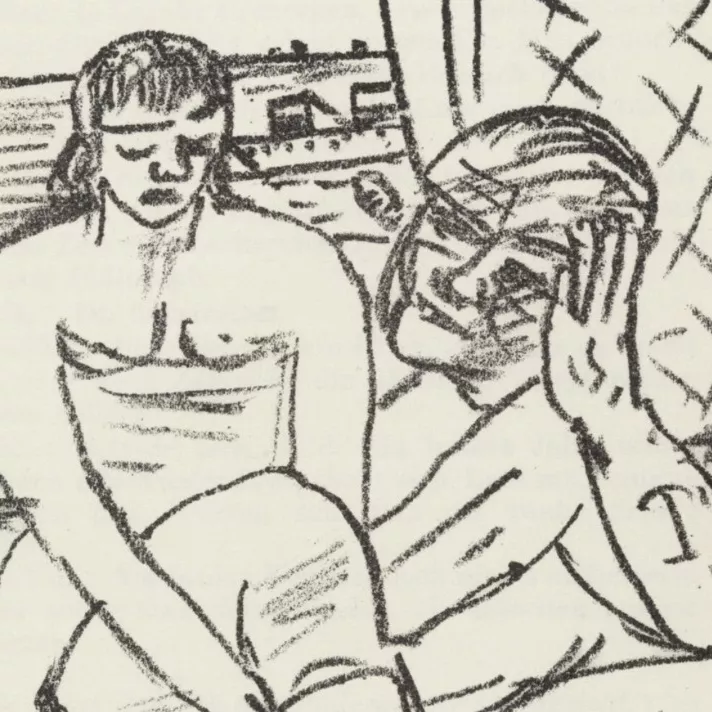
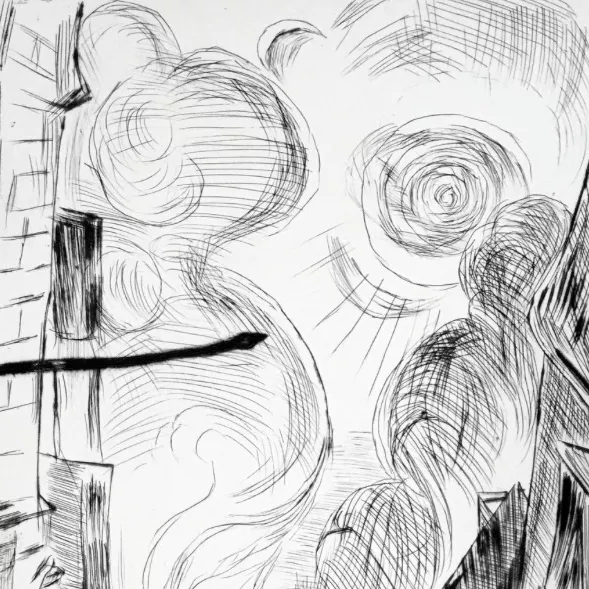
The career of Max Beckmann
Max Beckmann (1884 - 1950) was a German Expressionist who dominated the market in his category. Born in Leipzig in the German Empire, he studied at the Academy of Fine Arts in Weimar from 1900, and was trained in an academic framework before moving towards a less conventional style.
He exhibited at the Berliner Secession from 1906, and took part in international salons and exhibitions, which quickly brought him to the fore for his expressive treatment of the human figure.
During the First World War, he enlisted as a volunteer nurse, and the traumatic experience of war led to a stylistic shift towards a darker, more symbolic vision. In the 1920s, he became a major figure of New Objectivity (Neue Sachlichkeit), developing an autonomous pictorial language that blended realism, symbolism and allegory.
He became a teacher at Frankfurt's Städelschule. With the rise of Nazism, he was classified as a "degenerate" artist by the regime in 1937, and over 500 of his works were removed from German museums. He went into exile in Amsterdam the same year.
In the Netherlands, he spent several years in exile, moving to the United States in 1947. In all, he spent 20 years of his life outside Germany. Beckmann continued to paint complex cycles and triptychs, incorporating biblical, mythological and autobiographical references.
He was appointed Professor at Washington University in Saint Louis (1947 - 1949), then at the Art School of Brooklyn College in New York. He died there in 1950, leaving a dense body of work that includes over 800 paintings, numerous drawings and prints, but also a lasting influence on modern art.
He was one of those who sought to translate the horror of war through his work, as Käthe Kolwitz, Max Oppenheimer or Otto Dix.
Market segmentation and figures
For the artist, the world record stands at 48.5 M USD at Christie's in London in 2017, representing an increase of around +100% on his previous sale.
Other majors achieved very substantial prices, such as Self-Portrait with Horn, dating from 1938 and sold for €23.2m at Grisebach in Berlin, which was an all-time record for an art sale in Germany.
As for the average level of auctions, large-format canvases regularly exceed the million-dollar mark, with a marked premium for autobiographical subjects and symbolist compositions.
The market is fairly segmented for the artist, depending on his types of production. Self-portraits and large figurative compositions fetch eight-figure prices, while works on paper oscillate between 100,000 and 800,000 USD, depending on period and technique. The more accessible prints and etchings generally trade between 5,000 and 50,000 USD.
Today, demand is strong at sales in London, New York and Germany, with international competition between private collectors and institutions.
Valuation factors remain classic, with criteria such as museum provenance, exhibition in major retrospectives, belonging to emblematic thematic cycles (self-portraits, cabaret scenes, mythological reinterpretations).
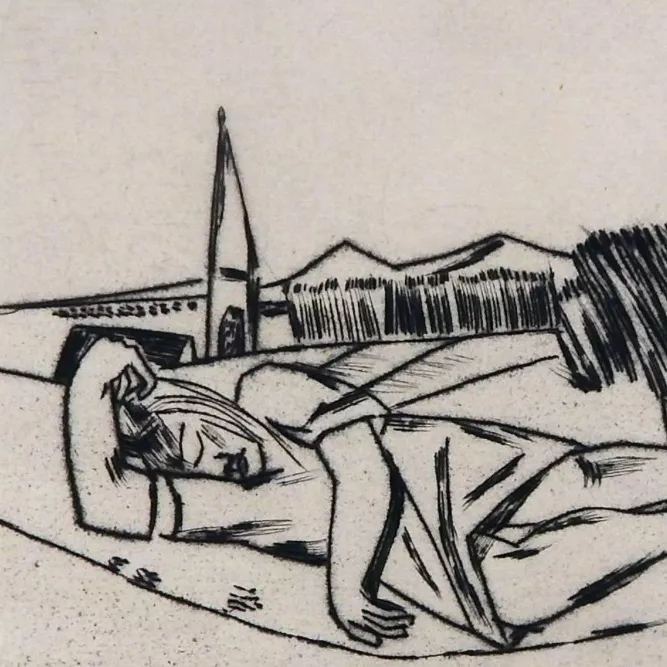
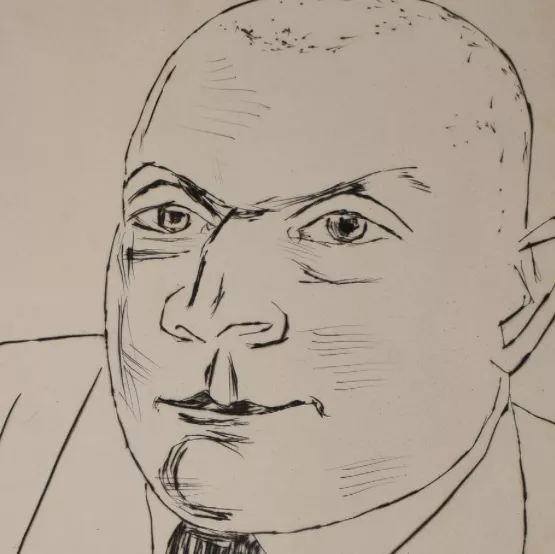
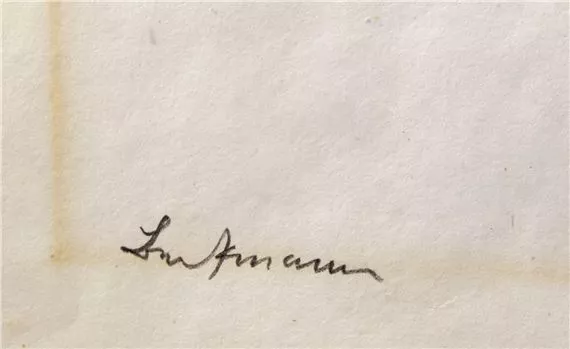
His signature
Not all of Max Beckmann's works are signed.
Although there are variations, here is a first example of his signature:
Expertise your property
If you own a work by Max Beckmann, don't hesitate to request a free appraisal by filling in our online form.
A member of our team of experts and certified auctioneers will contact you to provide an estimate of the market value of your work.
If you are considering selling your work, our specialists will also guide you through the various alternatives available to obtain the best possible price, taking into account market trends and the specific features of each object.
Estimate in less than 24h
Discover in the same theme

Rating and value of works, serigraphs, paintings by Alain Ja...
Alain Jacquet is a Figuration Nouvelle artist who introduced Pop Art. His works are quoted and successful at auction.
Learn more >

Rating and value of Russian paintings by Constantin Westchil...
Constantin Westchiloff is a Russian Impressionist painter who produced paintings that are sought after by collectors and are increasing in value.
Learn more >

Rating and value of paintings by Lovis Corinth
Lovis Corinth is a German Expressionist painter who produced works that are highly rated and valued at auction. 24h estimate.
Learn more >
D'autres tableaux expressionnistes vendus aux enchères


Secure site, anonymity preserved

Auctioneer approved by the State

Free and certified estimates
Frequently asked questions
-
Who is Max Beckmann, and what is his historical context?Max Beckmann (1884–1950) was a leading German Expressionist who trained at the Weimar Academy. His traumatic experience as a nurse during World War I shaped his stylistic evolution toward a dark and symbolic vision. A key figure in New Objectivity (Neue Sachlichkeit) in the 1920s, he was declared a “degenerate” artist by the Nazi regime in 1937, forcing him into exile first to the Netherlands and then to the United States, where he continued to paint complex series and triptychs until his death.
-
What is the price range for Max Beckmann's works?Auction prices for works by Max Beckmann vary considerably depending on the medium and the artist’s reputation: prints and multiples sell for between €5 and €355,000, drawings and watercolors between €280 and €1,797,300, and paintings between €500 and €36,448,000. The world record stands at $48.5 million for his painting “Hölle der Vögel” (1937–38). Self-portraits and large figurative compositions regularly fetch several million euros, while works on paper range from 100,000 to 800,000 USD.
-
How do you authenticate and appraise a work by Max Beckmann?To authenticate and appraise a work by Max Beckmann, we recommend that you request a free, no-obligation appraisal from Auctie's. A member of our team of experts and licensed auctioneers will contact you to evaluate your artwork and provide you with an accurate estimate of its market value. We will respond within 48 hours.
-
What factors influence the value of a work by Beckmann?The value of Max Beckmann’s works depends on several criteria: museum provenance, inclusion in major retrospectives, belonging to iconic thematic cycles (self-portraits, cabaret scenes, mythological reinterpretations), the work’s format, and the period in which it was created. Self-portraits and large figurative compositions command the highest prices, while works on paper are generally less expensive.
-
Is this the right time to sell a work by Max Beckmann?Yes, now is a good time to sell a work by Max Beckmann. Demand remains strong on the international market, particularly at auctions in London, New York, and Germany, with active competition between private collectors and institutions. Prices continue to show positive growth, especially for prestigious works and key periods of his career.
