



Rating and value of Otto Dix's paintings, drawings and prints

Key takeaways
- Otto Dix, a 20th-century German Expressionist painter, has works that fetch between €10 and €5,098,190 at international auctions.
- His oil-on-canvas paintings are among his most prestigious works, with prices ranging from €2,860 to €5,098,180, while his watercolor drawings range from €200 to €1,518,880.
- In 2016, his painting "Schwangeres Weib" (1919) sold for €3,159,840, exceeding its initial estimate of €2.6 to €2.9 million.
If you own a work by or based on the work of the artist Otto Dix and would like to know its value, our state-approved experts and auctioneers will guide you. Our specialists will carry out a free appraisal of your work, and provide you with a precise estimate of its value on the current market. Thereafter, if you wish to sell your work, we will direct you to the best possible arrangement to obtain the optimum price.
Artist's rating and value
On the art market, Otto Dix's rating is quite high. His most prized works are his expressionist canvases and his drawings of broken faces. The artist is particularly prized among 20th-century German painters and draughtsmen. Otto Dix's works sell for between €10 and €5,098,190 at auction. In 2016, his painting Schwangeres Weib (oil on canvas), dating from 1919, fetched €3,159,840, while it was estimated at €2,633,200 to €2,949,800.
Order of value from the most basic to the most prestigious
Technique used | Result | Estamp - multiple | From €10 to €326,270 |
|---|---|
Drawing - watercolor | From €200 to €1,518,880 |
Oil on canvas | From €2,860 to €5,098,180 |
Estimate in less than 24h
The artist's style and technique
Otto Dix belongs to the Expressionist movement, particularly German Expressionism. His compositions incorporate numerous references to the history of German art. He was one of the founders of the New Objectivity movement during the Weimar Republic, which brought together post-Expressionist artists whose works had a rather anti-establishment slant. He is the author of numerous paintings, as well as drawings and prints.
Part of the story
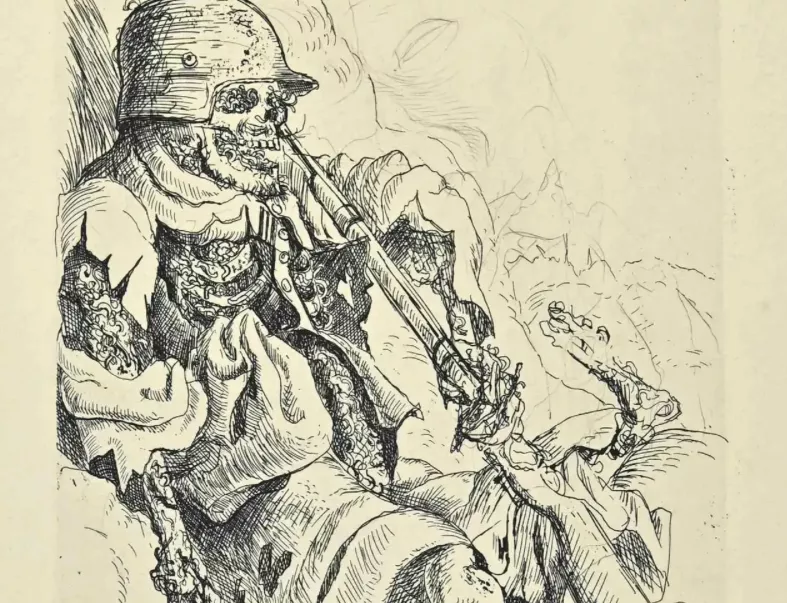
Otto Dix, from soldier portraits to degenerate art
Otto Dix (1891-1962) was a 20th-century German painter and printmaker.
He grew up in a working-class environment, where he received an artistic education from his mother. At a relatively young age, he took drawing lessons from Ernst Schunke and Carl Senff, the latter of whom questioned his pupil's talent. He entered the Dresden School of Applied Arts, where he produced his first Cubist and Futurist works, and was also influenced by the Dada group, thanks to a scholarship provided by the Prince of Reuss. He studied there until 1914 - when he was drafted into the German army. He spent a long time in training camp, and was sent to the front in 1915, having volunteered. He was trained as a machine-gunner, which enabled him to take part in several military campaigns, but also traumatized him for life. He emerged from the experience alive, albeit with significant physical and psychological injuries.
He bears witness to this quite violently in his painting, first producing a series of etchings entitled Der Krieg, then meticulously composed oils on canvas, part of the post-war pictorial trend advocating a return to order, aimed at safeguarding male virility called into question by the war - not least because of the soldiers' physical appearance, but also because of their traumas. Otto Dix's work is deeply marked by his fears, and he had violent nightmares long after the war, which he tried to express in his paintings. He wrote: " I dreamed that I had to crawl through ruined houses (seriously), through corridors where I could barely pass. Ruins were always present in my dreams ".
He fights the figure of the New Woman (cf Portrait of the journalist Sylvia von Harden), until the Nazis come to power. Otto Dix was one of the first to be sacked, his works labelled " degenerate " by the Nazis in 1937. His triptych War, the result of three years' work up to 1931, was banned by the Nazi authorities.
All his life, his aim was to transcribe the reality and violence of war in art.
He died in 1969 in Germany.
Otto Dix's imprint on his time
Otto Dix was one of the most celebrated painters of his era. The author of a considerable output, his works are exhibited in museums around the world, but it is private collectors who play the greatest role in preserving his work. He left a lasting mark on twentieth-century art history, and remarkably documented the physical and emotional plight of soldiers who came out of the Great War alive.
His signature
Although there are variations, here's a first example of his signature:

Expertise your property
If you happen to own a work by or after Otto Dix, don't hesitate to request a free valuation by filling in our form on our website. A member of our team of experts and certified auctioneers will contact you promptly with an estimate of the value of your work, as well as any relevant information you may require. If you are planning to sell your work, our specialists will also work with you to find alternatives for selling it at the best possible price, taking into account the inclinations of the market and its specific features.
Estimate in less than 24h
Discover in the same theme

Rating and value of works, drawings, paintings by Pierre Nar...
Pierre Narcisse Guérin was a 19th-century neoclassical painter who produced paintings and oil on canvas that were highly prized at auction.
Learn more >

Rating and value of paintings by Nicolas Kalmakoff
Nicolas Kalmakoff is a twentieth-century Russian Symbolist painter whose works are highly valued at auction.
Learn more >

Rating and value of sculptures, bronzes and drawings by Char...
Charles Malfray is a twentieth-century sculptor who produced works that are highly regarded and valued at auction. Free estimate.
Learn more >
Works from the same period sold at auction

Estimated 2 000 € - 3 000 €
Delphin ENJOLRAS (1857-1945) "A Midsummer Night's Dream", Oil on canvas

Estimated 15 000 - 20 000 €
Jean HENNINGER (1916-1994) Hunting scene.

Estimated Between €5,000 and €8,000
KRACHKOWSKY (1854-1914), Before the storm, oil on canvas

Secure site, anonymity preserved

Auctioneer approved by the State

Free and certified estimates
Frequently asked questions
-
Who is Otto Dix, and what is his artistic context?Otto Dix (1891–1962) was a major German painter and printmaker of the 20th century and the founder of the New Objectivity movement during the Weimar Republic. His work, deeply influenced by his traumatic experience of World War I, is part of the German Expressionist movement and aims to document, with raw intensity and realism, the physical and psychological scars of soldiers. His works were labeled “degenerate art” by the Nazis in 1937, a testament to their subversive nature.
-
What is the price range for Otto Dix's works, depending on the medium?Prices for works by Otto Dix vary considerably depending on the medium: prints and multiples range from €10 to €326,270, drawings and watercolors from €200 to €1,518,880, and oil paintings on canvas from €2,860 to €5,098,180. In 2016, his painting *Schwangeres Weib* (1919) sold for €3,159,840 at auction, exceeding its initial estimate.
-
How can I authenticate and have a work by Otto Dix appraised?To authenticate and appraise a work by Otto Dix, we recommend requesting a free estimate from Auctie's by filling out the form available on our website. A certified expert or auctioneer will contact you shortly to examine the artwork and provide you with an accurate estimate of its current market value, with no obligation on your part.
-
Is this the right time to sell a work by Otto Dix?Yes, now is a good time to sell a work by Otto Dix. The market for this 20th-century German artist remains vibrant, and his works—particularly his Expressionist paintings and drawings of traumatized soldiers—continue to be highly sought after by collectors and museums around the world. Our experts can advise you on the best sales strategy based on your artwork and current market conditions.
-
How does the sale of a work of art work at Auctie's?At Auctie's, we support sellers every step of the way: a free, no-obligation appraisal by an expert, advice on market conditions, and auction listings to achieve the best possible price. Our team of licensed auctioneers manages the entire process, taking into account the unique characteristics of the art market and the expectations of collectors.
