



Market Value and Price of Etel Adnan's Paintings, Drawings, and Artworks

Key takeaways
- Etel Adnan’s oil-on-canvas paintings sell for between €250 and €409,080, with prices rising sharply since 2012.
- The Lebanese-American artist (1925–2021) developed a refined, colorful style of abstraction using simple geometric shapes and dense blocks of color applied with a palette knife.
- Her prints range from €280 to €12,210, while her watercolor drawings fetch between €800 and €104,600, depending on the technique.
If you own a work by the artist Etel Adnan or based on his work and would like to know its value, our state-approved experts and auctioneers will guide you.
Our specialists will carry out a free appraisal of your work, and provide you with an accurate estimate of its value on the current market.
Then, should you wish to sell your work, we will direct you to the best possible arrangement to obtain the optimum price.
Rating and value of the artist Etel Adnan
Etel Adnan is a well-known artist among modern and contemporary art lovers. Now, prices for her works are rising at the auctioneers' gavel.
Her oils on canvas are particularly prized, especially by American buyers, and the price at which they sell on the art market ranges from €250 to €409,080, a large delta but one that speaks volumes about the value that can be attributed to the artist's works.
In 2024, his untitled oil on canvas from 1970 sold for €409,080, while it was estimated at between €175,320 and €233,760. Its value is rising sharply.
Order of value from the most basic to the most prestigious
Technique used | Result |
|---|---|
Estamp - multiple | From 280 to 12 210€ |
Drawing - watercolor | From 800 to 104 600€ |
Painting | From 250 to 409 080€ |
Estimate in less than 24h
The works and style of Etel Adnan
Etel Adnan (1925 - 2021) is a Lebanese-American artist, poet and thinker who produced a singular and free pictorial oeuvre. She is at the origin of a production that can be described as colorful, synthetic and direct abstraction.
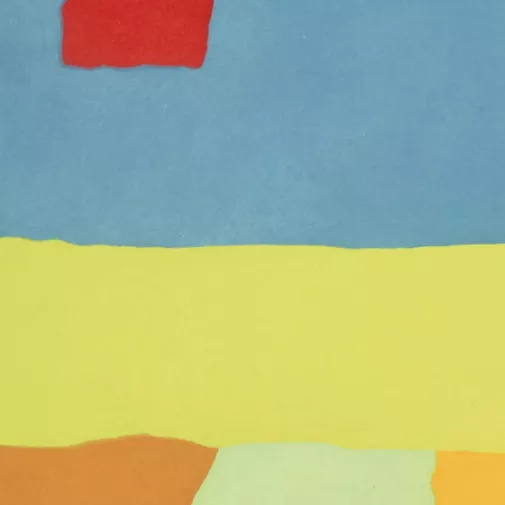
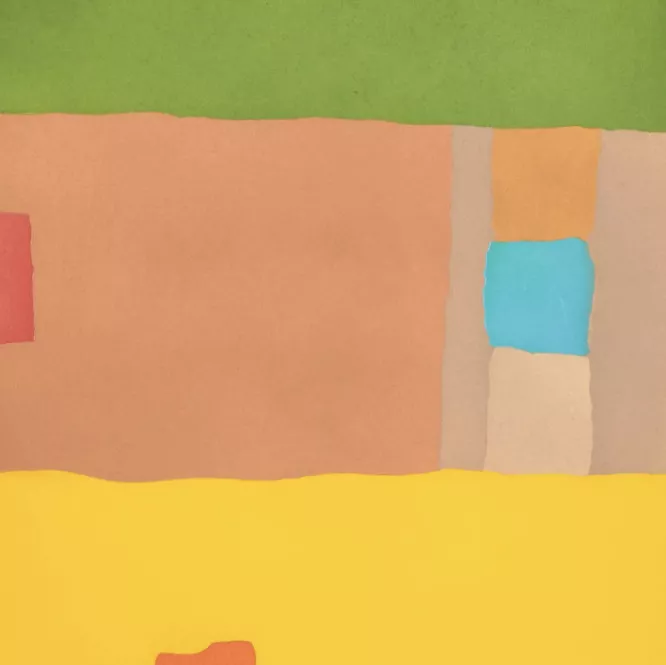
From the 1970s, Etel Adnan developed a very pared-down abstract painting, composed of simple geometric shapes (sun, mountain, sea, square, stripe, circle) that are often laid flat on colored backgrounds.
She refuses all descriptive naturalism; her painting is a condensation of sensations, inner spaces and lived horizons. The recurring motif of the mountains (particularly Mount Tamalpais) becomes a kind of sensitive and spiritual axis of her work.
She works mostly in oil on small format, often on modest-sized panels or canvases, used with painting knives (not brushes) to apply the material in dense, clean, unrepentant flat tints.
Painting is laid down with direct, joyful energy, without detailed planning and close to the act of writing (which she is also very familiar with in her career) or musical composition.
The colors she uses are intense and frank : lemon yellow, poppy red, indigo blue, emerald green and frank pink. They are often juxtaposed in large flat tones, the hues not seeking classical harmony but a vibrant tension.
Each color has an affective and spiritual value for Etel Adnan, which is not symbolic but fully experienced by the artist. Her art is closely linked to writing, as she was first a poet and philosopher, and painting appears as another form of language parallel to poetry.
The pictorial space is conceived as a place of breathing, balance and awakening, and is influenced by her vision of the world and her exiles (Lebanon, California, France). She speaks of painting as a " place of silence " where thought and emotion take shape in ways other than words.
Far from academism and aggressive avant-gardes, she develops an intuitive painting style, deeply personal yet immediately accessible and legible. Her work has often been compared to the tradition of Oriental painting, miniatures, Japanese art or American modernism. Despite this, she has never claimed any particular allegiance.
She embodies a luminous, meditative pictorial gesture, rooted in the everyday yet open to transcendence.
.
The life of Etel Adnan
Etel Adnan (1925 - 2021) is a major artistic and literary figure of the 20th and 21st centuries. Born in Beirut into a multicultural family, her Syrian Muslim father was an Ottoman officer, and her Greek Christian mother from Smyrna a refugee after 1922.
Her mother tongue is Greek, but she also speaks Arabic, French and English. This profound multilingualism shapes all her work. Her childhood was marked by exile and cultural upheaval, but also by the beauty of the Lebanese landscape, which she would cherish for the rest of her life.
She studied philosophy at the Sorbonne, then in the USA at Berkeley and Harvard in the 50s. She then moved to California, where she taught philosophy at the University of San Rafael for over twenty years.
Etel Adnan began writing in English in the 1960s, returning to French in the 1970s. She wrote numerous essays, poems, diaries, plays and various stories, including L'Apocalypse arabe (1975) and Sitt Marie-Rose (1978), an emblematic account of the civil war in Lebanon.
Her pen blends lyricism, commitment, political meditation and the experience of exile, with a voice that is both personal and universal. She takes a clear stand against war, injustice and cultural oppression, while refusing to adopt an ideological stance.
She began painting in the 1970s, first in California, then in Paris, seeing painting at the time as a silent extension of poetry. She also works with tapestry, leporello (painted accordion books) and ceramics, affirming a free, cross-disciplinary practice.
Etel Adnan doesn't claim to belong to any movement, but she is belatedly being recognized as a major figure in contemporary poetic abstraction. From the 2010s onwards, her painting has enjoyed renewed international interest with exhibitions at Documenta 13 (Kassel, 2012), the Musée de l'Institut du Monde Arabe and the Centre Pompidou (2021).
Today, in the image of some of its fellow artists such as Janet Sobel, Vera Molnar or Tamara de Lempicka, her valuation is rising sharply and her works are attracting considerable interest on the art market.
She died in Paris in November 2021, aged 96. Bequeathed with a double oeuvre (visual and literary), she is today considered one of the greatest artistic voices of the modern Mediterranean, and a living bridge between East and West.
Focus on Untitled, Etel Adnan, circa 2014, oil on canvas
Etel Adnan makes this untitled work circa 2014. It is a small format painted in oil on canvas. The composition is described by a large square of color set against a contrasting background, with horizontal stripes, a circle evoking a star and flat tints juxtaposed without gradation.
The composition is geometric but free, without mathematical rigidity : the shapes float and balance from one edge to the other. Using the painting knife, colors are applied in dense, clean, non-transparent layers, creating opaque, flat and powerful surfaces.
No texture is visible, the material is smooth, sometimes streaked by the passage of the knife, but without impasto or repentance. The primary and secondary colors are highly saturated (burnt orange, pure yellow, bright pink, midnight blue and grass green, laid side by side without transition).
The juxtaposition creates a vibrant chromatic tension, a play between warmth and coldness and between light and mass. Each hue seems autonomous, conveying an inner climate or sensation, without mimicking reality.
Even without a title, the canvas often evokes a mental landscape (sea, mountain, sun, sky) reduced to their elementary structures). The circle can be read as a star, an eye or even a solar enigma (a fixed presence in a moving composition).
The work thus gives the impression of a moment suspended in space, without narrative or classical depth but more in the spirit of a visual meditation.
This abstraction is born of direct experience of the landscape and a relationship to territory and memory (notably Mount Tamalpais in California), but also of exile, displacement and memory.
The pictorial space thus becomes an inner place that is not representation but condensation (what the mountain, sea and light have left in the mind). The work thus embodies a form of silent language, the pictorial equivalent of Adnan's poetry.
This painting is typical of the artist's last period : synthetic, dense, luminous and concise, it concentrates his gesture and thought. It illustrates the artist's ability to build a world in a few forms, quietly and without discourse, but with an almost archaic obviousness.
It also shows the visual force of an emotional and meditative abstraction, free from any school but nevertheless anchored in reality.
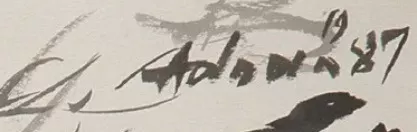
His signature
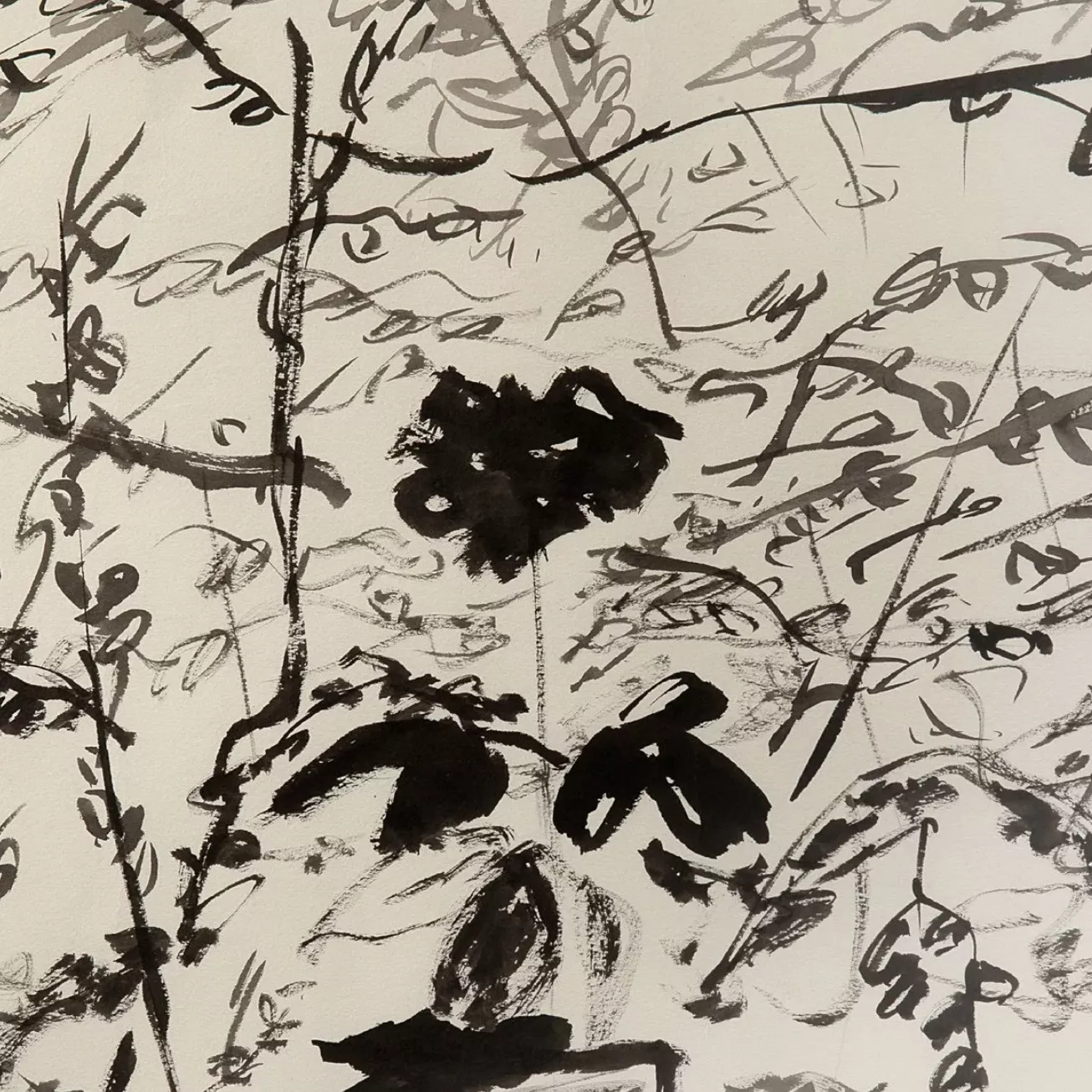
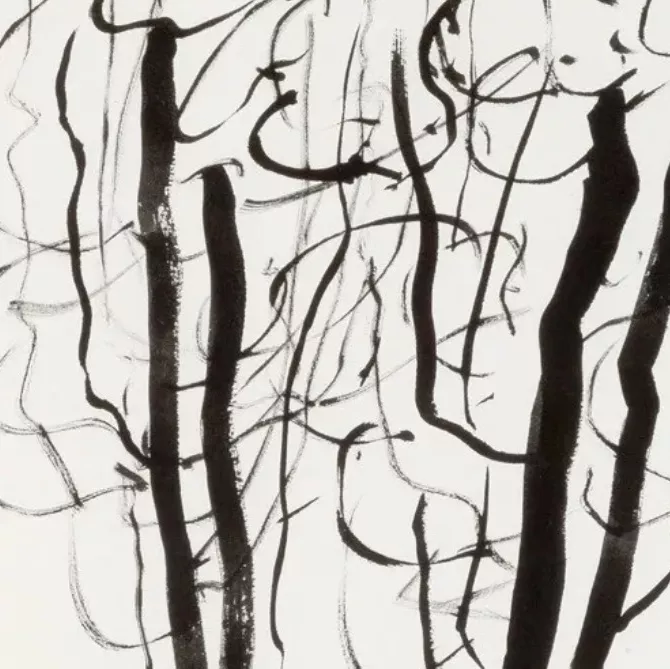
Not all Etel Adnan's works are signed.
Although there are variations, here is a first example of his signature:
Expertise your property
If you own a work by Etel Adnan, don't hesitate to request a free appraisal by filling in our online form.
A member of our team of experts and certified auctioneers will contact you to provide an estimate of the market value of your work.
If you are considering selling your work, our specialists will also guide you through the various alternatives available to obtain the best possible price, taking into account market trends and the specific features of each work.
Estimate in less than 24h
Discover in the same theme

Rating and value of paintings, drawings and engravings by Gu...
Gustave Doré was a 19th-century Romantic illustrator, painter and engraver. His works are highly valued at auction.
Learn more >

Rating and value of Caesar's sculptures, jewelry and expansi...
César is a French sculptor of the Nouveau Réalisme movement who has produced works that are highly valued on the auction market.
Learn more >

Rating and value of paintings by Arnulf Rainer
Arnulf Rainer is an abstract Austrian artist who has produced works that are highly regarded and valued.
Learn more >
D'autres tableaux abstraits vendus aux enchères

Estimated 2.000 - 4.000
Serge POLIAKOFF (1900-1969), Composition en rouge et bleu. 1965, Lithograph

Estimated Between €5,000 and €8,000
Jean MIOTTE (1926-2016), acrylic on canvas

Estimated 3.000 - 5.000
Roberto MATTA (1911-2002), Composition, Gouache on canvas

Secure site, anonymity preserved

Auctioneer approved by the State

Free and certified estimates
Frequently asked questions
-
Who is Etel Adnan, and what is her artistic style?Etel Adnan (1925–2021) was a Lebanese-American artist, poet, and thinker who pioneered contemporary poetic abstraction. Her style is characterized by a colorful, minimalist abstraction composed of simple geometric shapes (mountains, suns, circles, bands) with intense, bold colors juxtaposed in dense blocks, creating a vibrant tension without seeking classical harmony. She viewed painting as a “place of silence” where thought and emotion take shape, paralleling her poetic work.
-
What are the prices and price range for works by Etel Adnan?The prices of Etel Adnan’s works vary depending on the medium: paintings (oil on canvas) range from €250 to €409,080, drawings and watercolors from €800 to €104,600, and multiple prints from €280 to €12,210. Her market value has been rising sharply since 2010; she is particularly sought after by American buyers, with auction results regularly exceeding initial estimates.
-
How can you authenticate a work by Etel Adnan and determine its exact value?To authenticate a work by Etel Adnan and obtain an accurate estimate, we recommend that you submit a request for a free appraisal via our online form. A state-certified expert or auctioneer from our team will contact you within 48 hours to evaluate your artwork and provide you with a reliable estimate of its current market value, with no obligation.
-
Is this the right time to sell a work by Etel Adnan?Yes, now is a very good time to sell a work by Etel Adnan. Her market value has been rising sharply since the 2010s, bolstered by growing international recognition (Documenta 13, Centre Pompidou, Arab World Institute). As with Janet Sobel and Vera Molnar, market interest in this major artist of poetic abstraction continues to grow.
-
How does the sale of a work of art work at Auctie's?Auctie's guides you from appraisal to auction. After a free, no-obligation appraisal by our experts, we’ll help you choose the best sales approach for your artwork based on market trends and its specific characteristics. Our licensed auctioneers manage the entire process to secure the best possible price for you.
