



Rating and value of paintings by Vera Molnar

Key takeaways
- Vera Molnar (1924–2023), a French pioneer of digital art and geometric abstraction, revolutionized art creation as early as the 1960s with the use of computers.
- Her works sell for between €80 and €102,600, with prices skyrocketing since 2020, particularly for works from the 1970s.
- NFTs and multiple prints dominate the market (€80 to €102,600), while watercolor drawings and paintings remain more affordable (€300 to €46,230).
If you own a work by or based on the artist Vera Molnar and would like to know its value, our state-approved experts and auctioneers will guide you.
Our specialists will carry out a free appraisal of your work, and provide you with an accurate estimate of its value on the current market.
Then, should you wish to sell your work, we will direct you to the best possible arrangement to obtain the optimum price.
Artist's rating and value
A French artist of Hungarian origin, Vera Molnar won over the art critics, dealers and collectors of her day. Since then, the artist's works have established themselves as sure values on the art market.
From the 2020s onwards, her value has exploded, particularly for works created from the 70s onwards.
As a result, the price at which Vera Molnar's works sell ranges from €80 to €102,600. A digital print dating from 1974 entitled (Des)ordre sold for €94,000, whereas it was estimated at between €94,000 and €117,000.
Order of value ranging from the most basic to the most prestigious
Techniques used | Result |
|---|---|
Drawing - watercolor | From €300 to €20,500 |
Estamp - multiple | From €80 to €94,000 |
Painting | From 2,300 to €46,230 |
NFT | From €6,200 to €102,600 |
Estimate in less than 24h
The artist's works and style
Vera Molnar (1924 - 2023) is a pioneer of digital art and geometric abstraction. From the 1960s onwards, the artist used the computer to generate graphic works from simple algorithmic programs.
She used the FORTAN language and plotters to produce variable geometric compositions based on calculation and controlled chance. She calls this method " digital art avant la lettre " and seeks to create beauty through mathematical and rational processes.
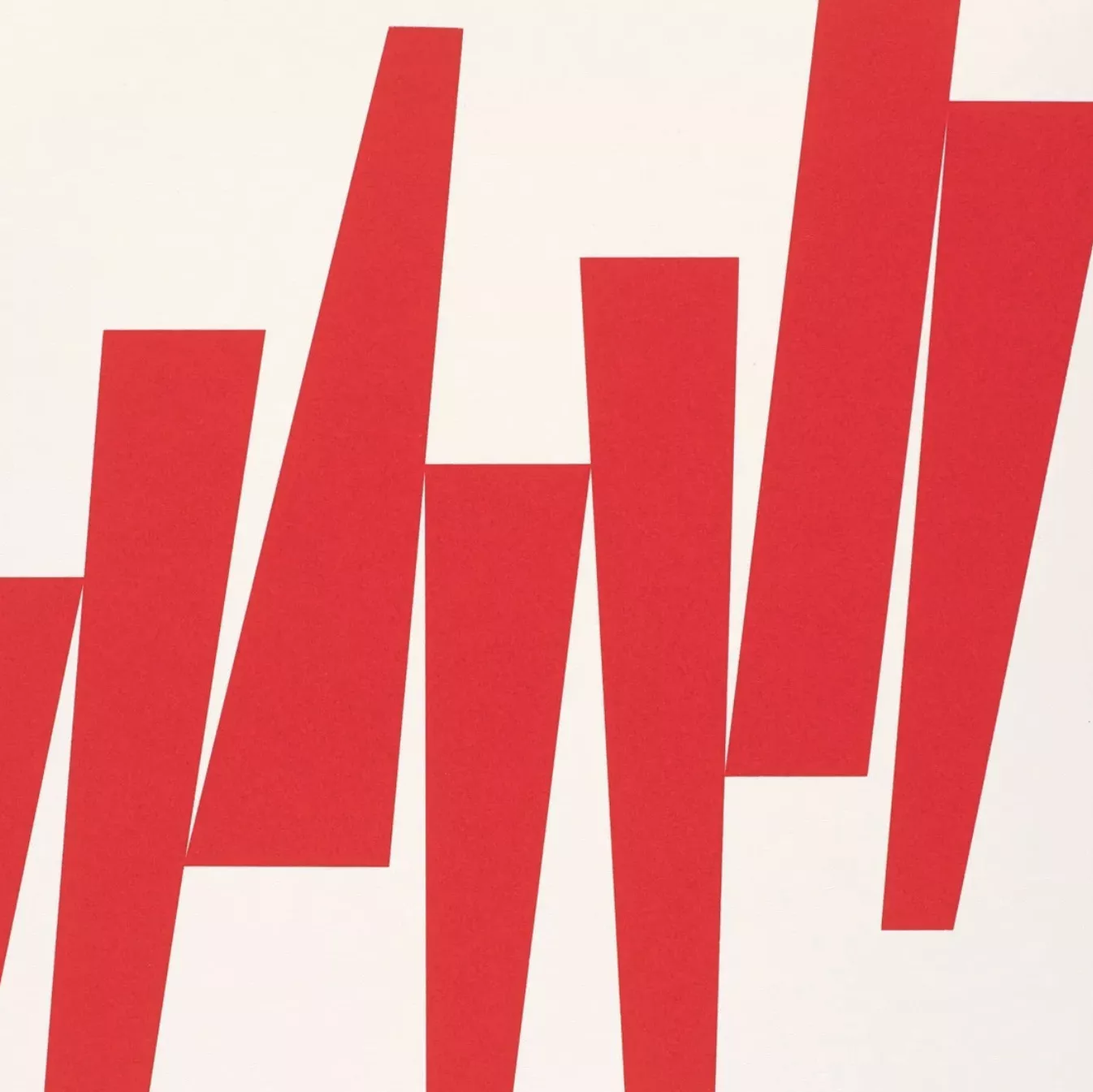
Her visual vocabulary is based on minimal forms, her abstraction radical. Squares, grids, circles, straight or broken lines are modified by slight disruptions. Patterns are often repeated with progressive alterations (rotation, translation, partial erasure) that introduce irregularity into the apparent order.
The artist describes this method as " disorder in order ", where mathematical rigor meets a poetics of the almost-chaotic. She works in black and white or reduced colors (blue, red, yellow), often flat, without modeling or gradation.
Her series play on visual rhythm, the tension between the predictable and the accidental, between structure and disruption. In this way, she tests the limits of human perception, to see at what point a motif becomes illegible or emotional.
Before her work with the computer, Vera Molnar was already experimenting with manual permutation systems in the 1950s (grids drawn with a ruler, systematic deformations). She does not replace the hand with the machine, but places it in tension with an impersonal process that is always modified by a final artistic decision.
For her, the computer is a partner in visual experimentation, not a passive tool. Behind each series is a clear protocol, often materialized by a quasi-poetic or scientific statement. She plays with the viewer's expectations and questions the notion of authorship, randomness and rational beauty.

The life of Vera Molnar
Vera Molnar (1924 - 2023) was born in Budapest, Hungary. She studied classical art, academic drawing and art history at the Budapest School of Fine Arts. She quickly became fascinated by geometric forms and abstraction, and began to develop compositions according to strict rules as early as the 1940s.
She moved to Paris in 1947 with her husband François Molnar, who was a researcher in the psychology of visual perception, and frequented concrete and constructivist art circles, particularly around Victor Vasarely, Auguste Herbin and François Morellet.
In the 1960s, she founded the GRAV (Groupe de Recherche d'Art Visuel) research group, and later Art et Informatique at IRIA. Molnar quickly established herself as a pioneer of generative art, and as early as 1968 began using the computer to create graphic works. She was one of the first in the world to exhibit algorithmic art.
Through the use of computer languages (FORTRAN), automatic plotters (plotters), she developed a method based on the deliberate disruption of regular structures, with the ambition of achieving 1% disorder in each work.
The artist defines her work as research into " presque rien ", a subtle imbalance in repetition, close to the concept of poetic error. Her recognition is late but major, as her work remains marginalized for a long time by the official history of modern art, partly due to her pioneering use of computer tools.
She was rediscovered in the 2000s, thanks to renewed interest in digital arts, systemic arts and the place of women in abstraction. Her work was exhibited around the world (Centre Pompidou, ZKM Karlsruhe, Tate Modern, Venice Biennale...)
Vera Molnar continued to produce work well into her later years, with humor, precision and fidelity to her method. She died in Paris in 2023, at the age of 99, leaving behind an immense, methodical body of work that makes her an absolute pioneer of conceptual, digital and geometric art.
The success of female artists of the 20th century at auction
Since 2020, auctions devoted to women artists have enjoyed steady growth, based on an active rereading of the market, a critical reappraisal of works, a new structuring of demand.
The figures, published by the leading auction houses, confirm this dynamic: Yayoi Kusama, Joan Mitchell, Louise Bourgeois, Georgia O'Keeffe, Cecily Brown are reaching heights rarely equaled until now, not for conjunctural reasons, but because their works are now part of a broader reading of the history of modern and contemporary art.
The results do not merely reflect a phenomenon of belated correction, they translate a transformation of the gaze, a redefinition of value.
The multiplication of thematic sales organized by Sotheby's or Christie's, exclusively dedicated to women artists, is another indication: the market is not adjusting, it is reconfiguring. Works are extracted from the margins, presented in museum contexts, published, analyzed, integrated into mainstream narratives.
This recognition is neither marginal nor temporary; it alters established hierarchies. It imposes a new cartography, in which works by Tanning, Saint Phalle, Hepworth or Leonor Fini find their place, not as objects of rehabilitation, but as constituent structures of another history.
The evolution is slow but steady: it doesn't correct an omission, it transforms the visible foundations of artistic recognition.

Her signature
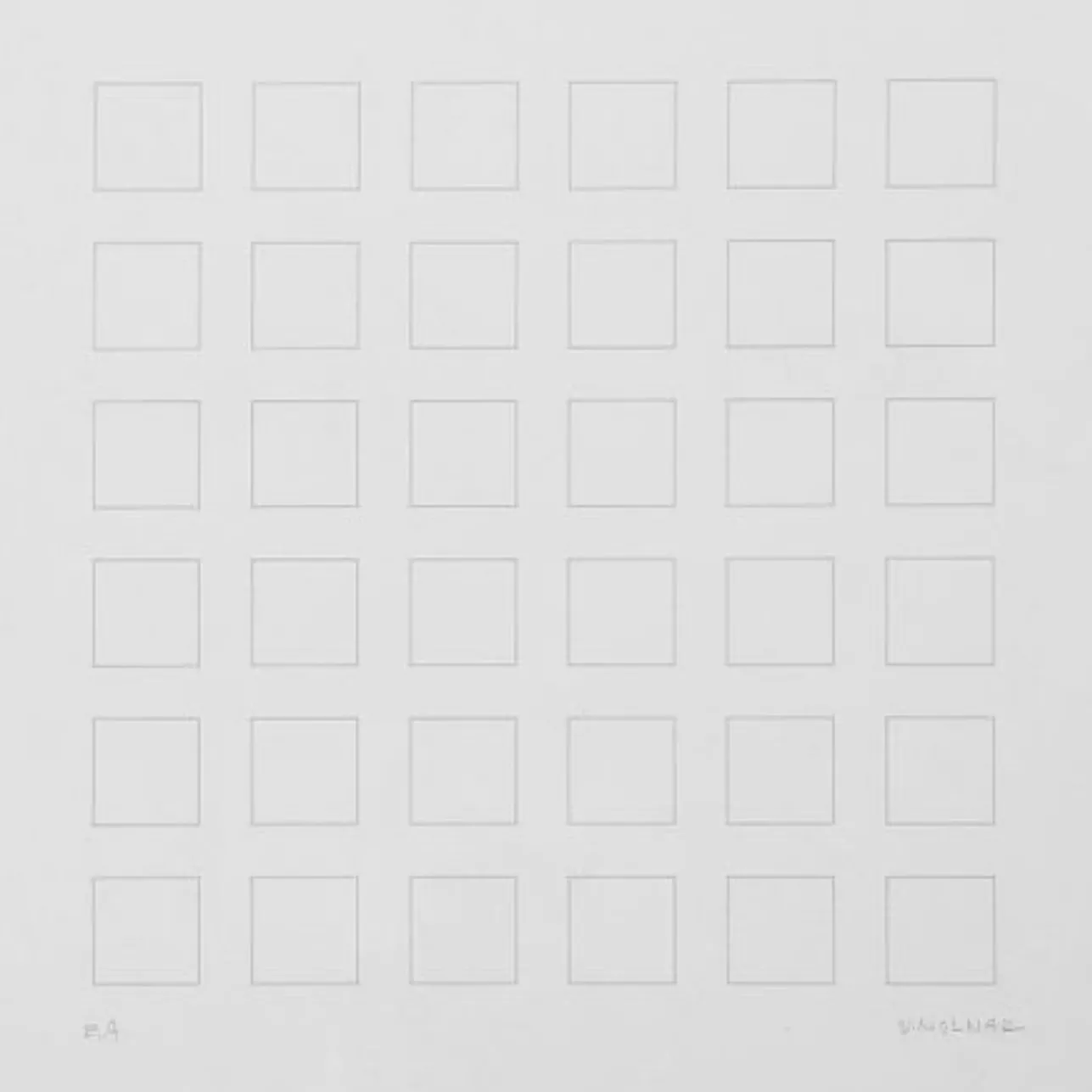
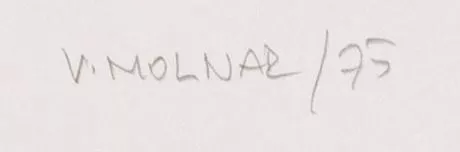
Not all of Vera Molnar's works are signed, and copies exist.
An example of her signature can be seen in the drawing below.
Expertise your property
If you own a work by Vera Molnar, don't hesitate to request a free appraisal by filling in our online form.
A member of our team of experts and certified auctioneers will contact you to provide an estimate of the market value of your work.
If you are considering selling your work, our specialists will also guide you through the various alternatives available to obtain the best possible price, taking into account market trends and the specific features of each object.
Estimate in less than 24h
Discover in the same theme

Rating and value of Claude Lalanne's sculptures
Claude Lalanne is a twentieth-century French artist whose sculptures set auction records.
Learn more >

Rating and value of sculptures, bronzes and marbles by Naoum...
Naoum Aronson is a Latvian sculptor who has produced bronzes and marbles that are highly valued at auction. Estimate in 24h.
Learn more >

Ratings and values of paintings by Alberto Savinio
Alberto Savinio is a twentieth-century Italian surrealist painter whose paintings are highly prized at auction.
Learn more >
D'autres tableaux abstraits vendus aux enchères

Estimated 2.000 - 4.000
Serge POLIAKOFF (1900-1969), Composition en rouge et bleu. 1965, Lithograph

Estimated Between €5,000 and €8,000
Jean MIOTTE (1926-2016), acrylic on canvas

Estimated 3.000 - 5.000
Roberto MATTA (1911-2002), Composition, Gouache on canvas

Secure site, anonymity preserved

Auctioneer approved by the State

Free and certified estimates
Frequently asked questions
-
Who is Vera Molnar, and what is her contribution to art history?Vera Molnar (1924–2023) was a French artist of Hungarian origin and a true pioneer of digital art and geometric abstraction. As early as the 1960s, she used computers and the FORTRAN programming language to generate algorithm-based geometric compositions, grounding her method in the concept of “disorder within order.” Although long marginalized by the official history of art, she was rediscovered in the 2000s and recognized as a major figure in conceptual, generative, and systemic art.
-
What is the current price range for Vera Molnar's works?Prices for Vera Molnar’s works range from €80 to €102,600, depending on the medium and period. Watercolor drawings range from €300 to €20,500, prints from €80 to €94,000, paintings from €2,300 to €46,230, and NFTs from €6,200 to €102,600. His market value has risen significantly since 2020, particularly for works dating from the 1970s and later.
-
How can you authenticate a work by Vera Molnar and determine its value?To authenticate and appraise a work by Vera Molnar, we recommend that you request a free, no-obligation appraisal from Auctie's. Our team of experts and state-certified auctioneers will examine your artwork and provide you with an accurate estimate of its market value within 48 hours. Please note: some works are unsigned, and copies exist, which is why a professional appraisal is so important.
-
Is this a good time to sell a work by Vera Molnar?Yes, now is an excellent time to sell a work by Vera Molnar. Her market value has skyrocketed since 2020, as part of the major rediscovery of 20th-century women artists at auction. Museums around the world (the Centre Pompidou, Tate Modern, Venice Biennale) recognize her importance, and demand for her works—particularly those from the 1970s onward—continues to rise.
-
How does the sale of a work of art work at Auctie's?Auctie's supports you every step of the way: a free appraisal by our experts, advice on the best sales approach based on your artwork and market trends, and then the auction. Our licensed auctioneers ensure a transparent and professional process, maximizing your final sale price while taking into account the unique characteristics of each artwork.
