



Rating and value of works, drawings, paintings by Léon Bakst

Key takeaways
- Léon Bakst, a leading figure in the Russian "World of Art" movement, created sets and costumes for Diaghilev's Ballets Russes between 1902 and 1924.
- Bakst’s works fetch exceptional prices: charcoal drawings up to 1 million euros, paintings ranging from 130 to 812,790 euros, and watercolor drawings ranging from 80 to 1,001,280 euros.
- His designs for *Scheherazade* (1910) combine silks, brocades, pearls, and saturated colors inspired by Orientalism, influencing 20th-century fashion and the decorative arts.
If you own a work by or based on the artist Léon Bakst and would like to know its value, our state-approved experts and auctioneers will guide you.
Our specialists will carry out a free appraisal of your work, and provide you with a precise estimate of its value on the current market.
Then, if you wish to sell your work, we will direct you to the best possible arrangement to obtain the optimum price.
Artist's rating and value
Considered one of the leading members of the Russian art movement "The World of Art", Léon Bakst designed numerous sets and costumes for composer Diaghilev's famous company.
Also a painter and draughtsman, Léon Bakst enjoyed a certain reputation during his lifetime, establishing himself as a major figure on the art market.
Today highly rated and sought after by collectors, the price of works by Léon Bakst soars at auction and can exceed the million euro mark, such as his charcoal on paper The yellow Sultana, auctioned in 2012.
Order of value from the most basic to the most prestigious
Technique used | Result |
|---|---|
Estamp - multiple | From €35 to €69,220 |
Paintings | From €130 to €812,790 |
Drawing - watercolor | From €80 to €1,001,280 |
Estimate in less than 24h
The artist's works and style
Léon Bakst (1866-1924) was a Russian painter. His practice was multi-faceted: drawing, gouache, watercolor, ink, tempera on paper or cardboard for his costume and set designs. He uses vivid, saturated pigments, sometimes enhanced with gold or silver, to achieve the effects of scenic brilliance.
His sketches are executed with a supple, calligraphic line, simultaneously specifying silhouette, volume and movement. His chromaticism is extremely bold and innovative (juxtaposition of intense complementary colors : reds/greens, blues/oranges, purples/yellows).
His work is directly influenced by the arts of the Orient, Persia and India, with polychromy inspired by oriental textiles, miniatures and carpets.
Bakst seeks a scenography of color, where each chromatic contrast produces a psychological and visual impact on the viewer. The line is elegant, sinuous and often exaggerated, inherited from Art Nouveau and Japanese prints. The figures are stylized, sometimes elongated, with clean, decorative contours.
The artist shows a marked interest in body dynamics, the costume being thought of in his work as an extension of the dancers' gestures and postures. He seeks total ornamentation, with an accumulation of floral, geometric or oriental motifs, organized according to repetitive rhythms.
The costumes and sets create an immersive unievers, where the stage becomes a global work of art. Symmetry and axial compositions are very important, combined with abundant detail. His costume designs take into account textile materials: silks, brocades, pearls, feathers and precious metals.
He works in close collaboration with sewing workshops and stage designers, transforming graphic projects into tangible objects. He integrates theatrical lighting into the design, with colors and materials chosen to interact with stage lighting.
Léon Bakst is the precursor of a modernized orientalism, which breaks with the academic naturalism of 19th-century theatrical décor, linked to Diaghuilev's Russian ballets, he embodies a new aesthetic of dance, seeing costume as a dramaturgical instrument and not a mere adornment.
In its decorative language, it anticipates Art Deco, notably in its use of geometric motifs and vibrant colors.
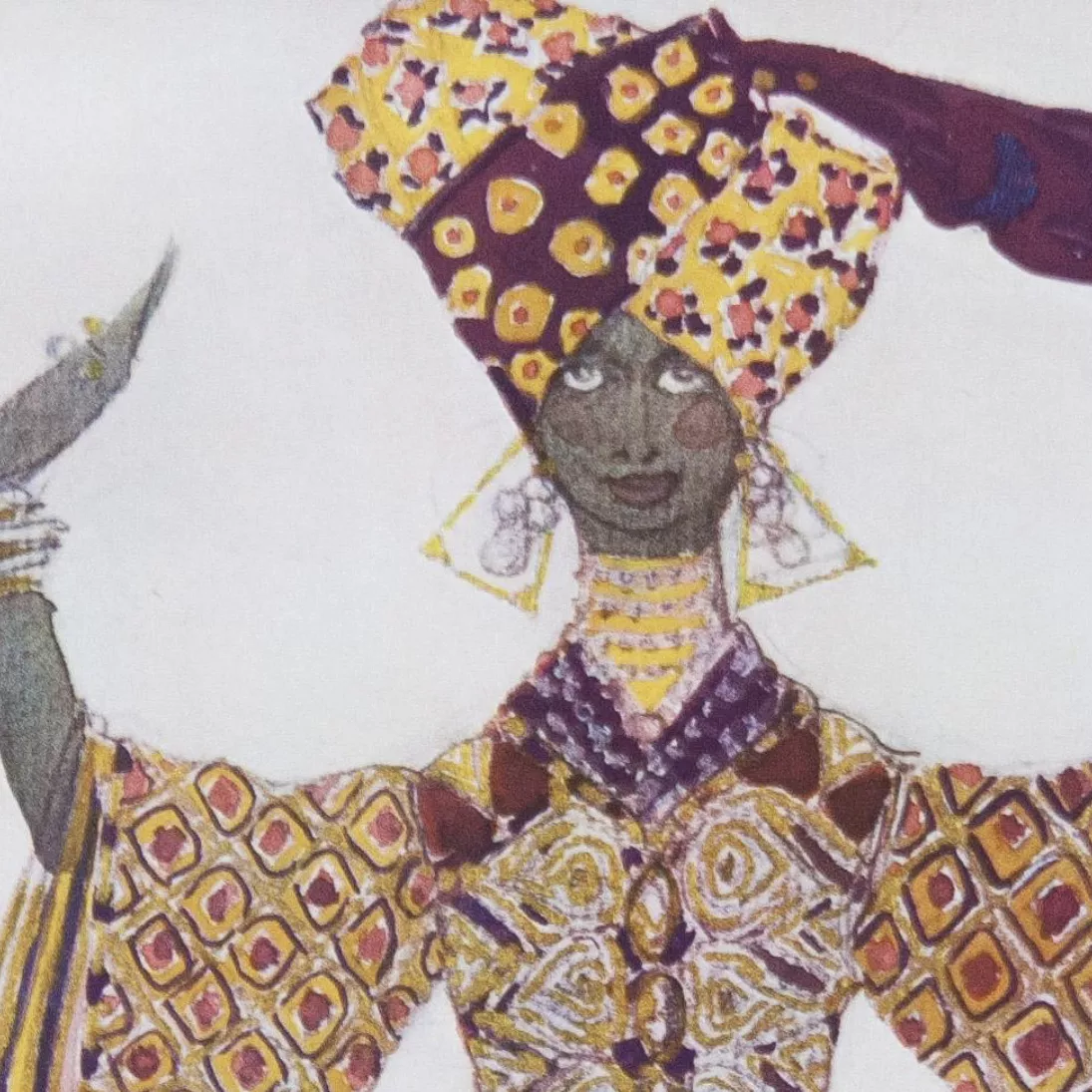
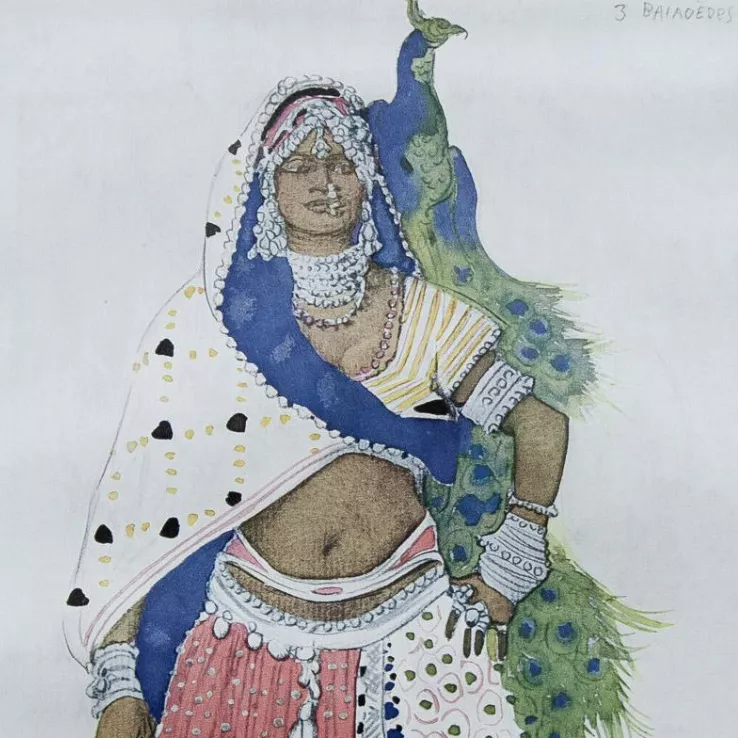
Bakst, behind the Opera sets
Leon Bakst was born in Belarus in 1866. At just 12, he won a drawing competition. He then decided to become a painter. Bakst entered the St. Petersburg Academy of Fine Arts, from which he was expelled for a Pietà judged too realistic.
After several trips to Italy, Germany and France, Léon Bakst settled in Paris. He was admitted to the Académie Julian and attended the studio of Jean-Léon Gérôme. His many travels enriched his culture, his career and his mind, culminating in a certain recognition in his native country.
After founding the magazine "Le Monde de l'art" in 1898, Bakst received commissions from Tsar Nicholas II and took part in the editorial staff of numerous Russian newspapers.
His career as a decorator began at the Imperial Ballet Theater in St. Petersburg in 1902. Five years later, he began a collaboration with the young choreographer Michel Fokine and also designed costume sketches for various ballets.
Léon Bakst thus became the favored partner of the Russian ballets.His boldly chromatic costumes and sets met with considerable success.
As an artist, Léon Bakst expressed a striking and refined personality, always driven by the desire to make an innovative contribution to the revival of modern art in his day. His influence left an indelible mark on the avant-garde, painting, as well as the fields of decorative arts and scenography in the first half of the 20th century.
Focus on drawings for Scheherazade, 1910
Scheherazade is a Russian ballet choreographed by Michel Fokine to music by Rimsky-Korsakov, dating from 1910. Bakst's role in this work was to design the costumes and sets for Serge de Diaghilev's Ballets Russes production.
Many of the models are now in the Victoria & Albert Museum in London or the National Theater Museum in St. Petersburg, but others are circulating on the art market.
The costumes are made from silks, brocades, velvets and chiffons, adorned with pearls, feathers and sequins. He uses saturated colors (gold, turquoise, purple, emerald green, carmine red). The models feature a precise, decorative design, where the fluid line clearly delineates the contours of the silhouettes.
The orientalizing ornamental motifs are very important in his work (arabesques, stylized floral motifs, geometric embroidery). The costumes visually convey the sensual exoticism of the libretto and the fantasized oriental luxuriance.
The garments are designed to amplify the dancers' movement, with light fabrics that create effects of fluidity and vibration. The chromatic palette contributes to the dramatic construction, with contrasting colors to differentiate between slaves, courtiers and the sultan. The overall effect, combined with the sets, transforms the scene into an immersive vision, saturated with color and light.
Bakst's Orientalism is not naturalistic but fantasized, as it responds to the Western taste for the exotic and elsewhere. Costumes evoke an imaginary Orient, lush and sensual, designed to stimulate the imagination of the European spectator. Later, Yves Saint Laurent would draw inspiration from his designs.
The visual pomp acts as a plastic equivalent of Rimsky-Korsakov's music, also orchestrated around exoticism. The creation of the costumes for Schéherazade marked a break with the academic naturalism of the 19th-century stage.
The costumes had a considerable influence on fashion (Paul Poiret drew inspiration from them for his orientalist collections). The ensemble is considered one of the major achievements of the Russian ballets, a symbol of the alliance between dance, painting, music and the decorative arts.
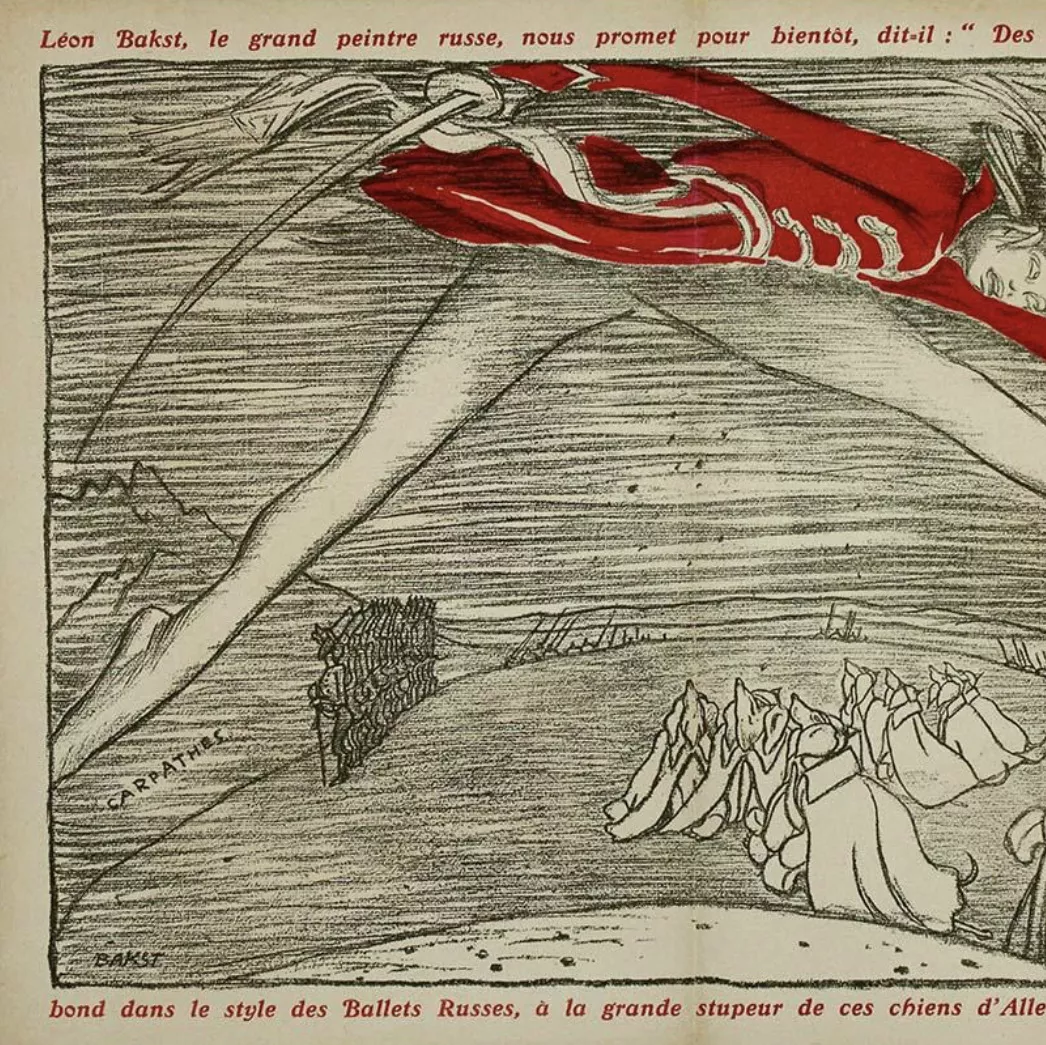
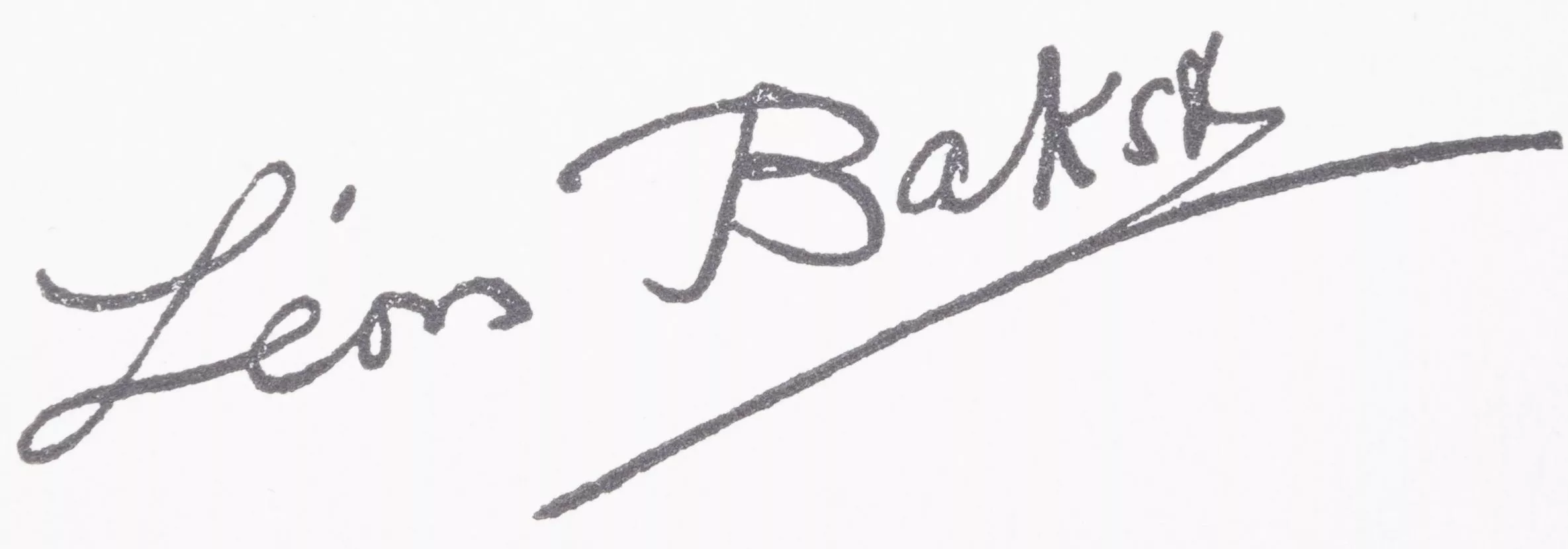
His signature
Not all of Léon Bakst's works are signed.
Although there are variants, here's a first example of his signature:
Expertise your property
If you own a work by Léon Bakst, don't hesitate to request a free appraisal by filling in our online form.
A member of our team of experts and chartered auctioneers will contact you to provide an estimate of the market value of your signed Bakst work.
If you're considering selling your work, our specialists will also guide you through the various alternatives available to obtain the best possible price, taking into account market trends and the specific features of each work.
Estimate in less than 24h
Discover in the same theme

Rating and value of Jean Prouvé furniture, chairs and desks
Jean Prouvé is a 20th-century ironmonger and designer, who produced a great deal of furniture that is highly valued at auction.
Learn more >

Rating and value of works, sculptures, paintings by Louis Ca...
Louis Cane is a 20th-century artist of narrative figuration, whose paintings and sculptures are quoted on the auction market.
Learn more >

Market Value and Pricing of Henri Manguin's Paintings, Drawi...
Henri Manguin was a Fauvist painter of the early 20th century, whose paintings are highly valued at auction.
Learn more >
Works from the same period sold at auction

Estimated 2 000 € - 3 000 €
Delphin ENJOLRAS (1857-1945) "A Midsummer Night's Dream", Oil on canvas

Estimated 600 € - 800 €
Henri ZUBER (1844-1909), Bridge at Artemare. Oil on canvas.

Estimated 3000-5000€
Alexandre Roubtzoff - View of Tunis (small format)

Estimated 3000-5000€
Alexandre Roubtzoff, Gammarth (small format)

Estimated 100-200€
Vassiliew Slavik, Oil on canvas

Secure site, anonymity preserved

Auctioneer approved by the State

Free and certified estimates
Frequently asked questions
-
Who was Léon Bakst, and why are his works so highly sought after?Léon Bakst (1866–1924) was a leading Russian painter of the “World of Art” movement and a close collaborator with Diaghilev’s Ballets Russes. He designed revolutionary costumes and sets characterized by bold colors and a modernized Orientalist aesthetic that influenced Art Deco and 20th-century fashion. His works, highly prized today, reflect his innovative approach, in which the costume becomes a dramatic and artistic tool.
-
What is the price range for Léon Bakst's works at auction?Prices vary considerably depending on the technique and the prestige of the work. Prints range from €35 to €69,220, paintings from €130 to €812,790, and watercolor drawings from €80 to €1,001,280. The most prestigious works, such as his costume designs for the Ballets Russes, can exceed one million euros.
-
How can you authenticate a work by Léon Bakst and determine its value?To authenticate and appraise a work by Bakst, we recommend that you request a free appraisal from Auctie's. Our team of experts and state-certified auctioneers will examine your item and provide you with an accurate estimate of its market value, with no obligation. You will receive a response within 48 hours.
-
Is this the right time to sell a work by Léon Bakst?Yes, now is a good time to sell. Bakst’s works remain highly valued and sought after by collectors. The market for his drawings, paintings, and theater costumes remains vibrant, particularly due to the growing interest in the decorative arts and design of the first half of the 20th century.
-
How does the sale of a work of art work at Auctie's?The process begins with a free, no-obligation appraisal conducted by our specialists. Once you accept the offer, Auctie's guides you through the entire process: appraisal, documentation, auction listing, and a guarantee of the best possible price. Our team of licensed auctioneers manages the entire process in accordance with market trends and the specific characteristics of your artwork.
