



Art Nouveau Appraisal: Valuation and Auction

Key takeaways
- The value of Art Nouveau pieces varies depending on the artist, the manufacturer, and the technique: standard Gallé vases cost €500–5,000, while one-of-a-kind pieces cost €5,000–100,000.
- Large exhibition vases and art glass signed by Gallé or Daum command the highest prices on the market due to their exceptional technical complexity.
- A free appraisal by an auctioneer within 24 hours is essential for authenticating pieces and identifying forged signatures, which are particularly common in Gallé’s work.
Curved lines, botanical motifs, and exquisite glasswork: the value of Art Nouveau pieces varies greatly depending on the designer, the manufacturer, and the technique used.
Below you’ll find all our valuation guides dedicated to Art Nouveau—signed glassware, furniture from the École de Nancy, ceramics, and jewelry. Each guide details the price ranges observed at auction and the factors that determine a piece’s value before you entrust it to our state-certified auctioneers.
Guides on this art movement
See all guides >
Rating and value of vases by Lucien Levy Dhurmer and Clément...
Clément Massier and Lucien-Lévy Dhurmer collaborated on Art Nouveau vases, which command high prices and are highly valued at auction.
Learn more >

Rating and value of drawings and paintings by Jan Toorop
Jan Toorop is a Dutch Symbolist painter whose Symbolist paintings command high prices at auction.
Learn more >

Rating and value of artists and objects by Ernest Baptiste L...
Ernest Baptiste Leveillé was a glassmaker active in the second half of the 19th century who produced vases and other objects that fetch high prices at...
Learn more >

Rating and value of vases and paintings by François Décorche...
François Décorchemont is a French Art Nouveau glass artist, ceramicist, and painter whose works fetch high prices at auction.
Learn more >

Rating and value of drawings and paintings by Henri Jossot
Henri Jossot was a 19th-century painter and draftsman who produced caricatures and Orientalist paintings that are highly valued.
Learn more >

Rating and value of boxes, inkwells and vases by Eugène Feui...
Eugène Feuillâtre is an Art Nouveau silversmith who produced few objects that have a significant value at auction. 24h estimate.
Learn more >

Rating and value of Jacques Duval-Brasseur's furniture and s...
Jacques Duval-Brasseur is an iconic French designer of the 1970s. His works are highly valued at auction.
Learn more >

Ratings and values of sculptures, bronzes and marbles by Égi...
Égide Rombaux is a Belgian sculptor whose work falls somewhere between Symbolism and Art Nouveau. Today, his works are highly valued.
Learn more >

Rating and value of Charles Greber's vases and ceramics
Charles Greber is a French ceramist who has produced works that can be highly valued at auction. 24h estimate.
Learn more >

Here's why Boucheron jewelry prices are skyrocketing at auct...
The Auctie's team explains the mechanisms behind the increase in Boucheron prices on the auction market.
Learn more >

Rating and value of Théophile Alexandre Steinlen's drawings,...
Théophile Alexandre Steinlen was a Franco-Swiss artist who produced a number of highly prized advertising posters and lithographs.
Learn more >

Rating and value of vases and ceramics by Gabriel Argy Rouss...
Gabriel Argy Rousseau is a French ceramist and glassmaker who has produced works that are highly regarded and valued at auction.
Learn more >
Understanding the Value of an Art Nouveau Piece
What Is Market Value in the Art Nouveau Market?
The market value of an Art Nouveau piece refers to the benchmark value assigned to it by the secondary market at a given time, based on the identity of the artist or manufacturer, the nature of the object, the quality of craftsmanship, its condition, the strength of the documentation, and current international demand.
Art Nouveau, which emerged in the late 19th century and flourished until World War I, was one of the first major international movements in modern decorative arts, whose influence spread from Nancy to Brussels, from Vienna to Barcelona, and through the major production centers of Paris.
This movement is characterized by a desire to reconcile art and industry, applying to everyday objects—furniture, glassware, ceramics, and jewelry—an ornamental vocabulary directly inspired by nature: curved lines, stylized plant and floral motifs, and sinuous arabesques.
This ambition, which has produced works of great technical sophistication—particularly in glass and ceramics— explains the enduring strength of demand in this market, driven both by long-standing specialized collectors and by a broader public drawn to the timeless elegance of this aesthetic.
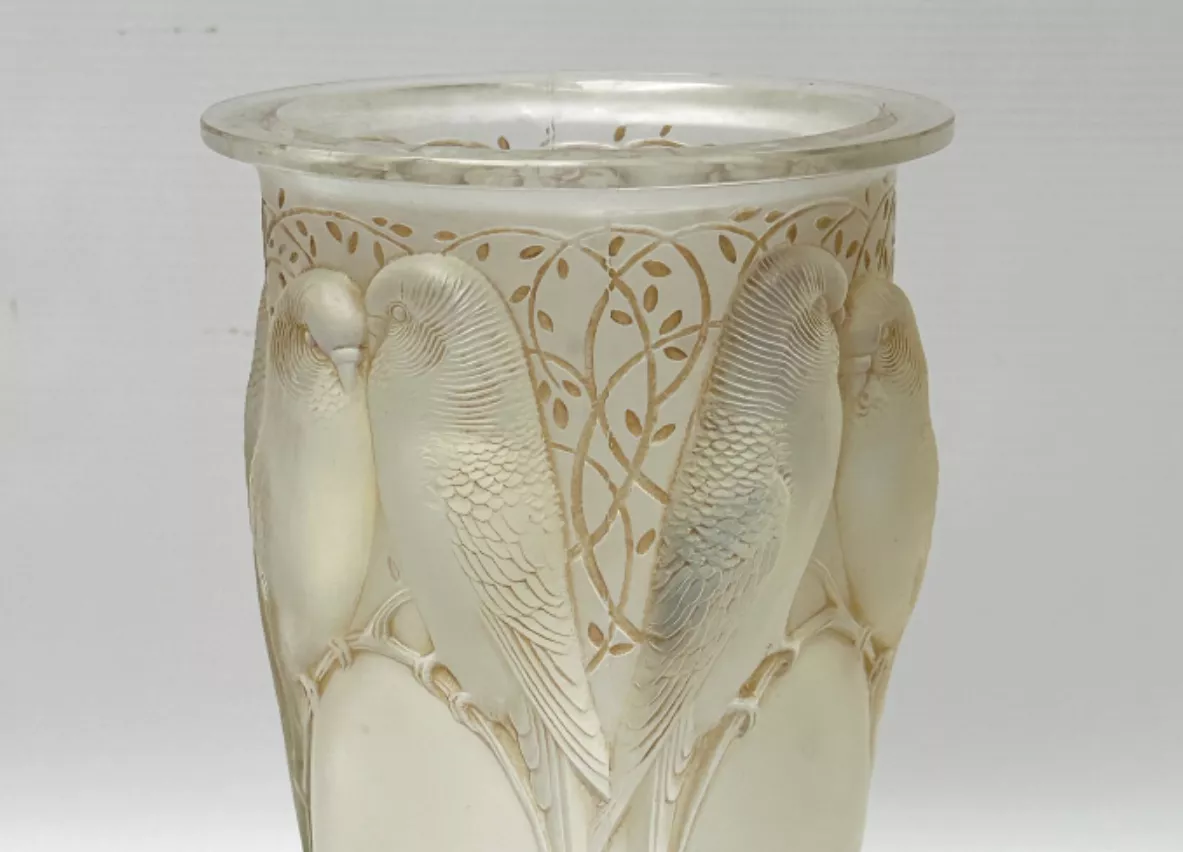
Art Nouveau and Art Deco: What Are the Differences in the Market?
Art Nouveau and Art Deco, separated by only about fifteen years but by a radical aesthetic shift, follow distinct market dynamics that should be clearly distinguished.
Art Nouveau, which dominated decorative design between 1890 and 1910, emphasized curved lines, botanical motifs, and an organic continuity between structure and decoration. In France, it was championed by the École de Nancy, centered around Émile Gallé and Louis Majorelle, and in Paris by figures such as Hector Guimard.
Art Deco, which succeeded it in the 1920s, broke with this aesthetic to adopt clean geometric lines and a formal rigor evocative of industrial modernity.
In terms of the market, Art Nouveau enjoys a very loyal following among specialized collectors, who are particularly drawn to the exceptional technical quality of the glassware and ceramics produced during this period.
The market value of the rarest and most accomplished pieces by Gallé, Majorelle, or the École de Nancy as a whole remains very strong, though generally lower than the peak values reached by prestigious Art Deco furniture.
René Lalique remains a notable exception, as his body of work spans both periods, with very strong market values across each of his successive stylistic phases.
Style | Period | Artists and Houses | Market Demand Level |
Art Nouveau, École de Nancy | 1890–1914 | Émile Gallé, Louis Majorelle, Jacques Grüber, Daum | Very strong, with a loyal niche market |
Parisian Art Nouveau | 1895–1910 | Hector Guimard, René Lalique (early works), Eugène Gaillard | Active, with European and American collectors |
Belgian Art Nouveau | 1893–1910 | Victor Horta, Henry van de Velde, Philippe Wolfers | Well-established, Belgian and international market |
Vienna Secession (related) | 1897–1910 | Gustav Klimt (decorative arts), Koloman Moser, Josef Hoffmann | Very active, strong international demand |
Catalan Art Nouveau (Modernisme) | 1888–1911 | Antoni Gaudí (decorative arts), Lluís Domènech i Montaner | Active, Spanish and international markets |
Art Deco (for comparison) | 1920–1935 | Émile-Jacques Ruhlmann, René Lalique (maturity) | Exceptional, very high auction prices |
Estimate in less than 24h
The criteria that determine the market value of an Art Nouveau object
The market value of an Art Nouveau object is determined by a hierarchy of criteria that the auctioneer weighs according to the category in question.
For glassware, the technical complexity of the craftsmanship—such as wheel engraving, glass marquetry, and the application of metallic powders—as well as the rarity of the model are decisive factors: Gallé’s unique pieces or those produced in very limited editions command prices far higher than his mass-produced items, which are already sought after but more accessible.
For furniture, the quality of the marquetry and the integrity of the original structure are essential. For ceramics, the quality of the glazing and the workshop’s signature are the primary evaluation criteria.
The price ranges observed on the secondary market illustrate this wide range. A mass-produced glass vase signed by Gallé or Daum can range from 500 to 5,000 euros.
A unique piece or a limited-edition piece from these same manufacturers—particularly large vases with complex decorations—ranges from 5,000 to 100,000 euros, depending on rarity and technical sophistication.
A piece of furniture signed by Majorelle or from the École de Nancy sells for between 3,000 and 80,000 euros, depending on the model and condition. Exceptional pieces, particularly large pieces of furniture or Gallé’s exhibition-quality glassware, can exceed 150,000 euros at public auction.
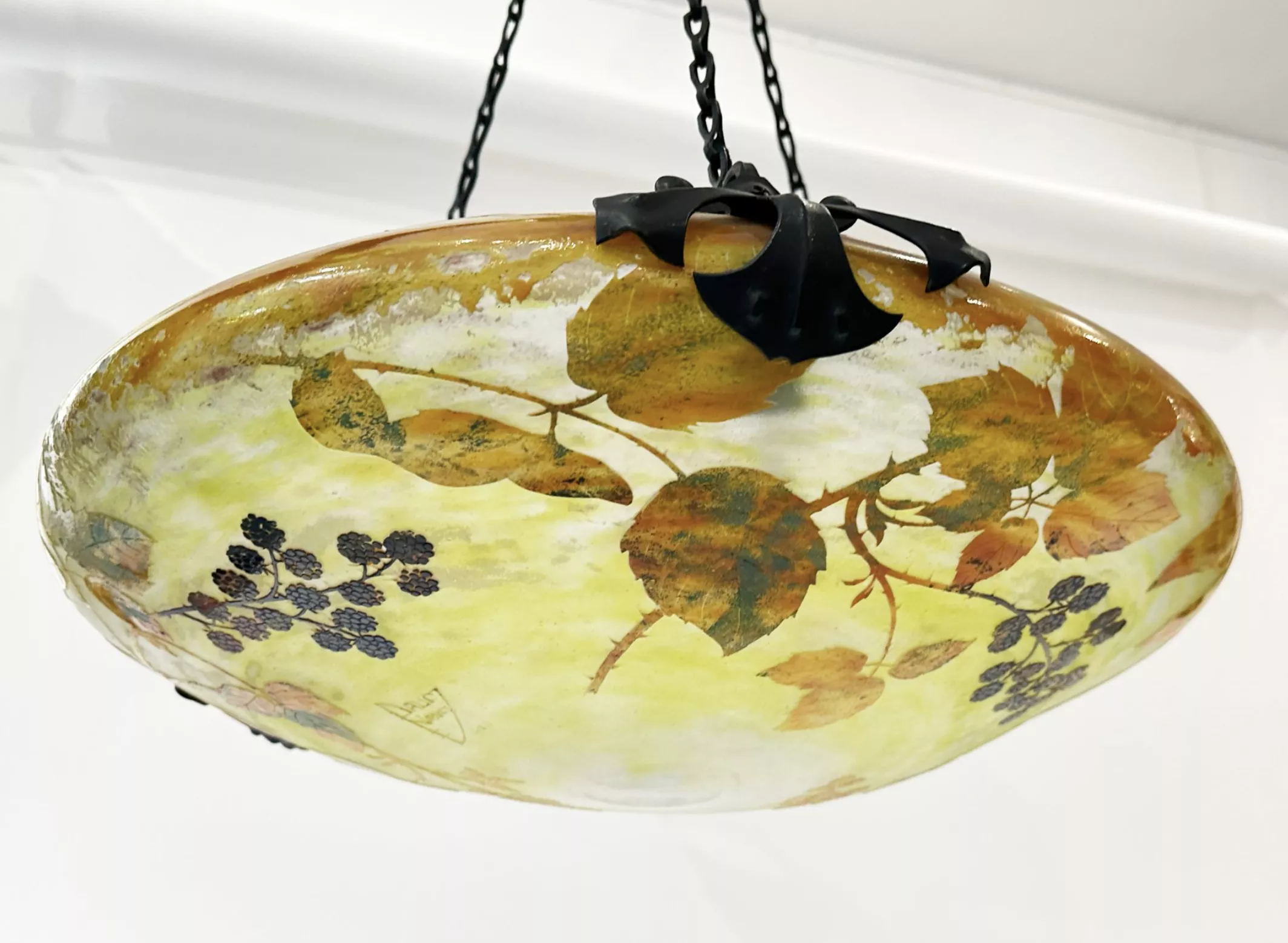
Glassware, ceramics, furniture: all items appraised
The Hierarchy of Art Nouveau Objects and Its Impact on Market Value
In the Art Nouveau market hierarchy, art glass occupies a prominent position, particularly pieces signed by Gallé and Daum, whose manufacturing techniques—glass marquetry, acid or wheel engraving, and the application of metal foils between layers of glass, have reached a level of technical sophistication considered one of the pinnacles in the history of Western glassmaking.
The large exhibition vases, designed for the salons and world’s fairs of the era, are the most sought-after pieces of this production; their rarity and technical complexity justify very high market valuations.
Furniture from the École de Nancy, spearheaded by Louis Majorelle—whose studio developed an ornamental vocabulary of great stylistic coherence—occupies a comparable place in the hierarchy of value, particularly for the most ambitious pieces, such as desks, display cases, beds, whose marquetry and bronze hardware directly evoke the movement’s characteristic botanical motifs.
Ceramics, which are generally more affordable, nevertheless command top prices for the most accomplished pieces, particularly glazed stoneware with the most sought-after firing effects.
Category | Characteristics | Approximate Price Range | Market Demand |
Large display vase (Gallé, one-of-a-kind or limited edition) | Glass marquetry, intricate engraving, extremely rare | €10,000 — several hundred thousand € | Very strong, international |
Mass-produced glassware signed by Gallé or Daum | More abundant production, consistent quality | €500 — €5,000 | Active market, broad buyer base |
Furniture from the École de Nancy (Majorelle, ambitious piece) | Floral marquetry, bronzes, rare model | 5,000 — 80,000 € | Strong demand, specialized collectors |
Small Art Nouveau furniture or decorative objects | Fair quality, more common pieces | €500 — €5,000 | Active, accessible, highly liquid |
Glazed ceramics and stoneware (renowned workshop) | Desirable firing effects, studio signature | €300–10,000 | Active, growing segment |
Art Nouveau jewelry (René Lalique, Floral Period) | Precious materials, refined naturalistic motifs | €5,000 — €200,000 | Very strong market, discerning collectors |
Vases, lamps, and glazed stoneware: the most sought-after pieces
Gallé’s vases, particularly those from his most ambitious body of work—glass marquetry depicting Lorraine landscapes and botanical scenes of great chromatic complexity—remain the most iconic and highly sought-after pieces on the Art Nouveau glass market.
His technique of double-layered and engraved glass, perfected over the course of his career, produced effects of depth and luminosity that have never truly been matched, which explains the enduring strength of demand for his most exceptional pieces.
Lamps—particularly those combining a bronze or wrought-iron base with a glass or pâte de verre shade—constitute a highly sought-after category of Art Nouveau production, blending technical prowess with a decorative function that is immediately appreciated in a contemporary interior.
Glazed stoneware, for which workshops experimented with firing techniques and glazes in a wide variety of colors, appeals to specialized collectors drawn to the uniqueness of each piece; variations in the firing process make it impossible to exactly reproduce the same effect from one piece to the next.
Estimate in less than 24h
Get a Free Appraisal of an Art Nouveau Item
A certified appraisal by a licensed auctioneer in less than 24 hours
Appraising an Art Nouveau object requires in-depth knowledge of the manufacturing techniques specific to each workshop and the stylistic evolution of the movement’s leading designers, as well as particular vigilance regarding the circulation, over the past several decades, of pieces fraudulently signed to inflate the value of lower-quality items—particularly Gallé and Daum glassware, whose fame has given rise to a relatively well-developed market for copies and forged signatures.
A certified auctioneer has the necessary training to conduct this appraisal with the rigor it requires.
Auctie’s offers this appraisal free of charge, with a certified response within 24 hours.
Whether you’ve inherited an Art Nouveau vase or piece of furniture, wish to have a ceramic or jewelry piece from this period appraised, or are considering compiling an estate inventory, the process is the same: submit your item to a trained expert capable of accurately assessing its value.
What you need to provide for an online appraisal
For a piece of glassware, please provide clear photographs of the entire piece and close-ups of the decoration, as well as a close-up of the signature—which may be engraved or overlaid, depending on the manufacturer—and is generally visible on the base or body of the piece.
The exact dimensions and any observations regarding transparency or color effects must be noted. For furniture, photographs of the entire piece and close-ups of the marquetry and hardware, as well as any visible stamps, are essential.
For ceramics, photographs of the piece as a whole and of the studio mark—usually located on the underside of the piece—must be provided.
Any information regarding provenance—such as an old purchase invoice, a mention in an auction catalog, or a reference in a specialized publication—must be provided. In case of doubt regarding attribution or the authenticity of the signature, a physical examination will be offered before any steps are taken to list the item for sale.
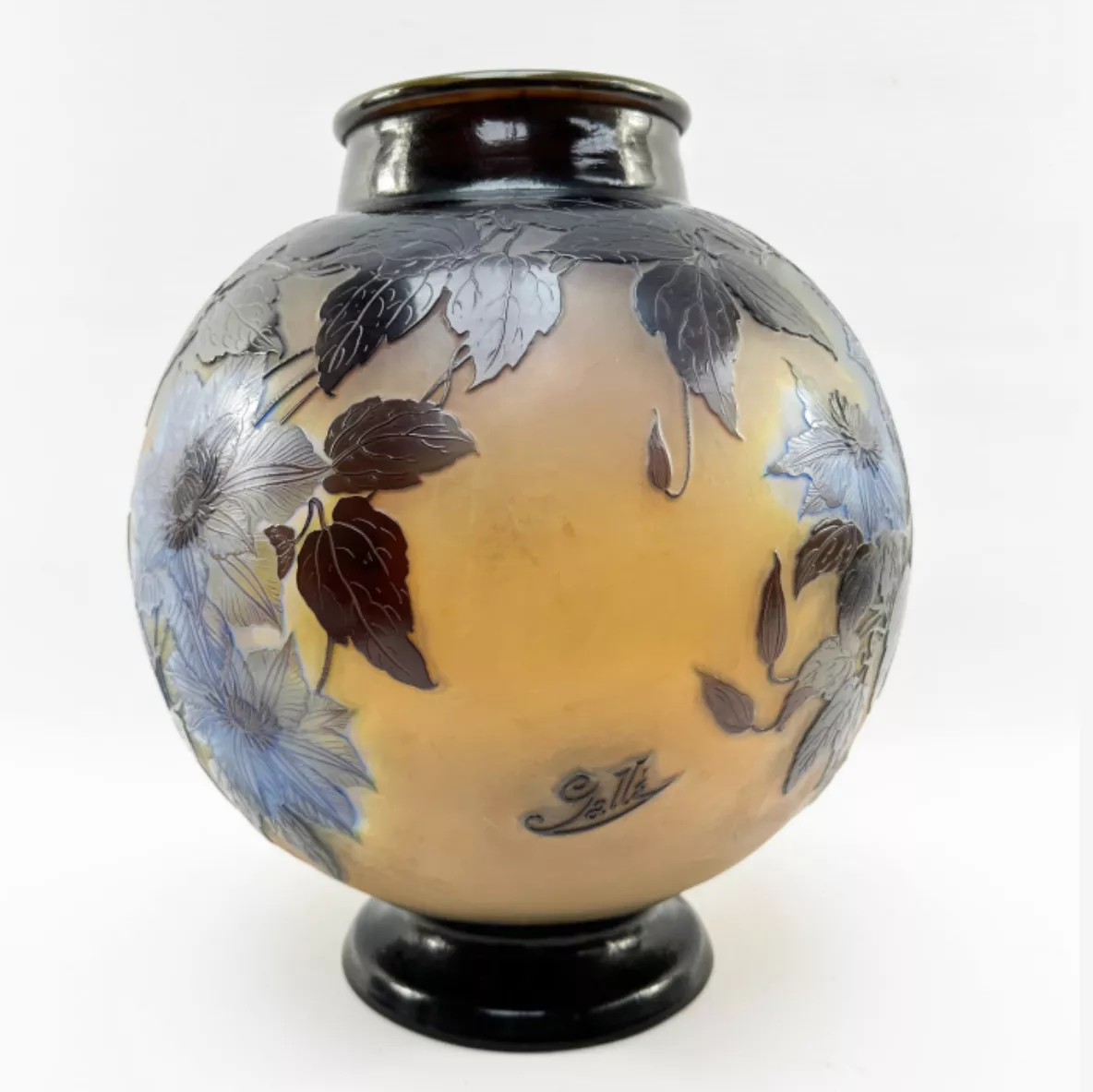
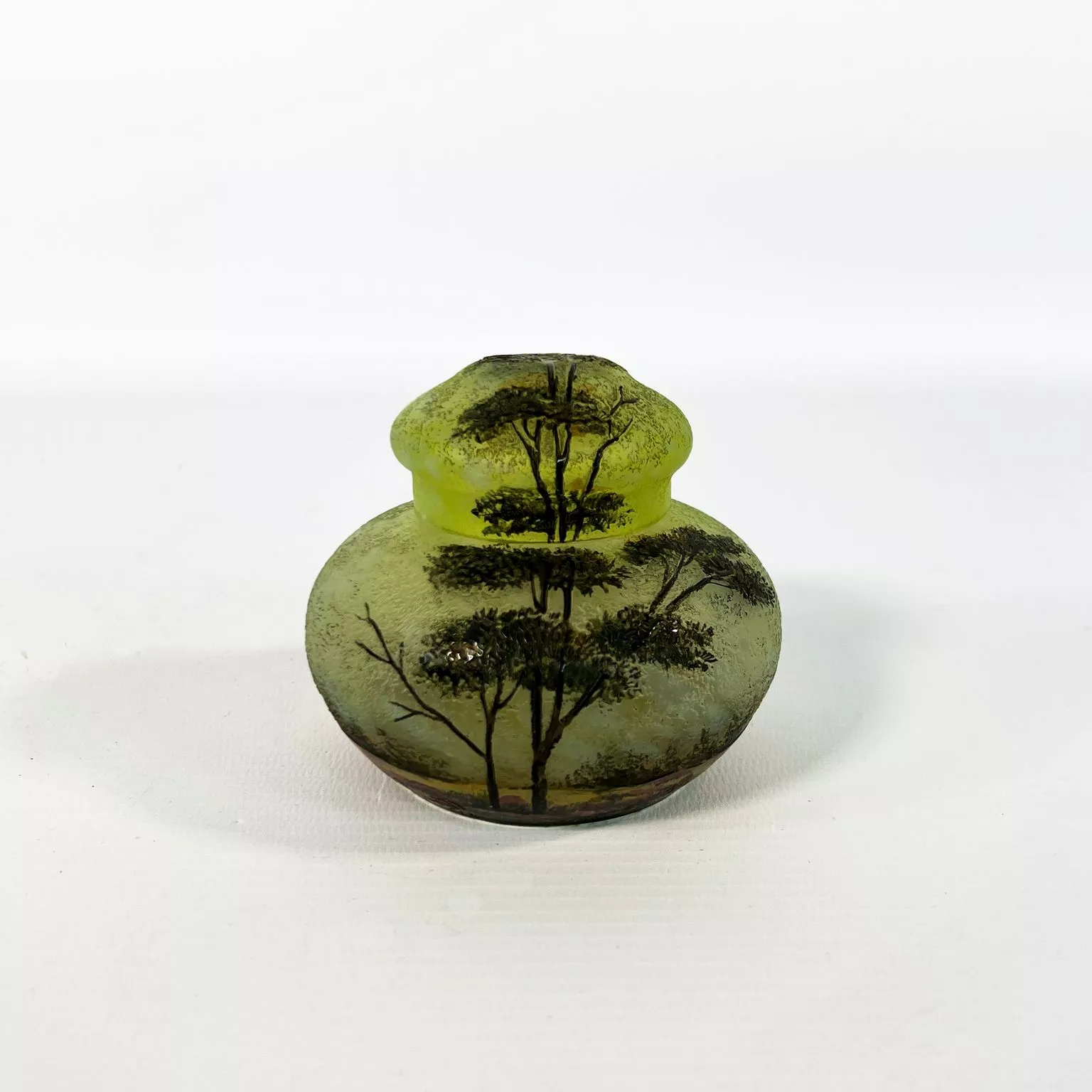
Signature, provenance, and authenticity: the pillars of valuation
Signatures, stamps, and workshop marks: their impact on value
The authentication of an Art Nouveau object relies on a careful examination of the signatures and studio marks traditionally found on high-quality pieces.
In the case of glassware, Gallé’s signature evolved over the course of his career, and pieces produced after his death in 1904 by the studio he founded bear a star preceding the signature—a crucial distinction that every expert must recognize in order to accurately date a piece.
Caution is warranted in light of the numerous forged signatures found on lower-quality or even mass-produced glassware—a practice that has, unfortunately, been widespread for several decades in this thriving market.
For the movement’s major designers, reference catalogs and studio archives serve as the definitive authorities in the market. The works on Gallé by Philippe Garner and the Musée de l’École de Nancy are essential references, as are studies on Majorelle’s work and René Lalique’s production during his Art Nouveau period. A piece listed in one of these documentary collections benefits from scientific validation, which is directly reflected in its market value.
Level of Documentation | Impact on the valuation |
Original signed piece, model identified in a catalog or monograph | Maximum assurance; very significant premium on value |
Piece published in specialized literature or exhibited in a retrospective | Strong scientific endorsement; significant increase in value |
Piece accompanied by a written appraisal from a recognized expert on the designer or manufacturer | Good guarantee; provides assurance to the buyer and facilitates the sale |
Piece with a signature consistent with the period but without additional documentation | Reasonable basis; estimate based on direct attribution |
Art Nouveau-style piece with no identifiable signature | Conservative estimate; value based solely on the quality of craftsmanship |
Piece with a signature suspected of being apocryphal or fraudulently added | Significant depreciation; thorough verification essential prior to any sale |
Provenance and Condition: Their Impact on Value
The provenance of an Art Nouveau object is a key factor in building trust in this market, particularly for the rarest and oldest pieces.
A piece whose original acquisition can be traced—or that has passed through a recognized specialized collection or a documented historical exhibition—enjoys a legitimacy that collectors directly reflect in their bids.
For glassware in particular, a solid provenance also reduces the risk associated with the circulation of apocryphal signatures mentioned above.
The condition of an item requires specific attention depending on the category. For glassware, cracks, chips, and changes in the patina must be examined carefully, as glass is by nature a fragile material whose condition strongly influences its value.
For furniture, the integrity of the marquetry and original bronze fittings is essential: a botched restoration or replacement of hardware can significantly reduce a piece’s value.
For ceramics, cracks and restorations must be carefully examined, as certain firing effects can mask old repairs to the untrained eye.
Selling an Art Nouveau Item at Auction with Auctie's
From the reserve price to the final bid: how the price is determined
Auctions are the most advantageous method of sale for high-quality Art Nouveau pieces, in a market where the encounter between a rare item—particularly Gallé’s large exhibition vases or Majorelle’s most ambitious furniture pieces—and a specialized collector can generate fierce competition.
The reserve price, set in consultation with the seller, must be carefully calibrated with particular attention to the specific category of the piece and the strength of its attribution, on which a considerable portion of its value depends in this market, which is highly sensitive to issues of authorship.
For major, well-documented pieces, the dynamics of the auction can lead to final prices far exceeding initial estimates, as several specialized collectors may engage in intense competition to acquire a rare and fully authenticated piece.
The auctioneer plays a vital role in facilitating this process by engaging networks of collectors and enthusiasts of the École de Nancy and international Art Nouveau who are active in this segment.
Hôtel Drouot and online auctions: reaching the right bidders
Auctie’s holds its auctions at Hôtel Drouot, the leading auction house in continental Europe, founded in 1852 and frequented by a dense network of dealers and collectors specializing in the decorative arts of the Belle Époque.
For an Art Nouveau piece, Drouot offers optimal visibility among French and European connoisseurs of this movement—which laid the foundation for modern decorative arts—complemented by an online presence that significantly expands the reach of each auction on an international scale.
An American collector passionate about the École de Nancy, a Japanese museum seeking an iconic piece by Gallé for its connection to Japonism—which profoundly influenced this movement—or a Belgian connoisseur drawn to the works of Victor Horta can bid in real time from their home countries.
For Art Nouveau, whose most passionate enthusiasts are spread across many countries, this international dimension is often decisive in securing the best hammer price.
Estimate in less than 24h
Estate Planning, Inheritance: Valuing an Inherited Art Nouveau Object
Inventory and Distribution of an Estate
Art Nouveau pieces are frequently found in the estates of families whose furnishings or collections were assembled during the Belle Époque or in the early decades of the 20th century.
These pieces, sometimes passed down through several generations without their current owners knowing their exact value or even the identity of the artist, can represent a significant asset in an estate, particularly when they are signed works by the greatest names of the École de Nancy or the art glass movement.
Auctie’s regularly works alongside notaries to compile comprehensive estate inventories that include Art Nouveau objects.
Each piece is appraised individually: identification of the artist or manufacturer, description of the materials and condition, and estimation of the market value as of the reference date. The resulting report is an official, legally binding document that can be included in the estate file without reservation.
Confidentiality and Anonymity Preserved
The circumstances leading to the appraisal of an inherited Art Nouveau object are often personal: an estate settlement, a move, estate reorganization, or a decision to sell after a long period of ownership.
Auctie’s handles each case with absolute discretion. The owner’s identity is never disclosed to third parties without their explicit consent, and items may be offered for sale under complete anonymity if the consignor so desires.
This confidentiality is a core commitment of Auctie’s, applicable at every stage of the relationship, from the initial contact through to the receipt of the proceeds from the sale.
Entrust the appraisal of your Art Nouveau piece to Auctie’s
An Art Nouveau piece deserves an appraisal that matches the technical sophistication of this movement, which laid the foundation for modern decorative arts.
The diversity of techniques—glassware, ceramics, furniture, and jewelry—the decisive importance of signatures in a market rife with forgeries, and the strength of demand consistently sustained by loyal collectors worldwide: these are all factors that only a licensed auctioneer, well-versed in the specificities of Art Nouveau, can assess with the rigor they require.
Auctie’s guides you from the initial appraisal through to the final auction, offering the expertise of a state-certified appraiser and the discretion your financial decisions deserve. The appraisal is free, confidential, and non-binding, and you’ll receive a response within 24 hours.
Discover in the same theme

Rating and value of bronze sculptures by Agathon Léonard
Agathon Léonard is an Art Nouveau sculptor who produced bronzes that are highly valued at auction. Estimate in 24h.
Learn more >

Rating and value of paintings by Ferdinand Holder
Ferdinand Holder was a 19th-century Swiss painter who became famous for his Symbolist works. His works are valued and quoted.
Learn more >

Rating and value of René Lalique works, vases, lighting fixt...
René Lalique, a talented and versatile 20th-century artist, produced many works for his home and others outside it. Estimated in 24h.
Learn more >
Estimate in less than 24h
Frequently asked questions
-
What are the price ranges for an Art Nouveau piece?Prices vary widely depending on the type of item and its rarity. Mass-produced glassware signed by Gallé or Daum ranges from 500 to 5,000 euros, while a one-of-a-kind piece or a limited-edition item ranges from 5,000 to 100,000 euros. A piece of furniture signed by Majorelle sells for between 3,000 and 80,000 euros depending on its condition, and exceptional pieces can fetch over 150,000 euros at public auction.
-
How can I have an Art Nouveau piece authenticated and verify its signature?Auctie's offers a free, certified appraisal by a licensed auctioneer, with a response within 24 hours. The expert carefully examines signatures, stamps, and workshop marks, as well as the manufacturing techniques specific to each manufacturer, to confirm authenticity and rule out forged signatures, which are particularly common in Gallé and Daum glassware.
-
What are the main criteria that determine the value of an Art Nouveau piece?Value depends on the identity of the creator or manufacturer, the technical complexity of the craftsmanship (glass marquetry, engraving, enameling), the rarity of the piece, its condition, the strength of the supporting documentation, and its provenance. In the case of glassware, one-of-a-kind pieces or those produced in limited editions are valued much more highly than mass-produced items.
-
Is this a good time to sell an Art Nouveau piece?Yes, the Art Nouveau market enjoys sustained, international demand, driven by loyal, specialized collectors and a broader audience drawn to the timeless elegance of this aesthetic. Glassware, furniture from the École de Nancy, and jewelry remain particularly sought after.
-
How does the sale of an Art Nouveau piece work at Auctie's?Auctie's supports sellers from the free appraisal through to the auction. Once the item has been appraised by our state-certified auctioneers, it is included in the catalog of a specialized auction, where it gains broad visibility among national and international collectors.
