



Rating and value of vases by Lucien Levy Dhurmer and Clément Massier

Key takeaways
- Clément Massier and Lucien Lévy-Dhurmer collaborated from 1887 to 1895 in Golfe-Juan; their work was awarded a gold medal at the 1889 World’s Fair.
- Three price categories: common pieces €300–2,000, pieces with distinctive metallic sheen €2,000–10,000, and exceptional pieces €10,000–25,000.
- Authenticity can be verified by the double signature (Massier + Lévy on the reverse) and iridescent glazes featuring Symbolist motifs typical of Art Nouveau.
The vases created collaboratively by Clément Massier (1844–1917) and Lucien Lévy-Dhurmer (1865–1953) hold a prominent place in the history of decorative arts during the Belle Époque. The result of eight years of collaborative work (1887–1895) in the Golfe-Juan studio, these ceramics with metallic sheen combine the exceptional craftsmanship of a Provençal ceramist with the Symbolist sensibility of a painter destined for fame.
Awarded a gold medal at the 1889 World’s Fair, these collaborative works are today among the most sought-after pieces of Art Nouveau ceramics.
On the art market, the vases from the Massier-Lévy collaboration fall into three main categories. Common pieces (small sizes, standard glazes) sell for between 300 and 2,000 euros.
Vases with characteristic metallic sheen—featuring baluster-shaped bodies or tall necks decorated with floral and symbolist motifs—fetch between 2,000 and 10,000 euros. Exceptional pieces (large sizes, figurative designs, impeccable condition, double signature) can exceed 15,000 euros at public auction.
Price ranges observed at public auctions
Type of item | Result |
|---|---|
Vases | From €300 to €2,000 |
Metallic Reflections (medium size) | From €2,000 to €10,000 |
Exceptional pieces (large format / double signature) | From €10,000 to €25,000 |
Estimate in less than 24h
Putting the Artists in Context: A Fateful Encounter
Clément Massier belongs to a dynasty of ceramicists that has been based in Vallauris since the 18th century. Having settled in Golfe-Juan in 1883, he established an independent studio there dedicated to experimenting with glazes, particularly the Hispano-Moorish-inspired metallic lustres he studied on the faience of the Alhambra and the Italian-Flemish majolica.
His research led him to develop firing processes in a reducing atmosphere that produced iridescent reflections of unparalleled richness.
Lucien Lévy-Dhurmer, a painter, pastel artist, and decorator trained at the École des Beaux-Arts in Paris, joined the Golfe-Juan studio in 1887 as artistic director. It was he who infused Massier’s ceramic bestiary with a distinctly Symbolist dimension: faces of women with long hair amidst the waves, emerald lizards against a backdrop of peacock-blue iridescence, and medallions of frogs surrounded by irises.
The collaboration gave rise to a body of work of remarkable formal and stylistic coherence, in which technique and inspiration blended with rare ease.
Their partnership ended around 1895, when Lévy-Dhurmer devoted himself entirely to his career as a pastel painter, a genre in which he would achieve fame.
The ceramic pieces from this period generally bear on the reverse the incised or stamped mark “Clément Massier Golfe Juan” along with the handwritten signature “L. Lévy,” sometimes “Lévy-Dhurmer.”
The Birth of a Style: Symbolist Metallic Glaze
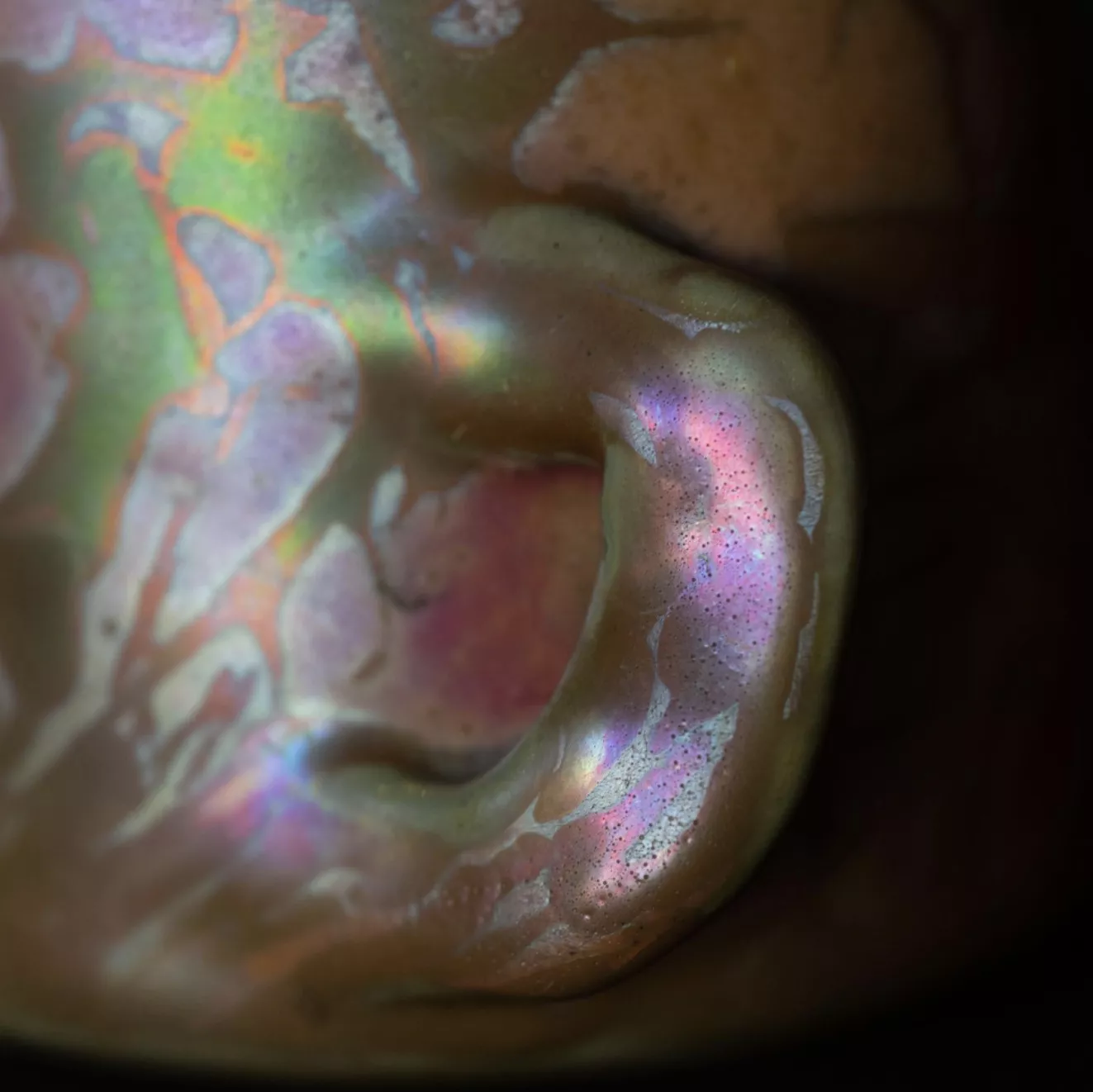
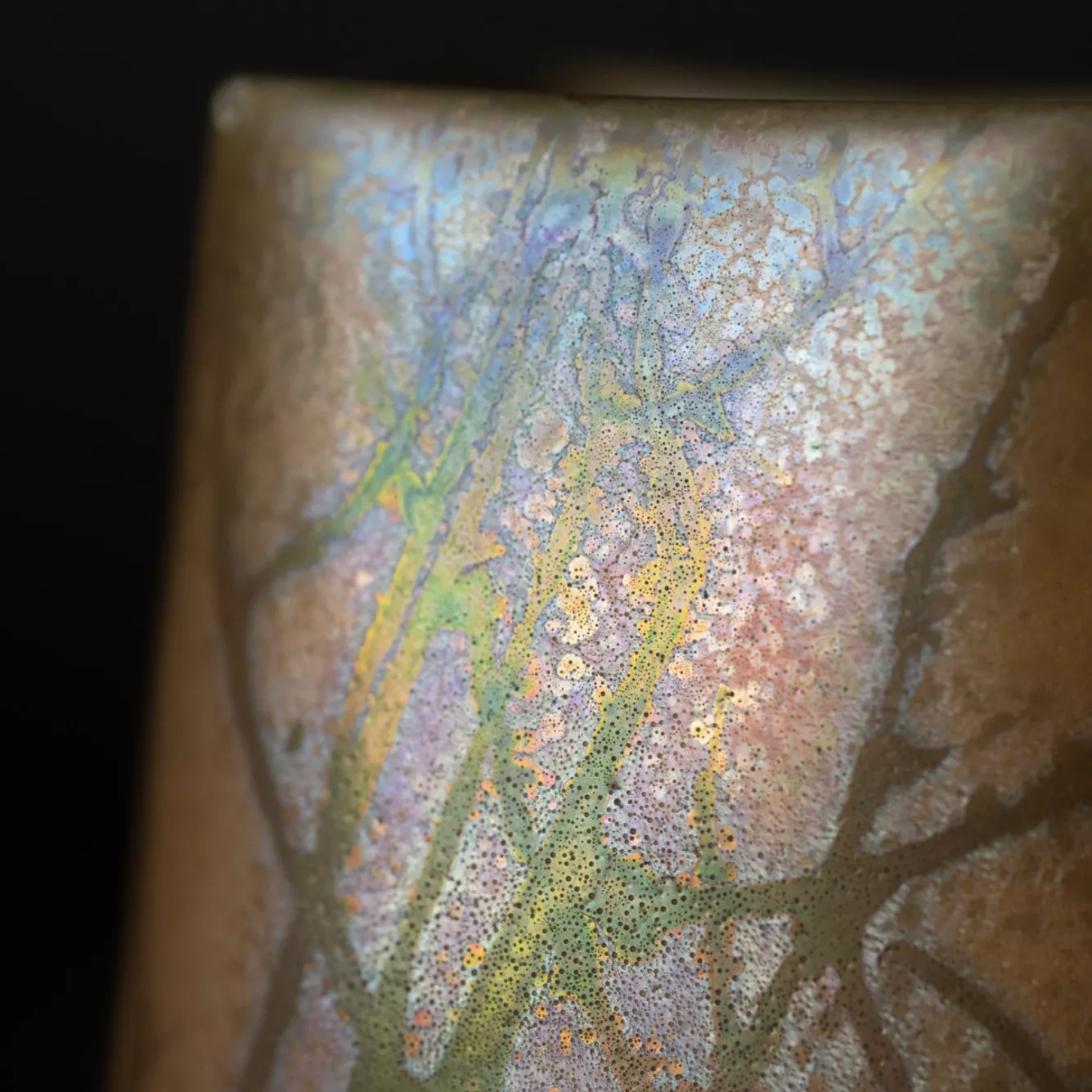
The technique of metallic-sheen glazing, at the heart of all Massier-Lévy production, relies on firing in a reducing atmosphere (low oxygen content), which creates iridescent effects on the glazed surface that shift in hue depending on the viewing angle: copper, gold, mother-of-pearl, peacock, and bronze green.
This technique, inherited from the ceramics of Persia and medieval Spain, had scarcely been mastered in France prior to Massier’s research.
The decorative repertoire developed under Lévy-Dhurmer’s influence draws heavily on Symbolist iconography: profiles of women with flowing hair (reminiscent of the models by Gustave Moreau or Walter Crane), majestic animals (dragonflies, scarabs, peacocks, lizards), and stylized plant motifs (irises, water lilies, wisteria).
This iconography lends the pieces a poetic resonance and a symbolic ambivalence characteristic of the fin-de-siècle spirit.
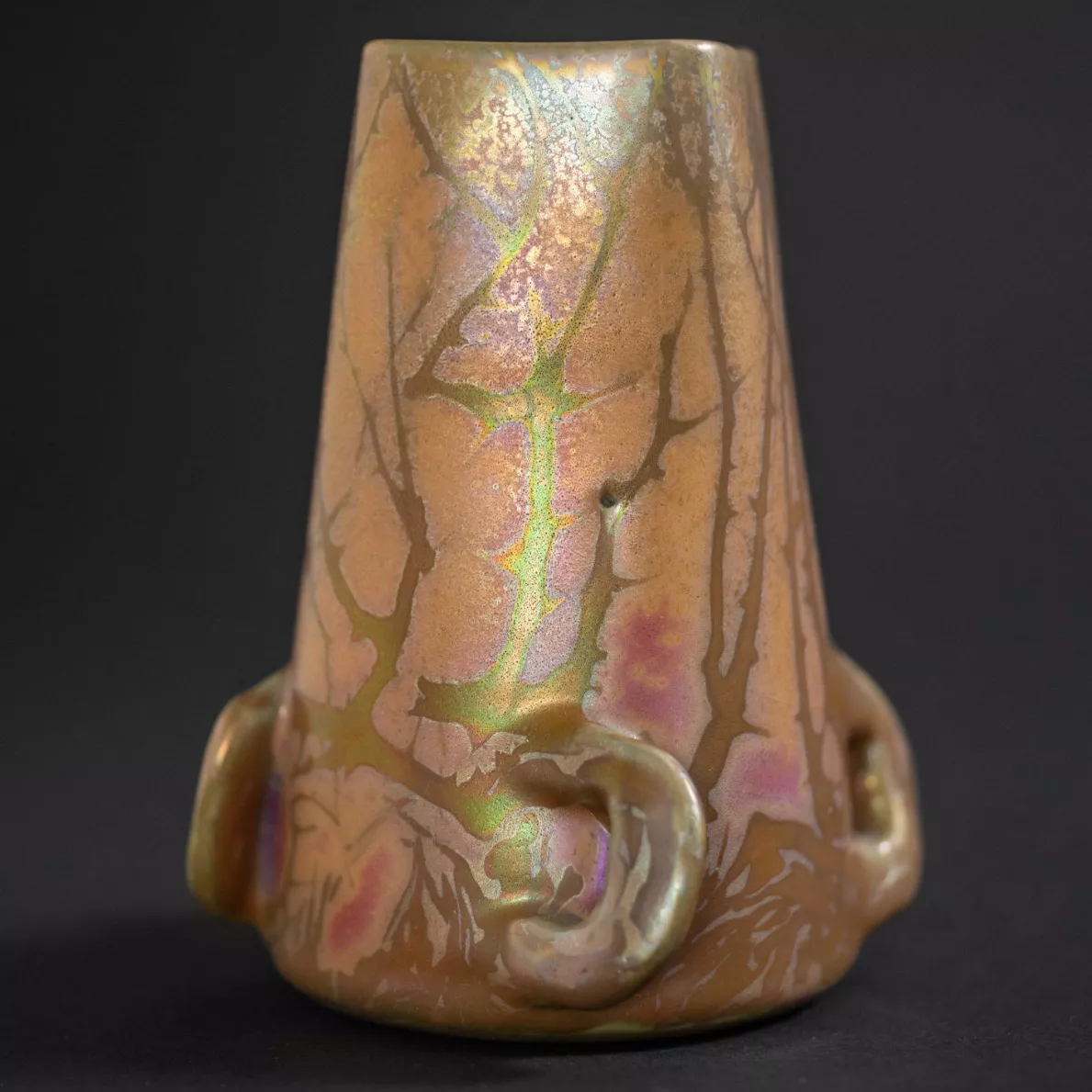
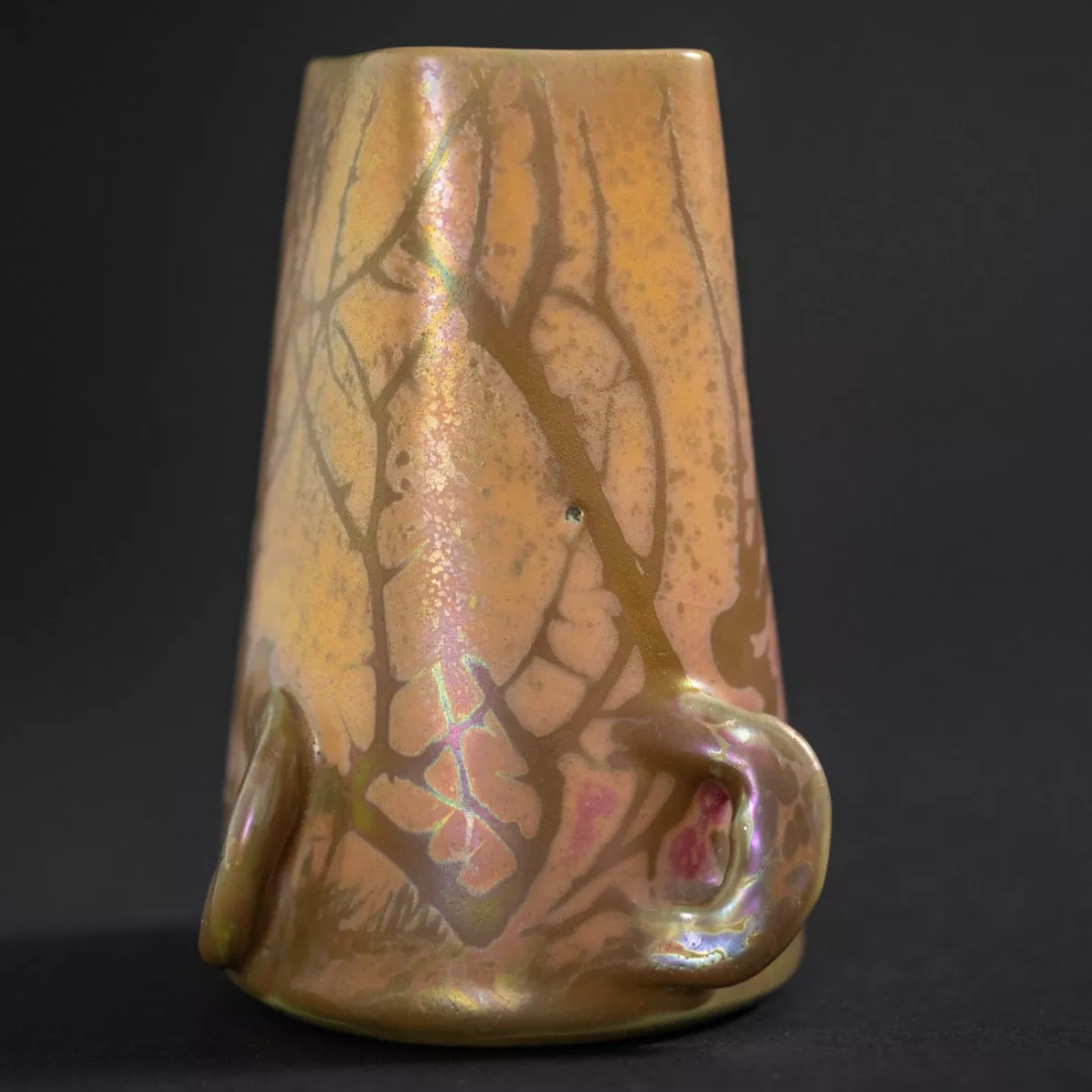
The forms are generally classical (baluster vases, tall-necked vases, spherical planters, dishes with handles) and allow the glaze to fully express its chromatic qualities. Large pieces (over 30 centimeters) are the most sought-after due to the scope they provide for the painted decoration and the technical difficulty of firing them flawlessly.

Market Segmentation
Common Vases (300 to 2,000 euros)
This segment includes small-format pieces (less than 15 centimeters), items with less refined glazes or minor imperfections (restored chips, partial glaze defects), as well as pieces whose attribution to the collaboration remains uncertain. Available at regional auction houses or specialized galleries, they offer an affordable way to enter this market.
Vases with characteristic metallic iridescence (2,000 to 10,000 euros)
These represent the core of the market. These pieces showcase the iridescent glaze in all its splendor, a clearly identifiable Symbolist design, and dual attribution (signed by Massier and Lévy). Medium-sized baluster vases (15 to 30 centimeters) featuring depictions of women, animals, or Art Nouveau motifs are the lots most frequently offered at auction.
Exceptional pieces (10,000 to 25,000 euros and above)
Large-format pieces in exceptional condition, featuring rare iconography (medallion portraits, complex figurative scenes), or with documented provenance dating back to the 1889 World’s Fair command the highest auction prices.
An exceptional planters sold at Millon exceeded 11,000 euros. Pieces with dual documentation (contemporary exhibition catalog, scholarly literature) are the most sought-after by collectors and museums.
Frequently Asked Questions About Massier-Lévy Vases
How can you identify a piece from the Massier-Lévy collaboration?
Authentic pieces generally bear two distinct marks on the reverse: the ceramist’s mark (“Clément Massier Golfe Juan,” printed or incised) and the decorator’s signature (“L. Lévy” or “Lévy-Dhurmer,” handwritten or incised).
The metallic-sheen glaze and the quality of the Symbolist decoration are key visual indicators. If in doubt, consulting specialized books on French Art Nouveau ceramics can provide useful confirmation.
Where are the finest pieces preserved?
Several museums house remarkable examples of the Massier-Lévy collaboration: the Magnelli Museum in Vallauris, the Museum of Modern and Contemporary Art in Nice, and various European museums of decorative arts all possess specimens.
Private collections, particularly in Germany and the United States, also feature fine sets. These museum references serve as a useful benchmark for evaluating the quality of pieces offered for sale.
Are Massier-Lévy vases increasing in value?
The Art Nouveau ceramics market has seen a significant resurgence of interest since the 2010s, driven by the rediscovery of European Symbolism and growing demand for objects of high artistic and technical quality.
The Massier-Lévy collaboration is benefiting from this favorable environment: the finest pieces are steadily appreciating in value, while the more common segment remains affordable. The internationalization of sales (online platforms, Anglo-Saxon auction houses) has expanded the pool of potential buyers.
Get a Massier-Lévy Vase Appraised or Sell It
Do you own a vase or ceramic piece from the Massier-Lévy collaboration and want to know its market value? Auctie’s provides you with experts in Belle Époque decorative arts who specialize in Art Nouveau and Symbolist ceramics.
An accurate appraisal takes into account the condition of the glaze, the decorative motif, any signatures present, the size, and documented provenance.
Submit your online appraisal request in just a few minutes, attaching photos of the reverse side (marks and signatures) and the decoration. Our specialists will respond promptly with a well-reasoned value range and, if you wish to sell, recommendations on the best sales channel.
Estimate in less than 24h
Nos records d'enchères à l'hôtel Drouot

Estimated 10.000 - 15.000 €
Ebridge Ayer BURBANK(1858-1949), Young African-American boy, Oil on panel.

Estimated 20.000 - 30.000
EXCEPTIONAL LARGE OVAL DISH IN VINCENNES SOFT PASTE PORCELAIN FROM THE "BLEU CÉLESTE" SERVICE OF KING LOUIS XV AT THE CHÂTEAU DE VERSAILLES

Estimated 20.000 - 30.000
MANUFACTURE ROYALE DE SÈVRES, 18th century "L'Empereur de la Chine" - Portrait of the Emperor Qianlong, Hard porcelain bisque, 1775

Estimated 1.500 - 3.000
HERMÈS, "Kelly" 32 saddle bag in black box calf

Estimated Between €5,000 and €8,000
KRACHKOWSKY (1854-1914), Before the storm, oil on canvas

Estimated 40.000 - 80.000
Alexandre ROUBTZOFF (1884-1949), Portrait of Arbia, oil on canvas

Secure site, anonymity preserved

Auctioneer approved by the State

Free and certified estimates
Frequently asked questions
-
Who are Clément Massier and Lucien Lévy-Dhurmer, and why is their collaboration significant?Clément Massier (1844–1917) was a Provençal ceramicist who specialized in glazes with metallic sheen, while Lucien Lévy-Dhurmer (1865–1953) was a painter and pastel artist trained at the École des Beaux-Arts in Paris. From 1887 to 1895, they collaborated in the studio in Golfe-Juan, creating Art Nouveau vases that were awarded a gold medal at the 1889 World’s Fair. This unique partnership combined Massier’s technical expertise with Lévy-Dhurmer’s Symbolist sensibility, producing some of the most sought-after ceramics of the French Art Nouveau movement.
-
What are the price ranges for Massier-Lévy vases by category?Vases fall into three categories: common pieces (small sizes, standard glazes) sell for between 300 and 2,000 euros; vases with characteristic metallic sheen and Symbolist decorations fetch between 2,000 and 10,000 euros; exceptional pieces (large sizes, figurative designs, double signature, impeccable condition) can exceed 15,000 euros, with some examples fetching over 25,000 euros at public auction.
-
How can you authenticate a Massier-Lévy vase and verify its authenticity?Authentic pieces bear two distinct marks on the reverse: the incised or stamped mark “Clément Massier Golfe Juan” and the handwritten or incised signature “L. Lévy” or “Lévy-Dhurmer.” The glaze with its iridescent metallic sheen and the quality of the Symbolist decoration are key visual indicators. If in doubt, Auctie’s offers a free, no-obligation estimate request, with a prompt response from an expert for accurate authentication and valuation.
-
Is this the right time to sell a Massier-Lévy vase?Yes, the market for Art Nouveau ceramics has seen a significant resurgence in interest since the 2010s, driven by the rediscovery of European Symbolism and a growing demand for objects of high artistic and technical quality. The Massier-Lévy partnership has particularly benefited from this favorable environment, with steady growth in the value of its finest pieces and an expansion of sales into international markets that has broadened the pool of potential buyers.
-
How do I get a Massier-Lévy vase appraised and sold at Auctie's?Auctie's supports sellers from the appraisal stage through to the auction. Submit your appraisal request online in just a few minutes by attaching photos of the reverse side (marks and signatures) and the decoration. Our experts in decorative arts and Art Nouveau ceramics will respond promptly with a well-reasoned value range and, if you wish to sell, recommendations on the best sales channel. The appraisal is free and non-binding.
