



Rating and value of vases and ceramics by Gabriel Argy Rousseau

Key takeaways
- Prices for works by Gabriel Argy-Rousseau range from €80 to €5,400, with exceptional pieces reaching €52,700 in 2013.
- Glass paste is the artist’s preferred medium, reflecting his innovative technical mastery developed beginning in 1914.
- His creations blend the legacy of Art Nouveau with the clean lines of Art Deco, characterized by subtle effects of form and translucency.
If you own a work by or after the artist Gabriel Argy Rousseau, and would like to know its value, our state-approved experts and auctioneers will offer you their appraisal services.
Our specialists will carry out a free appraisal of your work, and provide you with an accurate estimate of its value on the current market.
Then, should you wish to sell your work, we will direct you to the best possible arrangement to obtain the optimum price.
Rating and value of the artist Gabriel Argy Rousseau
French artist, Gabriel Argy Rousseau is a ceramist, master glassmaker, sculptor, jewelry designer and stained glass artist. Most of his work is based on a wide range of ceramics, but there is also rare jewelry and works in pâte de verre.
The prices at which his works are auctioned range from €80 to €5,400, a considerable delta but one that speaks volumes about the value that can be attributed to Gabriel Argy Rousseau's works.
In 2013, a vase entitled " Signes ", Bloch-Dermant N° 23.03, circa 1923, sold for €52,700, while it was estimated at between €18,800 and €26,400.
Order of value from a simple work to the most prestigious
Technique used | Result |
|---|---|
Ceramics | From 630 to 10 500€ |
Glass paste | From 130 to 52,700€ |
Luminaire | From €600 to €57,800 |
Estimate in less than 24h
Style and technique of Gabriel Argy Rousseau
Gabriel Argy-Rousseau inscribes his work in an approach where rigorous design and the search for luminous effects combine with exceptional technical mastery.
Heir to French glassmaking traditions, he stands out for his innovative use of glass paste, which he treats not as a simple translucent material, but as a sculptural and pictorial substance in its own right.
His technique is based on fusing and coloring in the mass, a complex process that enables him to achieve subtle modeling effects, playing on the diffusion of light through vibrant tones.
The influence of Art Nouveau is evident in the sinuous elegance of his floral and figurative motifs, inspired by stylized nature and dreamlike symbolism.
However, his approach differs from that of Gallé or Lalique through a more assertive structuring of volumes, where we perceive a plastic rigor reminiscent of ancient statuary or medieval bas-reliefs.
This formal precision is complemented by refined work on texture: surfaces are never uniform, but striated, granulated or punctuated with controlled irregularities that lend the whole an organic dimension.
Through this subtle alchemy between technical mastery and plastic freedom, Argy-Rousseau goes beyond mere ornament to inscribe his works in a dialogue between light and matter, where pâte de verre becomes the medium of a profoundly modern expression.
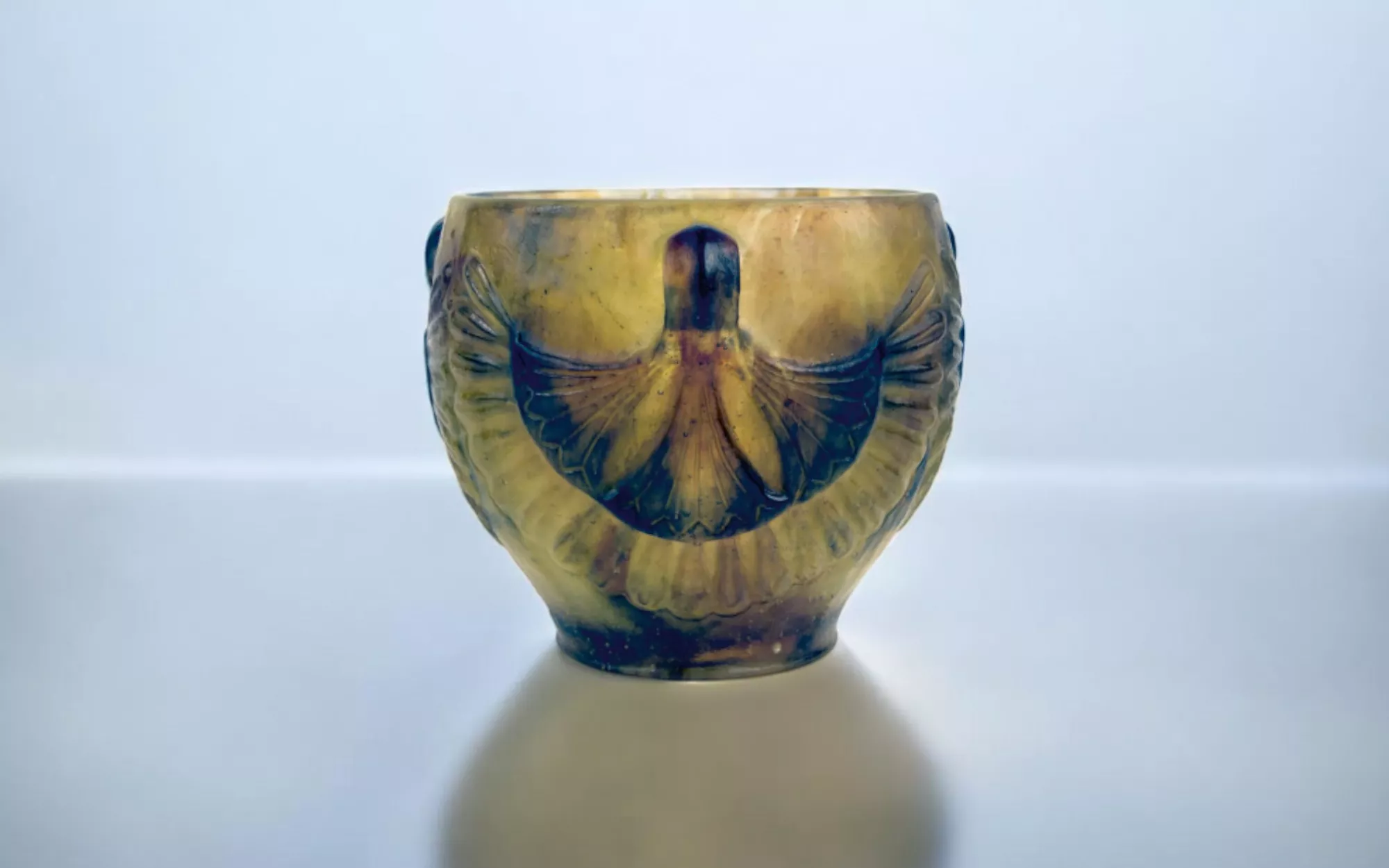
The life of Gabriel Argy Rousseau
Gabriel Argy-Rousseau, real name Joseph-Gabriel Rousseau, was born in Meslay-le-Vidame, Eure-et-Loir, in 1885.
His training began at the École nationale de céramique de Sèvres, where he was introduced to glassmaking processes and honed his interest in pâte de verre, a little-explored material at the time.
From his earliest research, he conceived of glass as an artistic medium in its own right, going beyond its utilitarian function to make it a medium for plastic and chromatic experimentation.
In 1914, he developed an innovative process of colored vitrification in the mass, which enabled him to achieve highly subtle modeling and translucent effects.
After the war, he founded his own factory and established himself as one of the masters of pâte de verre, alongside his contemporaries François Décorchemont and Amalric Walter.
His work, nourished by influences ranging from Art Nouveau to the purer forms of Art Deco, evolves towards a stylization of motifs, where nature, female figures and geometric compositions translate a sensibility close to symbolism.
His workshop, active until 1931, produced pieces of remarkable chromatic and textural richness, combining rigor of design and alchemy of color.
But the economic crisis weakened his business, and the artist had to withdraw from mass production, nevertheless pursuing his research into materials and the play of light.
He died in 1953, leaving behind a legacy in which pâte de verre, sublimated by fusion and modelling, achieved a novel plastic expression, oscillating between craft tradition and technical innovation.
Focus on Butterflies and Thistles, Gabriel Argy Rousseau
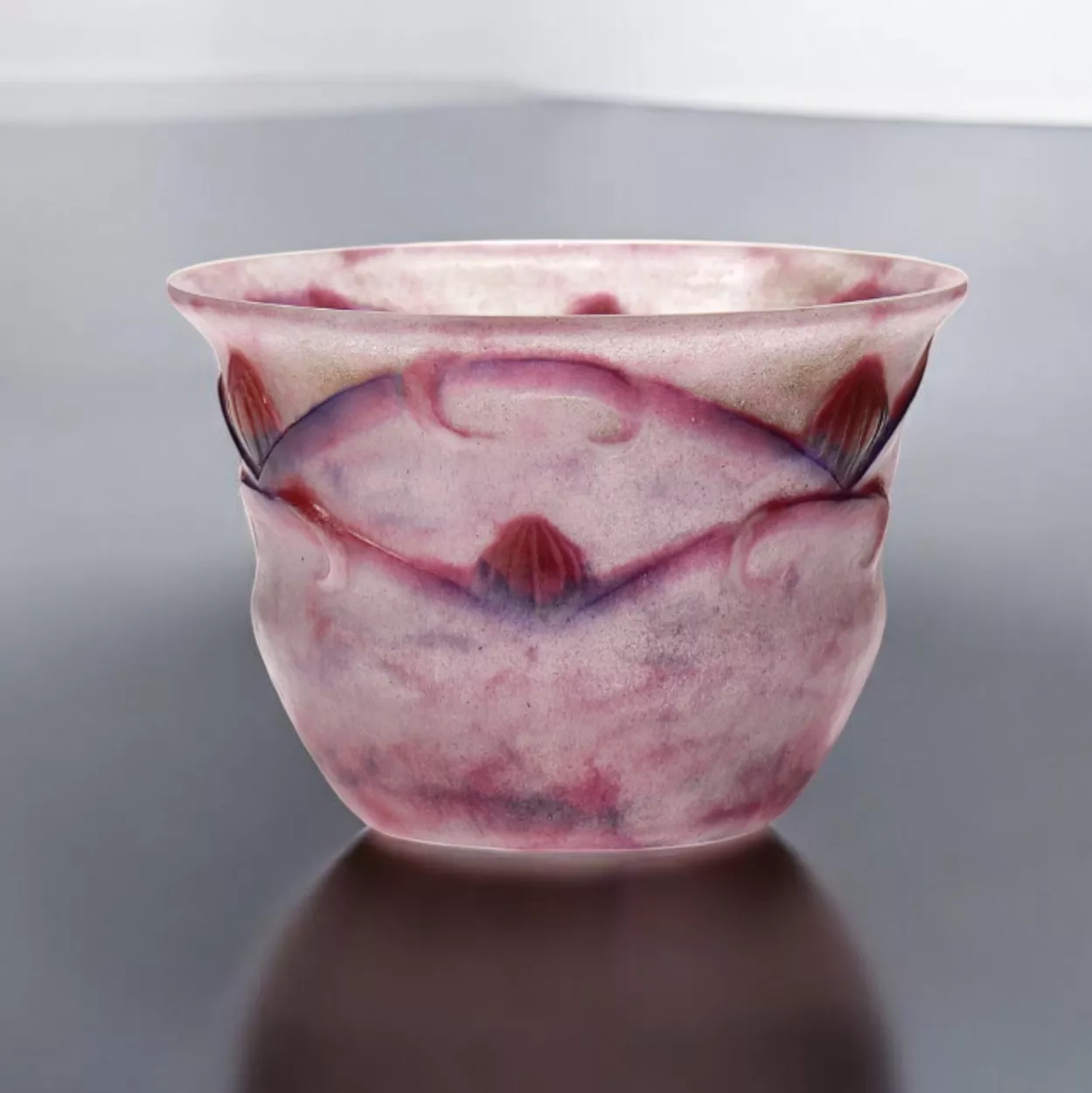
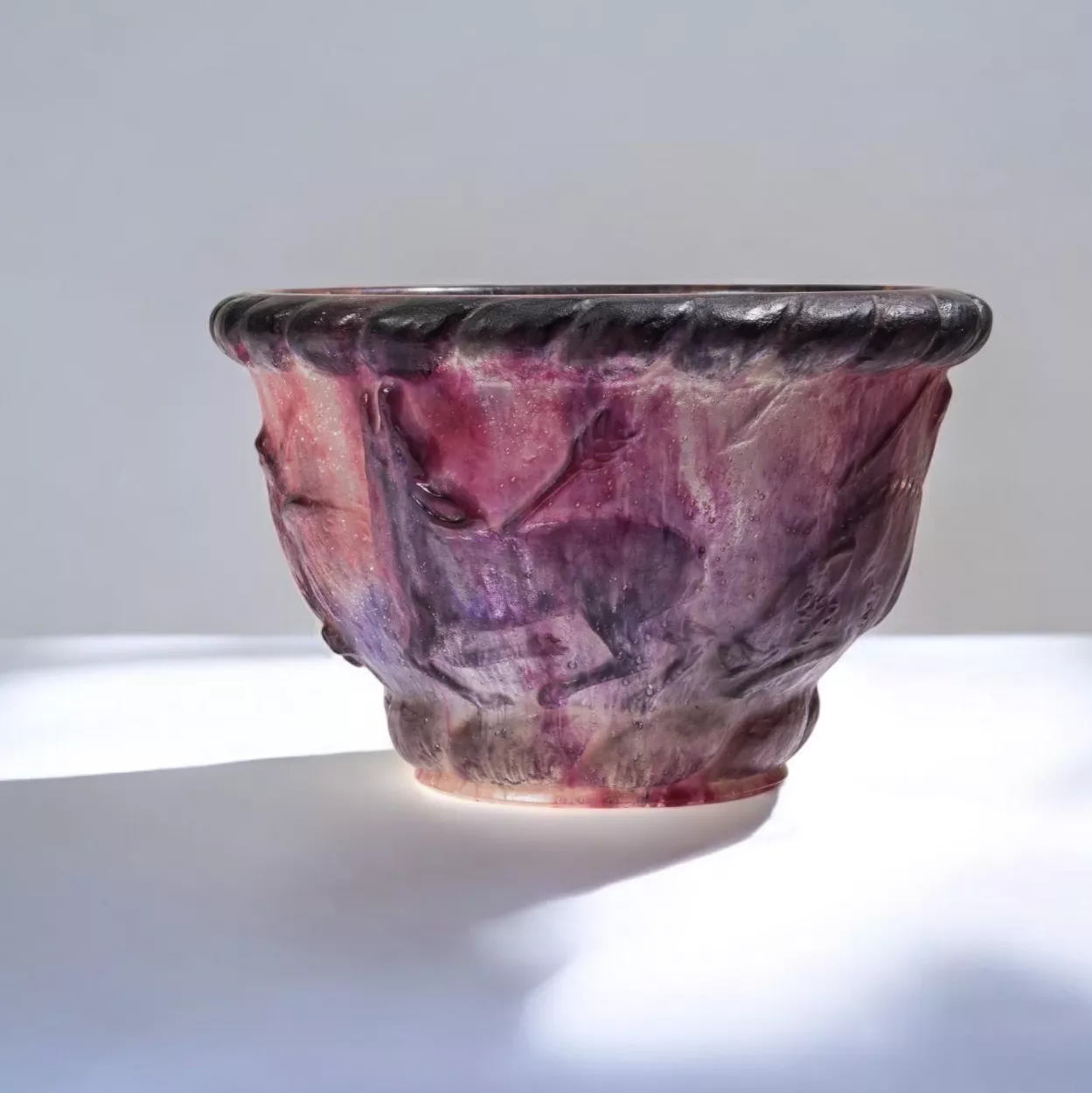
The Butterflies and Thistles, a pâte de verre vase designed by Gabriel Argy-Rousseau in the 1920s, vividly illustrates the glassmaker's mastery of combining modelling and light.
The composition revolves around a plant setting where the slender stems of thistles soar in supple arabesques, their bristling flower heads contrasting with the delicacy of the butterflies' diaphanous wings.
The artist plays with a subtle palette of nuanced purples, ochres and blues, achieved by coloring in the mass, giving the whole an almost unreal effect of depth and transparency.
The pâte de verre technique, whose process he has perfected, allows him here to alternate zones of opacity and translucence, modulating the perception of light that seems to filter through the vase's very material.
Far from the geometric rigor of Art Deco, the work retains an organic fluidity inherited from Art Nouveau, while taking on a more stylized approach in which each motif stands out with precision.
Both sculpture and miniature stained glass, this vase expresses Argy-Rousseau's sensitivity to nature transfigured by glass, a nature where the fragility of the living melts into the evanescence of light, and where matter becomes the receptacle of vibrant, fleeting poetry.
Gabriel Argy Rousseau's imprint on his era
In the glassmaking landscape of the early 20th century, Gabriel Argy-Rousseau stands out as a singular figure, reconciling the symbolist heritage of Art Nouveau with the geometric purity of Art Deco.
At a time when industry is tending to standardize production, he defends workshop work where each piece retains the singularity of the handmade, thus extending the ambition of 19th-century craftsmen.
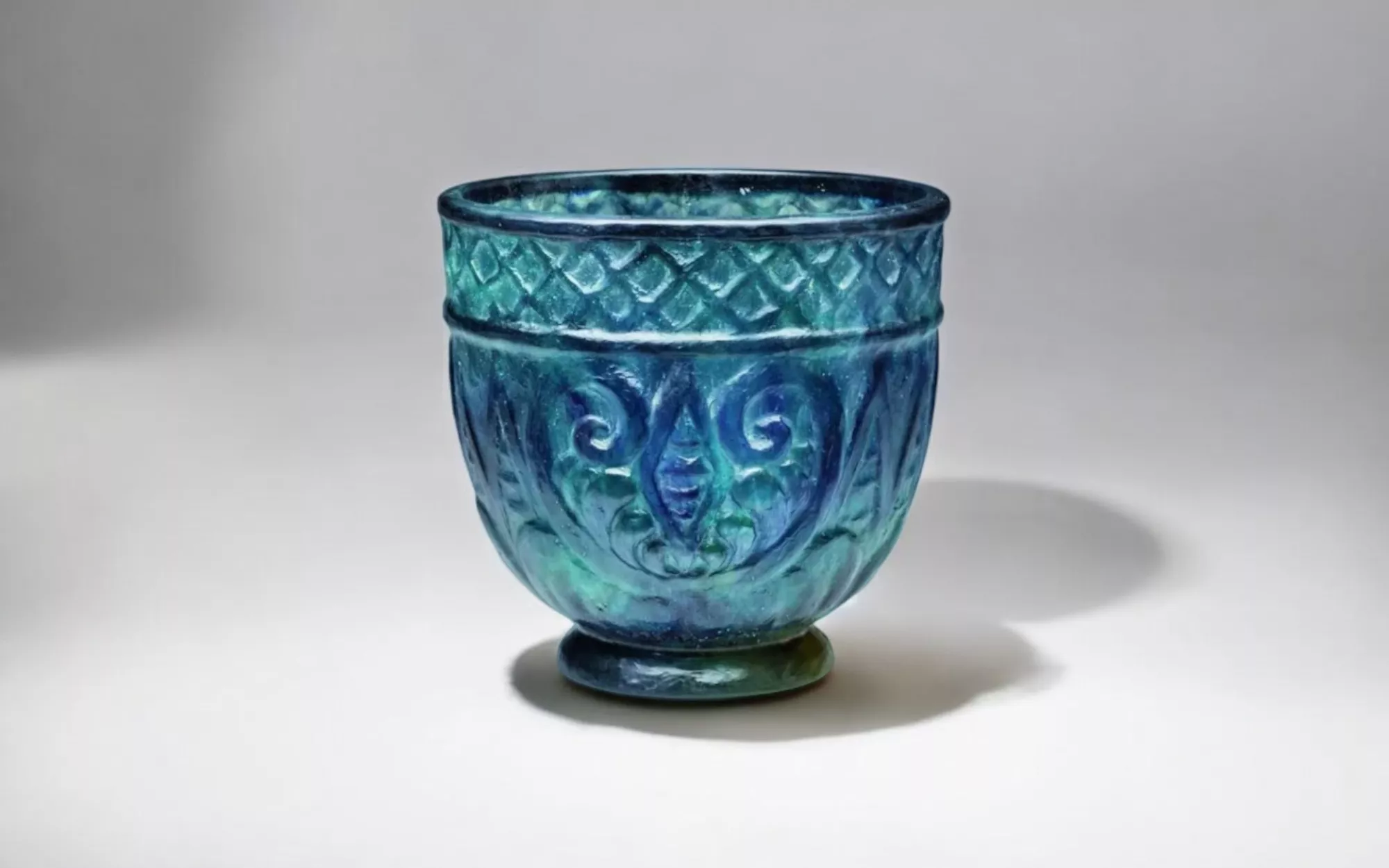
His mastery of pâte de verre, refined to the point of pictorial finesse, renews the relationship between opacity and transparency, modeling and color, giving his works an almost sculptural dimension.
Unlike Lalique, who sublimates glass through the play of relief and frosting, Argy-Rousseau inscribes his compositions in the very mass of the material, abolishing the boundary between decoration and structure.
His influence can be measured in the rise of designers who, in the 1920s and 1930s, in turn explored the expressive potential of colored glass, whether François Décorchemont or Henri Navarre.
But it's above all in the persistence of a poetic vision of the material that his imprint lies: where Art Deco often imposes rigid lines and formal abstraction, he preserves a fluidity, an inner light that lends his works a dreamlike quality.
Far from being a mere technician of glass, he turns it into a medium of emotion, a vibrant surface where naturalism and stylization, the erasure of contours and the brilliance of hues mingle, thus reconciling the aesthetics of dreams with the demands of a nascent modernity.
The stylistic influences of Gabriel Argy Rousseau
Trained at the École nationale supérieure des arts décoratifs, Gabriel Argy-Rousseau inherited a teaching style in which drawing, composition and the study of nature took precedence over purely technical execution.
His approach to glass is in line with Art Nouveau, from which he retains the attention to plant motifs and the use of supple modeling, but it breaks away from it with a more marked stylization, prefiguring the decorative abstraction of Art Deco.
Glass paste, of which he became one of the undisputed masters, enabled him to experiment with material effects close to ceramics, where Japanese influences and plays on transparency recalled certain productions by the École de Nancy.
The shadow of Gallé hovers over his floral compositions, but where Gallé plays on the contrast of inclusions and reliefs, Argy-Rousseau favors a fusion of hues, an almost painterly softness.
He also finds a source of inspiration in medieval miniatures and Limousin enamels, whose shimmering sparkles he transposes through opalescent shades.
But it is undoubtedly in fin-de-siècle symbolism that his vision is most deeply rooted: the diaphanous female figures, the stylized animal silhouettes recall the world of a Odilon Redon or a Maurice Denis, transposing to glass a dreamlike poetry where naturalism and unreality mingle.
At the crossroads of influences, Argy-Rousseau doesn't just imitate: he absorbs, metamorphoses, and forges his own language where the material itself becomes the vehicle for a luminous reverie.
Recognizing Gabriel Argy Rousseau's signature
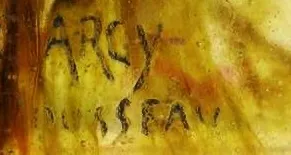
The artist didn't sign all his works, which doesn't make for easy appraisal, but his signature appears as a voluptuous, clearly visible idiogram in fluid writing.
Knowing the value of a work
If you happen to own a vase by Gabriel Argy Rousseau, request a free appraisal without further delay via our form on our website.
A member of our team of experts and accredited auctioneers will contact you promptly to provide you with an estimate of the value of your work, as well as any relevant information about it.
If you are considering selling your work, you will also be accompanied by our specialists in order to benefit from alternatives for selling it at the best possible price.
.Estimate in less than 24h
Discover in the same theme

Rating and value of sculptures, drawings and paintings by An...
André Cadere is a Romanian conceptual artist and member of the Op Art movement who has produced paintings and sculptures that are highly rated at auct...
Learn more >

Rating and value of screens, paintings on lacquer by Pierre...
Pierre Dunand is a coppersmith and decorator who has produced a number of highly-regarded works of art that are valued at auction.
Learn more >

Rating and value of sculptures and bronzes by Arno Breker
Arno Breker is a twentieth-century neoclassical sculptor whose sculptures and bronzes are highly valued at auction.
Learn more >
Similar works sold at auction

Estimated Between €1,500 and €3,000
Établissements Gallé - ovoid glass vase

Estimated 3.000 - 5.000
Émile GALLÉ (1846 - 1904) Mahogany-stained walnut display case

Estimated 600 - 1.200
ÉTABLISSEMENT GALLÉ (1904 - 1936) Vase with flattened ovoid body and conical neck

Estimated 1.000 - 2.000
DAUM - NANCY, Tubular vase with three-lobed hot-modelled neck

Estimated 10.000 - 15.000
DAUM - NANCY, "Water iris and dragonflies". Ovoid vase with conical neck on hemmed base

Estimated 1.000 - 2.000
DAUM France, Butterflies, Pair of wall lights in pâte de verre

Secure site, anonymity preserved

Auctioneer approved by the State

Free and certified estimates
Frequently asked questions
-
Who is Gabriel Argy-Rousseau, and what is his contribution to art history?Gabriel Argy-Rousseau (1885–1953) was a French ceramicist and master glassmaker, a unique figure of the early 20th century who revolutionized the use of pâte de verre. Trained at the École nationale de céramique de Sèvres, he developed an innovative process in 1914 for vitrifying glass with color throughout the mass, allowing for subtle effects of form and translucency. His work reconciles the Symbolist heritage of Art Nouveau with the geometric purity of Art Deco, making each piece a unique work of art in which the material itself becomes the vehicle for a profoundly modern expression.
-
What are the price ranges for Gabriel Argy-Rousseau's works, broken down by type of object?The prices of Gabriel Argy-Rousseau’s works vary considerably depending on the technique and the piece’s prestige. Ceramics range from €630 to €10,500, pâte de verre pieces from €130 to €52,700, and light fixtures from €600 to €57,800. The most exceptional works, such as the “Signes” vase sold in 2013 for €52,700, far exceed initial estimates, reflecting the rarity and technical quality of certain pieces.
-
How can you authenticate a work by Gabriel Argy-Rousseau?To authenticate a work by Gabriel Argy-Rousseau, we recommend that you submit your piece for a free appraisal using our online form. A state-certified expert or auctioneer will examine your piece, verify the signature (a voluptuous idiogram in fluid handwriting), its technical process, and its characteristics, and then provide you with an accurate estimate and detailed information regarding its authentication, with no obligation.
-
Is this a good time to sell a ceramic piece or vase by Gabriel Argy-Rousseau?Yes, now is a good time to sell a work by Gabriel Argy-Rousseau. The market recognizes the value and rarity of his creations, particularly his pâte de verre pieces and light fixtures, whose prices have shown good stability and often exceeded estimates. Collectors’ interest in Art Nouveau and Art Deco remains strong, ensuring steady demand for authenticated pieces.
-
How does the appraisal process work at Auctie's, and how do I sell my artwork?Appraisals at Auctie's are free, no-obligation, and quick: fill out our online form, and an expert will contact you promptly to provide you with the value of your artwork within 48 hours. If you decide to sell, our team of auctioneers will guide you through the process from appraisal to auction, offering you the best options to achieve the highest possible price.
