



Porcelain Appraisal: Valuation and Auction

Key takeaways
- The value of a piece of porcelain depends primarily on its manufacturer, the period in which it was made, and its condition, with prices ranging from 30 euros to several million based on these criteria.
- Sèvres porcelain from the royal periods (18th century) and 18th-century Meissen porcelain are the most highly valued segments of the Western market, with figurines fetching up to 50,000 euros.
- The piece’s absolute integrity—free of chips or restoration—is a key factor, and authenticated manufacturer’s marks significantly increase the value of a porcelain piece.
Royal porcelain manufacturers, complete sets, and workshop marks: the value of porcelain varies greatly depending on the manufacturer, the decoration, and the condition.
Below you’ll find all our valuation guides dedicated to porcelain—including pieces from royal manufactories, tableware sets, and collectible items. Each guide details the price ranges observed at auction and the factors that determine a piece’s value before you entrust it to our state-certified auctioneers.
Guides on this type of item
See all guides >
Marseille Auctioneer: Art Valuation – Aucties
Have your artwork, jewelry, and collectibles appraised in Marseille by the experts at Aucties. 100% free online appraisal within 24 hours. ✅
Learn more >

Rating and value of Hue porcelain from Vietnam
Vietnamese porcelain is a highly valued collectible at auction. Estimates within 24 hours.
Learn more >

Rating and value of sculptures and bronzes by Émile Bracquem...
Émile Bracquemond is a French animal sculptor who produced works that are highly valued at auction. Estimate in 24h
Learn more >

Rating and value of François-Xavier Lalanne's ceramics and p...
François-Xavier Lalanne is a twentieth-century artist and ceramist who has produced works in porcelain that are quoted on the auction market.
Learn more >

Rating and value of works, paintings, sculptures by Georges...
Georges de Feure is an artist of the early 20th century who produced paintings and sculptures that are quoted on the auction market.
Learn more >

Rating and value of works, drawings, paintings by Mathurin M...
Mathurin Meheut was a post-Impressionist artist who mainly depicted Brittany and produced works that were successful at auction.
Learn more >

Rating and value of works, paintings, drawings by Sergey Che...
Sergey Chekhonin is a Russian artist who has produced a wide range of works: paintings, porcelain and drawings that are valued and quoted.
Learn more >

Rating and value of the works, Alexandra Shchekotikhina-Poto...
Alexandra Shchekotikhina-Pototskaya is a twentieth-century Russian artist who mainly produced paintings on porcelain, which are highly valued.
Learn more >

Rating and value of Japanese porcelain: Imari and Satsuma...
Japanese porcelain is known the world over and appreciated by bidders. It is stable and valuable. Estimated in 24h.
Learn more >

Rating and value of works in Sèvres porcelain: vases, servic...
Sèvres porcelain, famous and appreciated throughout the world, has value on the auction market. Estimate in less than 24h.
Learn more >

Value and quotation of Émile Gallé's earthenware works
Nineteenth-century artist Émile Gallé produced a considerable number of works, notably in earthenware. Their vote is high. Estimated in 24h.
Learn more >

Free appraisal of your furniture and objets d'art
Furniture, whether antique, designer or contemporary, can be very valuable. Here are a few details about the different eras, so get them appraised!
Learn more >
Understanding the Value of Porcelain
What Is Market Value in the Porcelain Market?
A porcelain piece’s market value refers to the reference value assigned to it by the market at a given moment, resulting from a precise balance between the manufacturer, the period of production, the quality and rarity of the decoration, the piece’s condition, and the strength of the supporting documentation.
A translucent, resonant material produced by firing kaolin clay at extremely high temperatures, porcelain represents the technical pinnacle of the ceramic arts, a technique mastered by China as early as the 9th century and long jealously guarded as a state secret before being discovered in Europe in 1708 by the alchemist Johann Friedrich Böttger, who was working for Augustus the Strong, Elector of Saxony.
This market, one of the oldest and best-structured in the decorative arts, is driven by a unique dual logic of valuation: on the one hand, imperial Chinese porcelain from the Ming and Qing dynasties, whose rarest pieces regularly fetch spectacular auction records, driven by increasingly intense demand from Asia.
On the other hand, the major European manufactories—Meissen, Sèvres, Vienna, Chelsea, and Capodimonte—whose 18th-century productions form the most sought-after core of the Western market for antique porcelain.
Between these two geographic poles, a considerable output from secondary and regional manufacturers offers very accessible entry points for collectors with more modest means or interests.
Sèvres, Meissen, Imperial China: What Porcelains Are on the Market?
The Sèvres porcelain manufactory, founded in 1740 under the royal patronage of Louis XV and later Louis XVI, forms, along with Meissen, the undisputed duopoly of prestigious European porcelain.
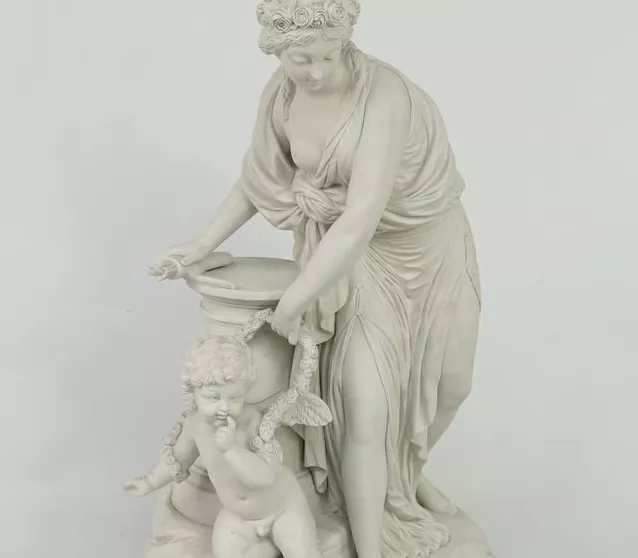
Its “royal blue”—a distinctive color found on the backgrounds of some of its most famous pieces—its production of biscuit porcelain, unglazed porcelain of a matte white used for sculpted groups of remarkable finesse, and its table services commissioned by the royal courts of Europe constitute the three main categories of a production of incomparable richness.
Pieces bearing the marks of the royal periods—in particular the two intertwined Ls characteristic of the manufactory under the Ancien Régime—are systematically valued higher than 19th-century productions.
The Meissen porcelain manufactory, founded in 1710 in Saxony following the discovery of the formula for hard-paste porcelain, was the first European manufactory to unlock China’s millennia-old secret, a fact that confers upon it absolute historical legitimacy—a factor the market continues to recognize.
Its tableware sets painted with Indian flowers or gallant scenes by Johann Joachim Kändler and his collaborators, its figurines depicting characters from the commedia dell’arte and the Saxon court, and its large ceremonial pieces constitute the most highly valued categories in this market.
Manufactory | Country | Key Period | Market Demand Level |
Sèvres (royal, then national) | France | 18th century (royal marks) | Very strong, institutional |
Meissen | Germany (Saxony) | 18th century, Kändler | Exceptional, very high auction prices |
Vienna (Imperial Manufactory) | Austria | 18th–early 19th century | Very active, European collectors |
Chelsea, Worcester, Bow | England | 18th century | Active, British and international markets |
Capodimonte | Italy (Naples) | 18th century | Active, Italian and international collectors |
Imperial China (Ming, Qing) | China | 15th–19th centuries | Exceptional, very strong demand in Asia |
The criteria that determine the value of porcelain
The market value of a piece of porcelain depends on a hierarchy of criteria, of which the manufacturer is the first and most decisive factor.
A Sèvres plate with a royal blue base, decorated with scenes painted by an artisan identified in the manufactory’s records, will always be worth significantly more than a piece from the same period and of the same decorative quality produced by a less prestigious manufactory.
The quality of the painted decoration, its rarity, and its condition constitute the second set of criteria: a decoration featuring exotic birds painted by a master decorator from Meissen will command a considerable premium over a stenciled or mechanically printed decoration. Finally, the absolute integrity of the piece—without the slightest chip, crack, or restoration—is an absolute criterion for determining its value.
The price ranges illustrate the breadth of this market. A common earthenware plate ranges from 30 to 300 euros. A fine piece of soft-paste porcelain from an 18th-century regional manufactory ranges from 300 to 5,000 euros. A high-quality piece of Sèvres porcelain sells for between 2,000 and 100,000 euros, depending on the period and the decoration.
A top-quality 18th-century Meissen figurine or group of figurines can exceed 20,000 euros. Chinese imperial porcelain from the Ming and Qing dynasties with authenticated reign marks frequently fetches several hundred thousand euros.
Estimate in less than 24h
Tableware, vases, figurines: appraised porcelain pieces
Tableware Sets, Ceremonial Pieces, and Figurines
In 18th-century European porcelain production, grand ceremonial table services were the most ambitious and highly prized pieces; their size and the decorative consistency they required called for a highly sophisticated manufacturing process and the collaboration of the manufactory’s finest painters. The sets produced for European royal courts, as documented in the manufacturers’ archives, occupy the very pinnacle of this hierarchy, their documentary value complementing their artistic merit.
Individual ceremonial pieces—vases, flowerpots, and table centerpieces—follow closely behind; their often impressive size allows painters to execute a decorative program of a complexity that service pieces do not always permit.
Porcelain figurines—a specialty of Meissen, with its characters from the commedia dell’arte, its shepherds and shepherdesses, and its animals sculpted by Kändler—as well as those from most European manufacturers that imitated them—constitute a particularly active segment of the market, as their often decorative nature and modest size make them easy to integrate into contemporary collections and interiors.
The quality of the original modeling—on which the fineness of detail in the cast pieces directly depends—and the condition of the original polychrome decoration are the primary criteria for evaluation.
Category | Characteristics | Estimated Price Range | Market Demand |
Tableware from a major manufacturer (Sèvres, Meissen) | Painted decoration, consistency, completeness | €10,000 — €500,000 and above | Very strong, institutional |
Vase or ceremonial piece (Sèvres, Meissen, Vienna) | Ambitious size, elaborate decoration | €3,000 — €100,000 | Very active, international |
Figurine or sculpted group (Meissen, 18th century) | Fine modeling, original polychrome decoration | €2,000 — €50,000 | Popular, broad buyer base |
Single piece (plate, cup, sauceboat) | High-quality painted decoration, identified maker’s mark | €500 — €15,000 | Highly liquid, active market |
Chinese Imperial Porcelain (reign mark) | Imperial clay, glaze, and decoration | €10,000 — several million € | Exceptional, high demand in Asia |
Sèvres, Meissen, China: the most sought-after pieces
Sèvres porcelain pieces from the royal periods—identifiable by the two interlaced, crowned “L”s and the date letters that allow each piece to be dated to the year—are the most sought-after and highly valued items on the French porcelain market.
The factory’s characteristic colored backgrounds—lapis blue, apple green, daffodil yellow, and Pompadour pink—are immediately recognizable aesthetic hallmarks whose rarity and quality justify the highest auction prices.
Get a Free Appraisal of Your Porcelain
A certified appraisal by a licensed auctioneer in less than 24 hours
Identifying antique porcelain, reading its marks, determining how its design fits into a manufacturer’s production, and assessing its market value requires specialized training that few professionals in the art market are able to apply with the same rigor across all European and Asian manufacturers.
Auctie’s auctioneer possesses this multidisciplinary expertise, which is made available to you free of charge for a certified response in less than 24 hours.
What You Need to Provide for an Online Appraisal
Clear photographs of the entire piece, the base with its markings, and details of the decoration are essential.
Please provide the exact dimensions, the general condition, and any information regarding provenance, previous purchases, collector’s labels, or prior appearances at public auctions.
Markings, Decorations, and Authenticity: The Pillars of Valuation
Manufacturer’s Marks and Authentication
Level of Documentation | Impact on Value |
Authenticated manufacturer’s mark (Sèvres, Meissen, etc.) | Maximum assurance; often an essential condition for a high valuation |
Piece documented in the manufacturer’s records | Significant impact; precise dating to the year and identification of the workshop |
Documented provenance from a major historical collection | High value; reassuring traceability and guaranteed authenticity |
Written appraisal by a recognized specialist in the manufacturer’s work | Solid guarantee; facilitates the sale and provides security for the buyer |
A coherent piece requiring no additional documentation | Conservative estimate; based on stylistic and material quality |
Suspicious brand or piece imitating an original without being one | Significant depreciation; thorough verification is essential |
Integrity and Condition
The integrity of a porcelain piece is an absolute criterion in this market: even the slightest chip, no matter how tiny, significantly reduces a piece’s value, and a restoration, regardless of its quality, cannot compensate for this alteration to the original material.
Examination under ultraviolet light is the standard method of appraisal for detecting restorations invisible to the naked eye, as adhesives and paint retouches absorb UV rays differently and are thus clearly revealed.
Sell Porcelain at Auction with Auctie's
From the reserve price to the final bid
Auctions are the most suitable method for selling high-quality porcelain, pitting collectors against one another—and their appreciation for the rarity of a beautiful piece can lead to remarkable final bids. Auctie's holds its auctions at the Hôtel Drouot and online, providing optimal visibility for the most sought-after lots.
Hôtel Drouot and Online Auctions
Auctie’s holds its auctions at the Hôtel Drouot, which regularly features sessions dedicated to decorative arts and ceramics. Online broadcasting allows us to reach collectors worldwide, particularly in Asia for Chinese porcelain.
Estate Settlement: Valuing Inherited Porcelain
Inventory and Distribution of an Estate
Antique porcelain is frequently found in estates, sometimes without the heirs knowing its exact value. Auctie's works alongside notaries to compile thorough inventories, with each piece appraised with the care it deserves.
Confidentiality and Discretion
Auctie's handles every case with absolute discretion. The owner’s identity is never disclosed to third parties without their explicit consent.
Glossary of Porcelain Grading and the Porcelain Market
Term | Definition |
Valuation | The estimated market value of a piece of porcelain, determined based on auction results and demand. |
Kaolin | A pure white clay, an essential component of hard-paste porcelain, whose purity determines its translucency. |
Hard-paste porcelain | Porcelain fired at over 1,300°C, translucent and resonant; a formula discovered in Meissen in 1708. |
Soft porcelain | Porcelain fired at a lower temperature, more fragile, typical of early European attempts. |
Biscuit | Unglazed porcelain with a matte white finish, used for figurines imitating marble. |
Manufacturer’s mark | A mark affixed to the bottom of the piece to identify the manufacturer; the two intertwined Ls are the Sèvres mark. |
Colored ground | A colored glaze characteristic of a particular manufacturer (royal blue, Pompadour pink, apple green at Sèvres). |
Underglaze decoration | Decor painted before the glaze is applied, which is set and protected during firing. |
Chip | A small chip on the surface of a ceramic piece; significantly reduces its value. |
Provenance | The ownership history of a piece of porcelain. |
Adjudication | Awarding of the lot to the highest bidder at the conclusion of an auction. |
Reserve Price | The starting price set for the auction. |
Estimate in less than 24h
Let Auctie's appraise your porcelain
Beautiful antique porcelain is the culmination of craftsmanship that generations of artisans have perfected over centuries, through an unbroken dialogue between China and Europe.
Understanding the value of such a piece means being able to interpret its material, markings, and decoration to uncover the entire history of artistic transmission and rivalry. Auctie's offers this expertise to you, free of charge and in complete confidence.
The appraisal is free, with no obligation, and you’ll receive a response within 24 hours.
Discover in the same theme

Bretagne Auctioneer: Valuation – Aucties
Have your artwork, jewelry, and collectibles appraised in Brittany by the experts at Aucties. 100% free online appraisal within 24 hours. ✅
Learn more >

Besançon Auctioneer: Art Valuation | Aucties
Have your artwork, jewelry, and collectibles appraised in Besançon by the experts at Aucties. 100% free online appraisal within 24 hours. ✅
Learn more >
Rating and value of sculptures and bronzes by Émile Bracquem...
Émile Bracquemond is a French animal sculptor who produced works that are highly valued at auction. Estimate in 24h
Learn more >

Secure site, anonymity preserved

Auctioneer approved by the State

Free and certified estimates
Frequently asked questions
-
What are the main factors that determine the value of a piece of porcelain?The value of a piece of porcelain depends first on the manufacturer (Sèvres, Meissen, Imperial China, etc.), then on the quality and rarity of the painted decoration, the period of manufacture, and finally on its condition. The piece’s absolute integrity—with no chips or restorations—is a key factor in determining its value. A piece documented in the manufacturer’s records or from a major collection commands a higher value.
-
How can I have an antique porcelain piece authenticated and find out its value?Auctie's offers a free, no-obligation appraisal by a certified auctioneer, completed in less than 48 hours. All you need to do is provide clear photographs of the entire piece, its markings and decorations, as well as its exact dimensions, condition, and any information regarding its provenance. Our multidisciplinary expertise covers all European and Asian manufacturers.
-
What price ranges can be expected in the porcelain market?Prices vary considerably depending on the manufacturer and quality. An 18th-century piece of soft-paste porcelain from a regional manufacturer ranges in price from 300 to 5,000 euros. Sèvres porcelain sells for between 2,000 and 100,000 euros. An 18th-century Meissen figurine often exceeds 20,000 euros. Chinese imperial porcelain with reign marks regularly fetches several hundred thousand euros.
-
Why is now a good time to sell antique porcelain?The porcelain market is one of the oldest and most well-structured in the decorative arts, with very strong institutional demand for major European manufacturers and growing demand in Asia for imperial Chinese porcelain. Auctions pit collectors against one another, and their keen sense of rarity can lead to remarkable bids.
-
How does the sale of porcelain work at Auctie's?Auctie's supports sellers from the free appraisal through to the auction. We organize auctions at the Hôtel Drouot and online, providing optimal visibility for the most sought-after lots and reaching collectors worldwide, particularly in Asia. For estates, we compile thorough inventories with detailed appraisals of each item.
