



Vase Value: Appraisal and Auction

Key takeaways
- The value of a vase depends mainly on its origin, its manufacturer (Sèvres, Gallé, Meissen), and its condition, which can increase the price by a factor of 10 to 100.
- Price ranges vary considerably: from 50 to 500 euros for common earthenware to several hundred thousand for Chinese imperial vases.
- An intact vase that has not been restored is worth 2 to 5 times more than a damaged one, with the quality of the decoration and the rarity of the subject being key determining factors.
Signed glassware, porcelain, and art ceramics: the value of antique vases varies greatly depending on the artist, the material, and the condition.
Below, you’ll find all our valuation guides dedicated to antique vases—including signed glassware, porcelain, and art ceramics. Each guide details the price ranges observed at auction and the factors that determine a piece’s value before you entrust it to our state-certified auctioneers.
Guides on this type of item
See all guides >
Rating and value of vases by Lucien Levy Dhurmer and Clément...
Clément Massier and Lucien-Lévy Dhurmer collaborated on Art Nouveau vases, which command high prices and are highly valued at auction.
Learn more >

Rating and value of artists and objects by Ernest Baptiste L...
Ernest Baptiste Leveillé was a glassmaker active in the second half of the 19th century who produced vases and other objects that fetch high prices at...
Learn more >

Rating and value of vases and paintings by François Décorche...
François Décorchemont is a French Art Nouveau glass artist, ceramicist, and painter whose works fetch high prices at auction.
Learn more >

Rating and value of boxes, inkwells and vases by Eugène Feui...
Eugène Feuillâtre is an Art Nouveau silversmith who produced few objects that have a significant value at auction. 24h estimate.
Learn more >

Rating and value of Charles Greber's vases and ceramics
Charles Greber is a French ceramist who has produced works that can be highly valued at auction. 24h estimate.
Learn more >

Rating and value of Anne Dangar's drawings, paintings and ce...
Anne Dangar is an Australian artist, active in France, who has produced paintings and ceramics that are highly regarded and valued.
Learn more >

Rating and value of vases and ceramics by Gabriel Argy Rouss...
Gabriel Argy Rousseau is a French ceramist and glassmaker who has produced works that are highly regarded and valued at auction.
Learn more >

Rating and value of works and vases by Aristide Colotte
Aristide Colotte is a French glass artist who has produced works that are highly valued at auction. 24h estimate.
Learn more >

Rating and value of Fabergé objets d'art
Pierre-Karl Fabergé is a master goldsmith who has produced numerous works of high value at auction. 24h estimate.
Learn more >

Rating and value of works, ceramics, paintings by Jacques Po...
Jacques Pouchain is an artist who has produced modernist ceramics that are highly valued at auction. Estimate in 24h.
Learn more >

Rating and value of Jacques and Dani Ruelland's ceramics, la...
Jacques and Dani Ruelland are ceramists who have produced lamps, vases and other shared works that are highly prized at auction.
Learn more >

Rating and value of Georges Jouve vases
Georges Jouve is a contemporary ceramist who has produced vases that are highly valued at auction. Estimate in 24h.
Learn more >
Understanding the Value of a Vase
What Is Market Value in the Decorative Arts Market?
A vase’s market value refers to the reference value assigned to it by the market at a given moment, based on its geographic and cultural origin, the artist or manufacturer who produced it, the materials and techniques used in its creation, its condition, and the strength of the supporting documentation.
The vase is one of the most universal forms of ceramic and decorative art, found in every civilization and across all regions since the dawn of humanity, which gives the market dedicated to it considerable diversity and scope, from ancient Greek vases to contemporary creations, including imperial Chinese porcelain and Art Nouveau pieces by Gallé and Daum.
This market has a distinctive feature: the vase is both a utilitarian object, designed to hold flowers or liquids, and a decorative or ceremonial object, whose formal and ornamental beauty can far exceed its primary function.
This dual nature explains the diversity of the collections that embrace it: collectors of antique porcelain, enthusiasts of Art Nouveau glassware, lovers of Asian art, and buyers of contemporary design all constitute distinct clienteles whose criteria for valuing objects—though they may converge on certain exceptional pieces—often follow very different standards.
Porcelain, stoneware, earthenware, glass: what materials are on the market?
Vases come in an extremely diverse range of materials, each with significantly different approaches to appraisal and valuation. Porcelain, a translucent and resonant material invented in China and long reserved for the imperial court, is the most highly valued medium in ceramic art, with its imperial Ming and Qing vases fetching spectacular auction prices.
Earthenware, a ceramic with an opaque tin-glaze, has given rise to distinct decorative traditions in France, Spain, Italy, and the Netherlands, with Rouen, Moustiers, Delft, and Alcora serving as the most renowned centers.
Stoneware, a hard, dense ceramic fired at high temperatures, has been used both in the Asian tradition—such as Korean and Japanese stoneware—and in modern European production, particularly by 19th- and 20th-century artists’ studios.
Glass, a material of exceptional formal flexibility that can be blown, cut, engraved, enamelled, or inlaid using a wide variety of techniques, has produced some of the most admired vases in the history of the decorative arts, from ancient molded glass vases to the Art Nouveau creations of Gallé and Daum, whose effects of texture and color—ranging from opacity to translucency—constitute an immediately recognizable aesthetic signature.
Material | Characteristics | Featured Pieces | Market Demand Level |
Porcelain (China, Europe) | Translucency, hardness, underglaze or overglaze decoration | Ming and Qing imperial vases, Sèvres, Meissen | Exceptional for major pieces |
Art Nouveau blown glass (Gallé, Daum) | Textural effects, inclusions, engraved or enameled decorations | Gallé vases with orchids, Daum vases with landscape motifs | Very strong, with an established niche market |
Faience (Rouen, Moustiers, Delft) | Opaque tin-glazed earthenware, painted decorations, fragile | Vases with radiating patterns from Rouen, Delft blue | Active market, regional and national collectors |
Stoneware (Asian or modern) | Hardness, impermeability, expressionist glaze | Korean Goryeo stoneware, flamed stoneware | Active, specialty market |
Glazed and rustic pottery | Regional production, naive designs | French and European regional pottery | Affordable, mass market |
The criteria that determine the value of a vase
The market value of a vase depends on a hierarchy of criteria, with geographic origin and manufacturer generally being the top two factors.
A porcelain vase from the Sèvres manufactory, identifiable by its maker’s marks and its characteristic royal blue glaze, will always be worth significantly more than a vase from a less prestigious manufactory of the same period and decorative quality.
The quality of the painted decoration, the rarity of the subject depicted, and the piece’s perfect condition—with no chips or restoration—are the other determining factors.
The price ranges illustrate this variation. A common regional earthenware vase can range from 50 to 500 euros. A beautiful 18th-century earthenware vase from Rouen or Moustiers ranges from 500 to 8,000 euros, depending on the decoration and condition.
A high-quality Sèvres porcelain vase sells for between 2,000 and 50,000 euros. A vintage Gallé glass vase can exceed 5,000 to 80,000 euros, depending on the complexity of the decoration and the quality of the craftsmanship. High-quality Chinese imperial vases can fetch several hundred thousand euros.
Estimate in less than 24h
Get a Free Appraisal of a Vase
A certified appraisal by a licensed auctioneer in less than 24 hours
Accurately identify a vase’s origin and manufacturer, decipher a porcelain mark, or recognize a manufacturing technique through visual examination: these are just some of the specialized expert services that Auctie’s auctioneer offers you free of charge, with a certified response in less than 24 hours.
What you need to provide for an online appraisal
Clear photographs of the entire vase from multiple angles, of the base (including any markings), and of any significant decoration are essential. Please specify the exact dimensions, the estimated material, and the overall condition—including any chips, cracks, or restorations.
Origin, brand, and condition: the key factors in a vase’s value
Manufacturer’s mark, decoration, and condition
Criterion | Impact on value |
Origin and Manufacturer (Sèvres, Meissen, Galle vs. mass-produced items) | Primary factor; can increase the value by a factor of 10 to 100 |
Decoration (quality and rarity of the subject depicted) | Historical and rare designs significantly increase value |
Condition (no chips or restoration) | An intact vase is often worth two to five times as much as a restored one |
Mark (identified manufacturer) | Sèvres, Meissen, Imperial China: strong impact due to reputation |
Size and format (pair vs. single piece) | A pair is always worth more than two identical individual pieces |
Provenance and condition
A vase’s provenance is a key factor in building trust, particularly for antique pieces whose origin in a major historical collection can be documented.
Condition is absolutely critical: an antique porcelain vase without a single chip, crack, or restoration is a rarity that even the most discerning collectors directly reflect in their offers.
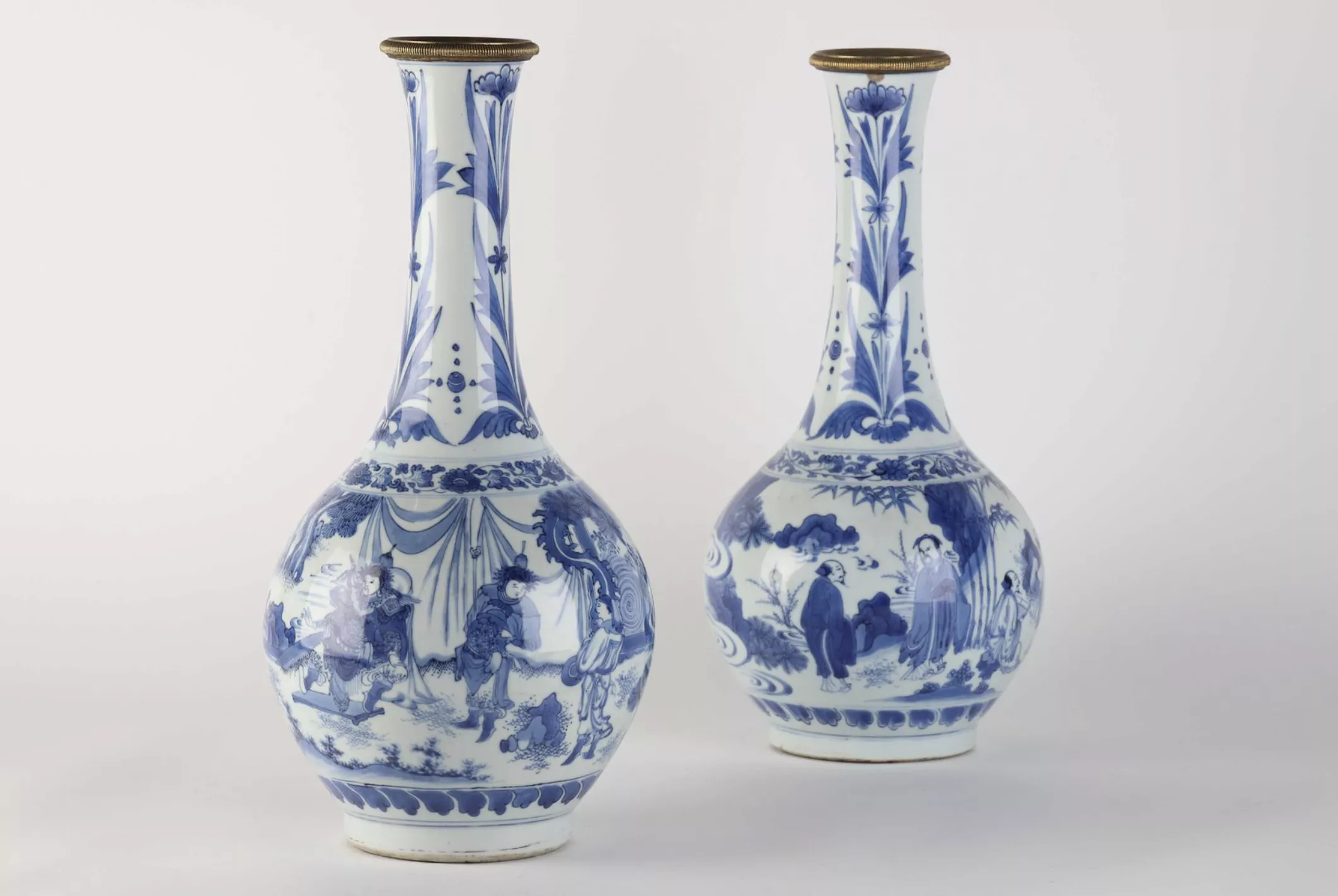
Sell a Vase at Auction with Auctie's
From the reserve price to the final bid
Auctions are the best way to sell high-quality vases. Auctie's holds its auctions at the Hôtel Drouot, which regularly hosts sales dedicated to decorative arts and ceramics, and streams its auctions online in real time.
Estates and Inheritance: Appraising an Inherited Vase
Auctie's works alongside notaries to compile detailed inventories, with each vase appraised individually. Every case is handled with the utmost discretion.
Glossary of the Vase Market
Term | Definition |
Estimate | Estimated market value of a vase, based on auction results and demand. |
Porcelain | A translucent, hard-paste ceramic invented in China, characterized by its whiteness and resonant sound. |
Earthenware | Ceramic with an opaque tin-based glaze, often decorated with painted designs. |
Stoneware | A dense, impermeable ceramic fired at high temperatures, featuring expressive glazes. |
Glaze | A translucent or opaque glaze applied to a ceramic piece before firing. |
Glaze mark | A mark affixed to the base of a ceramic piece to identify the manufacturer. |
Glazed decoration | Decor painted with colored glazes on the surface of a ceramic or glass object. |
Provenance | The history of ownership of a vase, which is crucial to its authenticity and value. |
Sold | The awarding of a lot to the highest bidder at the conclusion of an auction. |
Reserve Price | The starting price set for the auction. |
Estimate in less than 24h
Let Auctie's appraise your vase
A vase is much more than a simple container: it is the product of a technical tradition, artisanal or artistic craftsmanship, and sometimes an aesthetic vision that transcends mere functionality to achieve the fullness of form.
Understanding and recognizing the value of this complexity is the mission of Auctie’s appraiser.
The appraisal is free, with no obligation, and you’ll receive a response in less than 24 hours.
Discover in the same theme

Auctioneer Caen: Valuation – Aucties
Have your artwork, jewelry, and collectibles appraised in Caen by the experts at Aucties. 100% free online appraisal within 24 hours. ✅
Learn more >
Rating and value of works and vases by Aristide Colotte
Aristide Colotte is a French glass artist who has produced works that are highly valued at auction. 24h estimate.
Learn more >

Rating and value of Jean-François Fouillhoux's ceramics, sto...
Jean-François Fouillhoux is a contemporary artist who produces works that are highly valued at auction. Estimate in 24h.
Learn more >

Secure site, anonymity preserved

Auctioneer approved by the State

Free and certified estimates
Frequently asked questions
-
What are the price ranges for an antique vase based on its material?Prices vary considerably depending on the material and origin. A common regional earthenware vase ranges from 50 to 500 euros, while an 18th-century vase from Rouen or Moustiers ranges from 500 to 8,000 euros. A high-quality Sèvres porcelain vase sells for between 2,000 and 50,000 euros, and a vintage Gallé glass vase can fetch between 5,000 and 80,000 euros, depending on the complexity of the design. High-quality Chinese imperial vases exceed several hundred thousand euros.
-
How do I have a vase authenticated and appraised?Auctie's offers a free, no-obligation appraisal conducted by a licensed auctioneer, with a certified response within 24 hours. To request an appraisal, please provide clear photographs of the vase from multiple angles (including the base with its markings), the exact dimensions, the type of material, and a detailed description of its condition. This specialized appraisal allows us to precisely identify the vase’s origin, manufacturer, and production techniques.
-
What are the main factors that determine a vase's value?The value of a vase depends on a hierarchy of criteria: geographic origin and the manufacturer are the two most important factors (a vase from Sèvres is worth significantly more than a common piece). The quality and rarity of the painted decoration, the piece’s perfect condition (free of chips or restoration), the manufacturer’s mark, and provenance are all decisive factors. An intact vase is often worth two to five times as much as a restored one.
-
Is this a good time to sell a vase at auction?Yes, because the market for antique vases remains diverse and active, with strong demand particularly for pieces of imperial Chinese porcelain, Art Nouveau glassware (Gallé, Daum), and antique earthenware. Auctions are the most suitable method for selling high-quality vases, as they allow sellers to reach an international clientele of connoisseurs and specialized collectors.
-
How does the sale of a vase work at Auctie's?Auctie's supports sellers from the free appraisal through to the final bid. Following a certified appraisal, the vase is offered for auction during sales dedicated to decorative arts and ceramics held at the Hôtel Drouot, with real-time online streaming. For estates and inheritances, Auctie's works alongside notaries to compile detailed inventories, with each item appraised individually and discreetly.
