



Rating and value of paintings by Séraphine de Senlis

Key takeaways
- Works by Séraphine de Senlis (1864–1942) sell for between €1,340 and €290,000, with prices on the rise since 2024.
- Her oil paintings on canvas dominate the market and are particularly sought after by French collectors.
- Large floral compositions measuring over 100 cm constitute the premium segment, while small panels under 30 cm form the entry-level segment.
- Authentication, documented provenance, and condition are the key criteria for determining the value of her works.
If you own a work by or after Séraphine de Senlis and would like to know its value, our state-approved experts and auctioneers will offer you their appraisal services.
Our specialists will carry out a free appraisal of your work, and provide you with a precise estimate of its value on the current market.
Then, if you'd like to sell your work, we'll direct you to the best possible arrangement to get the best price for it.
Rating and value of the artist Séraphine de Senlis
The artist Séraphine de Senlis leaves behind a rather colorful and figurative work, she is famous for her paintings and drawings. Now, prices for her works are rising under the auctioneers' gavel.
Her paintings are particularly prized, especially by French buyers. The price at which they sell on the art market ranges from €1,340 to €290,000, a substantial gap but one that says a great deal about the value that can be attributed to the works of Séraphine de Senlis.
Fleurs, an oil on canvas dating from 1929 - 1930 sold for €290,000, when it was estimated at between €150,000 and €200,000 in 2024, a promising result that indicates a rising quotation.
Order of value from a simple work to the most prestigious
Technique used | Result |
|---|---|
Oil painting | From €1,340 to €290,000 |
Estimate in less than 24h
The style and technique of Séraphine de Senlis
Odette Pauvert (1864 - 1942) was a French painter associated with naïve art and art brut, with no academic training. She developed her work outside istitutional circuits, with a production based on intuitive, interior and non-theorized creation.
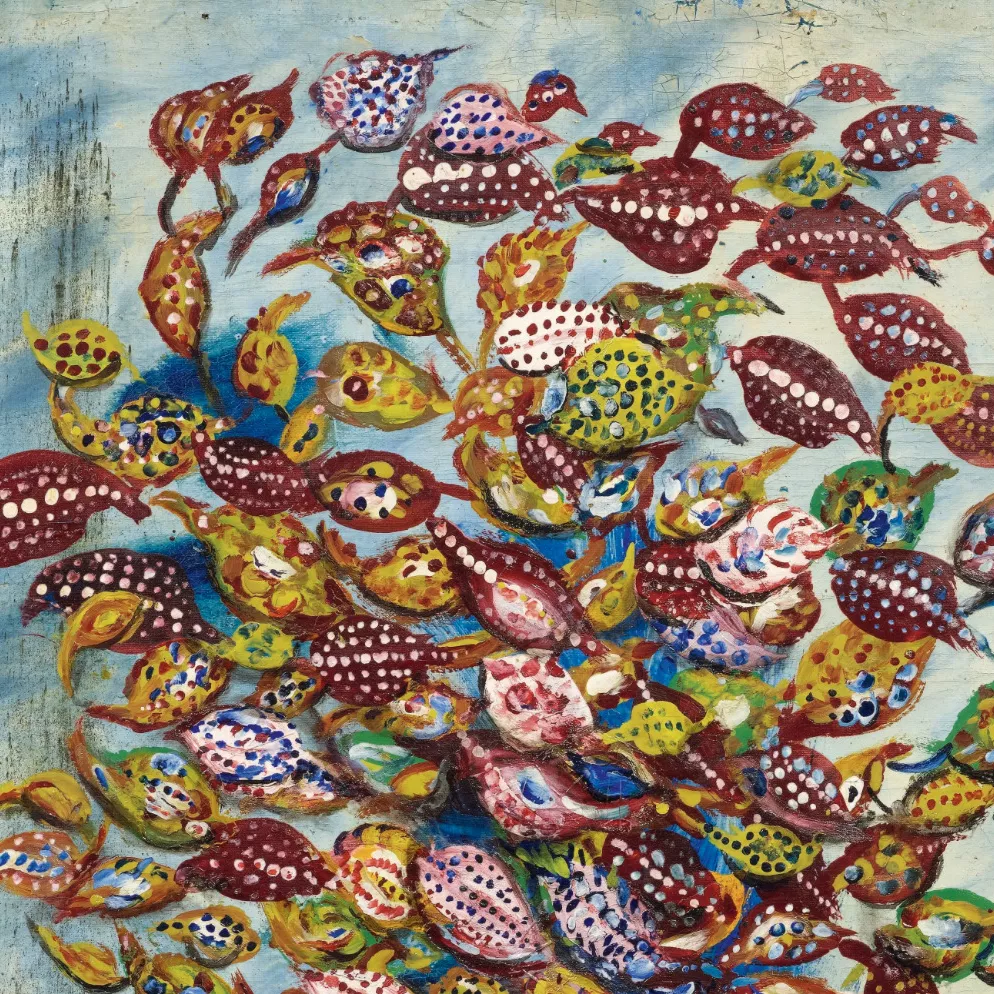
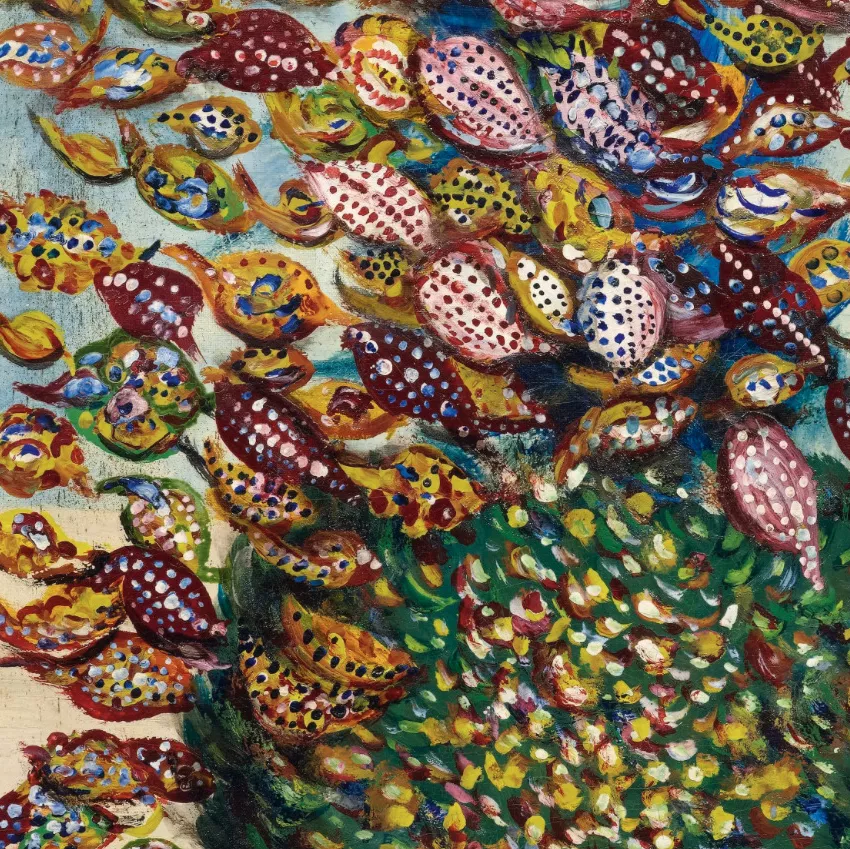
Her position is marginal in relation to official modern art, but retrospectively recognized as singular and major. His painting is non-mimetic, free from the rules of perspective and anatomy. His pictorial world is autonomous, structured by repetitive, proliferating motifs.
There is no narrative; the image functions as an ornamental and symbolic field. In his iconographic fields, we find imaginary vegetation (flowers, leaves, fruit, stylized trees), naturalistic motifs transformed into mental and decorative forms. No real landscapes or human figures are identifiable.
Her compositions are frontal, with no illusionistic depth. She works with a total filling of the surface (horror vacui), and a rhythmic organization through repetition and relative symmetry. The painting is conceived as a closed, saturated space.
Nature is reinvented with an inner, spiritual vision of plant life. Natural forms become abstract, almost organic motifs. There is no direct observation, nature is a symbolic pretext.
She uses intense, saturated and contrasting colors such as deep reds, dark greens, bright yellows and dense blues. Color is used as a vehicle for energy and spirituality, and chromatic superimpositions create a visual vibration.
Light is worked in a non-naturalistic way, to be internal to the painting. There are no identifiable light sources; color itself produces the luminous effect. Séraphine de Senlis often uses oil on canvas as a support, with personal mixtures of industrial paints, waxes, oils, sometimes blood, milk and other binders.
Her technique is experimental, empirical and uncodified. The material is thick, sometimes glossy, with an accumulation of successive layers. The effect is almost glazed in places. His gesture is repetitive, obsessive and ritual-like. His painting is executed slowly, by continuous addition of motifs.
The gesture is not expressive in the modern sense, but incantatory.
There is no prior academic drawing; shapes emerge directly from the color. Contour is created by chromatic juxtaposition, and no direct artistic influence is claimed. She received decisive support from collector Wilhem Uhde.
The life of Séraphine de Senlis
Séraphine de Senlis (1864 - 1942) was a French artist born in Arsy, Oise, under the name Séraphine Louis. She came from a modest rural background, and was orphaned at an early age, a situation that marked the development of her personality.
She had no academic artistic training, and her education was interrupted at an early age. She had a deep religious sensibility, nourished by Catholicism and convent life. She worked as a maid and housekeeper, notably in convents and private homes in Senlis.
Her artistic activity was carried out without recognition, often at night, in precarious material conditions. It was difficult for her to buy materials. She began painting as a self-taught artist at the beginning of the 20th century.
She was motivated to create by an inner need, which she attributed to divine inspiration. Her work is produced with no intention of distribution or sale. Her meeting with Wilhem Uhde in 1912 was to prove decisive, and he became the artist's financial and moral supporter.
She participated indirectly in the recognition of naive art, alongside Douanier Rousseau. She then progressively developed serious psychological problems and was hospitalized from 1912 onwards for long-term internment.
She lived her last years in an asylum, in conditions of great precariousness, and died in 1942 during the Occupation, and was buried in a mass grave, with no official recognition on her death. She received major posthumous recognition from the post-war period.
Her works are included in leading public collections such as the Musée Maillol, the Musée d'Art Moderne de Paris and other international collections. Her career has become emblematic of the condition of the marginalized self-taught artist.
Her work is today studied for its formal singularity, its mystical dimension and its radical autonomy from artistic currents. Séraphine de Senlis occupies an essential place in the reflection on the boundaries between art savant, naïf and brut.
Market segmentation and artist's rating
The artist's sales runs are fairly rare. The market is dominated by paintings (oil on canvas, panel and mixed media). Works on paper are marginal.
Large floral compositions on canvas, often larger than 100 cm, constitute a premium segment, with structural rarity and strong competition (collectors and institutions). Medium-format panels (40 - 70 cm) are the core market segment, with good liquidity when provenance and authentication are solid.
Small panels under 30 cm are part of an entry-level segment, highly sensitive to condition (warping, cracks, missing parts) and pictorial quality.
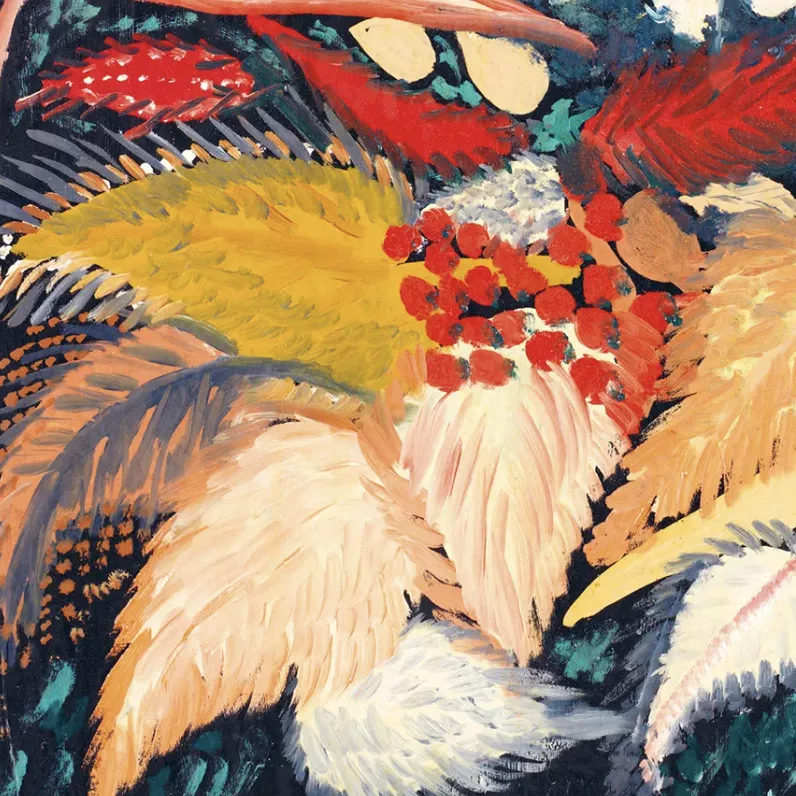
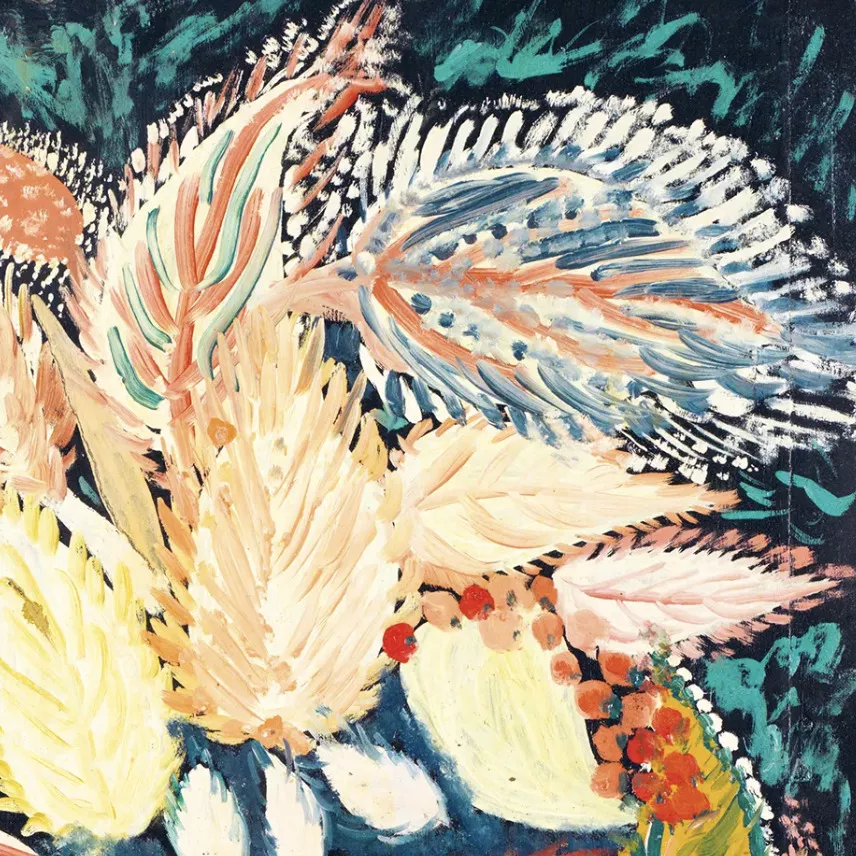
Subjects have a direct impact on the quotation : large blooms and " monumentalized " trees bring a clear premium (ornamental density, surface saturation, decorative impact). More atypical subjects such as birds and branches belong to a narrower market, dependent on rarity and documentation.
Valuation criteria are provenance (old collections, documented trajectory), authenticity and state of preservation. Her rating is solid with a market strongly polarized towards France, like other women artists of the period such as Marie Raymond, Louise Abbéma or Louise Desbordes Jonas.
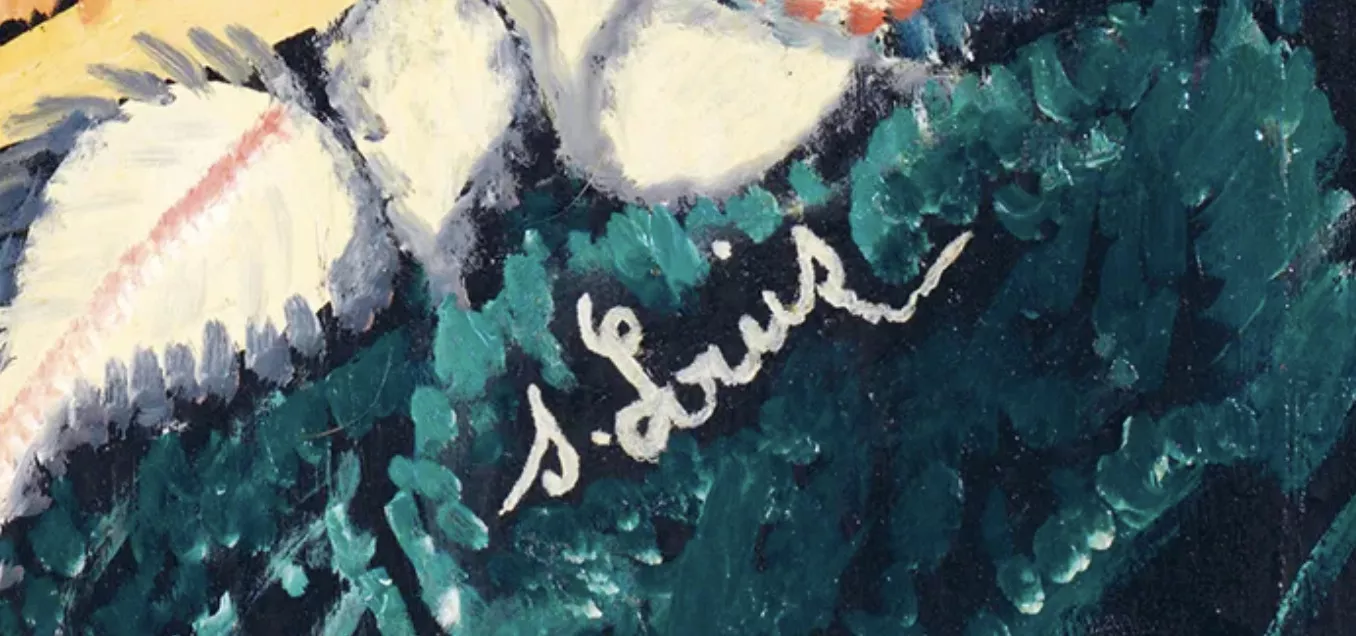
Her signature
Not all of Séraphine de Senlis's works are signed.
Although there are variations, here is a first example of her signature:
Expertise your property
If you own a work by Séraphine de Senlis, don't hesitate to request a free appraisal by filling in our online form.
A member of our team of experts and chartered auctioneers will contact you to provide an estimate of the market value of your work.
If you are considering selling your work, our specialists will also guide you through the various alternatives available to obtain the best possible price, taking into account market trends and the specific features of each work.
Estimate in less than 24h
Discover in the same theme

Rating and value of sculptures and bronzes by Séraphin Soubd...
Séraphin Soubdinine is a Russian-born sculptor trained by Rodin, who has produced works that are highly regarded and valued.
Learn more >

Rating and value of paintings by Marcel Mouillot
Marcel Mouillot is a twentieth-century figurative painter who produced many works that are highly valued at auction.
Learn more >

Rating and value of drawings and paintings by Tran Dinh Tho
Tran Dinh Tho is a modern Vietnamese painter whose paintings on lacquer and silk are highly prized and valued.
Learn more >
D'autres tableaux modernes figuratifs vendus aux enchères

Estimated 800 - 1.500
Jean Roger SOURGEN (1883-1978) Trees and dunes Oil on panel

Estimated 3.000 - 5.000
Georges LAPCHINE (1885-1951) The port of St Tropez Oil on canvas

Estimated 18.000 - 30.000
Charles CAMOIN (1879-1965) "Le Port de Marseille, 1928" Oil on canvas.

Estimated 1.500 - 3.000
Jean VANDEN EECKHOUDT (1875-1946), Basket of persimmons, Oil on canvas

Estimated 2.000 - 4.000
Charles LACOSTE (1870-1959) Starry night, Oil on paper mounted on canvas

Secure site, anonymity preserved

Auctioneer approved by the State

Free and certified estimates
Frequently asked questions
-
Who is Séraphine de Senlis, and what artistic movement does she belong to?Séraphine de Senlis (1864–1942), whose real name was Séraphine Louis, was a self-taught French painter associated with naïve art and art brut. Without any formal training, she developed a unique body of work based on intuitive creation, characterized by imaginary floral compositions, abstract forms, and intense colors. Although her work existed on the fringes of the official art world, it has been retrospectively recognized as significant.
-
What is the price range for works by Séraphine de Senlis?Prices for paintings by Séraphine de Senlis range from €1,340 to €290,000. This wide range depends primarily on the size, the medium (oil on canvas, panel, mixed media), the subject matter (large floral compositions command significantly higher prices), the provenance, and the condition of the work.
-
How can you authenticate a work by Séraphine de Senlis?To authenticate a work by Séraphine de Senlis, we recommend that you request a free appraisal from Auctie's by filling out our online form. A state-certified auctioneer or appraiser will analyze your artwork and provide you with an accurate estimate of its market value, taking into account factors such as the signature, provenance, and condition.
-
Is this the right time to sell a work by Séraphine de Senlis?Yes, this is a good time. Prices for works by Séraphine de Senlis are gradually rising on the market, particularly for her large floral compositions. Her work is gaining increasing recognition, especially among French collectors, and her paintings are being added to the collections of prestigious museums such as the Musée Maillol.
-
How does the appraisal process work at Auctie's, and how do I sell my artwork?Appraisals at Auctie's are free and non-binding. After you fill out our online form, an expert will contact you and provide an estimate within 48 hours. If you’d like to sell, our specialists will guide you through the available options to help you get the best price, taking into account market trends and the specific characteristics of your artwork.
