



Rating and value of paintings by Louise Abbéma

Key takeaways
- Oil-on-canvas paintings by Louise Abbéma, a major 19th-century artist, sell for between €100 and €103,000, depending on their quality and provenance.
- *Portrait of Renée Delmas by Pont-Jest* (1875) exceeded its estimate in 2019, fetching €103,000 instead of the projected €28,000–€47,000, confirming the rise in her market value.
- Her style combines academic mastery with Impressionism, featuring a subtle, luminous palette influenced by Sargent and Degas, characterized by soft skin tones and refined play of light.
If you own a work by or after the artist Louise Abbéma, and would like to know its value, our state-approved experts and auctioneers will offer you their appraisal services.
Our specialists will work to carry out a free appraisal of your work, and will provide you with an accurate estimate of its value on the current market.
Then, if you wish to sell your work, we will direct you to the best possible arrangement to obtain the optimum price.
Rating and value of the artist Louise Abbéma
Louise Abbéma is a major artist of 19th century painting. Now, the prices of her works are rising under the auctioneers' gavel.
Her oils on canvas are particularly prized, especially by French buyers, and the price at which they sell on the art market ranges from €40 to €103,000, a considerable delta but one that speaks volumes about the value that can be attributed to the artist's works.
In 2019, an oil on canvas entitled Portrait de Renée Delmas de Pont-Jest,dating from 1875, sold for €103,000, while it was estimated at between €28,000 and €47,000. Its value is on the rise.
Order of value from a simple work to the most prestigious
Technique used | Result |
|---|---|
Estamp - multiple | From €45 to €1,200 |
Drawing - watercolor | From €40 to €8,200 |
Oil on canvas | From €100 to €103,000 |
Estimate in less than 24h
Style and technique of artist Louise Abbéma
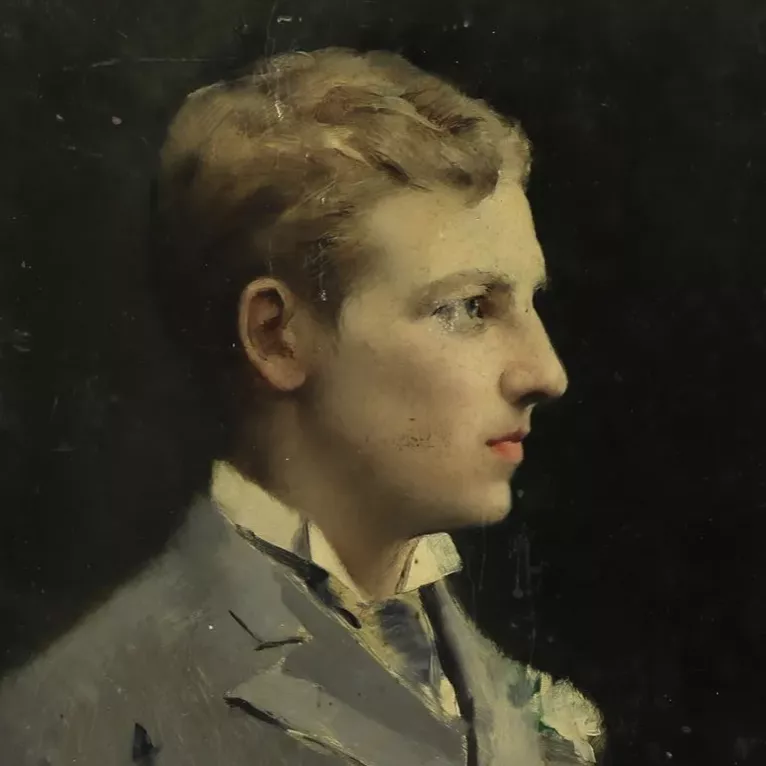
Louise Abbéma's technical subtlety has rarely been dwelt upon, often overshadowed by her role as a socialite portraitist and figure of the Belle Époque.
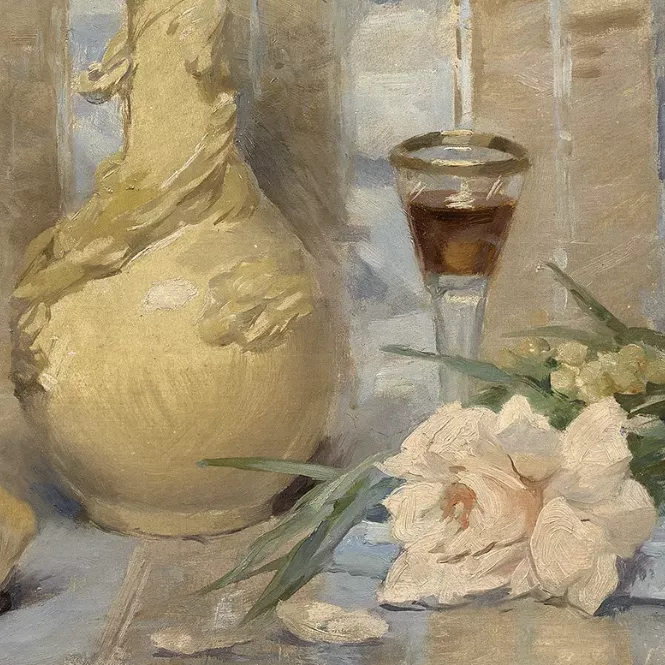
However, her style reflects a delicate mastery of the play of light and nuance, borrowing from the Impressionists their taste for vibrant atmospheres, while retaining an academic precision in the drawing.
Working in both oil and watercolor, she reveals a dexterity that balances the spontaneity of her brushstrokes with the rigor of careful composition.
The soft, radiant complexions of her female figures captivate with their naturalness, while her often sketched backgrounds testify to a keen sense of harmony.
Louise Abbéma also favors a luminous palette, dominated by light tones and subtle contrasts, evoking the freshness of a morning or the intimacy of a sun-drenched salon.
His technique, halfway between academic tradition and measured modernity, echoes the art of his contemporaries, but is distinguished from them by an almost tactile sensitivity, a visual poetry that enchants without ever rushing.
Hence, his painting unfolds like an elegant conversation between classicism and the effervescence of new currents, asserting a singular identity at the heart of a rapidly changing era.
Louise Abbéma, a singular trajectory
Rarely enough attention has been paid to the singular trajectory of Louise Abbéma, an artist who was able to combine talent and modernity while fully embracing the social circles of the Belle Époque.
Born in 1853 in Étampes to a well-to-do family, she benefited early on from an environment conducive to the blossoming of her artistic sense.
Student of masters such as Charles Chaplin, Carolus-Duran and Jean-Jacques Henner, she acquired a solid academic training, but it was her boldness and assertive personality that opened the doors to the Parisian salons.
Very close to Sarah Bernhardt, who became both her muse and close friend, Abbéma forged a reputation as a talented portraitist, immortalizing the emblematic figures of her time.
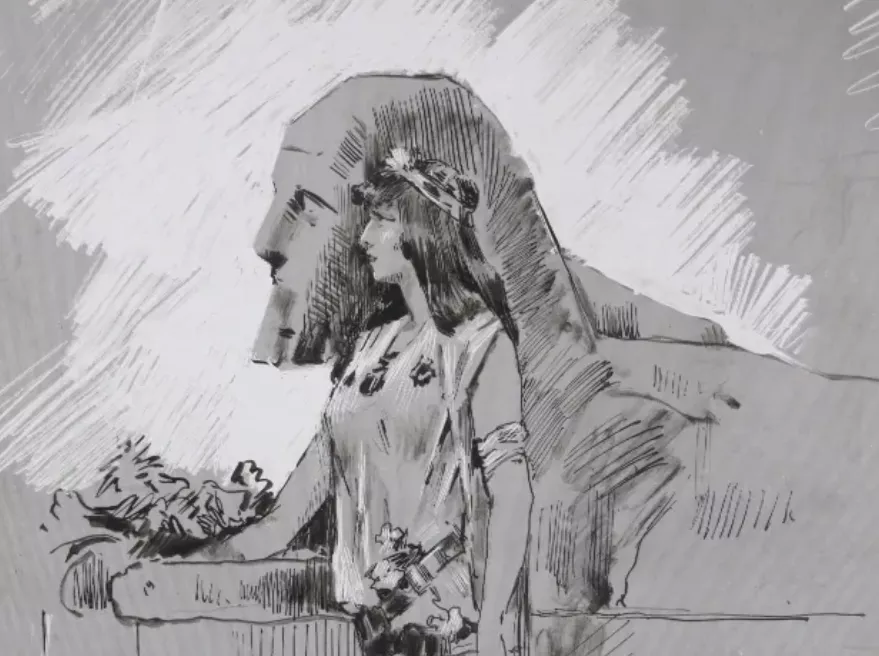
However, her career was not limited to painting. Illustrator, decorator, she also made a name for herself with monumental frescoes adorning various public places, testifying to a rare versatility for a woman artist of her era.
Recognized on several occasions at Salons, she gained international recognition, participating in Universal Exhibitions where her refined style was hailed.
Louise Abbéma, while remaining faithful to the academic heritage, embodies an assertive and elegant femininity, inscribing her name among the outstanding artistic personalities of her century.
Focus on Portrait of Sarah Bernhardt, Louise Abbéma
You could just as easily evoke Louise Abbéma's painting by comparing it to a vibrant encounter between light and intimacy.
In her portrait of Sarah Bernhardt, the work unfolds as an unparalleled tribute to the muse, who was both the central figure of her inspiration and her faithful friend.
Through this canvas, the artist manages to capture not only the actress's physiognomy but also the very essence of her aura.
You only have to look at the gestures, fluid and imbued with lightness, to sense the discreet but assumed staging of the period.
Sarah Bernhardt's face is treated with particular subtlety: the shades of color, sometimes soft, sometimes assertive, convey the complexity of the model's soul.
The brush seems to brush gently against the skin, revealing the radiance of a deep, intense gaze, as if we could almost hear the emotion of this great actress through her posture.
This is not just a representation, but the artist's interpretation of a personality. This typically academic technique in no way precludes a contemporary, modern approach that exudes an atmosphere both intimate and theatrical.
It's interesting to note that the light, almost divine, bathes Bernhardt's face, while the background remains blurred, blurred, almost as if to signify that this woman transcends the limits of her era.
Abbéma doesn't just paint an actress; she depicts a legend, in all her majesty, and invites us to take part in this fascinating spotlight.
Louise Abbéma's imprint on her period
It's rare that an artist like Louise Abbéma is remembered for her imprint on her era.
At first glance, one might think that her work is confined to the intimacy of salons, to the bewitching light of celebrity portraits, to those moments frozen in time. And yet, her impact goes far beyond this.
For Abbéma, through her art, brilliantly embodied the aspirations and contradictions of the Belle Époque, a time when the artist was no longer simply a witness but an actor in a rapidly changing society.
Her unique view of her contemporaries, all finesse and delicacy, was not without echoes of the social and cultural upheavals of her time.
She portrayed emancipated women, strong in character, muses but also creators, figures of the artistic and theatrical avant-garde.
Through her portraits, she thus participated in the construction of a modern image of women, far removed from the frozen stereotypes of the past.
By her discreet but profound commitment, she contributed to the emergence of new forms of representation, where academic tradition blended with touches of personal freedom.
She didn't just mark her time with her impeccable technique or aesthetic choices. Louise Abbéma also quietly acted as a catalyst, offering her subjects a space for expression that still resonates today.
Far from contenting herself with reproducing reality, she sublimated it, transformed it into a pure form of sensibility, paving the way for a more intimate, more human vision of art.
Louise Abbéma's stylistic influences
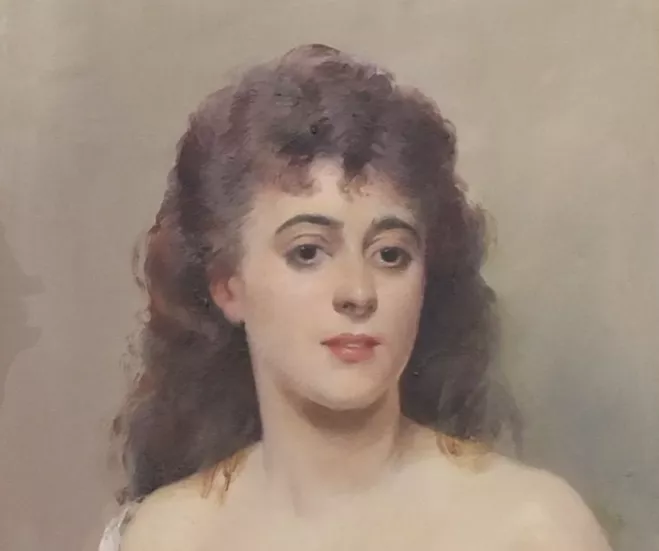
Louise Abbéma's stylistic influences can be seen at the crossroads of several major 19th-century currents, marked by a richness of approach and great finesse in the treatment of portraiture.
Her academic training, nourished by the classical precepts of the École des Beaux-Arts, gave her an undeniable mastery of drawing, perspective and anatomy, essential elements for capturing the personality of her models with striking precision.
But it was through her encounter with Impressionism that she departed from the constraints of academic realism, bringing to her portraits a new luminosity and a subtle sense of movement.
It's no coincidence that in her work we find an approach that evokes the play of light and shadow of the great masters such as John Singer Sargent, or the search for the psychology of subjects found in Edgar Degas.
However, Louise Abbéma was not content to simply echo the trends of her time; she added her own sensitive, elegant touch, influenced by Symbolism, which enabled her to install an almost mystical dimension in her portraits.
Her ability to capture the intensity of glances and underline emotions hidden beyond the surface makes her an artist at the crossroads of these currents, a unique voice that transforms the portrait into a work where the intimate and the sensitive come together.
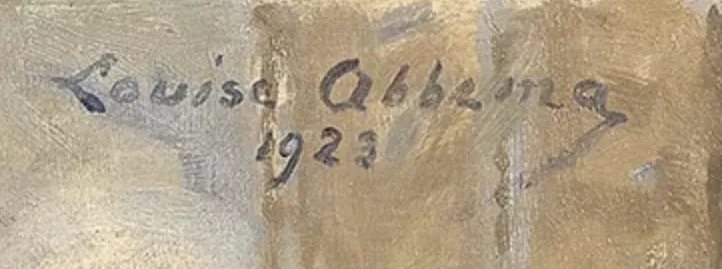
Recognizing the artist's signature
Louise Abbéma often signs her name at the bottom of her drawings, or her oils on canvas. Copies may exist, which is why expertise remains important.
Knowing the value of a work
If you happen to own a work by or after Louise Abbéma, don't hesitate to request a free appraisal using our form on our website.
A member of our team of experts and certified auctioneers will contact you promptly to provide you with an estimate of the market value of your work, as well as ad hoc information about it.
If you are considering selling your work, you will also be accompanied by our specialists in order to benefit from alternatives for selling it at the best possible price, taking into account market inclinations.
Estimate in less than 24h
Discover in the same theme

Rating and value of paintings, oil on canvas, paintings by B...
Benjamin Netter was a 19th-century landscape painter who produced oils on canvas that were highly regarded and sought-after at auction.
Learn more >

Rating and value of works, bronzes and sculptures by Hippoly...
Hippolyte Moreau is a 19th-century sculptor who produced works that are highly valued at auction. Estimate in 24h.
Learn more >

Rating and value of paintings by Emilio Sivilla Torres
Emilio Sivilla Torres was a Spanish Orientalist painter who produced views of Tangier that can be highly valued.
Learn more >
Works from the same period sold at auction

Estimated 1.000 - 2.000
French school, circa 1860 Presumed portrait of Églé Ney de la Moskowa (1832-1890), Duchess of Persigny

Estimated 6.000 - 8.000
Michel Martin DRÖLLING (1786-1851), Portrait of Dominique Alexandre "Charles" Legrand (1790-1808), oil on canvas

Estimated 20.000 - 30.000
Auguste RENOIR (1841-1919) Entrance to houses, circa 1895-1896, Oil on canvas.

Estimated 4.000 - 6.000
Ary Scheffer (Dordrecht 1795-1858 Argenteuil) One of the three holy women (meditating on Christ's resurrection after the vision in the tomb?) Oil on canvas

Estimated 1.500 - 3.000
Olivier Charles DE PENNE (1831-1897) The Pack, Oil on panel

Estimated 1.500 - 3.000
Macario VITALIS (1898-1989) Portrait of Marie Thérèse, Oil on canvas

Secure site, anonymity preserved

Auctioneer approved by the State

Free and certified estimates
Frequently asked questions
-
Who was Louise Abbéma, and what was her historical context?Louise Abbéma (1853–1934) was a leading painter of the 19th century, born in Étampes into a wealthy family. Trained by academic masters such as Charles Chaplin and Carolus-Duran, she established herself as a talented portraitist of the Belle Époque, and was particularly close to Sarah Bernhardt. Beyond portraiture, she distinguished herself as an illustrator, created monumental murals, and participated in the World’s Fairs, embodying a versatility rare for a female artist of her time.
-
What are the prices and price ranges for Louise Abbéma's paintings?The prices of Louise Abbéma’s works are rising steadily on the market. Her oil-on-canvas paintings, her most sought-after works, particularly among French buyers, sell for between €100 and €103,000, while her etchings range from €45 to €1,200 and her watercolor drawings from €40 to €8,200. In 2019, a Portrait from 1875 sold for €103,000, exceeding its initial estimate and confirming an upward trend in her market value.
-
How can you authenticate a work by Louise Abbéma?Louise Abbéma usually signs her name at the bottom of her drawings and oil paintings on canvas, but the existence of copies makes authentication important. We recommend that you request a free, no-obligation appraisal from Auctie’s via our online form. A state-certified expert or auctioneer will contact you promptly to authenticate your artwork and provide you with an estimate.
-
Is this a good time to sell a work by Louise Abbéma?Yes, now is a good time to sell a work by Louise Abbéma. Her market value has been rising steadily for several years, and buyers—particularly those in France—remain especially interested in her oil-on-canvas paintings. The market is increasingly recognizing the importance of this major 19th-century artist, which tends to drive up the value of her works.
-
How does the appraisal process work at Auctie's, and how do I sell my artwork?Appraisals at Auctie's are free and non-binding: simply fill out an online form, and a certified expert or auctioneer will contact you within 48 hours with an accurate valuation. If you’d like to sell, our specialists will guide you from the appraisal through to the auction, offering you the best options for selling your artwork at the optimal price, based on market trends.
