



Rating and value of paintings by Alexei Savrassov

Key takeaways
- A Russian realist painter, Savrasov (1830–1897) is known for his atmospheric landscapes, which laid the foundation for modern Russian landscape painting.
- His works range in price from €500 for watercolor drawings to €1,077,000 for oil-on-canvas paintings, with “Cottage in the Woods” selling for €1,077,000 in 2007.
- His masterpiece “The Return of the Crows” (1871) blends naturalism with lyrical sentiment, exerting a lasting influence on the generation of the Russian Wanderers.
If you own a work by or after the artist Alexei Savrassov, and would like to know its value, our state-approved experts and auctioneers will offer you their appraisal services.
Our specialists will carry out a free appraisal of your work, and provide you with an accurate estimate of its value on the current market.
Then, should you wish to sell your work, we will direct you to the best possible arrangement to obtain the optimum price.
Rating and value of the artist Alexei Savrassov
Savrassov is a Russian-born painter who is relatively unknown to the general public. He leaves behind a unique artistic repertoire characteristic of Russian realism.
This legacy consists of paintings that are predominantly oils on canvas. At present, prices for his works are flying off the auctioneers' hammers.
His paintings and other works are particularly prized, especially by European and American buyers, and the price at which they sell on the art market ranges from €500 to €1,077,000, a considerable delta but one that speaks volumes about the value that can be attributed to Savrassov's works.
In 2007, his composition Cottage in the woods sold for €1,077,000 in Sweden, while it was estimated at between €300,000 and €320,000.
Order of value from a simple work to the most prestigious
Technique used | Result |
|---|---|
Drawing - watercolor | From €500 to €90,600 |
Oil on canvas | From €850 to €1,077,000 |
Estimate in less than 24h
Style and technique of artist Alexei Savrassov
In The Return of the Crows (1871, Tretiakov Gallery, Moscow), Savrassov achieves that fusion of naturalism and lyrical feeling that defines his art.
With a supple, subtly nuanced touch, he modulates variations in light and atmosphere with a finesse unheard of in Russian landscape painting.
The light, almost diaphanous material detaches itself from the realistic density of Western schools to suggest, rather than describe, the melancholy of incipient spring.
The sky, crossed by gray and bluish glows, fades into infinite modulations, while the gaunt silhouettes of birch trees, treated in fine impasto, punctuate the space in vibrant verticality.
Savrassov avoids descriptive dryness through brushstrokes, where color, diluted and applied in superimposed glazes, evokes the ephemeral fragility of the moment.
Far from the monumental frontality of academic landscapes, he favors open compositions, where nature, captured in its humility, becomes the true subject of the painting.
Here, aerial perspective dissolves into a depth that is no longer illusionistic, but atmospheric, where every detail participates in that impression of transience so characteristic of his art.
This dissolution of lines and contours, this way of inscribing light into matter itself, had a lasting influence on the generation of Ambulants, where landscape ceased to be mere décor to become the expression of a state of soul, the reflection of an inner feeling.
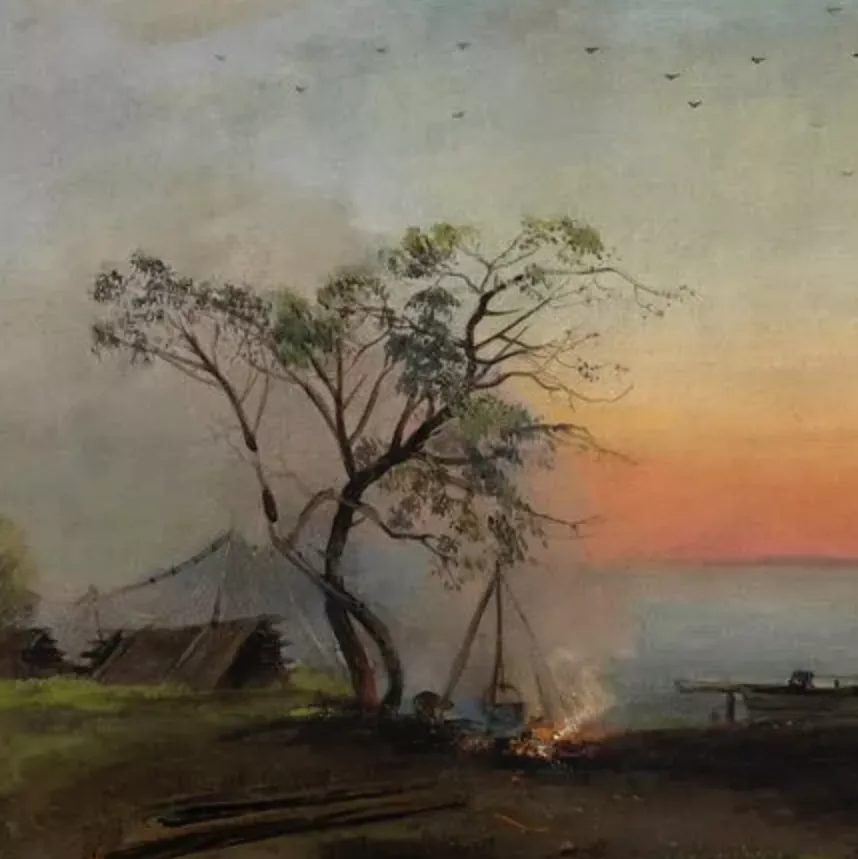
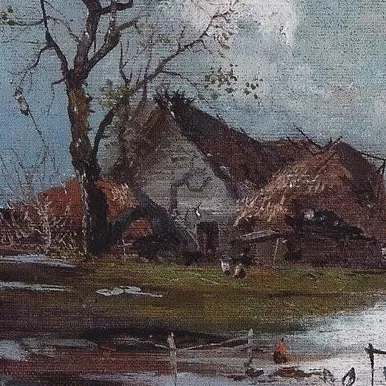
Alexei Savrassov, his life, his work
Born in 1830 in Moscow, in a Russia where landscape painting was still struggling to emancipate itself from academism, Savrassov soon established himself as one of the first to endow this genre with a distinctly national sensibility.
A student at the Moscow School of Painting, Sculpture and Architecture, he quickly moved away from neoclassical rigors to explore a more intimate, atmospheric nature, where landscape is no longer limited to a faithful transcription of reality but becomes the site of emotional resonance.
His rise was rapid: as early as the 1850s, his views of the Moscow region and the Volga earned him recognition, leading him to teach in his hometown.
However, it was in 1871, with The Return of the Crows, that he signed his masterpiece, a work in which the feeling of the Russian landscape reaches a rare poetic depth. But this success also marked the beginning of a gradual decline.
Moved by personal difficulties, overwhelmed by the loss of his daughter, he gradually sank into poverty and alcoholism, despite the support of his former students, among them Levitan.
At the end of his life, rejected by the Academy, he died forgotten in 1897, leaving behind a seminal body of work, in which landscape painting, freed from mere imitation, became the vibrant echo of the Russian soul.
Focus on The Return of the Ravens, Alexei Savrassov, 1871
In The Return of the Ravens (1871, Tretyakov Gallery, Moscow), Savrassov elevates the landscape to the status of a veritable emotional language, where nature is no longer merely a setting but an intimate reflection of the soul.
Here, far from idealized representations or grandiose panoramas, the artist depicts a silent plain, caught in the last shivers of winter, an expanse of snow beginning to dissolve under the effect of spring's timid warmth.
The trees, already almost naked, rise into space in broken silhouettes, their branches stretching out like arms frozen in expectation. Far from the dazzling splendor of summer nature, this is a beaten, almost sad land, where time seems suspended.
The church, in the distance, barely emerges, drowned in mist, evoking a furtive presence, a fading memory of the past.
The real subject of the painting is not so much the earth, the sky or the horizon, but this subtle relationship between the elements. The crows, in full flight, trace elegant black arabesques in a velvety gray sky.
These birds, traditional symbols of passage, of return, mark the threshold of an imminent renewal.
The cool tones, mainly grays, blues, and browns, are superimposed in subtle shades that, far from freezing the scene, lend it an almost imperceptible mobility.
The background, far from being frozen, seems to melt into a fluid mist, a veil that separates the visible world from the invisible, where time stretches and light almost fades away in favor of space, of sensation.
Savrassov works here by subtraction, erasing useless details to retain only the essential, by that rare ability to capture the essence of a scene by offering us a pared-down vision but one of profound intensity.
This stripping down is not an absence, but a stronger, more vibrant presence. The landscape thus becomes a metaphor for the human soul: a humble, fragile scene, where nature carries with it a gentle melancholy, tinged with hope, like an echo of a bygone past and a future that is slow to blossom.
The scene itself seems suspended in silent expectation, between two worlds, between two moments, inviting the observer to get lost in it and to rediscover, in this vast frozen plain, a little of his own humanity.
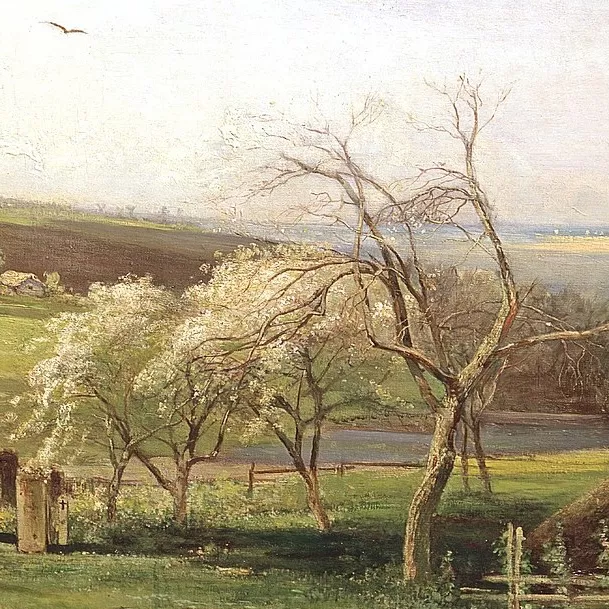
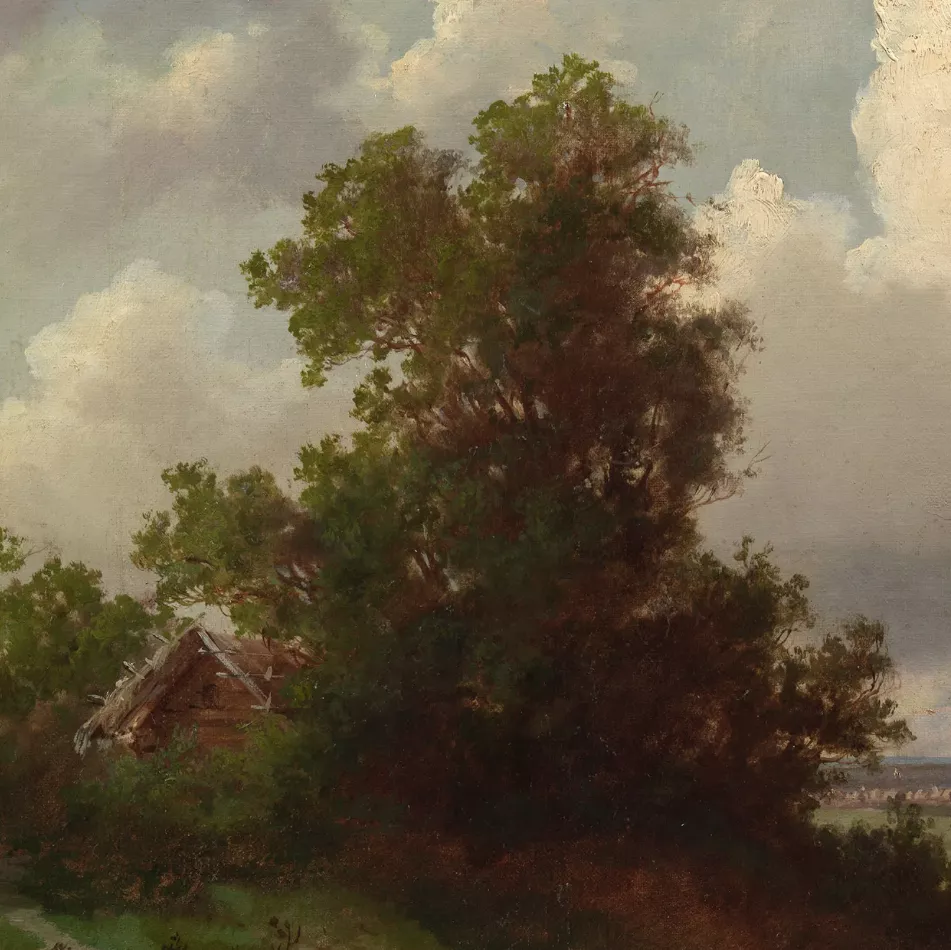
Alexei Savrassov's imprint on his period
Born in 1830 in Moscow, Alexei Savrassov evolved in a Russia where landscape painting was still struggling to shake off academic influences.
But, very early on, the artist demonstrated a very personal sensibility, moving away from rigid conventions to tackle a more intimate nature, more imbued with atmosphere.
While his early work seems to conform to the rules of the classical school, in certain respects it is reminiscent of the approach of contemporaries such as Ivan Shishkin, who also sought to inscribe the Russian landscape in a truth of expression.
However, Savrassov does not simply achieve a faithful reproduction of reality; he seeks to capture the essence of a landscape where light and atmosphere intertwine to convey raw emotion.
It is when he tackles the depiction of the humblest Russian expanses, the morbid beauty of winter fields or bare forests, that his painting becomes unique.
The famous Retour des corbeaux (1871), a masterpiece of poetry and solitude, marks this distancing from the more idyllic representations of Russian landscapes undertaken, at the same time, by a landscape painter such as Fyodor Vasilyev.
Savrassov's choice to paint melancholy scenes, in which nature mirrors a tormented inner world, elevated him to the ranks of the greats of his time. Yet his trajectory soon turned darker.
Far from the effervescence of his early years, his work drowned in a slow personal decline, fueled by the pain of losing his daughter and financial difficulties.
Stylistically, he was close to other Russian landscape painters such as Constantin Korovine, Constantin Westchiloff or Mikhail Guermacheff.
In his last years, marked by misery and alcoholism, he died in 1897, forgotten, leaving behind him a profound legacy: landscape painting which, far from being limited to a simple transcription, became an emotional and universal language, durably influencing generations of Russian landscape painters, from Levitan to Kramskoy.
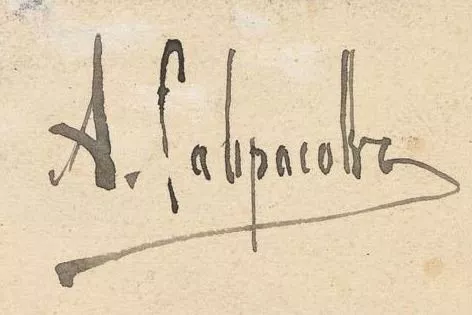
Recognizing Savrassov's signature
Alexei Savrassov's paintings are often signed in the lower left-hand corner of the canvas. He signs with his first and last name, often in a dark tone; sometimes with the city where he painted the picture, or the date.
Knowing the value of a work
If you happen to own a work by or after Alexei Savrassov, don't hesitate to request a free appraisal using our form on our website.
A member of our team of experts and licensed auctioneers will contact you promptly to provide you with an estimate of the market value of your work, as well as ad hoc information about it.
If you are considering selling your work, you will also be accompanied by our specialists in order to benefit from alternatives for selling it at the best possible price, taking into account the inclinations of the market.
.Estimate in less than 24h
Discover in the same theme

Rating and value of works, paintings by Jean Antoine Watteau
Jean-Antoine Watteau was a founding painter of the Rococo movement, who produced many oil on canvas paintings, which are highly prized at auction. Est...
Learn more >

Rating and value of paintings by Richard Parkes Bonington
Richard Parkes Bonington was a 19th-century marine painter. His works are quoted on the auction market, and their value is high.
Learn more >

Agathon Léonard porcelain biscuit rating and value
Agathon Léonard was an Art Nouveau sculptor who created porcelain biscuit for the Manufacture de Sèvres, which are listed at auction.
Learn more >
D'autres tableaux russes anciens vendus aux enchères


Secure site, anonymity preserved

Auctioneer approved by the State

Free and certified estimates
Frequently asked questions
-
Who was Alexei Savrassov, and what was his contribution to art history?Alexei Savrassov (1830–1897) was a leading Russian realist painter who revolutionized landscape painting in Russia. A student of the Moscow School, he broke free from academic rigidity to create an emotional language in which the landscape becomes a reflection of a state of mind. His masterpiece, “The Return of the Crows” (1871), profoundly influenced subsequent generations of Russian landscape painters, including Levitan.
-
What is the price range for Alexei Savrassov's works?The prices of Savrassov’s paintings vary considerably depending on their size and medium. Drawings and watercolors range from €500 to €90,600, while oil-on-canvas paintings, which are more prestigious, range from €850 to over one million euros. In 2007, his painting “Cottage in the Woods” exceeded estimates, selling for €1,077,000.
-
How can you authenticate a work by Savrassov and determine its value?To authenticate a work of art and obtain an accurate estimate, we recommend that you request a free appraisal from Auctie's using our online form. A certified expert or auctioneer will examine your painting and provide you with a detailed assessment of its current market value, with no obligation on your part.
-
Is this the right time to sell a work by Savrassov?Yes, now is a good time to sell. Savrassov’s works are gaining increasing recognition among European and American collectors, and the prices they fetch at auction continue to rise. The market is showing sustained interest in this painter, who was long overlooked by the general public.
-
How does the sale of a work of art work at Auctie's?Auctie's supports you every step of the way: a free, no-obligation appraisal, an accurate estimate of market value, and guidance on the best terms for selling. Our experts advise you on the available options for getting the best price, taking current art market trends into account.
