



Rating and value of Russian paintings by Mikhail Guermacheff

Key takeaways
- Works by Mikhail Guermacheff (1867–1930), a Russian painter of the School of Paris, sell for between €200 and €135,000 at auction.
- His snowy landscapes, particularly *The Kremlin Under the Snow*, which sold for €135,000 in 2008, are his most sought-after and highly valued works.
- A master of Russian realism, Guermacheff excels at depicting natural light and idealized winter scenes that express nostalgia for the Russian Empire.
If you own a work by artist Mikhail Guermacheff or based on his work and would like to know its value, our state-approved experts and auctioneers will guide you.
Our specialists will carry out a free appraisal of your work, and provide you with an accurate estimate of its value on the current market. Then, if you wish to sell your work, we will direct you to the best possible arrangement to obtain the optimum price.
Artist's rating and value
Mikhail Guermacheff's work is uncommon and fairly highly rated on the auction market. His works arouse interest among collectors and art lovers, particularly those who appreciate 20th-century Russian painting.
The quotation for his works is currently on the rise on the art market, and the price at which his works are selling on the art market ranges from €200 to €135,000, at the moment, a considerable delta but one that speaks volumes about the value that can be attributed to the artist's works.
The most sought-after pieces are paintings depicting landscapes. Thus, a work signed by Guermacheff can fetch thousands of euros at auction, such as his painting Le Kremlin sous la neige, which fetched €135,000 in 2008, whereas it was estimated at between €40,000 and €50,000.
Order of value from the most basic to the most prestigious
Technique used | Result |
|---|---|
Drawing - watercolor | From €200 to €360 |
Paintings | From €200 to €135,000 |
Estimate in less than 24h
Style and technique of Mikhail Guermacheff
Mikhail Guermacheff belongs to the École de Paris group, like other artists (Michel Kikoine, Alessio Isupoff, Nicolas de Staël) who immigrated to Paris from Russia, although this term is far too broad to give a precise definition of his work.
He fits in with the Russian realist artists, producing mainly oils on canvas. Guermacheff worked extensively on the representation of light, drawing his inspiration in particular from snowy landscapes.
The life of Mikhail Guermacheff
Mikhail Markanovich Guermacheff (1867-1930) was a Russian painter associated with the École de Paris. Born in Kharkov, in the Russian Empire, he received his artistic training at the Moscow School of Fine Arts, where he specialized in landscape painting and mastered the techniques of the Russian realists.
He took part in various Salons, notably in Moscow and Saint Petersburg, where he exhibited his works.
After the 1917 revolution, Guermacheff, like many of his contemporaries, had to leave his native country. He settled in France, where he exhibited his paintings at the Grand Palais des Champs-Élysées and at the Salon de la Société nationale des Beaux-Arts.
His works, marked by the Russian realism of his early years, depict a luminous, idealized country, contrasting with the revolutionary upheavals of the 20th century. They express a discreet nostalgia for the last moments of the Russian Empire, particularly in his famous depictions of the snow-covered Kremlin.
Guermacheff died in Paris in 1930.
Understanding Russian realism in painting
Russian realism in painting, a predominant movement in 19th-century Russia, is distinguished by its desire to faithfully represent everyday life, landscapes and rural scenes of the Russian Empire, with particular emphasis on the work of light.
Influenced by the social and political ideals of the time, this artistic movement sought to reflect reality without embellishment, capturing the harshness of peasant life and the striking contrasts between different social classes.
Russian realist artists, such as Ilia Répine, Vassili Perov, and Ivan Chichkine, played a key role in the emergence of this style, favoring a narrative and often critical approach in their works.
Russian realist painting is characterized by meticulous attention to detail, a restrained color palette and natural light that lends paintings an atmosphere both tangible and poignant.
By depicting the vast expanses of the Russian countryside or the dignified portraits of workers and peasants, these artists immortalized a changing world, while expressing a deep attachment to their native land, thus marking the history of Russian art.
Many artists such as Constantin Korovine and Nikolai Sapunov also produced landscape paintings without protagonists or portraits. Those by Korovine, who notably produced Views of Paris, are today highly rated on the auction market.
Focus on a landscape by Guermacheff (early 20th century)
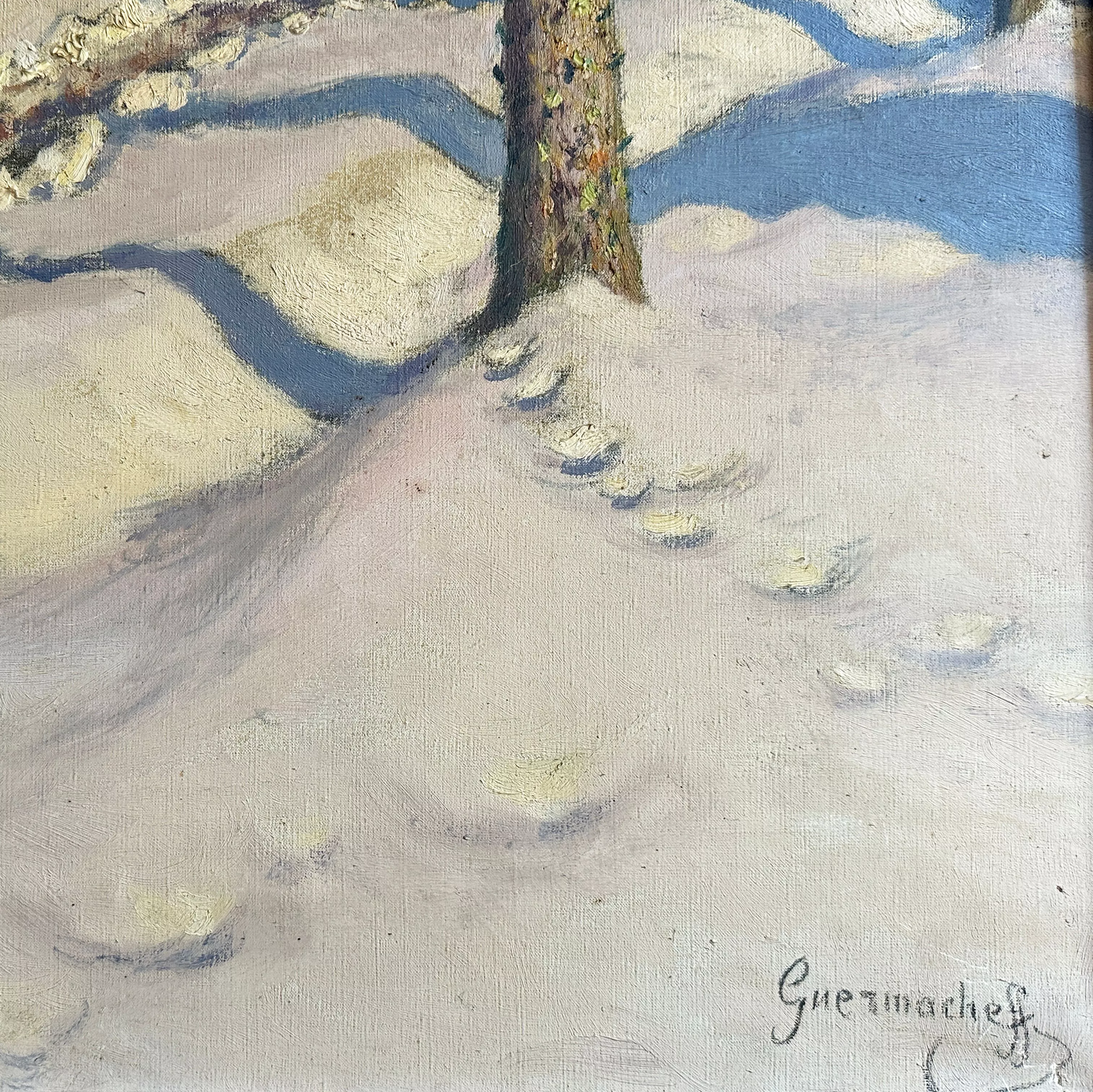
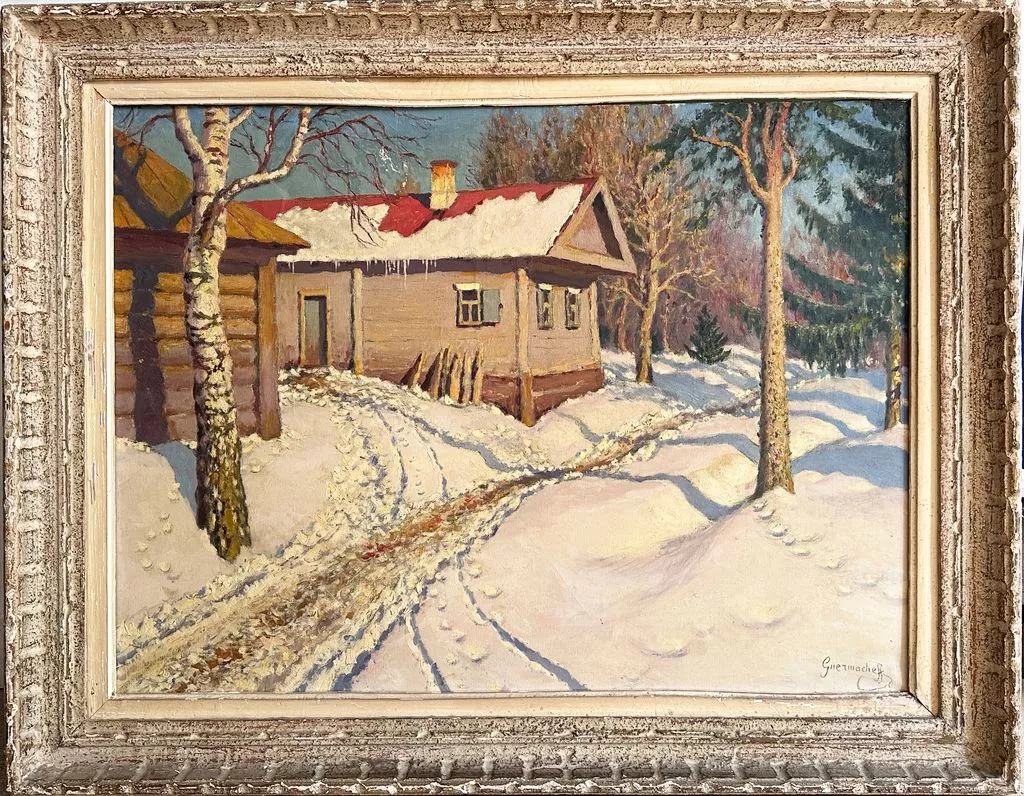
Guermacheff invites us here to discover a peaceful winter scene where the elements blend together in complete harmony. The artist did not date his paintings, and little documentary information is available on most of his landscapes, making it impossible to give a precise title.
In this work, snow covers the entire landscape in a soft white, bringing a sense of calm and serenity. The subtle hues, from the blue of the sky to the red of the roofs, bring a touch of warmth to this cold landscape.
The tracks left in the snow tell us a discreet story, guiding our gaze through the painting. The artist hints at the crackling of the ground and the freshness of the air. The trees, with their bare branches, stand like sentinels, their shadows stretching delicately across the snow-covered ground.
Every detail, from the wooden houses to the shadows, seems thought out to create a tranquil, balanced atmosphere.
Guermacheff here captures the essence of a simple yet beautiful moment, where nature and architecture coexist in perfect harmony. The whole exudes a gentle visual melody, where light and color play together to soothe the spirit.
Hinting at human presence without actually representing it, this work is characteristic of the Russian landscapes produced by the artist during his career, and is beyond characteristic of Russian realist paintings of the early 20th century.
Guermacheff thus fits into a creative context established by his predecessors, following in their footsteps, and signs an utterly striking work that brings together many elements peculiar to Russian realism.
Understanding Germacheff's Russian realism through Répine
The creative context of Russian realism in the 20th century
At the beginning of the 20th century, Russian realist painting continued to tell the story of everyday life with touching sincerity. The artists of this period were deeply rooted in the tradition of realism, inherited from the great masters of the previous century.
They focused on depicting scenes of rural life, the vast and often austere landscapes of the countryside, and the living conditions of workers and peasants.
It's not just a question of depicting reality, but of understanding and sharing it, with particular attention to the details that reveal the beauty and harshness of this existence.
Yet these artists don't work in a vacuum. Their times were marked by profound social and political upheavals.
As Russia headed towards the 1917 Revolution, social tensions and aspirations for a better world were felt ever more intensely. In this climate, pictorial realism begins to evolve.
Works gradually become more engaged, capturing not only what is, but also what could be. Painters seek to express the hopes, frustrations and struggles of the Russian people, at a time when history is about to be turned upside down.
After the Revolution, art in Russia takes a new direction. Realism did not disappear, but was transformed by the demands of the new Soviet state.
What emerges is socialist realism, a style in which artists are called upon to glorify the proletariat, exalt labor and promote the ideals of the Communist regime.
Art then became a propaganda tool, while retaining the techniques and attention to detail that characterized pre-Revolution realism.
Thus, Russian realist painting of the early 20th century bears witness to a period of transition, when artists, while remaining faithful to a tradition of faithful representation of the world, began to grasp the currents of change running through their society.
It's a time when art echoes a changing world, when every brushstroke tells of both the present and the hopes of a still uncertain future.
Mikhail Guermacheff's imprint on his period
Mikhail Guermacheff is not a painter widely known to the general public, either during his lifetime or today. His paintings of landscapes and other compositions are, however, popular with collectors and have a certain success at auction.
Some of his works are exhibited in museums in France, but private collectors play a major role in preserving his work.
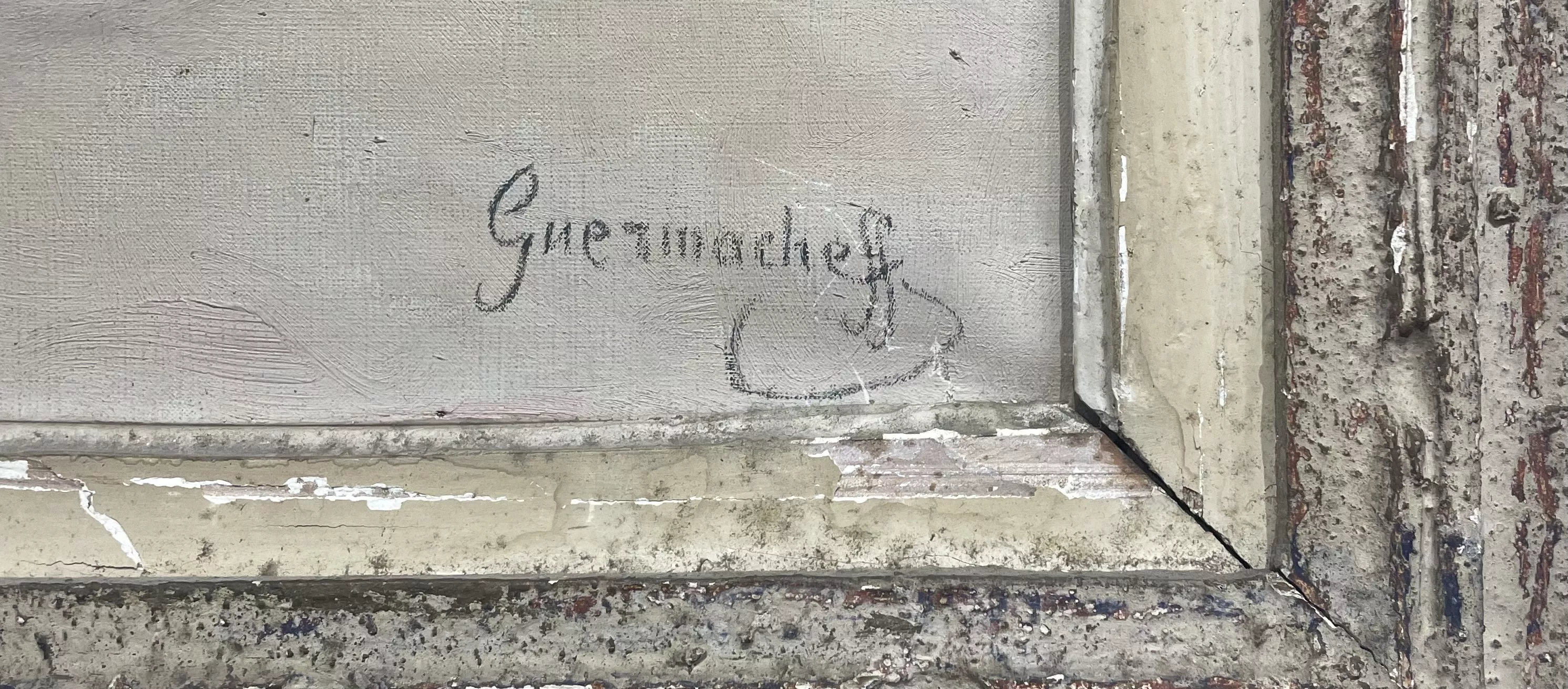
His signature
Not all Mikhail Guermacheff's works are signed. It is also possible that it is a copy or that the mention has faded over time, which is why expertise is paramount.
Expertise your property
If you own a work by Mikhail Guermacheff, don't hesitate to request a free appraisal by filling in our online form.
A member of our team of experts and licensed auctioneers will contact you to provide an estimate of the market value of your work.
If you are considering selling your work, our specialists will also guide you through the various alternatives available to obtain the best possible price, taking into account market trends and the specific features of each work.
Estimate in less than 24h
Discover in the same theme

The price of paintings and ceramics by Guidette Carbonell
Guidette Carbonell, the power of color in contemporary painting and ceramics
Learn more >

Rating and value of works, sculptures by Amalric Walter
Almaric Walter is a 20th-century sculptor who collaborated with Daum. His works are valued at auction. Estimate in 24h
Learn more >

Rating and value of works, prints and paintings by Jacques V...
Jacques Villon is a Cubist artist of the 20th century who produced prints and paintings quoted on the auction market. Estimated in 24h.
Learn more >
Other Russian paintings sold at auction

Estimated 3000-5000€
Alexandre Roubtzoff, Gammarth (small format)

Estimated Between €800 and €1,500
Alexandre ROUBTZOFF (1884-1949), View of Notre Dame de Paris, oil on canvas

Estimated Between €5,000 and €8,000
KRACHKOWSKY (1854-1914), Before the storm, oil on canvas

Estimated 40.000 - 80.000
Alexandre ROUBTZOFF (1884-1949), Portrait of Arbia, oil on canvas

Estimated 20.000 - 30.000
Alexandre ROUBTZOFF (1884-1949), Portrait of Marie-Madeleine Leroy, oil on canvas

Estimated 5.000 - 8.000
Alexandre ROUBTZOFF (1884-1949), The Sidi Makhlouf Mosque, oil on canvas

Secure site, anonymity preserved

Auctioneer approved by the State

Free and certified estimates
Frequently asked questions
-
Who is Mikhail Guermacheff, and what is his artistic background?Mikhail Guermacheff (1867–1930) was a Russian painter trained at the Moscow School of Fine Arts, associated with the School of Paris. After the 1917 Revolution, he moved to France, where he exhibited at the Grand Palais and the Salon of the National Society of Fine Arts. His work, influenced by Russian realism, is characterized by snowy landscapes and a particular focus on the play of light, expressing a nostalgia for the Russian Empire.
-
What is the range of prices and values for Guermacheff's paintings?Mikhail Guermacheff’s works sell for between €200 and €135,000 on the current market. His paintings command the highest prices, while his drawings and watercolors range from €200 to €360. Landscapes—particularly those depicting snowy scenes—are the most sought-after and can fetch several thousand euros at auction.
-
How can you authenticate a work by Mikhail Guermacheff?To authenticate a work by Guermacheff, we recommend that you request a free, no-obligation appraisal from Auctie's. Our experts and certified auctioneers will analyze your painting and provide you with an accurate estimate. Please note that many of Guermacheff’s works are unsigned, making the appraisal particularly important.
-
Is this the right time to sell a painting by Guermacheff?Yes, now is a good time to sell a work by Guermacheff. His market value is currently on the rise, and his paintings are attracting growing interest among collectors and enthusiasts of 20th-century Russian art. Landscapes, in particular, are in high demand.
-
How does the appraisal process work at Auctie's?Appraisals at Auctie's are free and non-binding. Simply fill out our online form with information about your artwork and photos of it. A certified expert or auctioneer will contact you within 48 hours to provide an accurate assessment of the market value and, if you wish, advise you on the best options for selling your painting.
