



Rating and value of paintings, Views of Paris by Constantin Korovine

Key takeaways
- Works by Constantin Korovine, a Russian Post-Impressionist painter (1861–1939), fetch prices ranging from €50 to €1,649,740, depending on the technique and subject matter.
- His "Vues de Paris" sell for between €490 and €924,850 and are particularly sought after by European and American collectors.
- *Boulevard des Capucines* (1912) sold for €924,850 in 2008 at Sotheby’s, exceeding its initial estimate of €624,900 to €874,860.
If you own a work by or after the artist Constantin Korivine, and would like to know its value, our state-approved experts and auctioneers will offer you their appraisal services.
Our specialists will carry out a free appraisal of your work, and provide you with a precise estimate of its value on the current market.
Then, if you wish to sell your work, we will direct you to the best possible arrangement to obtain the optimum price.
Rating and value of the artist Constantin Korovine
Korivine is a Russian-born painter who is relatively unknown to the general public. He leaves behind a unique artistic repertoire characteristic of Russian post-impressionism.
This legacy consists of paintings that are predominantly oils on canvas. At present, prices for his works are flying off the auctioneers' hammers.
His paintings and other works are particularly prized, especially by European and American buyers, and the price at which they sell on the art market ranges from €50 to €1,649,740, a considerable delta but one that speaks volumes about the value that can be attributed to Korovine's works.
In 2008, his composition Boulevard des Capucines, dating from 1912 was sold for €924,850 by Sotheby's, while it was estimated at between €624,900 and €874,860.
Order of value from a simple work to the most prestigious
Technique used | Result |
|---|---|
Drawing - aquarelle | From 50 to 70 750€ |
Vues de Paris | From 490 to €924,850 |
Oil on canvas | From €191 to €1,649,740 |
Estimate in less than 24h
Style and technique of artist Constantin Korovine
In his views of Paris, Constantin Korovine transposes the Impressionist heritage into a pictorial syntax where the nervous touch and fluid impastos translate the mobility of urban light.
The structure of space is often deliberately unstable, with planes superimposed without clear demarcation, in a chromatic dissolution dominated by silvery grays, nocturnal blues and the vibrant golds of streetlamps.
The pictorial material, applied in broad, fragmented strokes, captures the reflections on the damp asphalt, the diffuse flicker of signs and the uncertain transparency of the Seine's mists.
In Korovine's work, color is never treated as a flat surface, but as a network of shifting strata where contrasts are resolved in an optical continuity akin to sfumato effects.
This fast, flexible style, inherited from his work as a decorator, favors instant impressions over the rigorous construction of the motif: forms almost fade away under the glare of artificial lights, in a vision where matter and atmosphere merge in a sensory shimmer.
In contrast to the precise framing of realist painters, his Parisian views are akin to fleeting captures in which the city dissolves into a luminous effervescence, placing his work in the continuity of late Impressionism, sublimated by a sensibility that is properly theatrical.
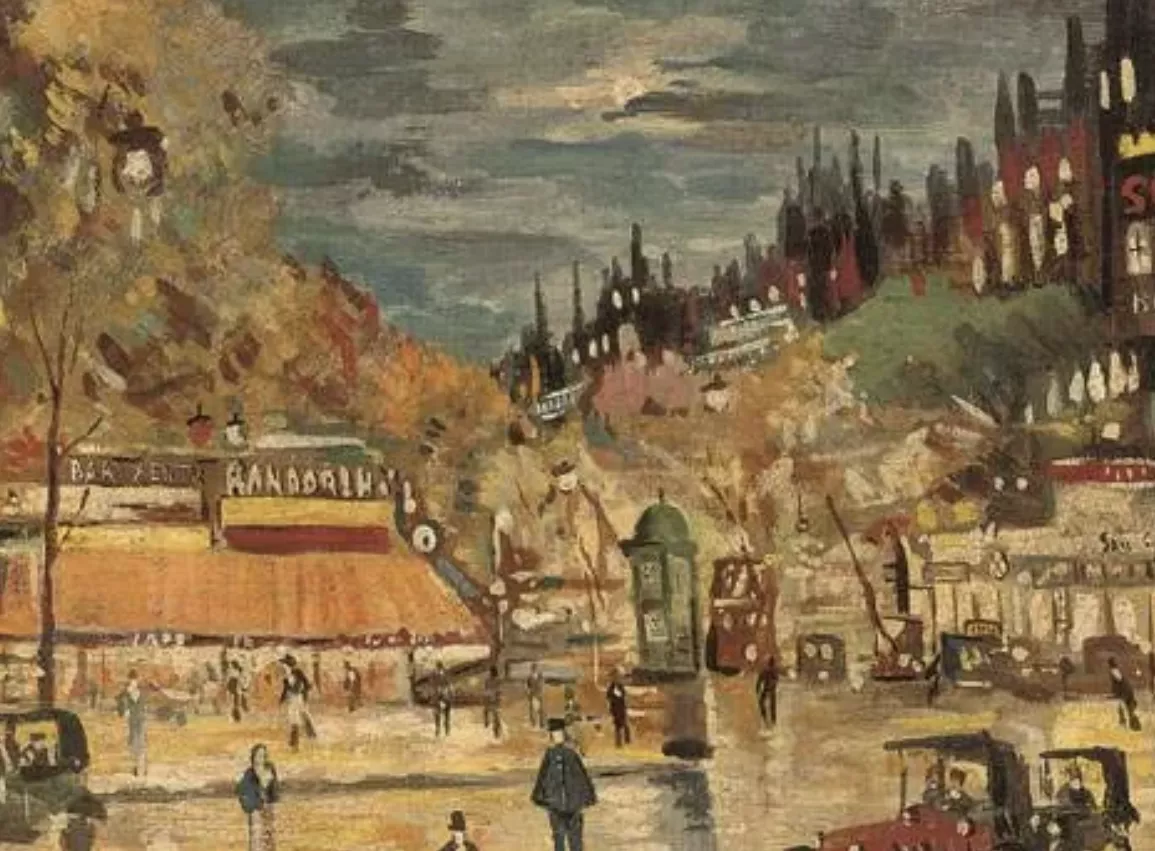
Constantin Korovine, a prized painter
Constantin Korovine (1861-1939), a Russian-born artist, became a figure prized by collectors, as did Krachkowsky and Bessonov.
The artist was born in Moscow into a family of merchants, and quickly entered painting school, aged just 14. Savrassov was one of his teachers.
Didn't like it there, he preferred to travel first to Scandinavia, then to France, where his works began to be strongly inspired by Impressionism this is why critics would call him a postimpressionist.
Painter but also decorator, he worked like other artists (we'll mention Vassilew Slavik) for ballet and decoration. In 1900, he designed the sets for the Russian pavilion at the Universal Exhibition.
The following year, he returned to Russia, where he taught painting alongside Serov ; while working for the Russian ballet. Still close to the Ambulants, from whom he drew inspiration early in his career, and despite his disconnect with their austerity and rigor, he exhibited his paintings alongside theirs, but also at the Société des Trente-Six as well as the Société des artistes russes.
In 1923, he emigrated to France due to the political context in his native country, where he continued to produce ballet and theater sets.
Korovine died in Paris in 1939, aged 77.
Les vues de Paris
In his views of Paris, Constantin Korovine captures the city in a shifting radiance where artificial light and the humidity of the air transform urban space into an incessant shimmer.
The rapid, fluid brushstrokes follow the pulsations of the city: broad impastos thrown onto the canvas in a supple, almost liquid material, where the reflections of streetlamps stretch out in vibrant sheets on the damp pavement.
The boulevards, bridges and quays are never treated with architectural rigor, but in a chromatic dissolution where forms seem absorbed by the atmosphere.
The golden yellows of the lampposts stand out against inky blues, translucent greys and blurred mauves, in a fragile balance between luminous flashes and nocturnal depth.
In contrast to Caillebotte, who fixes the city in an ordered geometry, Korovine favors the instantaneous and the quivering, multiplying the vibrations of color to render the effervescence of the capital.
There is, in these canvases, a diffuse theatricality, a taste for staging modern Paris, where the pictorial material, by almost fading into the light, tends to confuse the city and its reflection, architecture and atmosphere, in a luminous fade where sensation prevails over structure.
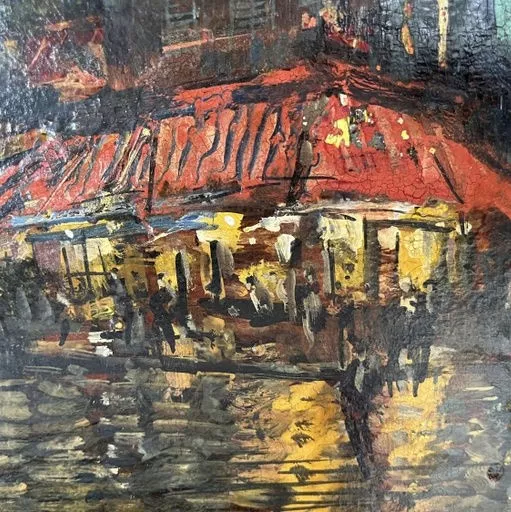
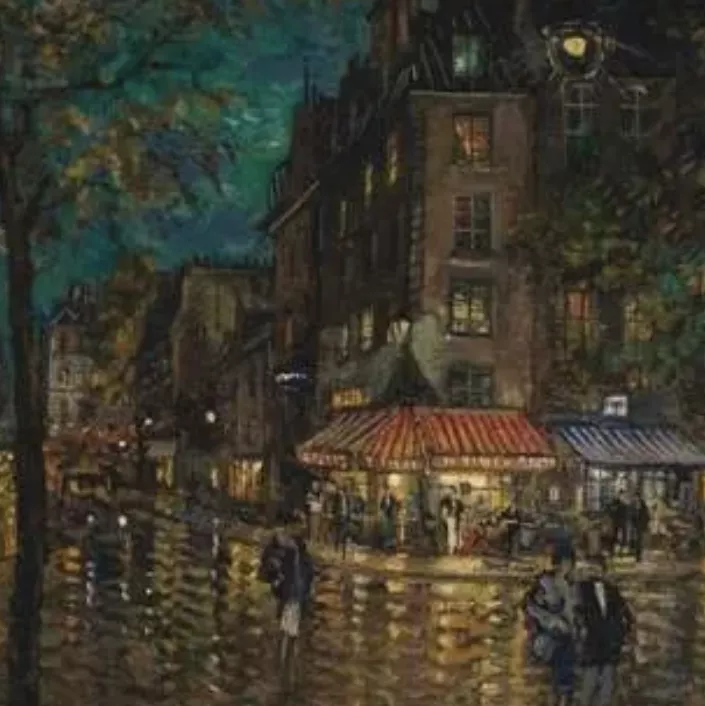
Focus on Boulevard des Capucines, Constantin Korovine
In Boulevard des Capucines, Constantin Korovine captures the effervescence of the capital in a luminous explosion where the scene seems to dissolve in a haze of brilliant colors.
The reflections of the streetlamps, almost spectral, glide across the cobblestones, mingling with the puffs of air created by the traffic.
The space, barely structured, is lost in a succession of bright, intertwined strokes, where yellows, blues and grays are superimposed without clear transition, with an intensity that captures the immediacy of the scene.
The perspective is deliberately blurred, the lines of the buildings melting into a sea of light, as if the artist had wanted to convey the sensation of movement rather than the solidity of the place.
Through this nervous, vibrant facture, Korovine captures the dynamics of the boulevard in its most fleeting reality: the light spilling onto the sidewalks, the blurred silhouettes of passers-by, the lively air of a street in perpetual motion.
It's less the street as such that is painted than the soul of the street, a constant vibration, where form is lost to better render the energy of urban life.
Korovine's imprint on his period
Korovine left his mark on his era in Russia and France, although the general public no longer remembers him today. Nevertheless, his technical mastery interests collectors and his works are highly sought-after on the auction market.
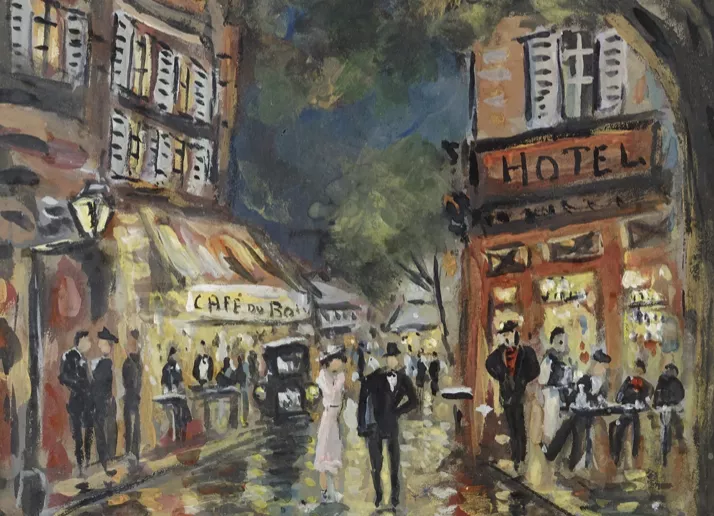
The stylistic influences of Constantin Korovine
The stylistic influences of Constantin Korovine unfold in an osmosis between the great currents of French painting and the sensibility specific to his Russian eye.
First, his passage through the Moscow School of Fine Arts and his first contacts with Impressionism mark a synthesis of Monet's exploded touch and attention to light, inherited from l'école de Barbizon.
In Paris, where he frequented workshops and salons, he quickly integrated the principles of art nouveau, where fluidity of line and harmony of color dictate composition.
However, he was not content with simple imitation. The vibrant hues, which he borrows from Impressionism, are nuanced by a more personal influence from the Peredvizhniki school, particularly visible in his Russian landscapes, where color, though vibrant, is structured and denser.
Korovine doesn't limit himself to one technique; he captures the essence of light, oscillating between the finesse of nuances and the density of pictorial matter.
Hence, his views of Paris, for example, also draw on the lesson of the Fauves, who valued pure color as a means of expressing the dynamism of urban space.
He fuses these influences to offer a deeply sensory vision, where the brilliance of light translates into a fluid construction of atmosphere, and where the sensation of the moment prevails over the precise figuration of the world.
Recognizing Korovine's signature
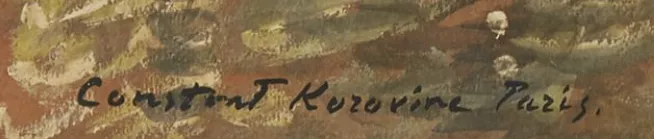
Often, Contantin Korovine's paintings are signed at the bottom left of the painting. He signs with his surname and first name, often in a dark tone ; sometimes with the town where he painted the picture, or the date.
Knowing the value of a work
If you happen to own a work by or after Constantin Korovine, don't hesitate to request a free appraisal using our form on our website.
A member of our team of experts and licensed auctioneers will contact you promptly to provide you with an estimate of the market value of your work, not forgetting to send you ad hoc information about it.
If you are considering selling your work, you will also be accompanied by our specialists in order to benefit from alternatives for selling it at the best possible price, taking into account market inclinations.
Estimate in less than 24h
Discover in the same theme

Value and quotation of works, furniture, panels by Gaston Su...
Gaston Suisse, a 20th-century artist and decorator, produced a great deal of lacquered wood furniture. A founder of Art Deco, his work is highly regar...
Learn more >

Rating and value of paintings by Alexander Deineka
Alexander Deineka is a Russian artist who has produced engaged art, and works that are highly rated and valued at auction. 24h estimate
Learn more >

Rating and value of drawings and paintings by Arbit Blatas
Arbit Blatas is a painter from the School of Paris whose paintings and sculptures command high prices at auction.
Learn more >
Similar works sold at auction


Secure site, anonymity preserved

Auctioneer approved by the State

Free and certified estimates
Frequently asked questions
-
Who was Constantin Korovine, and what was his artistic background?Constantin Korovine (1861–1939) was a Russian painter, born in Moscow, who became a sought-after figure among collectors. Trained at the Moscow School of Painting under Savrasov, he studied French Impressionism before developing his own Post-Impressionist style. A talented painter and set designer, he worked for the Russian ballet before emigrating to France in 1923, where he continued his career until his death in Paris.
-
What is the price range for Constantin Korovine's works?Prices for Korovine’s works vary considerably depending on the medium and subject matter. Drawings and watercolors range from 50 to 70,750€, while views of Paris range from 490 to 924,850€. Oil-on-canvas paintings, his primary medium, span the widest price range, from 191 to 1,649,740 euros, reflecting the importance of provenance and condition.
-
How can you authenticate and appraise a work by Constantin Korovine?To authenticate a work by Korovine and determine its value, we recommend that you request a free appraisal from Auctie's using our online form. Our team of experts and state-certified auctioneers will examine your painting and provide you with an accurate appraisal within 48 hours, with no obligation on your part.
-
Why is now the right time to sell a work by Korovine?Yes, now is a good time to sell a work by Korovine. His paintings are in growing demand among European and American collectors, and prices for his works are regularly soaring at auction. His talent as a Post-Impressionist, long underestimated, is now enjoying renewed commercial recognition.
-
How does the sale of a work of art work at Auctie's?Auctie's supports you every step of the way: a free, no-obligation appraisal by an expert; advice on the best sales strategies to maximize the price; and then listing your artwork for sale through our auction house. Our specialists take market trends into account to offer you the options best suited to your painting.
