



Rating and value of paintings by Paul Louis Bouchard

Key takeaways
- Works by Paul Louis Bouchard (1853–1937) sell for between €350 and €80,000 depending on the medium: watercolor drawings €350–€1,000, oil on canvas €10–€80,000.
- A Pointillist painter trained by Fernand Cormon, Bouchard combines the academic rigor of drawing with an Impressionist sensitivity to the effects of light and atmosphere.
- His painting *View of the Moscow Kremlin*, estimated at €70,000–90,000, sold for €80,000 in 2015, reflecting growing demand in the French market.
If you own a work of art by or after Paul Louis Bouchard, and would like to know its value, our state-approved experts and auctioneers will offer you their appraisal services.
Our specialists will carry out a free appraisal of your work, and provide you with an accurate estimate of its value on the current market.
Then, should you wish to sell your work, we will direct you to the best possible arrangement to obtain the optimum price.
Rating and value of the artist Paul Louis Bouchard
The artist Paul Louis Bouchard leaves behind a classic body of work, composed mainly of pointillist landscape scenes. He studied painting with Fernand Cormon.
Henceforth, the prices of his works rise at the auctioneers' gavel. His paintings are highly prized, especially by French buyers.
The price at which they sell on the art market ranges from €10 to €80,000, a very substantial range but one that speaks volumes about the value that can be attributed to Bouchard's works.
In 2015, the painting Vue du Kremlin de Moscou was sold for €80,000, while it was estimated at between €70,000 and €90,000.
Order of value from a simple work to the most prestigious
Technique used | Result |
|---|---|
Drawing - watercolor | From 350 to 1 000€ |
Oil on canvas | From 10 to 80,000€ |
Estimate in less than 24h
Style and technique by artist Paul Louis Bouchard
Paul Louis Bouchard inscribes his work in a pictorial tradition where rigorous drawing combines with meticulous attention to the effects of light and matter.
Trained in the academic atmosphere of the late 19th century, he inherits a precise know-how, where the line, firm and controlled, structures the composition with an almost architectural clarity.
But far from limiting himself to a purely descriptive approach, Bouchard accords an essential place to modelling and chromatic subtleties.
The touch, supple and vibrant, testifies to a sensitivity to atmospheric variations and the nuances of reality, inscribing himself in a filiation close to Impressionism without ever adopting its formal abandon.
His use of glazes and impastos reveals a methodical work, where each element is articulated in a considered construction, oscillating between spontaneity of gesture and precision of rendering.
Whether in his genre scenes, portraits or historical compositions, he strives for a faithful representation of textures and volumes, playing on the density of shadows and the luminosity of complexions.
This technical mastery, combined with a constant quest for accuracy and balance, lends his work a quiet intensity, both rooted in tradition and attentive to the evolutions of his time.
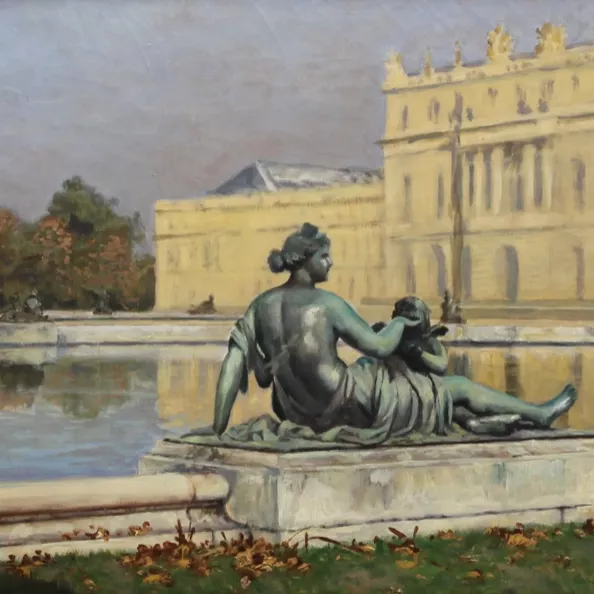
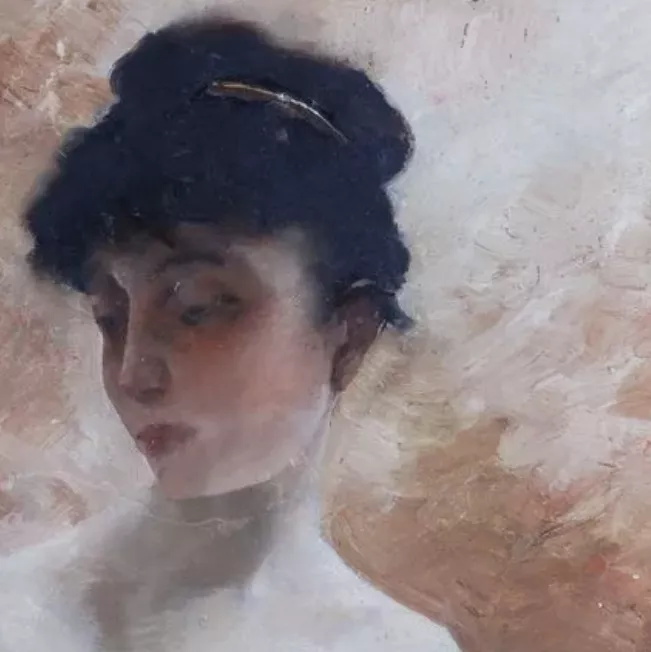
The life of Paul Louis Bouchard
Paul Louis Bouchard (1853 - 1937) was born into a teeming artistic context, where the great academic schools coexisted with the emerging movements of the turn of the century.
Trained according to the rigorous principles of academic teaching, he very soon developed a mastery of drawing and a sensitivity to the effects of matter that would mark the whole of his work.
His career led him to frequent Parisian studios where the heirs of realism and the proponents of a freer style of painting, attached to the play of light and the expressiveness of line, met.
While he adheres to a figurative tradition, he remains no stranger to contemporary research into color and movement.
Over the years, his compositions, whether genre scenes, portraits or military registers, bear witness to a precise eye and a constant interest in transcribing atmospheres.
Participating in the official Salons, where he regularly exhibited, he gained recognition that enabled him to inscribe his work in the artistic landscape of his time.
Adhering to a demanding vision of his art, he tirelessly pursued his work, leaving a production where rigorous drawing and chromatic sensitivity are combined, marked by a balance between tradition and modernity.
Focus on View of the Moscow Kremlin
In View of the Moscow Kremlin, Paul Louis Bouchard adopts an approach in which architectural rigor is combined with careful attention to atmospheric effects.
The massive structure of the Kremlin imposes itself in the composition, punctuated by domes and walls that stand out in the diffused light.
The artist plays on chromatic modulations to restore the texture of the stones and the muted glow of the sky, avoiding any rigidity in the outline of the forms.
The spatial organization testifies to a desire to structure the perception of the place while preserving a certain optical vibration.
The muted tones convey an atmosphere where time seems suspended, accentuated by the choice of a soft, slightly blurred touch.
The rendering of volumes relies on a balance between precision and dissolution of contours, lending the whole a monumentality that never yields to descriptive dryness.
The discreet human figures enliven the scene without breaking its harmony, suggesting an inhabited space yet dominated by the imposing immobility of the buildings.
Through this articulation of structure and impression, solidity and fluidity, Bouchard goes beyond the exercise of topographical transcription to deliver an interpretation in which the pictorial material itself participates in the sensation of a landscape captured in its luminous and historical resonance.
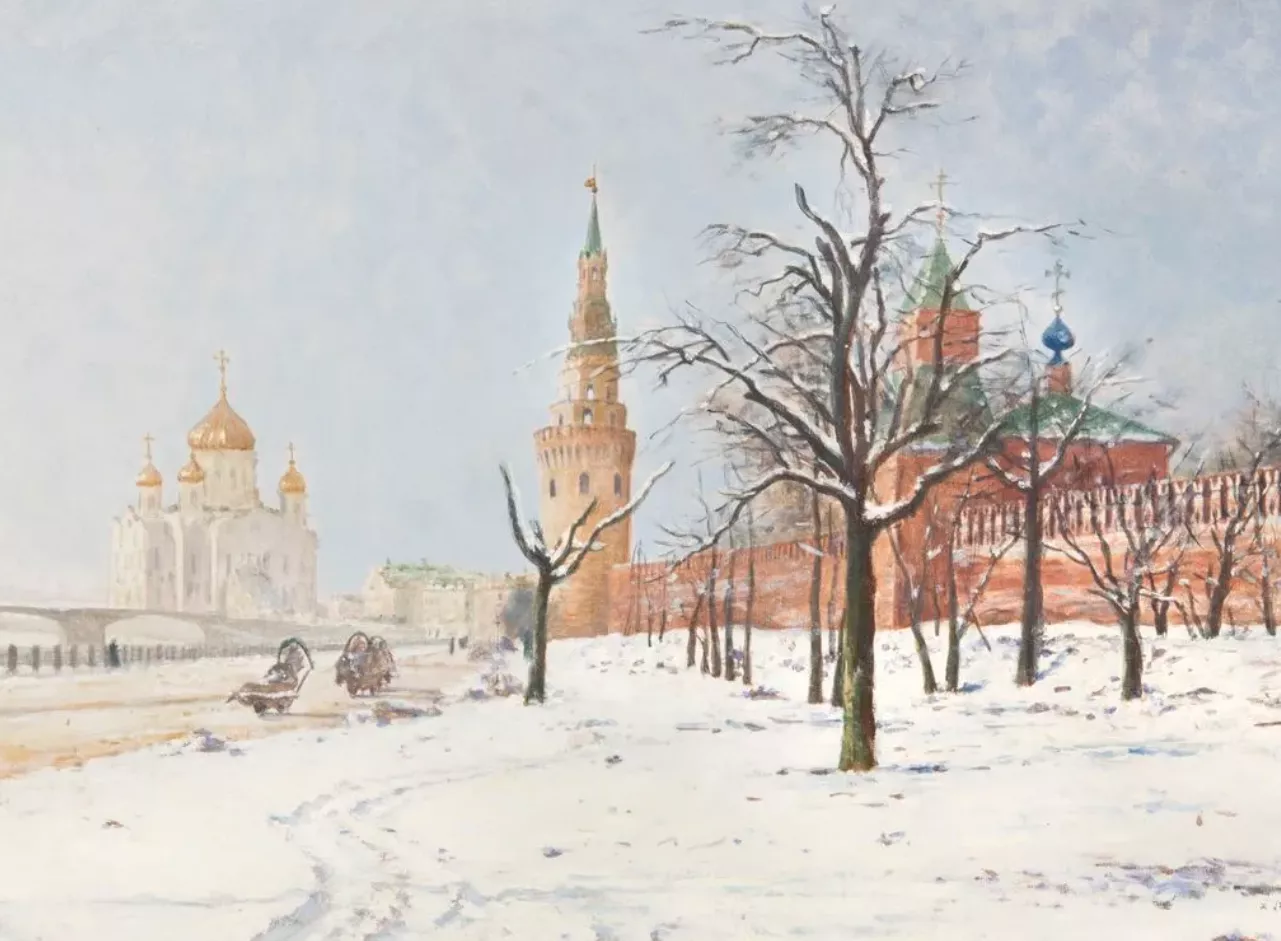
Paul Louis Bouchard's imprint on his period
Paul Louis Bouchard belongs to the tradition of painting in which meticulous observation of reality is combined with a sensitivity to the effects of light and matter.
His work, permeated by a rigorous composition inherited from the academic masters, is distinguished by an approach in which the precision of drawing serves an almost tactile rendering of surfaces.
A painter of his time, he sets out to capture moments in which architecture and history converse with an atmosphere in perpetual modulation.
His hallmark lies in this ability to transcribe the balance between structure and sensation, to go beyond simple representation to suggest a temporal depth.
His eye, focused on subjects where the monumental softens under the effect of the play of light, reveals an attachment to a painting where the motif never exhausts the mystery of its presence.
Through this approach, Bouchard establishes himself as a witness of his time, seeking in each scene a visual truth where form and perception intertwine in subtle coherence.
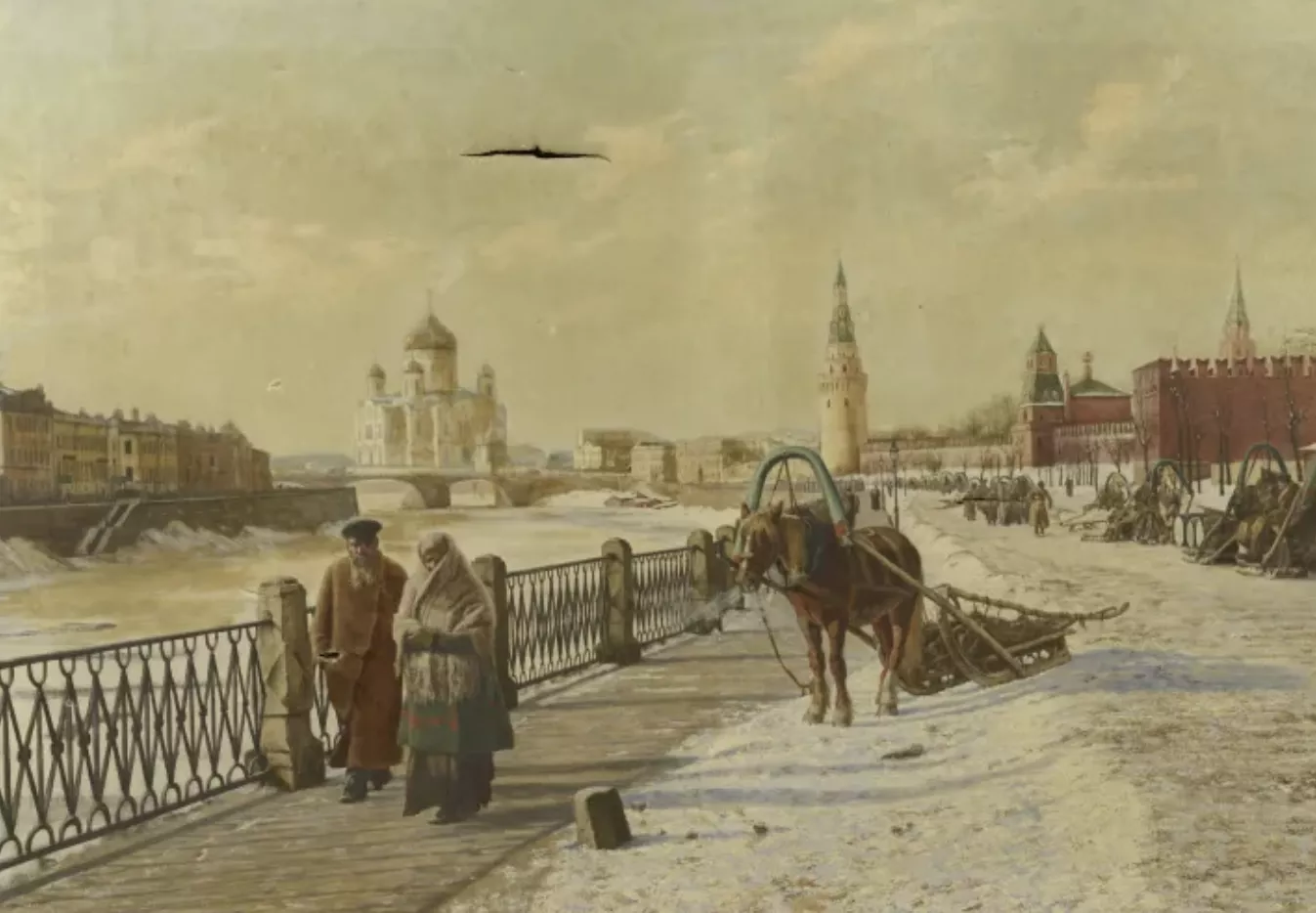
Paul Louis Bouchard's stylistic influences
Paul Louis Bouchard's work is rooted in a lineage in which the accuracy of drawing and the rigor of composition inherit from the great academic masters, while integrating a more modern sensitivity to the play of light and atmosphere.
Trained in a context where the influence of Jean-Léon Gérôme and Russian painters such as Bessonov remains prevalent (cf his Views of the Kremlin), he adopts an approach where detail and clarity of line impose themselves as the foundations of pictorial elaboration.
This taste for precision, combined with a mastery of contrasts and volumes, reveals the lasting imprint of late 19th-century history painting and realism on his output.
To this academic influence is added a particular attention to the subtleties of color and atmospheric effects, in the tradition of orientalists and plein air painters.
Bouchard, in capturing the diffuse light of a cityscape or the depth of an architectural scene, recalls the lesson of Félix Ziem and Georges Clairin, who knew how to marry the rigor of drawing with a freer approach to touch and tonality.
This dual influence, where the sharpness of the motif is balanced with a certain flexibility in the rendering, enables him to give his works a density that is both structured and vibrant.
His attraction to the representation of large cities and historic monuments also reflects a dialogue with painters of urban reality, such as Luigi Loir or d'Édouard Detaille, whose meticulous views strive to retranscribe the animation and splendor of city spaces.
Bouchard continues this tradition while integrating a more measured approach, where architecture is never frozen but imbued with a silent presence, oscillating between precision and evocation.
Through these multiple influences, he develops a pictorial style that, without breaking with academicism, is enriched by a more attentive eye for the nuances of reality and the resonance of time on shapes and colors.
Recognizing the artist's signature
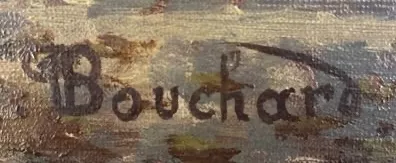
Not all of Paul Louis Bouchard's works are signed. They may be at the bottom of the painting, but if you think you own one, it's best to have it appraised to be sure of its originality.
Knowing the value of a work
If you happen to own a work by or after Paul Louis Bouchard, don't hesitate to request a free appraisal using our form on our website.
A member of our team of experts and chartered auctioneers will contact you promptly to provide you with an estimate of the market value of your work, as well as any relevant information about it.
If you wish to sell your work, our specialists will also help you find alternatives for selling it at the best possible price, taking into account market inclinations.
.Estimate in less than 24h
D'autres tableaux impressionnistes vendus aux enchères

Estimated 6.000 - 8.000
Mikhail Markianovich GUERMACHEFF (1867 - 1930) House under the snow, oil on canvas

Estimated 2.000 - 4.000
Jean DUFY (1888-1964) Vase of anemones, Watercolor

Estimated 600 € - 800 €
Henri ZUBER (1844-1909), Bridge at Artemare. Oil on canvas.
Discover in the same theme

Rating and value of marine paintings by Richard Parkes Bonin...
Richard Parkes Bonington's paintings are among the most sought-after. They are highly valued at auction.
Learn more >

Rating and value of paintings by Edmond Aman-Jean
Edmond Aman-Jean was a 19th-century Symbolist painter whose works are highly valued at auction.
Learn more >

Rating and value of drawings and paintings by Emile Schuffen...
Emile Schuffenecker is a Post-Impressionist painter whose works command high prices at auction. 24-hour estimate.
Learn more >

Secure site, anonymity preserved

Auctioneer approved by the State

Free and certified estimates
Frequently asked questions
-
Who is Paul Louis Bouchard, and what is his artistic background?Paul Louis Bouchard (1853–1937) was a painter trained in the academic tradition under Fernand Cormon. His work follows the figurative tradition of the late 19th century, balancing the precision of academic drawing with a sensitivity to the effects of light and atmosphere. He is particularly known for his landscape scenes, views of historic monuments, and urban compositions, in which he combines architectural precision with chromatic subtlety.
-
What is the price range for works by Paul Louis Bouchard?Prices for Bouchard’s works range from €10 to €80,000, depending on the type and quality of the piece. Drawings and watercolors range from €350 to €1,000, while oil paintings on canvas—which are particularly sought after by French buyers—command much higher prices. This significant variation reflects the importance of factors such as size, subject matter, and condition.
-
How can you authenticate a work by Paul Louis Bouchard?To authenticate a work by Bouchard, we recommend that you request a free appraisal using our online form. Our team of experts and state-certified auctioneers will examine your item and provide you with an accurate estimate within 48 hours. This process is non-binding and confidential.
-
Is this the right time to sell a work by Paul Louis Bouchard?Yes, this is a favorable time. The market for Bouchard’s paintings and drawings is showing positive momentum, with stable and growing demand, particularly among French collectors. His paintings are gaining increased recognition at auction, as demonstrated by the sale of *View of the Moscow Kremlin* for €80,000 in 2015.
-
How does the sale of a work of art work at Auctie's?The process begins with a free, no-obligation appraisal conducted by our experts and auctioneers. If you decide to sell, we’ll guide you through the entire process up to the auction, offering you the best options to achieve the highest possible price based on current market trends.
