



Rating and value of Russian paintings by Constantin Westchiloff

Key takeaways
- Constantin Westchiloff’s works sell for between €430 and €75,900 at auction, with his paintings and study drawings showing strong appreciation.
- A Russian-American Impressionist painter (1878–1945) and student of Ilya Repin, he is known for his landscapes and seascapes that delicately capture light and nature.
- His paintings attract the interest of collectors of 20th-century Russian art, although not all of his works are signed, making expert authentication essential.
If you own a work by or based on the artist Constantin Westchiloff and would like to know its value, our state-approved experts and auctioneers will guide you.
Our specialists will carry out a free appraisal of your work, and provide you with a precise estimate of its value on the current market.
Then, if you wish to sell your work, we will direct you to the best possible arrangement to obtain the optimum price.
Artist's rating and value
Constantin Westchiloff's work is uncommon and fairly highly rated on the auction market. His works arouse interest among collectors and art lovers, particularly those who appreciate 20th-century Russian painting.
The price at which his works sell on the art market ranges from €430 to €75,900, a considerable delta but one that speaks volumes about the value that can be attributed to the artist's works.
As such, a painting by Westchiloff can fetch thousands of euros at auction, like his study drawing Afternoon sun, Crimea, adjudged for €75,900 in 2011, whereas it was estimated at between €58,000 and €82,000.
Order of value from the most basic to the most prestigious
Technique used | Result |
|---|---|
Estamp - multiple | From €10 to €400 |
Drawing - watercolor | From 430 to 29 300€ |
Painting | From 170 to 75 900€ |
Estimate in less than 24h
Constantin Westchiloff's style and technique
Constantin Westchiloff is a Russian painter in keeping with Russian Impressionism, who during his career belonged to the Naturalist group, rejecting movements such as Suprematism and Constructivism. He maintains a fairly traditional working method.
Yet his master, none other than Elie Repin, had rejected academic conventions at the end of the 19th century and founded the Ambulants group, bringing together painters opposed to the pictorial norms current in Russia.
Westchiloff is thus part of the history of Russian painting in the midst of upheaval.
Constantin Westchiloff : his life, his work
Constantin Alexsandrovitch Wetschiloff, (1878 - 1945) was an American-Russian impressionist painter.
Born in St. Petersburg, he studied at the Imperial Academy of the same city in the studio of Elie Répine. In his youth, he lived through all the revolutionary events leading up to Russia's implosion in 1917.
After the Revolution, he chose to support Soviet propaganda, which enabled him to exhibit paintings at the " first free national exhibition ", in 1919 in Petrograd. Described as an Impressionist, his paintings were initially inspired by naturalism, aiming to depict nature as it is, without artifice.
He chose to pursue his career in Italy, where he produced various landscape paintings. In 1935, he decided to settle permanently in the United States, where he continued to paint landscapes but also marine paintings, like his fellow Ivan Aïvazovsky.
Focus on a marine painting by Westchiloff
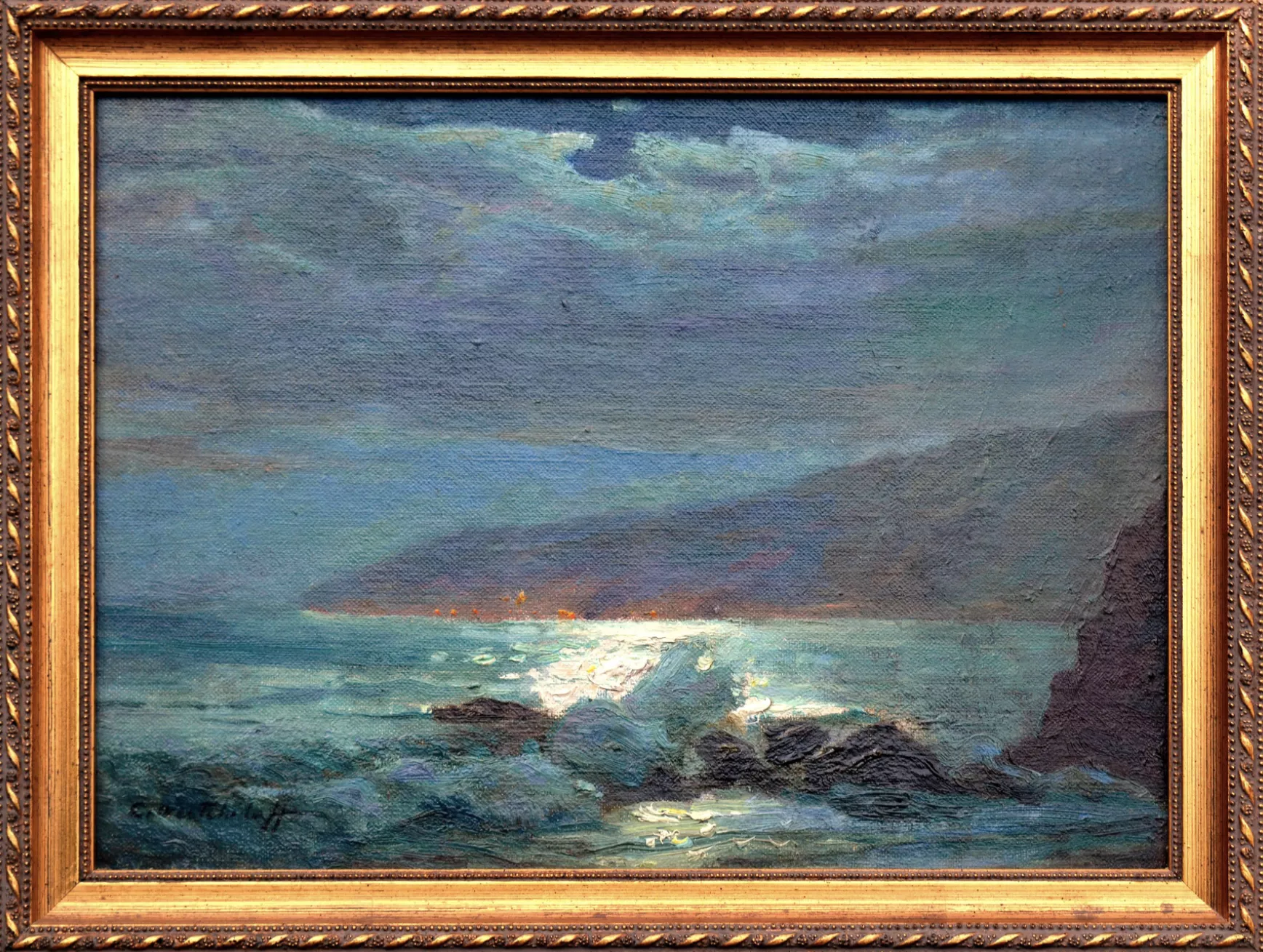
Constantin Westchiloff, usually recognized for his powerful seascapes, here reveals a turbulent sea scene under a heavy sky. The artist highlights the indomitable force of nature, where the waves come crashing violently against the rocks at dusk.
We see a tumultuous expanse of water, lit by silver flashes reflected on the wave crests. White foam stands out against the dark surface of the water, creating a striking contrast with the sky, tinged with shades of bluish and violet. On the horizon, orange lights appear, perhaps fires, suggesting a human presence at the edge of this wilderness.
The painter here captures a moment of tension between the immensity of the sea and the fragile presence of man. The waves, rendered with meticulous realism, seem ready to engulf everything in their path. The stormy sky, with its menacing clouds, adds to this impression of hostility and mystery.
Everything, from the flickering light to the force of the wind, seems to underline the power of nature and man's helplessness in its face.
The details are carefully crafted, particularly in the reflections of light on the water, which capture the way the dying sun tries to break through the thick clouds.
Cold hues dominate the composition, but the warm touches of the fires in the distance subtly draw the eye in, reminding us that despite the force of nature, human life persists.
With this work, Westchiloff demonstrates not only his ability to depict the grandeur of the sea, but also to convey a certain poetry in this confrontation between man and the elements. The soft but fleeting light that illuminates the scene creates a balance between beauty and menace, inviting the viewer to contemplate both the serenity and brutality of the ocean.
The contrast between the agitation of the waves and the calm glow on the horizon creates a fascinating dynamic, in which the artist demonstrates his mastery of both the representation of natural forces and the subtle play of light. Here, Westchiloff excels in the art of capturing an ephemeral moment, between calm and storm, where every detail contributes to creating an immersive scene, filled with movement and emotion.
In this way, the artist offers us a painting where nature becomes both character and setting, and where emotion is born from the contemplation of a sea that is both magnificent and threatening.
.
The context of Westchiloff's artistic creation
The Russian Impressionists, like their Western counterparts, captured the fleeting moment and the subtle variations of light, but their work was set in a very particular context: that of a Russia in upheaval.
At the dawn of the 20th century, while Western Europe was enthusiastic about the aesthetic innovations of Impressionism, Russian artists, such as Isaac Levitan, Konstantin Korovin or Valentin Serov, seize on this style to express both the beauty and fragility of their native land.
In the midst of revolutionary turmoil, their works take on an extra dimension. The peaceful landscapes, bathed in soft light, seem almost at odds with the political and social turmoil shaking the country.
Yet, this dissonance between the serenity of the scenes depicted and the violence of the surrounding events is deeply significant. The Russian Impressionists sought to preserve, in their canvases, the beauty of a world that was disappearing.
Nature, which they painted with such delicacy, became a refuge from the storms of history. Their luminous palette and light brushstroke technique create a striking contrast with the darkness of the coming revolution.
The revolutions of 1905 and 1917 mark a turning point, and for many artists, this impressionism becomes a swan song, a final attempt to capture peace before the irruption of chaos.
In this context, the art of the Russian Impressionists resonates as both an aesthetic and emotional testimony to an era in flux, where the ephemeral beauty of landscapes reflects the precariousness of a society on the verge of toppling over.
Focus on a Russian landscape painting by Westchiloff
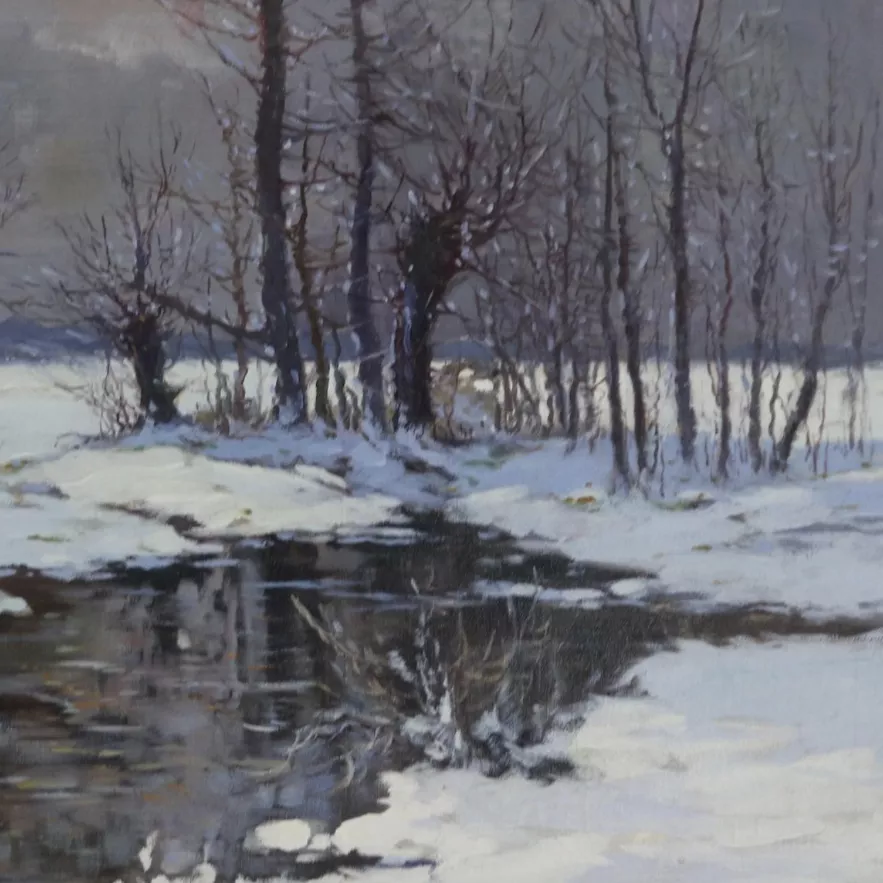
Constantin Westchiloff takes us here to a peaceful winter landscape, typical of the vast Russian expanses. The painting exudes calm and tranquility, with its bare trees and stream meandering gently through the snow.
The colors are soft, almost muted, dominated by cool tones of white, gray and blue, evoking the quietude of a winter's day.
The trees, with their bare branches, stand out against a gray, heavy sky. Their reflections in the dark water bring a touch of movement to this setting frozen by the cold.
The stream, though small, catches the eye with its shimmering surface that contrasts with the immaculate whiteness of the snow. It becomes a central element of the painting, creating a sense of depth and continuity in this seemingly silent landscape.
The overall atmosphere is one of serenity, almost solitude. One imagines the biting cold, the silence interrupted only by the discreet rustle of water. The total absence of human presence accentuates this impression of absolute calm, as if nature, in its simplicity, were self-sufficient.
The light is subtle, diffused through an overcast sky, but it illuminates just enough to bring out the details of the trees and the stream. This play of light, typical of winter, adds an almost dreamlike touch to the scene, making the whole both realistic and poetic.
With this work, Westchiloff captures the essence of the Russian winter, not in its violence or austerity, but in its silent, still beauty.
The whole is soothing, from the soft colors to the calm of the landscape. The viewer is invited to lose himself in this sleeping nature, to take a moment's pause, away from the hustle and bustle of the outside world.
Constantin Westchiloff's imprint on his period
Constantin Westchiloff is a world-famous painter, both during his lifetime and today. His paintings of landscapes and other compositions are highly sought-after by collectors and are successful at auction, but so are his preparatory drawings.
Some of his works are exhibited in museums in France, but private collectors play a major role in preserving his work.
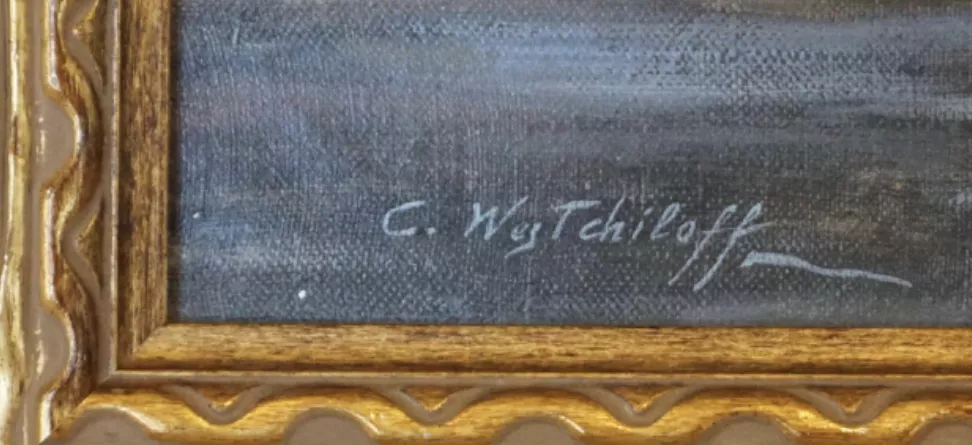
His signature
Not all of Wetschiloff's works are signed. It's also possible that they're copies or that the inscription has faded over time, which is why expertise is essential.
Expertise your property
If you own a work by Constantin Westchiloff, don't hesitate to request a free appraisal by filling in our online form.
A member of our team of experts and certified auctioneers will contact you to provide an estimate of the market value of your work.
If you are considering selling your work, our specialists will also guide you through the various alternatives available to obtain the best possible price, taking into account market trends and the specific features of each work.
Estimate in less than 24h
Discover in the same theme

Rating and value of works, drawings, paintings by Henri Mège
Henri Mège is a 20th-century landscape and still-life painter of the Indochina school. His works are listed at auction.
Learn more >

Rating and value of Rémi Blanchard's works, drawings and pai...
Remi Blanchard is a contemporary figuration libre artist who has produced drawings and oils on canvas that are highly regarded at auction.
Learn more >

Rating and value of paintings by Gerhard Richter
Gerhard Richter is a German abstract painter who has produced works that are highly valued on the auction market.
Learn more >
Other Russian paintings sold at auction

Estimated 3000-5000€
Alexandre Roubtzoff, Gammarth (small format)

Estimated Between €800 and €1,500
Alexandre ROUBTZOFF (1884-1949), View of Notre Dame de Paris, oil on canvas

Estimated Between €5,000 and €8,000
KRACHKOWSKY (1854-1914), Before the storm, oil on canvas

Estimated 40.000 - 80.000
Alexandre ROUBTZOFF (1884-1949), Portrait of Arbia, oil on canvas

Estimated 20.000 - 30.000
Alexandre ROUBTZOFF (1884-1949), Portrait of Marie-Madeleine Leroy, oil on canvas

Estimated 5.000 - 8.000
Alexandre ROUBTZOFF (1884-1949), The Sidi Makhlouf Mosque, oil on canvas

Secure site, anonymity preserved

Auctioneer approved by the State

Free and certified estimates
Frequently asked questions
-
Who is Constantin Westchiloff, and what is his artistic background?Constantin Westchiloff (1878–1945) was a Russian-American Impressionist painter who trained in Saint Petersburg in Ilya Repin’s studio. A proponent of Russian Impressionism and Naturalism, he rejected avant-garde movements such as Suprematism and Constructivism. After the 1917 Revolution, he continued his career in Italy and then in the United States, where he specialized in landscapes and seascapes.
-
What is the price range for Constantin Westchiloff's paintings?Constantin Westchiloff's works sell for between €430 and €75,900, depending on the medium and the work's prestige. Paintings range from €170 to €75,900, drawings and watercolors from €430 to €29,300, while prints and multiples range from €10 to €400. A notable example: his study drawing “Afternoon Sun, Crimea” sold for €75,900 in 2011.
-
How can I authenticate a painting by Westchiloff and determine its value?To authenticate a work by Westchiloff, we recommend requesting a free appraisal from Auctie's. Our experts and state-certified auctioneers will examine your artwork with no obligation and provide you with an accurate estimate of its market value. This appraisal is particularly important because some works are unsigned, or the signature may have faded over time.
-
How does the appraisal process work at Auctie's, and what are the timeframes?Appraisals at Auctie's are free and non-binding. Simply fill out our online form with information and photos of your artwork. A member of our team of experts and licensed auctioneers will contact you to provide an estimate of the market value. We’ll usually get back to you with our findings very quickly.
-
How do you sell a work by Constantin Westchiloff?If you’d like to sell a work by Westchiloff, Auctie’s will guide you every step of the way—from the initial appraisal to the auction sale. After the appraisal, our specialists will advise you on the best possible approach to achieve the highest price, taking into account market trends and the unique characteristics of your work.
