



Rating and value of paintings by Lois Mailou Jones

Key takeaways
- Lois Mailou Jones’s works sell for between €60 and €54,400, with her paintings fetching the highest prices since 2020.
- An African American artist (1905–1998), she combined Western modernism with African and Caribbean aesthetics, becoming a pioneer of diaspora art.
- Her watercolors and drawings range from €390 to €28,130, while her prints remain affordable, ranging from €60 to €8,870.
If you own a work by or after Lois Mailou Jones, and would like to know its value, our state-approved experts and auctioneers will offer you their appraisal services.
Our specialists will carry out a free appraisal of your work, and provide you with an accurate estimate of its value on the current market.
Then, if you'd like to sell your work, we'll direct you to the best possible arrangement to get the best price for it.
Rating and value of the artist Lois Mailou Jones
The artist Lois Mailou Jones leaves behind a rather colorful and figurative work, she is famous for her paintings and drawings. Now, prices for her works are rising under the auctioneers' gavel.
Her paintings are particularly prized, especially by American buyers. The price at which they sell on the art market ranges from €60 to €54,400, a substantial range but one that says a lot about the value that can be attributed to Lois Mailou Jones' works.
In 2020, Bazar du quai, Port au prince, Haiti, a 1961 oil on linen canvas depicting the landscape stated in the title was sold for €54,400, despite being estimated at between €18,000 and €27,000.
Order of value ranging from a simple work to the most prestigious
Technique used | Result |
|---|---|
Estamp - multiple | From €60 to €8,870 |
Drawing - watercolor | From €390 to €28,130 |
Painting | From €380 to €54,400 |
Estimate in less than 24h
The style and technique of Lois Mailou Jones
Lois Mailou Jones (1905 - 1998) is a key figure in twentieth-century African-American art. Her style evolved from academic realism to a syncretic plastic syntax, combining modernist, African, Caribbean and symbolist elements.
She worked in distinct series, successively exploiting frontal figuration, decorative flatness and then more abstract plastic structures, particularly after her stays in Haiti and Africa.
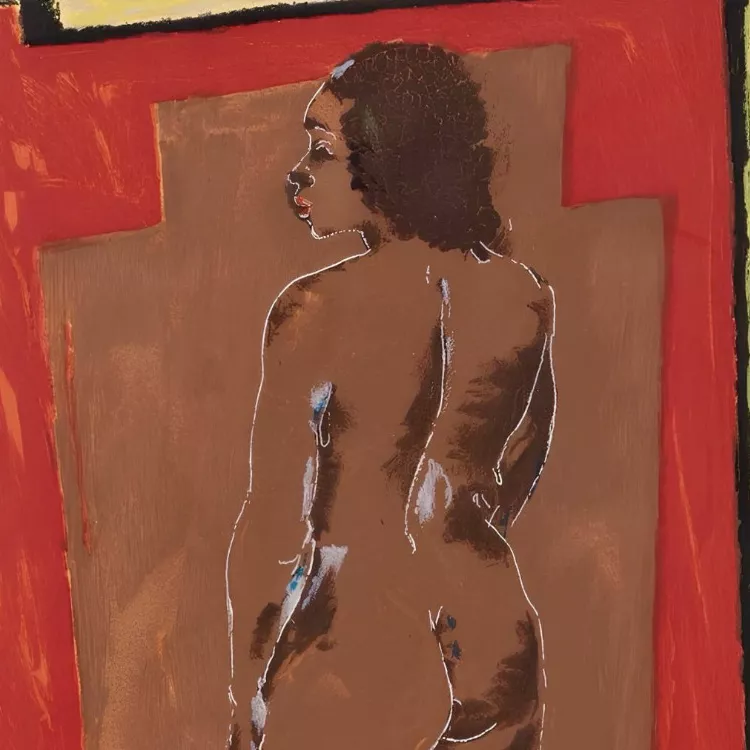
She first trained at the School of Museum of Fine Arts in Boston, which ensured her a precise drawing with just the right proportions, with classical modeling using tight hatching and controlled blending.
She demonstrates an advanced understanding of anatomy and volume, particularly in her portraits, where she articulates forms with targeted highlights of light and rigorous construction by planes.
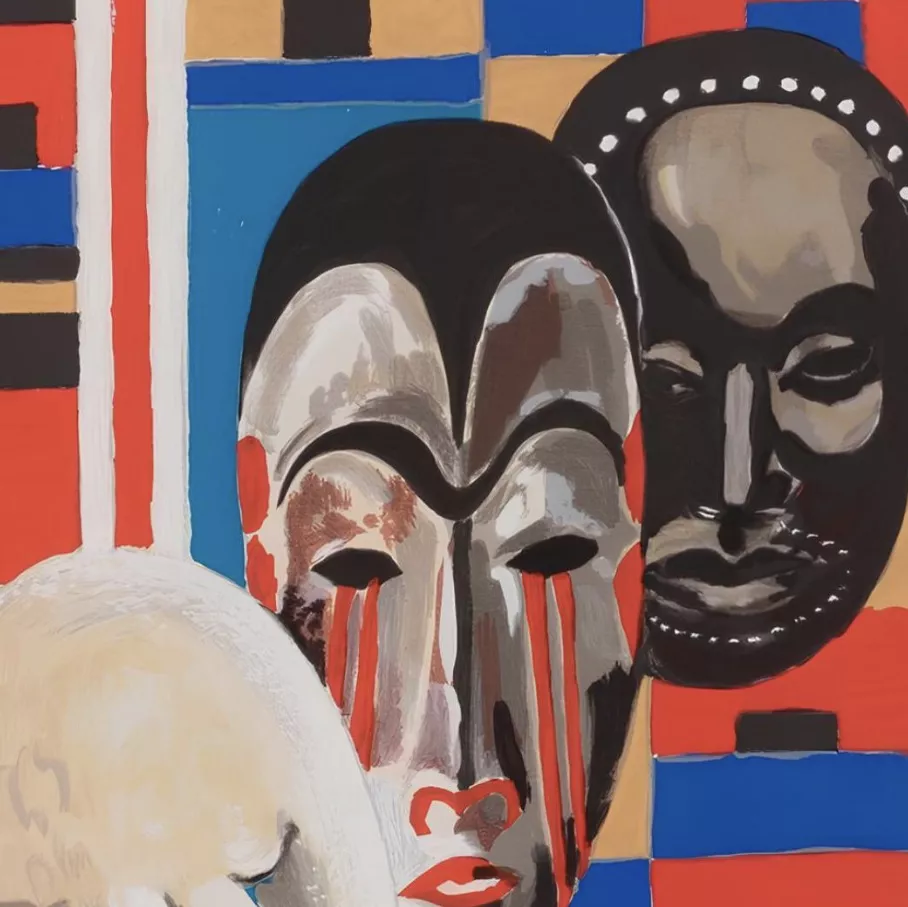
Lois Mailou Jones works with a saturated, contrasting and segmented palette, which is often organized in warm, complementary ranges, with frequent usgae of earthy tones, oranges, emerald greens, turquoises, red ochres and dense blacks.
Color is not naturalistic but structural and meaningful, organizing space into colored fields, sometimes nested in horizontal registers or networks of patterns.
She uses flat paint combined with circled or screened highlights, integrating a decorative plasticity akin to textile or mural arts. The artist often works on underlying geometric structures (grid, bilateral symmetry, radial arrangement), which support dense yet legible compositions.
She shows a tendency towards formal flatness, with figures that are inscribed in space like signs, without illusionistic perspective, and incorporates symbolic iconographic elements such as African masks, Kongo motifs and ritual objects, which are arranged according to an almost hieroglyphic syntax.
She works with oil paint on canvas, but also with other media such as gouache, watercolor, ink and collage, depending on the period. In the 1970s-80s, she developed a freer, more ornamental style, combining stencils, stamping, decorative stylization and repeated geometric motifs.
The artist demonstrates great technical plasticity, adapting her medium to the symbolic and cultural axigences of each series. She masterfully blends the codes of Western painting (composition, chiaroscuro, linear perspective) with motifs from African and Afro-diasporic cultures, in a logic of plastic and spiritual reappropriation.
Her work becomes a painting that is at once intellectual, decorative and political, where each element is formally articulated and semantically charged. She claims a diasporic pictorial identity, based on the conscious hybridization of forms and signs, within a mastered plastic grammar.

The life of Lois Mailou Jones
Lois Mailou Jones was born in 1905 in Boston, into a middle-class family, her father an employee of the Justice Department and her mother a hairdresser and milliner.
She showed an early talent for drawing and color, encouraged by her parents to develop an artistic career, which remained exceptional for a black woman in the early 20th century.
In Boston, while studying at the School of the Museum of Fine Arts, she suffered discrimination. She began her career as an art teacher at the Palmer Memorial Institute (North Carolina), then in 1930 joined Howard University in Washington D.C., where she taught for almost 50 years, training several generations of African-American artists.
Lois Mailou Jones established herself as a central figure in the black American academic world, in a still highly segregated environment. She used teaching as a space for cultural transmission and intellectual emancipation, in connection with the Harlem Renaissance movement.
She also trained at the Julian Academy in 1937 and 1938, thanks to a grant from the Rosenwald Foundation, and this period marked a stylistic turning point, as she discovered artistic freedom liberated from American racism.
Later, she traveled and painted in Haiti, Senegal, Nigeria, Kenya, Benin and Côte d'Ivoire : these sojourns nourished her work with African and diasporic references, and affirmed her interest in a transnational black aesthetic.
She became one of the first African-American artists to consciously integrate elements of traditional African art into a modern pictorial language. However, despite a prolific career, she struggled against double racial and sexist prejudice, as her works were sometimes exhibited without mention of her name or attributed to other male artists.
Throughout her life, she claimed a full presence in the history of American art, refusing to be confined to a marginal category. She was also a cultural activist, publishing, exhibiting, writing and promoting black artists in a still closed institutional context.
The artist continued to paint and exhibit well into old age, her last works dating from the 1990s. She received numerous institutional tributes in the 1980s - 90s (retrospectives, awards, honorary doctorates).
Lois Mailou Jones died in 1998 in Washington D.C., aged 92, considered a pioneer both for her production and for her educational and cultural impact.
Focus on The Fetishes, Lois Mailou Jones, 1938
The Fetishes is one of Lois Mailou Jones' most iconic works. Medium-sized (76 x 61 cm), it is held in an American public collection (Howard University Art Gallery) and produced in oil on canvas. It is a groundbreaking work, painted in Paris, which synthesizes Western modernism and African aesthetics.
Five masks are arranged frontally, isolated on a dark background, in a quasi-ritual composition, evoking both cult and museography. Each mask is different in proportion, form and presumed cultural origin (some are reminiscent of the Kongo style, others of West Africa).
The artist does not produce precise ethnographic models, but instead composes a symbolic visual grammar from stylized African referents. She works on vertical symmetry and modulated repetition, as the masks are arranged like signs in a flat syntax.
The space is flattened, without illusionistic depth, but with volume effects achieved by soft shadows and discreet gradations. The composition evokes cubist painting as much as ritualistic decorative or textile panels, through its frontal and rhythmic organization.
His palette in this work is limited but expressive (red ochres, deep blacks, bone whites and muted blues), which are used to accentuate the contrasts between the masks and the background. The colors are not naturalistic but symbolic and graphic, intended to make each motif emerge as an autonomous entity.
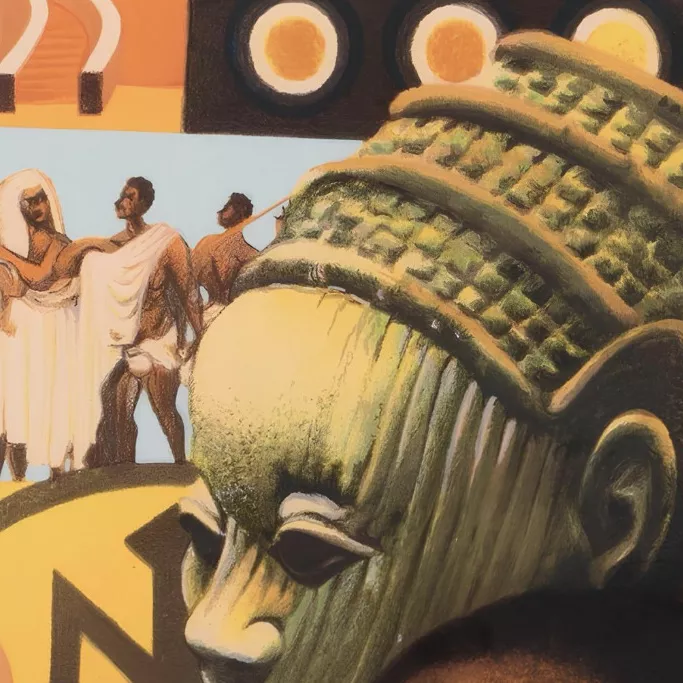
She makes subtle use of chromatic highlights to animate surfaces (red lips, white eyes, white lines that encircle shapes). Les Fétiches marks the conscious affirmation of a modern Afro-diasporic aesthetic, which integrates African sources into a contemporary pictorial language.
In 1938, this work thus goes against the grain of an art world that still regarded African art as primitive or decorative. It is also a strong statement of identity : Jones affirms that African references are not incidental but foundational to his plastic and cultural approach.
It is a manifesto work that heralds the great series to come in which Jones will blend traditional African motifs, symbolic calligraphy and modernist compositions ; which also testifies to his emancipation from academic canons and his conscious appropriation of an African heritage reinterpreted, not copied.
This work is today considered seminal in the history of African-American art, for having laid the foundations of a diasporic modernism for women.
She is now one of the highest-priced African artists at auction ; and figures prominently among her female colleagues, following the cote ascendante des plus élevées du marché comme Leonora Carrington, Tamara de Lempicka or Etel Adnan.
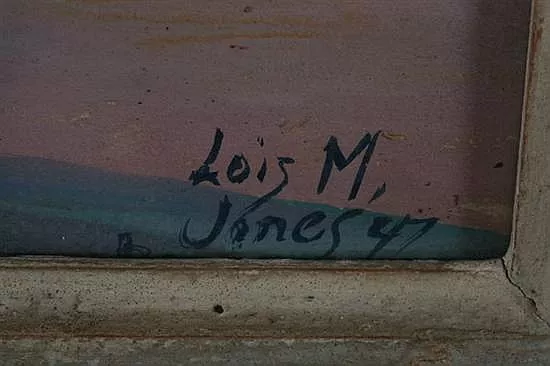
His signature
Not all of Lois Mailou Jones' work is signed.
Although there are variations, here is a first example of her signature:
Expertise your property
If you own a Lois Mailou Jones work, don't hesitate to request a free valuation by filling in our online form.
A member of our team of experts and chartered auctioneers will contact you to provide an estimate of the market value of your work.
If you are considering selling your work, our specialists will also guide you through the various alternatives available to obtain the best possible price, taking into account market trends and the specific features of each work.
Estimate in less than 24h
Discover in the same theme

Rating and value of Otto Dix's paintings, drawings and print...
Otto Dix was a 20th-century German Expressionist artist who produced drawings, prints and paintings that are highly regarded.
Learn more >

Rating and value of paintings by Lee Ufan
Lee Ufan is a contemporary South Korean artist who has produced works of considerable value at auction.
Learn more >

Rating and value of sculptures and furniture by Odile Noll
Odile Noll was an active artist from the 1950s to the 70s, producing works in fine wood. Her works are valued and quoted.
Learn more >
D'autres tableaux modernes figuratifs vendus aux enchères

Estimated 800 - 1.500
Jean Roger SOURGEN (1883-1978) Trees and dunes Oil on panel

Estimated 3.000 - 5.000
Georges LAPCHINE (1885-1951) The port of St Tropez Oil on canvas

Estimated 18.000 - 30.000
Charles CAMOIN (1879-1965) "Le Port de Marseille, 1928" Oil on canvas.

Estimated 1.500 - 3.000
Jean VANDEN EECKHOUDT (1875-1946), Basket of persimmons, Oil on canvas

Estimated 2.000 - 4.000
Charles LACOSTE (1870-1959) Starry night, Oil on paper mounted on canvas

Secure site, anonymity preserved

Auctioneer approved by the State

Free and certified estimates
Frequently asked questions
-
Who was Lois Mailou Jones, and what was her historical context?Lois Mailou Jones (1905–1998) was a major figure in 20th-century African American art. A pioneer who trained in Boston and later at the Académie Julian in Paris, she taught for 50 years at Howard University, shaping several generations of artists. Her work blends Western modernism with African and Caribbean aesthetics, asserting a conscious and assertive artistic identity rooted in the diaspora—a particularly significant statement in the context of racial segregation and gender discrimination.
-
What are the price ranges for Lois Mailou Jones's works at auction?Lois Mailou Jones's works sell for between €60 and €54,400, depending on the type and quality. Prints range from €60 to €8,870, drawings and watercolors from €390 to €28,130, and paintings from €380 to €54,400. In 2020, a major oil painting, *Bazar du quai, Port-au-Prince, Haiti* (1961), sold for €54,400 despite an estimate of between €18,000 and €27,000, reflecting growing market demand.
-
How can you authenticate and appraise a work by Lois Mailou Jones?To authenticate and appraise a work by Lois Mailou Jones, request a free, no-obligation appraisal from Auctie's. Our team of experts and licensed auctioneers will contact you and provide you with an accurate estimate of its market value within 48 hours. This process also helps identify the specific characteristics of your artwork (technique, provenance, condition) prior to a potential sale.
-
Is this a good time to sell a work by Lois Mailou Jones?Yes, now is a good time to sell a work by Lois Mailou Jones. The artist’s market value is rising steadily at auction, driven by growing recognition of her importance in the history of African American art and increased demand, particularly from American collectors. Her status as a pioneer of diasporic modernism continues to bolster the value of her work on the market.
-
How does the appraisal and sale of a work of art take place at Auctie's?At Auctie's, the process is simple and transparent: fill out our online form for a free, no-obligation appraisal. A certified expert or auctioneer will contact you to examine your piece and provide an estimate. If you decide to sell, our specialists will guide you toward the best available option based on market trends and the characteristics of your item, all the way through to the auction.
