



Rating and value of paintings by Leonora Carrington

Key takeaways
- The prices of Leonora Carrington’s works vary considerably, ranging from 70 euros for a print to 22.5 million euros for a painting from 1945.
- A major surrealist artist (1917–2011), she developed a unique style blending mythology, esotericism, and feminism using mixed media, including oil, tempera, and collage.
- Her paintings, particularly sought after by American buyers, have seen a significant rise in value since the 1980s as she is recognized as a key figure in feminist surrealism.
If you own a work by or after Leonora Carrington, and would like to know its value, our state-approved experts and auctioneers will offer you their appraisal services.
Our specialists will work to carry out a free appraisal of your work, and provide you with an accurate estimate of its value on the current market.
Then, should you wish to sell your work, we will direct you to the best possible arrangement to obtain the optimum price.
Rating and value of the artist Leonora Carrington
The artist Leonora Carrington leaves behind a rather colorful and figurative oeuvre, she is famous for her canvases and drawings. Now, prices for her works are rising under the auctioneers' gavel.
Her paintings are particularly prized, especially by American buyers. The price at which they sell on the art market ranges from €70 to €22,531,000, a substantial range but one that says a lot about the value that can be attributed to Leonora Carrington's works.
In 2024, La distraction de Dagobert, a 1945 tempera on masonite depicting a fantastic landscape was sold for €22,531,000, against an estimate of €11,035,000 to €16,554,000.
Order of value from a simple work to the most prestigious
Technique used | Result |
|---|---|
Estamp - multiple | From €70 to €58,300 |
Drawing - watercolor | From €190 to €94,000 |
Sculpture - volume | From €9,500 to €9,253,000 |
Painting | From €1,000 to €22,531,000 |
Estimate in less than 24h
Leonora Carrington's style and technique
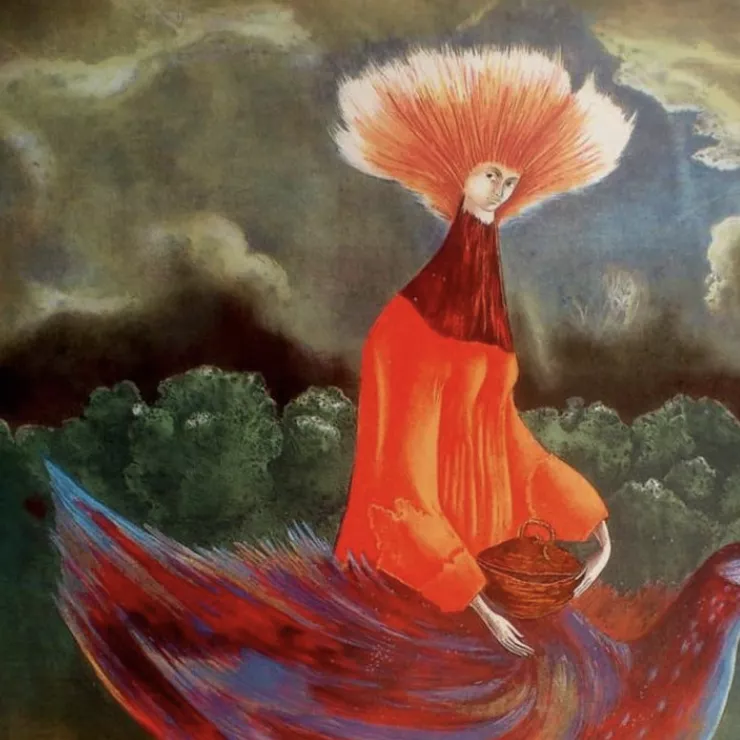
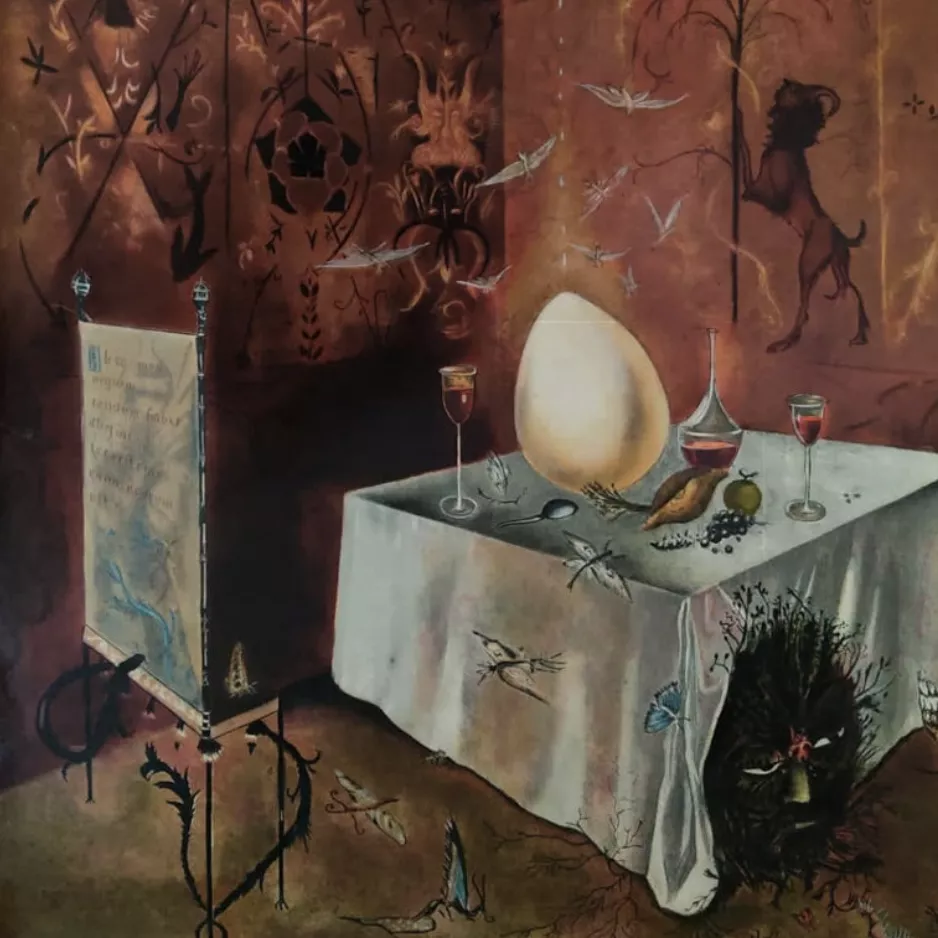
Leonora Carrington is a major figure of Surrealism, using a meticulous, multi-media technique. She mixes oil paint, tempera, collage, rubbing and automatic drawing to achieve rich, varied textures.
Her brushwork is precise, despite surrealist influences, she retains a fine, crystallized rendering, giving forms a sharp, unusual definition. She chooses mythical iconography that she blends with symbolism.
The artist depicts hybrid creatures, half-human and half-animal figures (horses, hyenas) that embody dreams, transformation and the unconscious. She includes in her compositions esoteric symbols relating to alchemy, Celtic mythology, Mexican religion and magic, used to structure an inner, initiatory imagery.
The tone of her works is dreamlike, with a poetic vein : the tones are earthy or muted, the unreal light seems to come from nowhere and creates a waking dream effect.
There is no single focal point, the scenes are organized like visual narratives with a tangle of signs, without immediate hierarchies, creating a narrative all-over.
We witness in her work a subversion of masculine surrealism. Leonora Carrington feminizes the movement, focusing her forms on subjectivity, the female body, the witch and inner autobiography.
The life of Leonora Carrington
Leonora Carrington (1917-2011) was a Surrealist artist born in Clayton Green (Lancashire, UK) into an aristocratic, industrial family. She rejected the strict Catholic upbringing and bourgeois social model imposed by her family.
She studied art in Florence, then at the Chelsea School of Art and the Ozenfant Academy in London, where she trained in modern painting. She met Max Ernst in Lodnres in 1937, became his companion and followed the Surrealist group to Paris.
The artist thus participated in the artistic effervescence of the movement alongside André Breton, Yves Tanguy, Paul Éluard and others. Early on, she created singular works combining dreams, Celtic myths, bestiaries, alchemy and black humor.
She was traumatized by the Nazi arrest of Max Ernst in 1940, and suffered a psychotic break in Spain. She was committed against her will to a psychiatric hospital in Santander, and this experience nourished her book En bas, published in 1943.
She managed to escape from Europe thanks to the Mexican embassy in Lisbon, and went into permanent exile in
Mexico. She settled there in 1942 and spent most of her life. She collaborated with other exiled artists such as Remedios Varo, Kati Horna and Octavio Paz.
Leonora Carrington became a major figure on the Mexican art scene, recognized as much for her painting as for her writing (novels, short stories, plays). She continued to paint well into old age, producing a body of work marked by spirituality, feminism and humor.
From the 1980s onwards, the artist gained international recognition as one of the great female figures of Surrealism. She died in Mexico City on May 25, 2011 at the age of 94, leaving behind a profoundly personal and visionary body of visual and literary work.
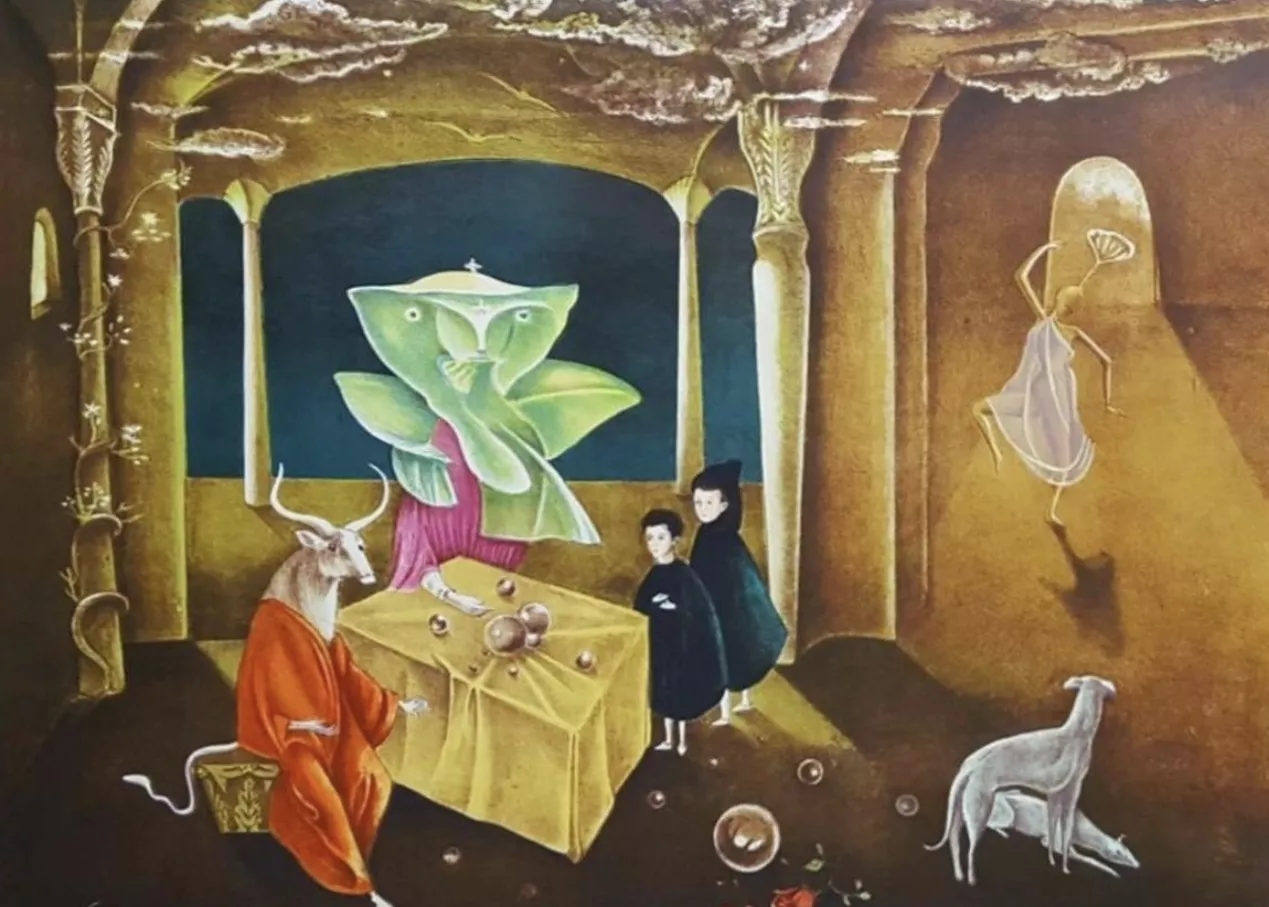
Focus on The Pomps of the Subsoil, Leonora Carrigton, 1947
The Pomps of the Subsoil is an oil on canvas from 1947 housed at MoMA in New York. The composition is labyrinthine and fantastical, populated by animal, human and chimerical figures in a subterranean universe.
The visual structure and narrative are organized in superimposed planes, with scenes set in a partitioned space, like a vertical cut through a subterranean world. The layout is frontal, almost theatrical, and guides the eye in a progressive exploration of the pictorial space.
There is an absence of a clear narrative center : the figures all seem animated by a symbolic intention, with no apparent hierarchy. It includes hybrid creatures such as snake-birds, tree-women, animal-spirits, and each figure refers to a mythical or personal bestiary.
She chooses occult references (homunculi, substrances, metaphors) that evoke an inner world in flux, and also incorporates an intertextuality with motifs inspired by Celtic mythology, Kabbalah, alchemy as well as her own experiences of mystical delirium.
The colors are muted and autumnal, with deep ochres, grays, greens and iridescent internal lighting. The clarity seems supernatural, as the light sources appear to be internal to the bodies or emanating from the ground, reinforcing the painting's strangeness.
The textures are meticulous, the painting detailed, almost minimalist despite the abundance of figures. The work can be interpreted as a symbolic self-portrait: Carrington projects herself into her matricial, subterranean, feminine and spiritual universe.
This is a painting of reconstruction, painted after her internment and move to Mexico, and can be read as a tale of rebirth through the imaginary. Today, this painting is seen as a key work of feminine surrealism: an art of metamorphosis, inner resistance and personal myth.
Leonora Carrington's imprint on her period
Leonora Carrington joined the Paris Surrealist movement early on, but soon emancipated herself from it by developing an autonomous, more introspective and feminine vision.
Contrary to many members of the group, she doesn't just paint dreams or desire, but constructs a symbolic and mythical imaginary of her own, which is nourished by folklore, esotericism and intuition.
Through her paintings, stories and plays, she brings out a singular female voice in a surrealism dominated by male figures (Breton, Ernst, Dali), and revalorizes marginal figures (witches, chimeras, priestesses) in order to propose a vision of the world freed from certain codes.
Thanks to her voluntary exile in Mexico in 1942, she played a key role in bridging the gap between the European avant-garde and the Latin American art scene. She exerted a major influence on her Mexican contemporaries, such as Remedios Varo and Kati Horna, and later on the young Mexican intellectual scene.
She thus became an essential literary and pictorial figure in twentieth-century Mexican culture. Her work is not limited to the visual arts, but also includes novels, short stories, plays and essays, all of which are traversed by the same alchemical and feminist imaginary.
Her work is today studied in several fields, and has been showcased in major exhibitions in the 2010s and 2020s, including at Tate Liverpool, MAP Mexico City and the Montreal Museum of Fine Arts.
She is considered one of Surrealism's most radical and complete artists, at once visual, literary, philosophical and spiritual, and is being revalued alongside female artists such as Judith Reigl or Yvonne Canu.
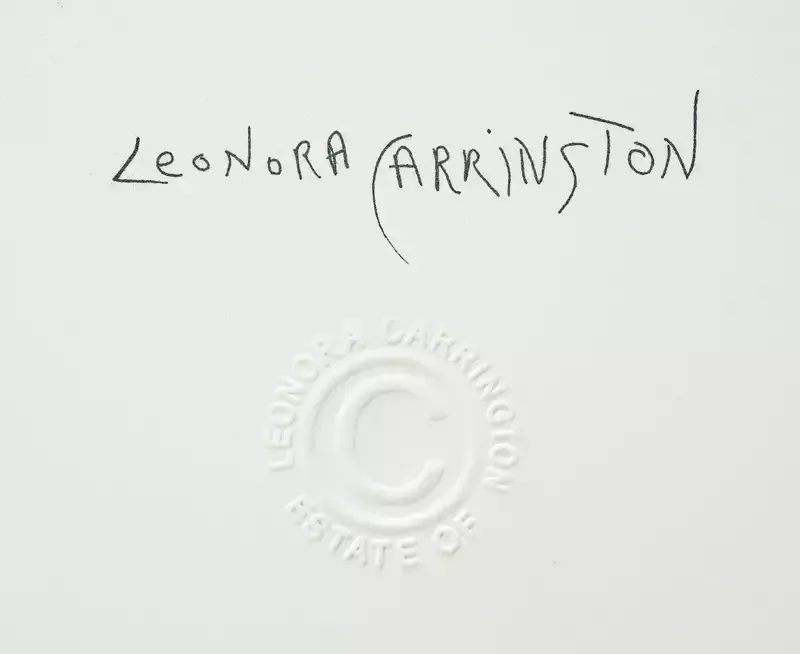
Her signature
Not all of Leonora Carrington's works are signed.
Although there are variations, here is a first example of her signature:
Expertise your property
If you own a work by Leonora Carrington, don't hesitate to request a free appraisal by filling in our online form.
A member of our team of experts and chartered auctioneers will contact you to provide an estimate of the market value of your work.
If you are considering selling your work, our specialists will also guide you through the various alternatives available to obtain the best possible price, taking into account market trends and the specific features of each work.
Estimate in less than 24h
D'autres tableaux modernes figuratifs vendus aux enchères

Estimated 800 - 1.500
Jean Roger SOURGEN (1883-1978) Trees and dunes Oil on panel

Estimated 3.000 - 5.000
Georges LAPCHINE (1885-1951) The port of St Tropez Oil on canvas

Estimated 18.000 - 30.000
Charles CAMOIN (1879-1965) "Le Port de Marseille, 1928" Oil on canvas.

Estimated 1.500 - 3.000
Jean VANDEN EECKHOUDT (1875-1946), Basket of persimmons, Oil on canvas

Estimated 2.000 - 4.000
Charles LACOSTE (1870-1959) Starry night, Oil on paper mounted on canvas
Discover in the same theme

Rating and value of paintings by Pavel Chmaroff
Pavel Chmaroff is a twentieth-century Russian painter who produced works that are highly rated and sought-after on the auction market. Estimated in 24...
Learn more >

Market Value and Price of Sculptures and Bronzes by Henri Bo...
Henri Bouchard is a French naturalist sculptor who produced works that are highly valued at auction. Estimate in 24h.
Learn more >

Rating and value of paintings by Oskar Kokoschka
Oskar Kokoschka is a 20th-century Austrian Expressionist painter whose works are highly valued at auction.
Learn more >

Secure site, anonymity preserved

Auctioneer approved by the State

Free and certified estimates
Frequently asked questions
-
Who was Leonora Carrington, and what was her role in Surrealism?Leonora Carrington (1917–2011) was a major British surrealist artist, born into an aristocratic family. She joined the Parisian Surrealist movement in the 1930s, then went into exile in Mexico in 1942, where she developed a unique and feminist vision of Surrealism, incorporating Celtic mythology, esotericism, and spirituality. Gaining international recognition in the 1980s, she is considered one of the movement’s most radical female figures, influencing the Latin American art scene.
-
What is the price range for Leonora Carrington's works?Prices for works by Leonora Carrington vary considerably depending on the medium and rarity: prints sell for between €70 and €58,300, watercolor drawings from €190 to €94,000, sculptures from €9,500 to €9,253,000, and paintings from €1,000 to €22,531,000. Value depends on the work’s historical significance, provenance, condition, and the period in which it was created.
-
How do you authenticate a work by Leonora Carrington?To authenticate a work by Leonora Carrington, we recommend that you request a free appraisal from Auctie's. A certified expert or auctioneer will examine the work, verify the signature (although some works are unsigned), analyze the technique and provenance, and then provide you with a reliable estimate within 48 hours, with no obligation on your part.
-
Is this the right time to sell a work by Leonora Carrington?Yes, now is a good time to sell a work by Leonora Carrington. The artist’s international recognition has grown rapidly since the 1980s, and she is the subject of major exhibitions and ongoing academic reappraisal. Prices for her works are rising steadily, particularly among American collectors and museums.
-
How does the free appraisal of a work of art work at Auctie's?The appraisal is simple and non-binding: you fill out an online form to describe your artwork. A certified expert or auctioneer from our team will contact you to examine the item and gather the necessary information (technique, dimensions, condition, provenance). You’ll receive an accurate estimate of the market value within 48 hours, and we’ll then offer you the best options for selling your artwork if you’re interested.
