



Rating and value of paintings by Auguste Herbin

Key takeaways
- Works by Auguste Herbin (1882–1960) sell for between €40 and €589,400, with oil paintings fetching the highest prices.
- A French pioneer of geometric abstraction, Herbin developed, beginning in 1917, a visual language based on correspondences between 26 colors, geometric shapes, and sounds.
- His later compositions (1940s) emphasize the juxtaposition of pure forms and flat color to create a universal language, completely abandoning figurative illusion.
If you own a work by the artist Auguste Herbin or based on his work and would like to know its value, our state-approved experts and auctioneers will guide you.
Our specialists will carry out a free appraisal of your work, and provide you with an accurate estimate of its value on the current market.
Then, should you wish to sell your work, we will direct you to the best possible arrangement to obtain the optimum price.
Artist Auguste Herbin's rating and value
Auguste Herbin is a French painter of the 20th century. He left behind a unique artistic repertoire characteristic of French abstract art. This legacy is made up of paintings that are predominantly oils on canvas.
At present, the prices of his works are flying off the auctioneers' hammers. His paintings and other works are particularly prized, especially by French buyers, and the price at which they sell on the art market ranges from €40 to €589,400, a considerable delta but one that speaks volumes about the value that can be attributed to Herbin's works.
In 2018, a predominantly green polychrome composition entitled Mountain Road in Corsica, dating from 1907, sold for €589,400 while it was estimated at between €420,000 and €589,400.
Order of value from a simple work to the most prestigious
Technique used | Result |
|---|---|
Estamp - multiple | From €40 to €8,200 |
Sculpture- volume | From €180 to €9,000 |
Drawing - watercolor | From €100 to €72,900 |
Oil painting | From €500 to €589,400 |
Estimate in less than 24h
Style and technique by artist Auguste Herbin
In his compositions of the late 1910s, such as Le Port (Musée d'Art Moderne de Paris) or Nature morte au compotier (Musée de Grenoble), Auguste Herbin adopts a rigorous fragmentation of the surface, where color seems to emancipate itself from the motif.
This simplification of the plane is accompanied by systematic use of the straight line and sharp angles, signs of a gradual move towards geometric abstraction.
By 1920, under the influence of Cubist research, his work moved towards greater stylization, where color, initially muted, became more frank and autonomous.
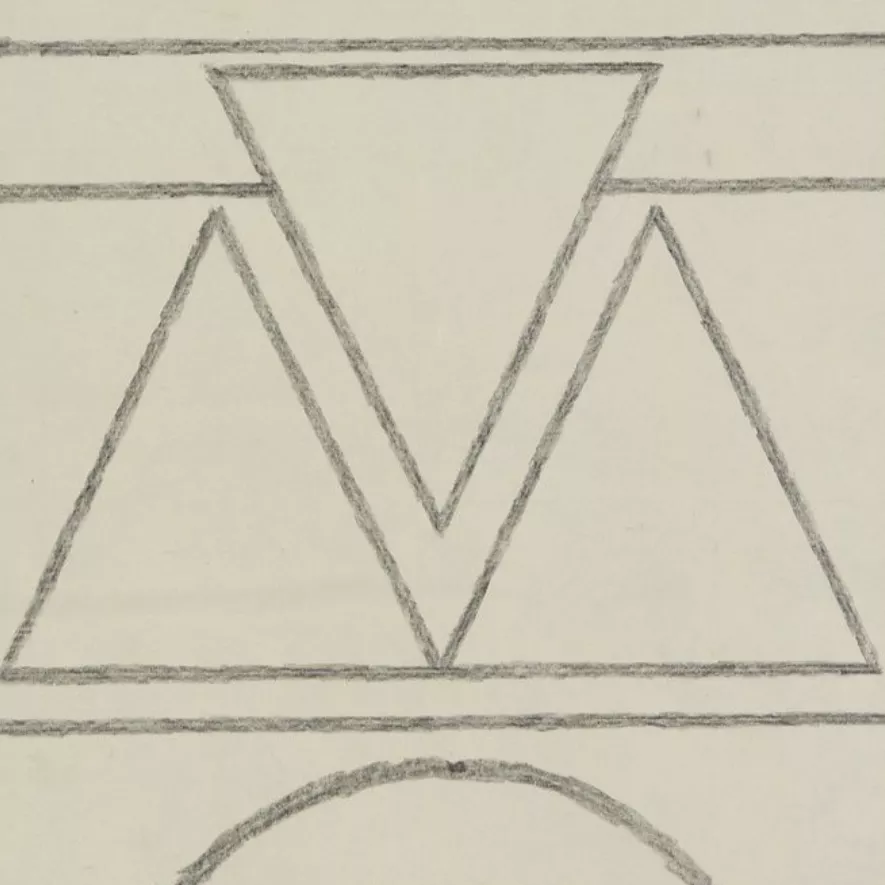
In Composition abstraite (Musée national d'art moderne, Paris), Herbin superimposes simple shapes-triangles, rectangles, arcs of a circle-in a rigorous layout that owes as much to architectonic construction as to the principles of neoplasticism.
At this time, as he would later confide, he set out to "reduce painting to its primary elements", discarding any illusionist effect in favor of spatial organization and purity of hue.
In his works of the late 1940s, such as Abstraction (private collection), the systematic juxtaposition of colored forms and the elimination of traditional outlines participate in a new pictorial syntax in which chromatic contrasts become the sole vectors of structure.
The smooth, even brushwork itself moves away from expressive gesture in favor of meticulous surface work, where each element finds its place in a pre-established balance.
This rejection of accident and subjectivity places Herbin in a tradition where painting is first and foremost a language, governed by a precise formal alphabet.
The life of Auguste Herbin
Auguste Herbin (1882-1960), a French artist, became a sought-after figure among collectors.
He was born in northern France, and began his training at the Académie des Beaux-Arts in Lille, where he learned painting in the studio of Pharaon de Winter. His first canvases are imbued with Post-Impressionist influence.
He sent paintings to the Salon des Indépendants as early as 1906. Herbin gradually drew closer to Picasso and Braque, starting in 1909 at the Bateau-Lavoir in Paris, on the Butte Montmartre, a group through which he also met Wilhem Unde.
In 1910, at the Salon des Indépendants, he was exhibited in the same room as Jean Metzinger, Fernand Léger and Albert Gleizes. In the same spirit, he took part in the Section d'Or exhibition in 1912, led by Jacques Villon.
At Céret, he was to produce several cubist works - thus removing the notion of perspective from his work. During the First World War. In 1917, he produced his first abstract canvases, and was immediately noticed by Léonce Rosenberg, who bought several paintings from him. From then on, he exhibited at the Galerie de l'Effort moderne in Paris.
Two years later, he chose to abandon cubism, telling Albert Gleizes that he found this movement " outdated ", and that " art can only be monumental ". It is from this observation that he creates his series of monumental objects.
Through his geometric paintings on wood, he wishes to question the status of the easel - but they are extremely poorly received by the public and critics.
From 1922 until 1925, he returns to a figurative style, not really finding his way. He would later disavow the genre scenes, landscapes and still lifes he painted during this period. In 1929, he co-founded the Salon des surindépendants.
In 1931, he established himself as a pioneer, exhibiting at the Salon Association 1910, which led to the creation of the Abstraction-Création group, founded with Georges Vantongerloo. During these years, he favored an entirely geometric style of painting, composed of flat, pure-colored shapes alternating with undulating forms.
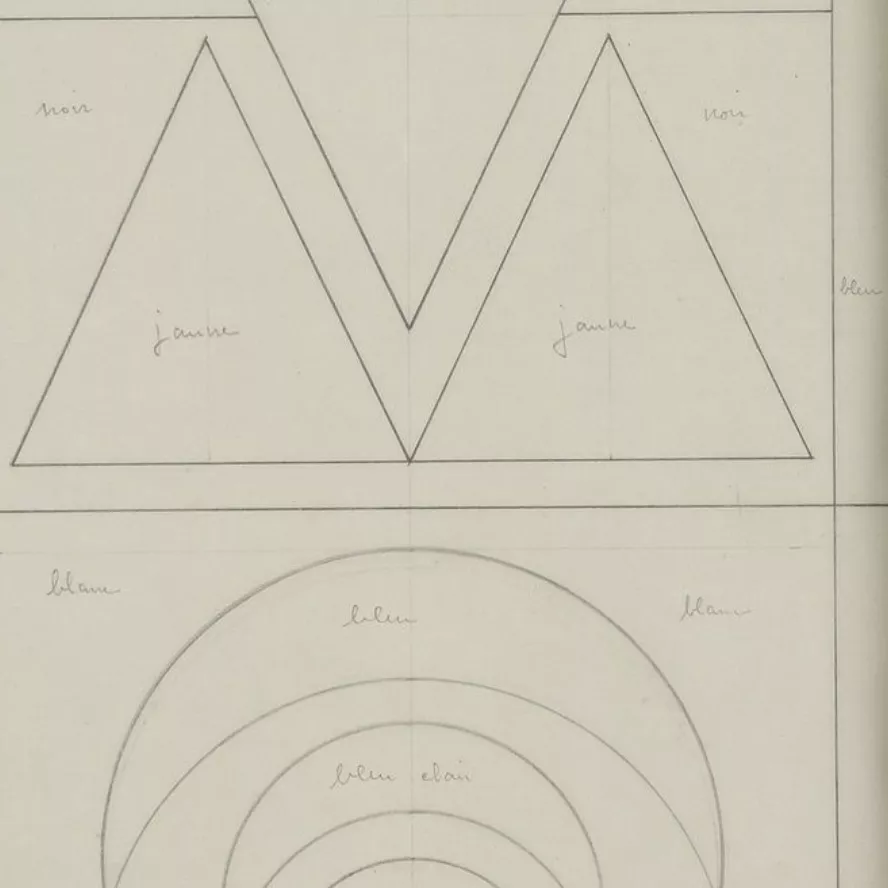
His research was constantly renewed, and he invented his own plastic alphabet based on synesthesia (a compositional method based on a repertoire of 26 colors, each corresponding to a letter and geometric shapes - but also to a sound).
Painter but also theorist, in 1949 he published his book entitled L'Art non figuratif, non objectif. In it, he developed elements on his plastic alphabet, and became a reference for other abstract painters such as Jean Dewasne, Jean Arp and Victor Vasarely.
Focus on Composition n°54, Auguste Herbin
In Composition n°54 (Musée National d'Art Moderne, Paris), in his contemporary canvases such as Abstraction (private collection), Herbin had chosen pure geometric form and bold color to structure pictorial space : likely borrowings from the neoplastic research he had recently assimilated, to which is added the artist's proverbial inclination for symmetry and order.
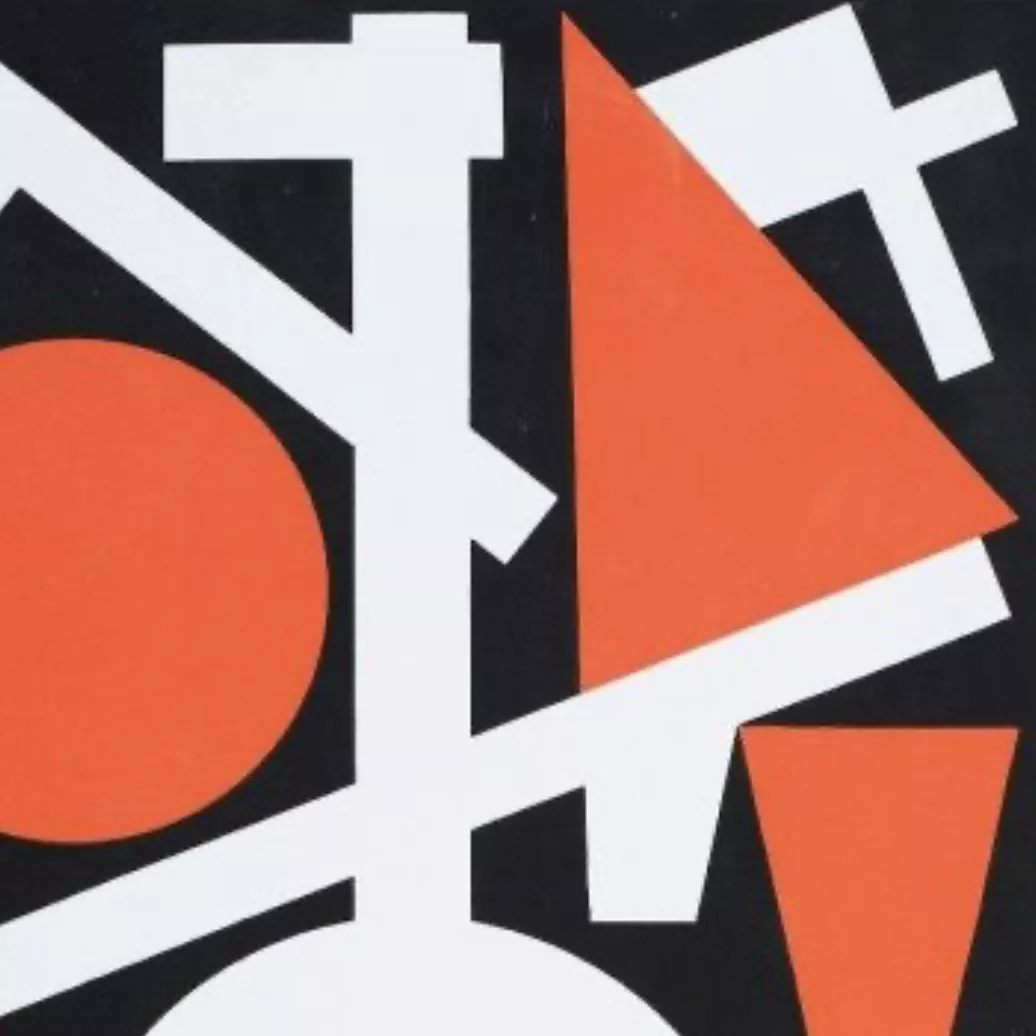
From the 1940s onwards, his painting adopted a rigorous syntax in which shapes, reduced to disks, triangles and rectangles, were organized according to a strict chromatic balance.
At this time, the canvas was no longer constructed by modeling or chiaroscuro, but by the juxtaposition of clean, flat colors. Here, Herbin breaks with the vestiges of Cubism and joins an abstraction in which illusionistic depth disappears in favor of a space generated entirely by color.
This evolution, the painter would later say, aimed to create a universal language in which each shape and hue would carry its own meaning, detached from any imitation of reality.
In this respect, his late compositions bear witness to a new radicalism: the line ceases to be a mere outline to become a structuring element, while color, freed from all modulation, imposes an autonomous rhythm on the canvas.
Auguste Herbin's imprint on his period
In 1946, in his compositions based on the opposition of shapes and colors (Musée National d'Art Moderne, Paris), in his plastic alphabet conceived as a universal language, Herbin had chosen geometric simplification and the flat plane to structure pictorial space : These are likely borrowings from the constructivist research he has recently reinterpreted, to which is added the artist's proverbial inclination for rigor and mathematical order.
Mondrian, around the same period, pushed formal reduction to its paroxysm, excluding the diagonal in favor of strict verticality and horizontality: the teaching of an autonomous pictorial language and calculated chromatic harmony is perceptible in Herbin's works from the 1930s onwards, such as Composition en rouge et vert (private collection) or Abstraction (Musée d'Art Moderne de la Ville de Paris).
At this time, for both, painting abandoned all figurative illusion in favor of a visual system in which shapes and colors became the only possible subject, which must have - one imagines - greatly baffled contemporaries, still attached to the vestiges of cubism and the last fires of surrealism.
With their stark contrasts and flat surfaces, Herbin's canvases herald an evolution which, the artist would later say, was to lead to a veritable "plastic grammar" based on symbolic correspondences between shapes and colors.
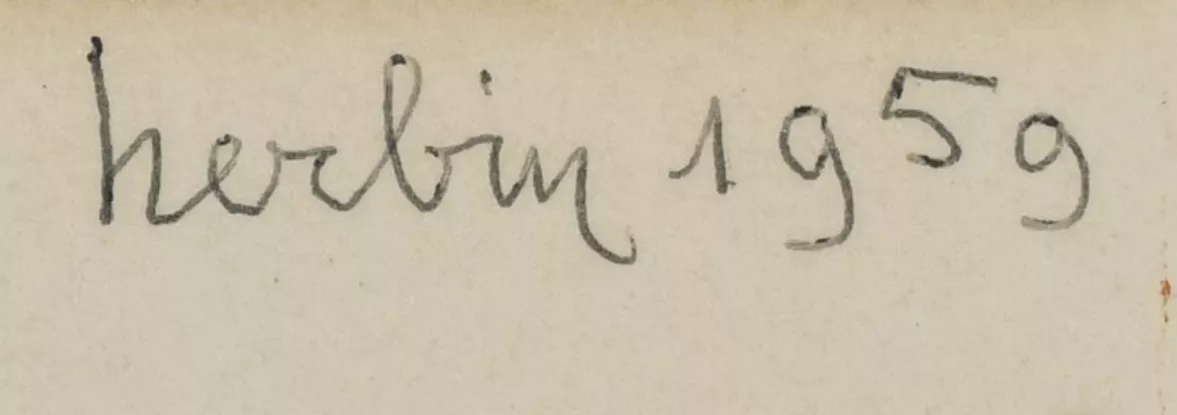
His signature
Not all of Auguste Herbin's works are signed.
Although there are variations, here is a first example of his signature :
Expertise your property
If you own a work by Auguste Herbin, don't hesitate to request a free appraisal by filling in our online form.
A member of our team of experts and certified auctioneers will contact you to provide an estimate of the market value of your work.
If you are considering selling your work, our specialists will also guide you through the various alternatives available to obtain the best possible price, taking into account market trends and the specific features of each work.
Estimate in less than 24h
Discover in the same theme

Rating and value of paintings, drawings and sculptures by Je...
Jean Lambert-Rucki is a twentieth-century Cubist artist who produced paintings and sculptures with a high market value.
Learn more >

Rating and value of paintings by Georges Rouault
Georges Rouault is a twentieth-century Expressionist painter who produced many works that are highly valued at auction.
Learn more >

Rating and value of paintings and laquers by Le Quoc Loc
Le Quoc Loc is a modern Vietnamese artist who has worked mainly in lacquer. His works are highly valued.
Learn more >
D'autres tableaux abstraits vendus aux enchères

Estimated 2.000 - 4.000
Serge POLIAKOFF (1900-1969), Composition en rouge et bleu. 1965, Lithograph

Estimated Between €5,000 and €8,000
Jean MIOTTE (1926-2016), acrylic on canvas

Estimated 3.000 - 5.000
Roberto MATTA (1911-2002), Composition, Gouache on canvas

Secure site, anonymity preserved

Auctioneer approved by the State

Free and certified estimates
Frequently asked questions
-
Who is Auguste Herbin, and what is his contribution to modern art?Auguste Herbin (1882–1960) was a major 20th-century French painter and a pioneer of geometric abstraction. After exploring Cubism, he developed, beginning in the 1930s, a unique “plastic alphabet” based on symbolic correspondences between geometric shapes and colors, considered a true universal language. His innovative work placed him alongside Mondrian and influenced artists such as Jean Dewasne and Victor Vasarely.
-
What is the price range for Auguste Herbin's works?The prices of Auguste Herbin’s works vary considerably depending on the type and period: prints range from €40 to €8,200, sculptures from €180 to €9,000, drawings and watercolors from €100 to €72,900, and oil paintings from €500 to €589,400. For example, in 2018, “Mountain Road in Corsica” (1907) sold for €589,400. The paintings from his abstract mature period (1930s–1960s) are his most sought-after works.
-
How can you authenticate a work by Auguste Herbin?To authenticate a work by Herbin, we recommend that you request a free, no-obligation appraisal from our experts and state-certified auctioneers. Simply fill out our online form: a specialist will contact you within 48 hours to examine your work and provide you with an accurate estimate of its current market value.
-
Is this the right time to sell a work by Auguste Herbin?Yes, now is a good time to sell a work by Herbin. The artist’s market value has been steadily rising for several years; his abstract compositions and “plastic alphabet” are attracting growing interest from French and international collectors, and the market for 20th-century geometric abstraction remains dynamic and in high demand.
-
How does the appraisal and sale of a work of art take place at Auctie's?The process is simple and free: contact us via our online form, and an expert will examine your item and provide you with a no-obligation estimate within 48 hours. If you’d like to sell, our specialists will guide you toward the best option (auction, private sale, etc.) based on market trends and the characteristics of your artwork, from consignment through to the final sale.
