



Value and quotation, paintings and works by Maurice de Vlaminck

Key takeaways
- Maurice de Vlaminck, a pioneer of Fauvism, sees his works fetch prices ranging from €100 to €762,000 on the current art market.
- Oil paintings sell for between €400 and €762,245, while lithographs range from €100 to €6,000.
- A prolific 20th-century artist (1876–1958), he explored landscapes, still lifes, and nudes using a vibrant palette and energetic brushstrokes characteristic of Fauvism.
If you own a work by or after the artist Maurice de Vlaminck, and would like to know its value, our state-approved experts and auctioneers will offer you their appraisal services.
Our specialists will carry out a free appraisal of your work, and provide you with a precise estimate of its value on the current market.
Then, if you wish to sell your work, we will direct you to the best possible arrangement to obtain the optimum price.
Rating and value of the artist Maurice de Vlaminck
Considered one of the pioneers of Fauvism, Maurice de Vlaminck quickly made his mark on twentieth-century art. This legacy is composed in many media: etchings, drawings, but above all painting.
At present, prices for his works are rising enormously at auctioneers' gavels.
His creations are particularly prized, and the price at which they sell on the art market ranges from €100 to €762,000, a considerable gap but one that speaks volumes about the value that can be attributed to Maurice Vlaminck's works.
In 2020, a floral composition sold for €30,630 while it was estimated at €25,000 to €35,000.
Order of value from simplest to most prestigious work
Technique | Estimation |
|---|---|
Lithography | From €100 to €6,000 |
Oil on canvas | From €400 to €762,245 |
Estimate in less than 24h
Style and technique of the artist Maurice de Vlaminck
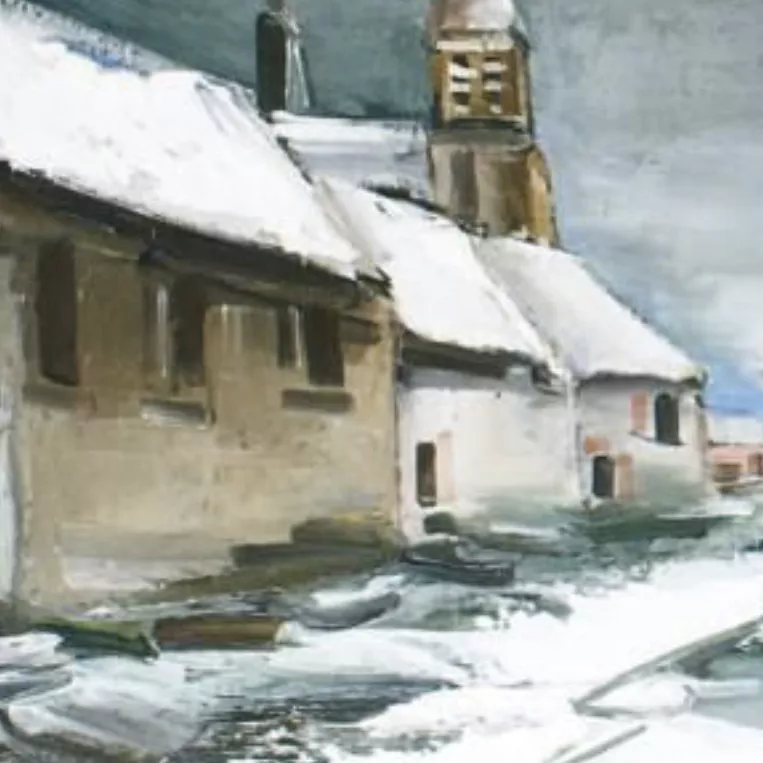
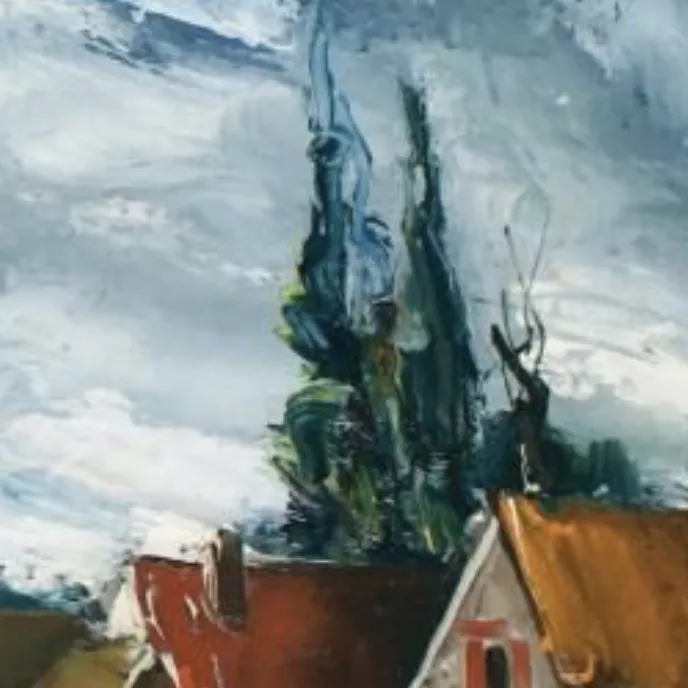
Vlaminck began under the influence of the Fauvist and Cubist movements, finding in them a freedom of form and expression that marked his early works. However, a large part of his artistic output consists of still lifes and landscapes, in which a notable impression of Impressionism shines through.
His energetic strokes and bold brushstrokes evoke the spontaneity of gesture, while his vibrant palette comes alive with a chromatic lyricism, recalling Claude Monet's manner in the subtle treatment of light and nuance.
Vlaminck doesn't hesitate to explore striking contrasts, combining fierce modernity with a certain attachment to tradition, making his work a captivating synthesis of innovation and heritage.
Vlaminck's life
Maurice de Vlaminck, whose real name was Maurice Edmond Devlaeminck (1876-1958), was a key figure in 20th-century art. Born in Paris, he spent his entire life there, developing a deep attachment to his urban roots.
A prolific painter, he was particularly famous for landscapes, but also showed an interest in nudes. Although his work with ceramics is less well known, he also explored this art.
Vlaminck did not limit himself to painting: a committed writer, he published several theoretical essays on art, contributing to reflection on the artistic movements of his time.
His fame was partly due to the influence of his brother-in-law, an influential Parisian journalist, who made him known in artistic circles. From childhood, Vlaminck received training in painting, inspired by a local artist living near his home.
He married Suzanne de Verly as he began his career, which extended far beyond painting to include music and cycling, his other passions. At the time, he was still unable to make a living from his art.
His meeting with André Derain marked a turning point: a deep friendship was born between them, each influencing the other's work.
In 1905, he took part in the first Salon des Indépendants in Paris, where he was part of "la cage aux fauves", alongside André Derain, Louis Valtat and Charles Camoin, and other major artists of Fauvism. Together, they became the pioneers of a new artistic era, laying the foundations for contemporary art.
Rapidly, Vlaminck befriended art dealers Ambroise Vollard and Daniel-Henry Kahnweiler, who brought him international exposure.
However, his career experienced a slowdown with the First World War. Although he was not sent to the front, due to his family situation with three daughters, he was assigned to a factory.
His career continued successfully until the Second World War, during which time he became involved in the Resistance, firmly opposing figures such as Louis-Ferdinand Céline.
Focus on the cover painting by Maurice de Vlaminck
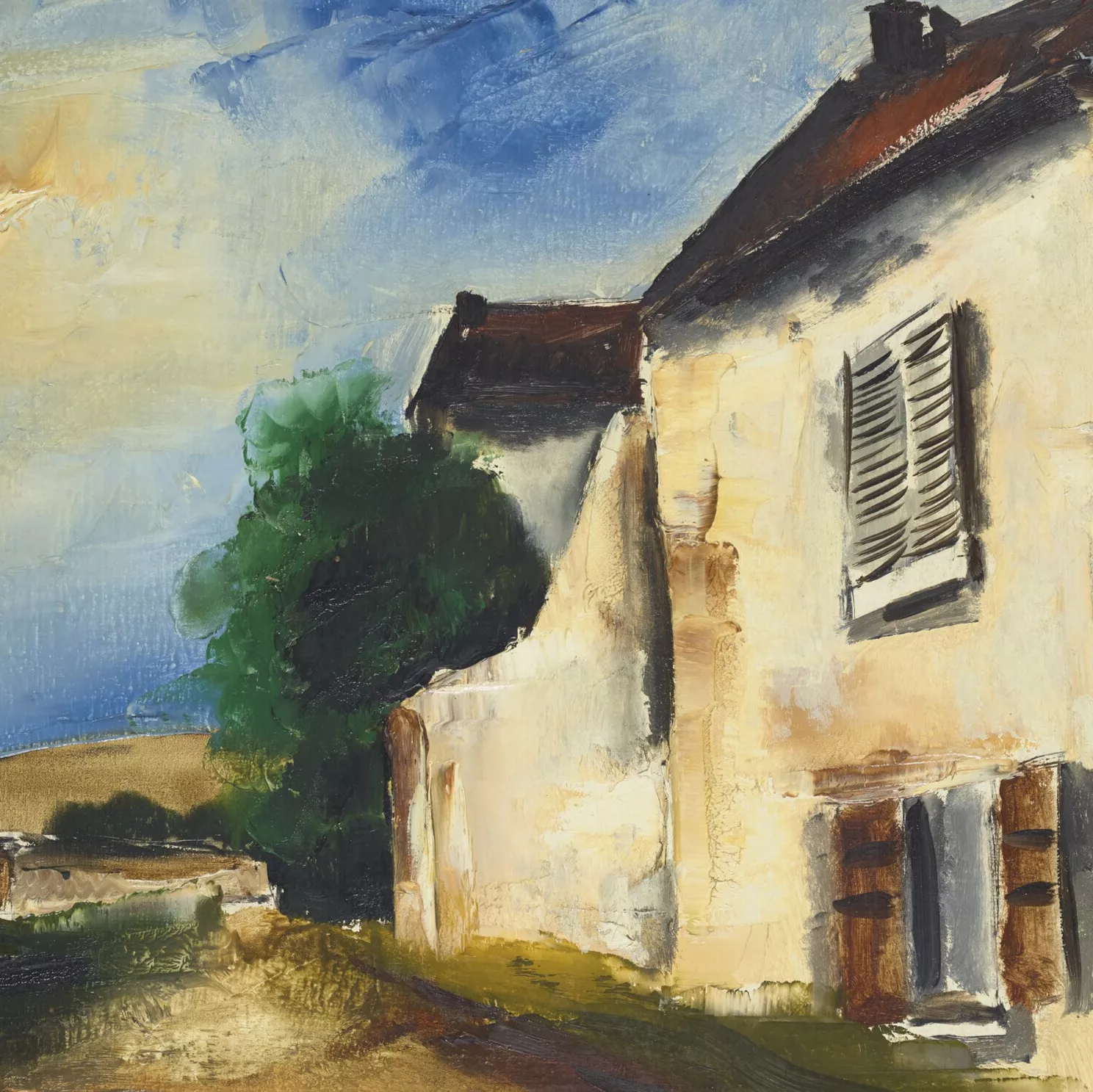
Maurice de Vlaminck, often recognized for his powerful, emotionally-charged landscapes, here delivers a village scene under a dramatic sky, capturing with intensity the tranquility and tension of a place frozen in time.
The artist, true to his fauve style, does not seek to represent the world as it is, but to convey an impression, a raw emotion through color and form.
The painting opens onto a deserted, curving street, lined with houses with closed shutters, witnesses to a quiet but withdrawn life. The buildings, painted in neutral, matte tones, seem crushed by the weight of the sky, almost threatening in their simplicity.
The sky becomes one of the central elements of the composition. In perpetual motion, it is traversed by heavy clouds, both dark and luminous, where bright blue breaks through here and there, like a glimmer of hope in this heavy atmosphere.
The cold hues of the sky create a striking contrast with the orange roofs, which almost seem to burst forth in this otherwise subdued palette.
As for the trees, they raise their bare branches to the immensity of the sky, creating a kind of silent dialogue between earth and air. They are both witnesses and actors, their bareness symbolizing winter and the solitude of the place.
Everything in this scene seems asleep, almost frozen, and yet every element contributes to creating a latent tension. We feel the weight of silence, waiting for the wind or the passage of a wagon, for noises to break the stillness.
Human presence is minimal, reduced to two small, blurred silhouettes in the center of the image, almost anonymous. These figures are only passing through, lost in the immensity of the setting.
They do not interact with their environment; the latter dominates them entirely. The work suggests that man, though present, remains secondary, insignificant in the face of nature and the forces it deploys.
This theme, dear to Vlaminck, returns here with force: man is but a tiny part of a much larger, indomitable world.
The play of light is particularly interesting in this work. The long, sharp shadows cast on the ground contrast with the flashes of light illuminating certain facades.This interplay of light and shadow accentuates the depth of the composition, giving an impression of relief and movement, despite the apparent stillness of the scene.
In the end, Vlaminck captures here not only the cold beauty of a rural village, but also the immensity of a nature that, without being threatening, imposes its presence.
The painter plays on this tension between calm and menace, solitude and serenity, where every detail, every brushstroke, contributes to creating an immersive, almost palpable atmosphere.
This is not simply a visual representation, but a poetic translation of the soul of a place, where the viewer is invited to feel the very essence of this silent confrontation between man and his environment.
With this work, Maurice de Vlaminck once again demonstrates his talent for capturing the ephemeral moment, that suspended moment between calm and turmoil, when everything seems in precarious equilibrium.
The light, diffuse and soft, slips through the threatening clouds, as if to remind us that, even in the harshness of winter, there is always a promise of renewal.
A minute with Maurice de Vlaminck
The legacy of Maurice de Vlaminck
Vlaminck was an artist deeply rooted in his time, whose work bears witness to an artistic evolution in step with the great upheavals of the 20th century.
As a pioneer of Fauvism, he played an active part in the revolution in contemporary art, alongside the early Fauvists who broke with academic conventions and opened the way to a new freedom of expression.
His rich and diverse output reflects the evolution of the century. Towards the end of his career, his work takes on darker accents, with marked expressionist touches, reflecting a heightened emotional intensity.
Like Wassily Kandinsky, Vlaminck explores color in depth, making it a vehicle for emotion and abstraction. For him, color becomes not only a means of representing reality, but also a means of expressing the invisible, of capturing states of mind.
Parallel to his pictorial work, he published theoretical essays on art that would have a lasting influence on his contemporaries and generations of painters to come.
His reflections, while rooted in his personal experience of painting, helped redefine the way art was conceived and its relationship with the viewer. Vlaminck's legacy thus remains that of a visionary artist, who shaped the contours of modern art.
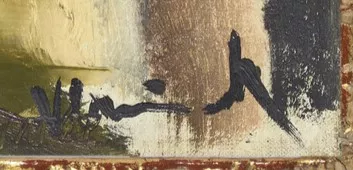
Recognizing the artist's signature
Vlaminck's works are often signed, and his signature can vary from year to year. It can also be found on manuscripts. However, he was and is much copied, which is why it's important to have your work appraised.
Knowing the value of a work
If you happen to own a work by or after Maurice de Vlaminck, don't hesitate to request a free valuation using our form on our website.
A member of our team of experts and licensed auctioneers will contact you promptly to provide you with an estimate of the market value of your work, not forgetting to send you ad hoc information about it.
If you are considering selling your work, you will also be accompanied by our specialists in order to benefit from alternatives for selling it at the best possible price, taking into account market inclinations.
Estimate in less than 24h
Discover in the same theme

Rating and value of paintings by Jean Buhot
Jean Buhot was a twentieth-century Orientalist painter who produced oil-on-canvas paintings that enjoyed relative success at auction.
Learn more >

Market Value and Price of André Cottavoz's Paintings, Drawin...
André Cottavoz is a twentieth-century Sanzist artist who produced works that are highly rated and valued at auction.
Learn more >

Rating and value of Hubert Yencesse's drawings, sculptures a...
Hubert Yencesse is a French sculptor who worked with Maillol, producing works whose prices soar at auction.
Learn more >
Other paintings from the same period sold at auction

Estimated 2500 - 5000 €
Henri EPSTEIN (1892-1944), View of the village through the trees, Oil on canvas

Estimated 4.000 - 6.000 €
EUGÈNE LEROY (1910-2000), Maison dans un sous bois, oil on canvas mounted on panel.

Estimated 500 - 800 €
Louis BUISSERET (1888-1956) - Water carrier, Portugal, circa 1943, Oil on canvas

Estimated 15.000 - 20.000 €
Jacques MAJORELLE (1886-1962) - Fishermen embarking, Abidjan, Ivory Coast - Oil on canvas.

Estimated 3.000 - 5.000 €
Henri EPSTEIN (1892-1944), Place du sud de la France, Oil on canvas.

Estimated 4.000 - 6.000 €
GASTON CHAISSAC (1910-1964) Composition 1947, Gouache and Indian ink on paper.

Secure site, anonymity preserved

Auctioneer approved by the State

Free and certified estimates
Frequently asked questions
-
Who was Maurice de Vlaminck, and what is his role in art history?Maurice de Vlaminck (1876–1958) was a Parisian painter considered one of the pioneers of Fauvism. In 1905, he participated in the first Salon des Indépendants in Paris alongside André Derain and other leading figures of the movement. Beyond painting, he was also a writer and art theorist, having made significant contributions to the redefinition of modern art in the 20th century.
-
What are the prices and price ranges for works by Maurice de Vlaminck?Prices for Vlaminck’s works vary considerably depending on the medium and quality. Lithographs are valued between €100 and €6,000, while oil paintings on canvas can range from €400 to €762,245. This wide range reflects the diversity of his body of work and the importance of factors such as authenticity, the period, and the provenance of each piece.
-
How do I have a work by Maurice de Vlaminck authenticated?Auctie's offers a free, no-obligation appraisal via a form on its website. A certified expert or auctioneer will contact you within 48 hours to examine your artwork, verify its authenticity, and provide you with an estimate of its market value. This process is highly recommended, as Vlaminck’s works are frequently copied.
-
What is the current market for Vlaminck's works, and is now a good time to sell?The market for Vlaminck’s works is seeing rising auction prices, with growing demand for his paintings and prints. Now is a good time to sell, as the works of this pioneer of Fauvism continue to enjoy enduring recognition and steady interest from collectors and institutions.
-
How does the process of selling a Vlaminck artwork at Auctie's work?After a free appraisal by our experts and auctioneers, our specialists will work with you to guide you through the various options for selling your artwork at the best price. As an auction house, Auctie's will help you choose the best approach, taking current market trends into account.
