



Rating and value of paintings by André Derain

Key takeaways
- André Derain's works sell for between €10 and 17.4 million, with his Fauvist paintings of Provence regularly fetching over one million euros.
- A leading figure in Fauvism since 1905, Derain revolutionized art through his use of vivid, pure colors inspired by the light of southern France.
- His oil-on-canvas paintings are his most prestigious works (selling for up to €17.3 million), while his prints and drawings range in price from €10 to €412,570.
If you own a work by the artist André Derain or based on his work and would like to know its value, our state-approved experts and auctioneers will guide you. Our specialists will carry out a free appraisal of your work, and provide you with a precise estimate of its value on the current market. Thereafter, if you wish to sell your work, we will direct you to the best possible arrangement to obtain the optimum price.
Rating and value of the artist
On the art market, works by André Derain are fairly common. Associated with the Fauvist group, works from this movement are the most sought-after by 20th-century collectors, especially those depicting Provence, with auctions that can exceed the million euro mark. Equally prized, his works that are not categorized as Fauvist can fetch tens of thousands of euros at auction. Works by André Derain sell for between €10 and €17,373,900 on the art market, a substantial range but one that speaks volumes about the value that can be attributed to these works. In 2018, his oil on canvas Bateaux à Collioure sold for €10,721,300, while it was estimated at €8,474,180 to €11,285,580 by Sotheby's.
Order of value from the most basic to the most prestigious
Technique used | Result | Stamps - multiples | From €10 to €39,400 |
|---|---|
Sculpture - volume | From €200 to €46,309 |
Upholstery | From €1,550 to €33,000 |
Drawing - watercolor | From €50 to €412,570 |
Oil on canvas | From €350 to €17,373,900 |
Estimate in less than 24h
The artist's style and technique
Derain's works are characterized by synthetic, pared-down compositions (i.e., the horizon line is drawn at the height of the painting), a sacrifice of detail and a simplification of light.
The intense light of southern France has the effect of evacuating the perception of detail. The link between color and light is established through the flat color or the fragmented brushstroke, which spaces out to leave the canvas in reserve. This presence of reserve in the painting is intended to evoke light and its dazzling effect on the viewer in a sparing manner. It is an essential element of the Fauvist group.
André Derain, major figure of Fauvism
André Derain (1880-1954) was born into a well-to-do family and demonstrated his genius for painting as early as high school. In
1898, Derain began his studies at the Camillo Academy run by symbolist painter Eugène Carrière. At
the same time, the young artist met Henri Matisse and the painter Maurice de Vlaminck, who would remain his friend throughout his career. It was in Collioure, in the company of Matisse, that he revolutionized the aesthetics of the turn of the century. After a brief stint at the Académie Julian, Derain was quickly propelled onto the art scene by his friends, and began exhibiting at the Salon d'Automne in 1905.
The Salon d'Automne caused a scandal in 1905. In the middle of Room VII, which featured works by those who would later be called "the Fauves", were traditional busts by Albert Marquet. Louis de Vauxcelles wrote: "The candor of these busts surprises amidst the orgy of pure tones: it's Donatello among the Fauves". Derain himself wrote of his work to Matisse: " I let myself go to color by color ". His canvases are characterized by the use of vivid nuances, propelled onto the support by broad brushstrokes that hint at movement. Derain's compositions, along with those of the other Fauvists, were to embody the beginning of the twentieth-century artistic revolution, through scandal and novelty.
Gradually, Derain's style evolved. It was also at this time that Derain produced his first illustrations. In the 1920s, Derain's work became more realistic and classical, in reference to the Old Masters. There is talk of a "return to order" that echoes the neo-classical ideal. Picasso and Braque took the same path temporarily.
After the First World War, André Derain created numerous ballet and theater sets, notably for Serge de Diaghilev, the founder of the Ballets Russes. Far from neglecting the beginnings of his art, the artist returned to Fauvist painting in the 1940s. André Derain died following a car accident in 1954, leaving behind a significant artistic legacy.
Derain's imprint on his period
Derain made a lasting mark on his period, notably through the scandal of Room VII, which introduced the pictorial and artistic upheavals that took place in the 20th century. Today, many of his works are exhibited in museums in France and around the world, but collectors play the greatest role in preserving his work.
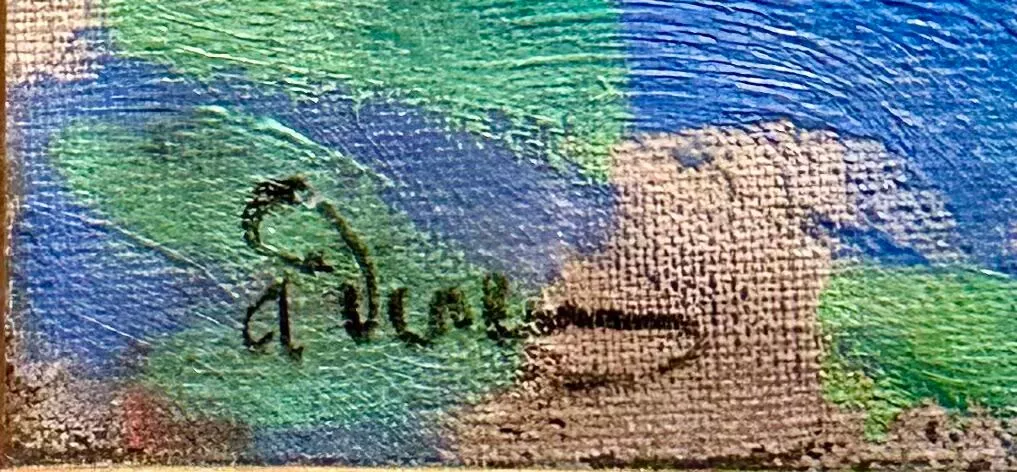
The artist's signature
Not all André Derain's works are signed. Works are usually stamped with a studio stamp reading " Atelier Derain "
Although there are variations, here is a first example of his signature :
Expertise your property
If you happen to own a work by André Derain, request a free appraisal without further ado using the form on our website. A member of our team will contact you promptly to provide you with an estimate of the value of your work, as well as any relevant information about it. If you're thinking of selling your work, our specialists will also be on hand to help you find alternatives for selling it at the best possible price.
Estimate in less than 24h
Discover in the same theme

Value and quotation of works, paintings by Henri Pontoy
Henri Pontoy is one of the last Orientalist painters. His works are stable at auction. Estimates in less than 24 hours.
Learn more >

Rating and value of paintings by Mikhail Guermacheff
Mikhail Guermacheff is a Russian realist painter who has produced drawings and oils on canvas that are highly regarded and valued at auction.
Learn more >

Rating and value of paintings by Anna Boch
Anna Boch is an Impressionist artist who produced paintings that are highly rated and valued at auction. 100% free estimate
Learn more >
Works from the same period sold at auction

Estimated 3.000 - 5.000 €
Henri EPSTEIN (1892-1944), Place du sud de la France, Oil on canvas.

Estimated 4.000 - 6.000 €
GASTON CHAISSAC (1910-1964) Composition 1947, Gouache and Indian ink on paper.

Estimated 8000 - 12000 €
Raymond THIBESART (1874-1968) Apple trees in blossom Oil on canvas.

Estimated 3000-5000€
Alexandre Roubtzoff - View of Tunis (small format)

Secure site, anonymity preserved

Auctioneer approved by the State

Free and certified estimates
Frequently asked questions
-
Who was André Derain, and what is his role in art history?André Derain (1880–1954) was a leading figure in the Fauvist movement of the early 20th century. A friend of Henri Matisse and Maurice de Vlaminck, he revolutionized the aesthetics of his time by using vivid colors and broad brushstrokes. His exhibition at the 1905 Salon d’Automne caused a scandal that marked the beginning of the artistic upheavals of the 20th century. After World War I, he also designed sets for the Ballets Russes before returning to Fauvism in the 1940s.
-
What is the market value of André Derain's works?André Derain's works sell for between 10 and over 17 million euros, depending on the medium and the period. Prints and multiples range from €10 to €39,400, drawings and watercolors from €50 to €412,570, while oil paintings on canvas—which are particularly sought after—can fetch up to 17 million euros. Fauvist works depicting Provence are the most prized by collectors and can fetch over one million euros at auction.
-
How do you authenticate a work by André Derain?To authenticate a work by André Derain, you can request a free, no-obligation appraisal from Auctie's by filling out the appraisal form on our website. A state-certified expert or auctioneer will contact you shortly to examine the artwork and provide you with an accurate appraisal within 48 hours. Please note that not all of Derain’s works are signed, but they generally bear an “Atelier Derain” stamp.
-
Is this the right time to sell a work by André Derain?Yes, now is a good time to sell a work by André Derain. His paintings and drawings remain highly sought after by collectors of 20th-century art, particularly his Fauvist works from the Collioure period. The art market continues to recognize the significant value of his artistic legacy, with regular auctions and steadily rising prices.
-
How does the sales process work at Auctie's?At Auctie's, the sales process is simple and transparent: start by requesting a free, no-obligation estimate by filling out our online form. An expert will contact you to appraise your artwork and provide you with an estimate within 48 hours. After that, our specialists will guide you through the process, offering the best options for selling your artwork at the highest possible price, from the initial estimate to the final sale.
