



Rating and value of paintings by André Barbier

Key takeaways
- Works by André Barbier estimated at between €10 and €42,700, with his painting "Les canotiers" exceeding its initial estimate of €12,000–€15,000.
- French Impressionist painter (1883–1970) specializing in landscapes of light, a friend of Claude Monet, and an exhibitor at the Salon des Indépendants and the Durand-Ruel Gallery.
- Prices are on the rise in the current market, with watercolor drawings ranging from €20 to €3,350 and oil-on-canvas paintings from €10 to €42,700, depending on the technique used.
If you own a work by artist André Barbier or based on his work and would like to know its value, our state-approved experts and auctioneers will guide you.
Our specialists will carry out a free appraisal of your work, and provide you with a precise estimate of its value on the current market.
Then, should you wish to sell your work, we will direct you to the best possible arrangement to obtain the optimum price.
Artist's rating and value
Thanks to their serene, luminous atmosphere, André Barbier's works are popular with collectors.
On the market, his various realistic compositions are successful at auction. His works sell for between €10 and €42,700, a significant delta but one that speaks volumes about the value that can be attributed to these canvases.
As such, some of the artist's works have reached unprecedented amounts, as evidenced by his painting Les canotiers, adjudicated at €42,700 whereas it was estimated at between €12,000 and €15,000.
Order of value from the most basic to the most prestigious
Technique used | Result |
|---|---|
Drawing - watercolor | From €20 to €3,350 |
Oil on canvas | From €10 to €42,700 |
Estimate in less than 24h
The artist's works and style
An artist who was active mainly in Paris, the Côte d'Azur and Italy during the 20th century, André Barbier is an Impressionist painter. He depicts mainly landscape scenes, with a particular focus on the sky and the representation of light.
He worked a lot with drawing, and produced a lot of it - with oils on canvas. He did not use the print medium during his career.
The life of André Barbier
André Barbier (1883-1970) was a French Impressionist painter.
Born in Arras into a family of notables, he was initially a musician, playing the piano from the age of eight. Barbier then became interested in photography, an accessible medium that he was able to combine with his interest in astronomy, but which quickly led him to painting. He moved to Paris at the age of 20, and from the outset succeeded in having his paintings exhibited at the Salon des Indépendants.
Producing mainly landscape views, of the countryside, the suburbs or the capital, he became friends with Claude Monet, then 66, in 1906, through the intermediary of art critic Gustave Geoffroy. Barbier thus spent time early in his career in Monet's studio and learned a great deal from him.
At the time, Barbier was also friends with Albert Marquet, Georges d'Espagnat and Maurice Denis, encounters that enabled him to open up his field of possibilities and take an interest in the various currents in full bloom at the beginning of the 20th century, including fauvism but also the Nabis group.
In addition to exhibiting at the Salon des Indépendants, he also made a name for himself by exhibiting at the Salon d'Automne and the Salon des Tuileries. Supported by the critics, he managed to secure a contract with the Durand-Ruel gallery, where he held regular solo exhibitions.
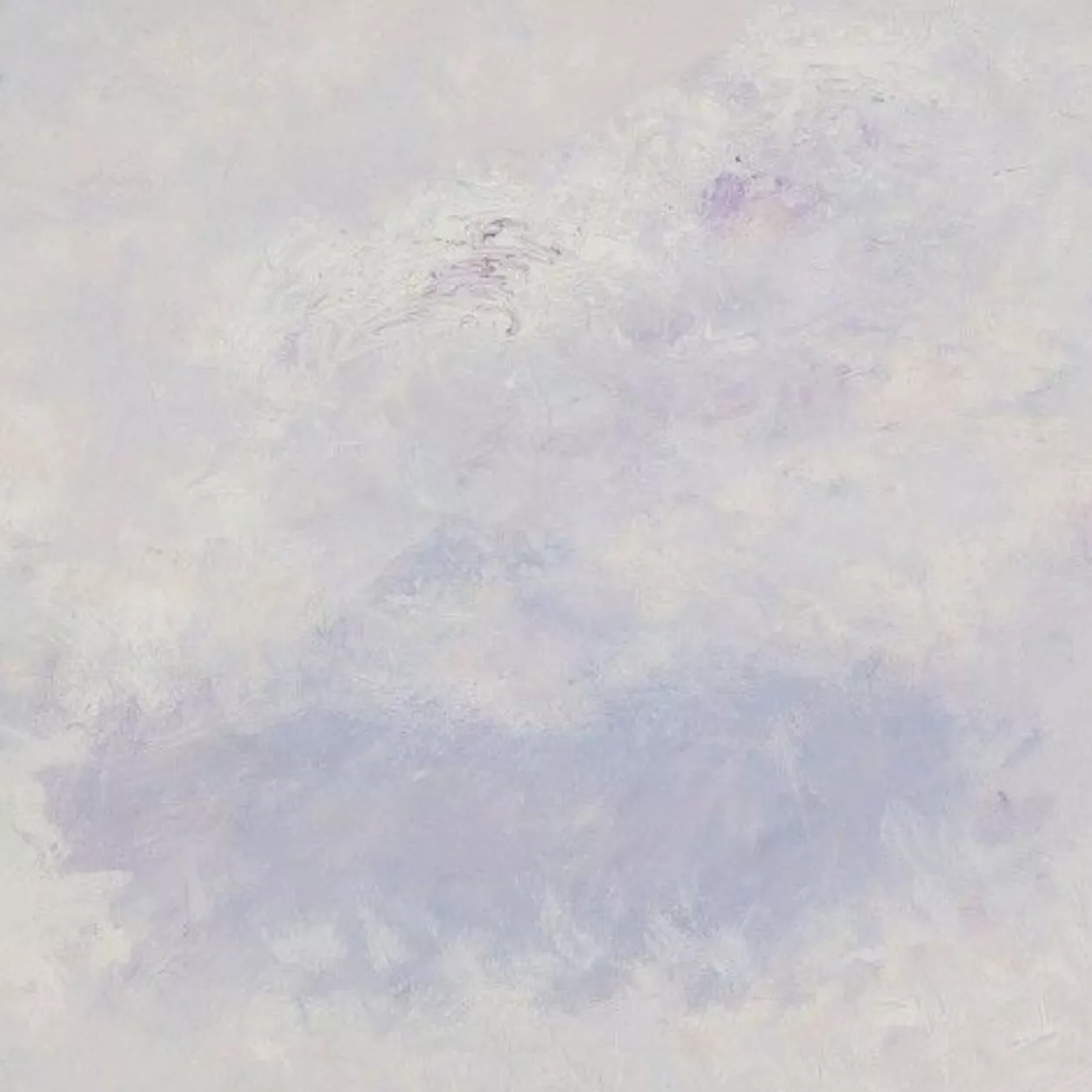
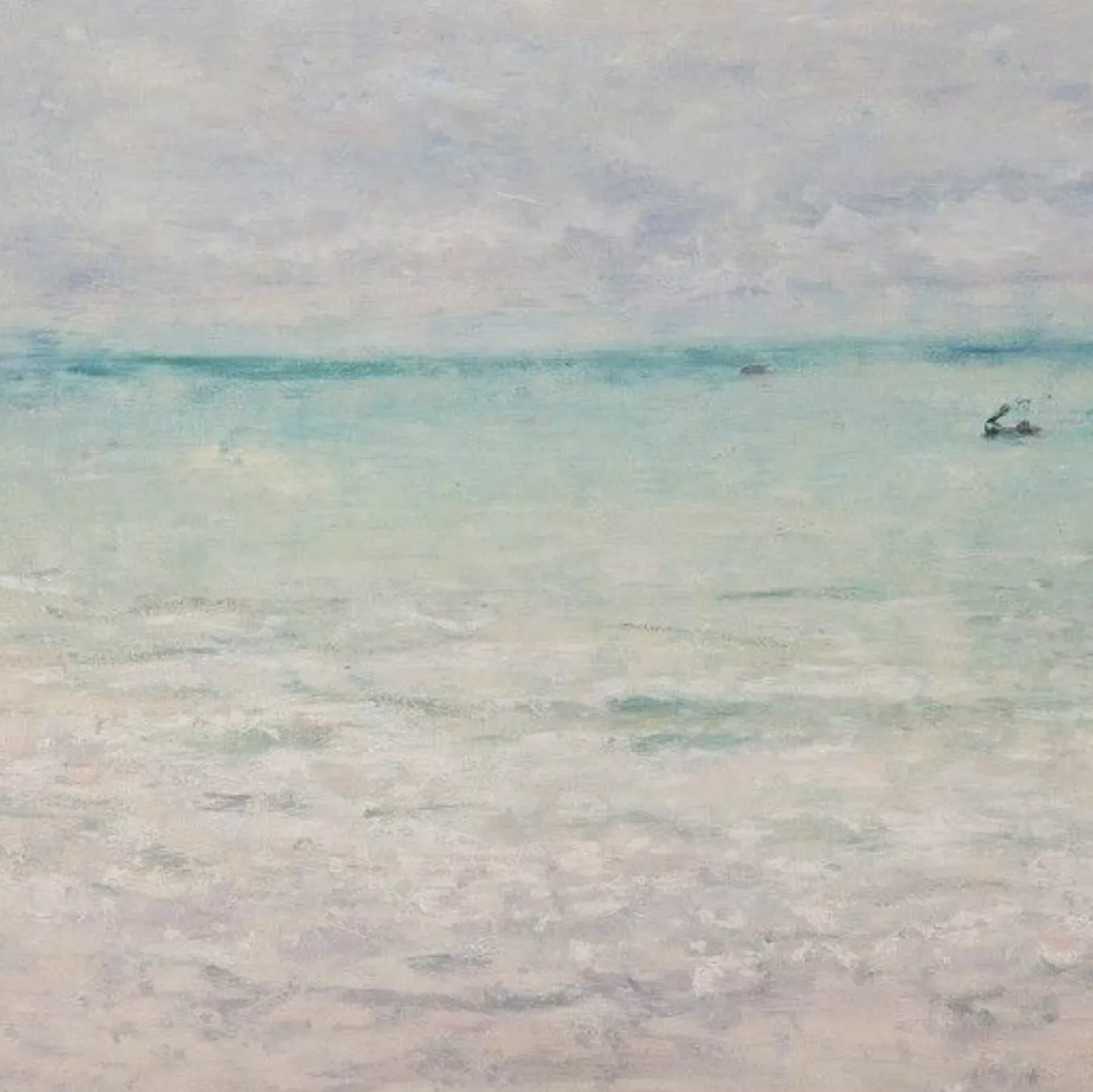
Focus on Paysage au bord de l'eau, André Barbier (on cover)
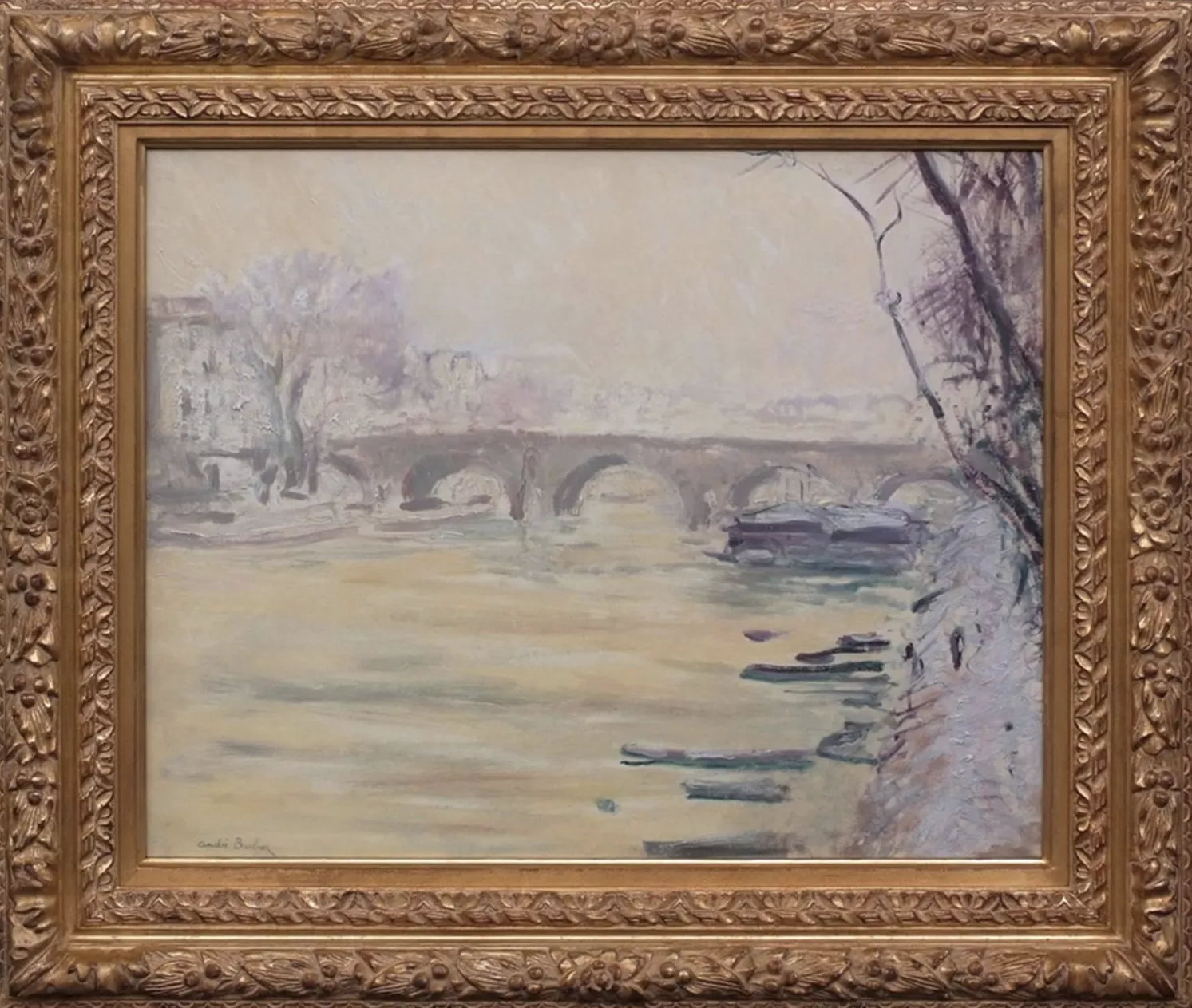
André Barbier, an artist less well known than the great names of Impressionism, nevertheless produced works that deserve to be rediscovered. One of his paintings, Paysage au bord de l'eau, wonderfully captures the spirit of Impressionism while bringing his own sensibility to it.
This painting, depicting a river bordered by trees with light foliage, is bathed in soft, diffused light. Here, Barbier plays on the effects of light, one of the central elements of the Impressionist approach, seeking to render a precise moment of the day, when nature seems suspended in a moment of calm.
This choice of subject - peaceful nature by the water - is fully in keeping with the Impressionist tradition, which favored outdoor scenes and landscapes changing under the effect of natural light.
Like Claude Monet with his famous Water Lilies series or Alfred Sisley in his depictions of rivers and bridges, Barbier seems driven by a desire to capture the fleetingness of the moment.
The slightly veiled sky is reflected in the water with a subtlety of tone reminiscent of the Impressionist technique, where short, light brushstrokes overlap to create an impression of movement.
André Barbier, however, stands out for a more structured approach than that of some of his contemporaries. While the Impressionists, following in the footsteps of Monet or Renoir, often sought to dissolve form in light, Barbier retained a certain rigor in the drawing of his trees and the riverbank.
This does not place him in opposition to the Impressionist movement, but rather in a variant closer to Camille Pissarro, who managed to marry precision of line with the play of light.
This duality, between the desire to capture changing light and the desire to retain a clear structure to the composition, gives his work an identity of its own.
This painting, Landscape by the Water, also seems to draw its inspiration from the heritage of plein-air painting practiced by the first generation of Impressionists, while heralding an evolution towards calmer, more reflective compositions.
Contrary to Monet, whose landscapes are often imbued with a certain luminous frenzy, Barbier here creates a calm, meditative atmosphere.
The colors, though luminous, remain soft, in a palette of greens, blues and browns. The reflections in the water add an almost poetic dimension, inviting the viewer to lose himself in the nuances of the ripples.
The Impressionist context in which Barbier evolved was that of an era when plein air painting revolutionized the way nature was represented. Artists were leaving the studio to capture the effects of light and color directly outdoors.
Newly invented paint tubes enabled this new freedom, and landscapes became a favorite subject. Barbier, like his colleagues, seized this opportunity to explore nature under different climatic and lighting conditions.
His landscapes, imbued with this impressionist research, nevertheless retain a sensibility all his own: a particular attention to the structure of forms and the balance of composition.
In sum, André Barbier's Paysage au bord de l'eau fits perfectly into the Impressionist movement, while revealing a personal approach.
The painting, with its subtle mastery of the play of light and reflections, bears witness to the influence of his predecessors, while affirming the artist's singular voice. Barbier, though less well known, reveals himself here as a faithful heir to Impressionism, while at the same time making his own mark on this movement that revolutionized 19th-century art.
Impressionism and art criticism in the twentieth century
At the beginning of the twentieth century, art criticism of Impressionism underwent a notable reversal. Whereas the movement had initially been greeted with skepticism and derision, it gradually began to be rehabilitated and even celebrated by certain influential commentators.
The early years of the movement, marked by acerbic criticism of the works of Monet, Renoir or Pissarro, gave way to a new reading of their work.
Roger Marx, a leading critic of the period, saw Impressionism as a necessary break with academic conventions, a bold movement that captured the light and modernity of a changing world.
Impressionist painting, long considered unfinished or too chaotic, thus finds a favorable echo in the writings of those who finally perceive the subtlety of its intentions.
The rapid brushstrokes, which seem to fragment reality, are interpreted no longer as clumsiness but as the reflection of a quest for the instantaneous, the ephemeral. Félix Fénéon, another influential critic, admires this ability to render the fleetingness of the moment, to translate sensations rather than freeze forms.
As the century progresses, Impressionism ceases to be perceived as an artistic scandal and becomes a reference point, an anchor. Critics understood that this movement opened the way to new explorations, paving the way for avant-gardes such as Fauvism and Cubism. Impressionism, once shunned, became the bedrock of artistic modernity.
André Barbier's imprint on his period
André Barbier did not mark his period on a regional scale, and was not extremely well known during his lifetime. However, some collectors appreciate his work, and the majority of his paintings are in private hands. His value is on the rise in today's auction market.
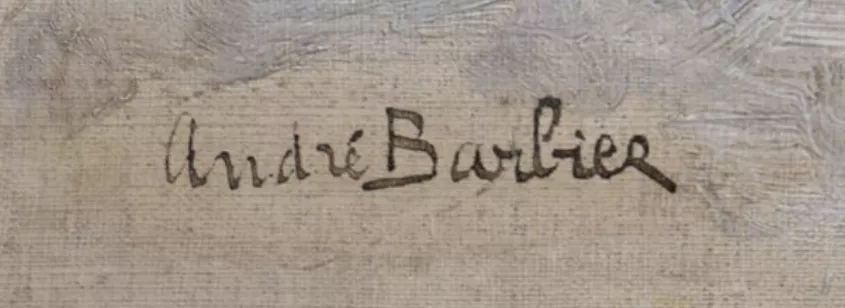
His signature
André Barbier's works are not all signed.
Although there are variations, here is a first example of his signature:
Expertise your property
If you own a work by André Barbier, don't hesitate to request a free appraisal by filling in our online form.
A member of our team of experts and certified auctioneers will contact you to provide an estimate of the market value of your work.
If you are considering selling your work, our specialists will also guide you through the various alternatives available to obtain the best possible price, taking into account market trends and the specific features of each work.
Estimate in less than 24h
Discover in the same theme

Value and quotation of works, paintings by Jules René Hervé
Jules René Hervé, a 20th-century painter of genre scenes, produced many canvases in demand on the auction market. Estimated in 24h.
Learn more >

Rating and value of paintings by Suzanne Valadon
Suzanne Valadon is a twentieth-century French artist who produced paintings that are highly regarded and valued on the auction market.
Learn more >

Rating and value of paintings by Martial Raysse
Martial Raysse is a twentieth-century New Realist painter whose drawings and oil paintings are highly regarded and valuable.
Learn more >
Similar paintings sold at auction

Estimated 5.000 - 10.000
Jean Roger SOURGEN (1883-1978), Lake and pine forest, oil on canvas

Estimated 2.000 - 3.000
Raymond THIBÉSART (1874-1968) Apple trees in blossom, oil on canvas

Estimated 1.000 - 2.000
Lucien GOUBERT (1887-1964), Rochers à Fermanville, oil on canvas

Estimated 2.000 - 4.000
Charles LACOSTE (1870-1959) Starry night, Oil on paper mounted on canvas

Estimated 5.000 - 8.000
Robert PINCHON (1886-1943) View of a port on the banks of the Seine, Oil on canvas

Secure site, anonymity preserved

Auctioneer approved by the State

Free and certified estimates
Frequently asked questions
-
Who was André Barbier, and what was his artistic background?André Barbier (1883–1970) was a French Impressionist painter born in Arras. He moved to Paris at the age of 20 and formed a pivotal friendship with Claude Monet in 1906, which profoundly influenced his artistic approach. He also associated with Albert Marquet, Georges d’Espagnat, and Maurice Denis, which allowed him to explore the modern art movements of his time, such as Fauvism and the Nabis movement. Although less well-known than the great Impressionist masters, his luminous landscapes and serene scenes are gaining increasing popularity among collectors.
-
What is the price range for a work by André Barbier?André Barbier’s works sell for between €10 and €42,700, depending on the medium and quality. Drawings and watercolors generally range from €20 to €3,350, while oil paintings on canvas range from €10 to €42,700. For example, his painting *Les canotiers* sold for €42,700, far exceeding its initial estimate of €12,000 to €15,000, demonstrating the potential for appreciation of his works.
-
How can you authenticate a work by André Barbier?To authenticate a work by André Barbier, we recommend that you request a free appraisal from Auctie's. Our team of experts and state-certified auctioneers will conduct a no-obligation appraisal of your item and provide you with an accurate estimate within 48 hours. This process will allow you to verify the authenticity and current market value of your artwork.
-
Is this the right time to sell a work by André Barbier?Yes, now is a good time to sell a work by André Barbier. The artist’s value is currently on the rise in the auction market, and his serene, atmospheric landscapes are enjoying growing popularity among collectors. His realistic compositions and his mastery of Impressionist lighting are gradually reestablishing him as one of the most sought-after artists of this period.
-
How does the appraisal process work at Auctie's?Appraisals at Auctie's are free and non-binding. Simply fill out an online form or contact us with information and photos of your artwork. A certified expert or auctioneer will contact you within 48 hours to refine their analysis and provide you with an accurate estimate of the market value. If you decide to sell, our team will then guide you through the process from the appraisal to the auction to help you get the best price for your item.
