



Rating and value of paintings by James Ensor

Key takeaways
- James Ensor’s works sell for between €10 and €6,400,000 at auction, with his oil-on-canvas paintings being the most sought-after by collectors.
- His painting “Skeletons Holding Masks” (1891) fetched €6,400,000 in 2016, far exceeding its initial estimate of €1,000,000 to €1,500,000.
- Ensor (1860–1949), co-founder of the Group of the XX, is known for his avant-garde Symbolism, which explores allegory, death, and social criticism through recurring motifs of skulls and masks.
If you own a work by or based on the artist James Ensor and would like to know its value, our state-approved experts and auctioneers will guide you.
Our specialists will carry out a free appraisal of your work, and provide you with a precise estimate of its value on the current market.
Then, if you wish to sell your work, we'll direct you to the best possible arrangement to get the best price for it.
Rating and value of the artist
On the auction market, works by James Ensor are uncommon and quite prized by collectors.
The most sought-after works are the oils on canvas, the price at which they sell on the auction market ranges between €10 and €6,400,000, a consequent delta but one that speaks volumes about the value that can be attributed to the artist's works.
As such, a painting signed by Ensor can fetch millions of euros in the auction room, as evidenced by his painting Squelettes arrêtant masques,dating from 1891, sold for €6,400,000 in 2016 while it was estimated at between €1,000,000 and €1,500,000.
Order of value from the most basic to the most prestigious
Technique used | Result |
|---|---|
Estamp - multiple | From €10 to €227,630 |
Drawing - watercolor | From €250 to €791,860 |
Oil on canvas | From €10 to €6,400,000 |
Estimate in less than 24h
The artist's style and technique
Baron Ensor's work is heavily influenced by Symbolism, and is almost avant-garde in that the artist uses iconography and processes that will remain relevant long after him.
His compositions are characterized by ongoing experimentation with the arrangement of space, colorimetry and the scope and meaning of the theme represented.
Each composition seems orchestrated to capture the eye and the mind, blending harmony and chaos with a precision that strikes the viewer. Skulls and masks are iconographic programs that recur frequently in his paintings.
Allegorical elements occupy a central place, sometimes grotesque, often imbued with mystery and intense emotion.
Ensor virtuously explores light contrasts, notably by accentuating chiaroscuro, which reinforces the sometimes strange, even macabre atmosphere of his canvases. Although he is best known for his oils on canvas, he does not limit himself to this medium.
His work also demonstrates a great mastery of drawing and printmaking, techniques he uses to refine his ideas and develop recurring themes in his work.
This attention to detail and exploration of light make his creations unique, straddling the line between realism and surrealism, conducive to emotional introspection.
The life of James Ensor
James Sidney Édouard, Baron Ensor (1860-1949), a leading figure in Belgian symbolism and orientalism, led an artistic career marked by originality and avant-garde.
Born in Ostend to a bourgeois family, Ensor grew up in a rather peculiar environment that would profoundly influence his work.
His mother, the owner of a costume store, played a decisive role in his visual imagination, with masks and disguises becoming recurrent motifs in his paintings, often associated with social criticism or depictions of human vanity.
Trained from the age of fifteen, Ensor entered the Académie des Beaux-Arts de Bruxelles, where he confronted academic dogma, which he quickly rejected. In 1880, he left the Académie with a bang, calling it a "boîte à myopes", preferring to pursue more innovative avenues.
Returning to Ostend, he retreated to the family studio and began painting realistic portraits and scenes, while gradually evolving towards pointillism and symbolism, joining the artistic vein of Nikolai Sapunov, Odilon Redon or Alphonse Osbert.
It was during this period that he co-founded the XX group, a collective of avant-garde artists who broke with academic norms, advocating total freedom in artistic creation.
The belated recognition of his genius by critics and the public would not come until the early 20th century. From then on, he exhibited internationally and received numerous honors, culminating in 1929, when he was knighted and made a baron by the King of the Belgians.
Paradoxically, Ensor reacted poorly to this growing recognition. Uncomfortable with fame, he gradually turned away from painting to devote himself to contemporary music, another of his passions. He died in his hometown of Ostend in 1949, leaving behind a powerful, fascinating and profoundly innovative body of work, which continues to influence contemporary artists.
.
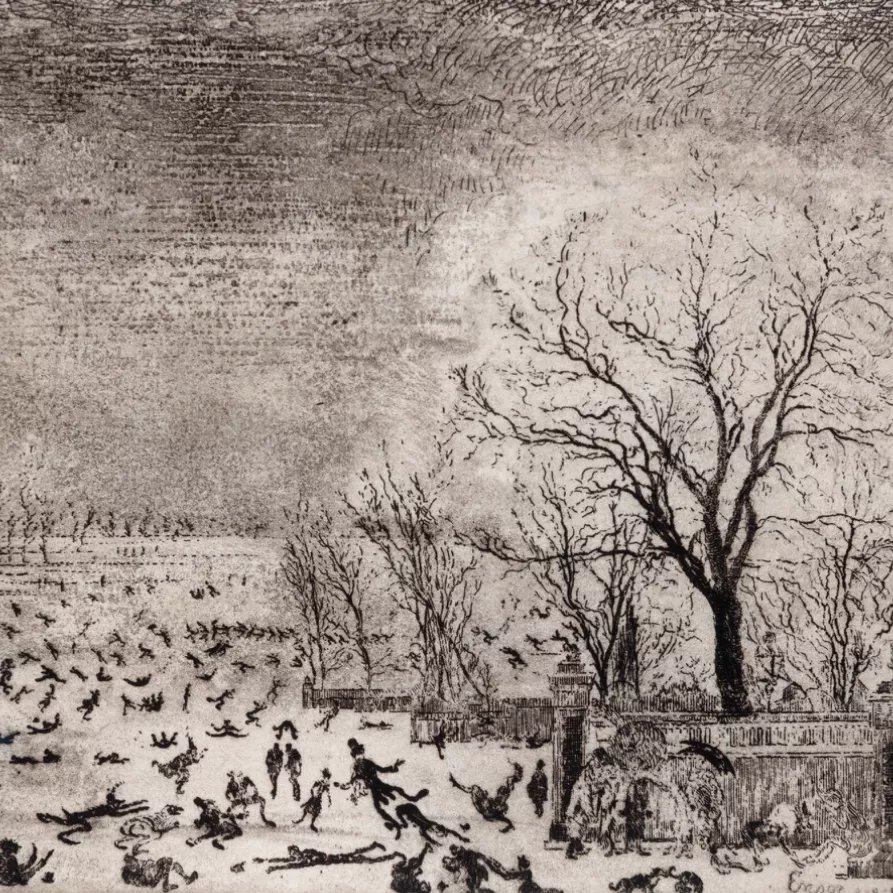
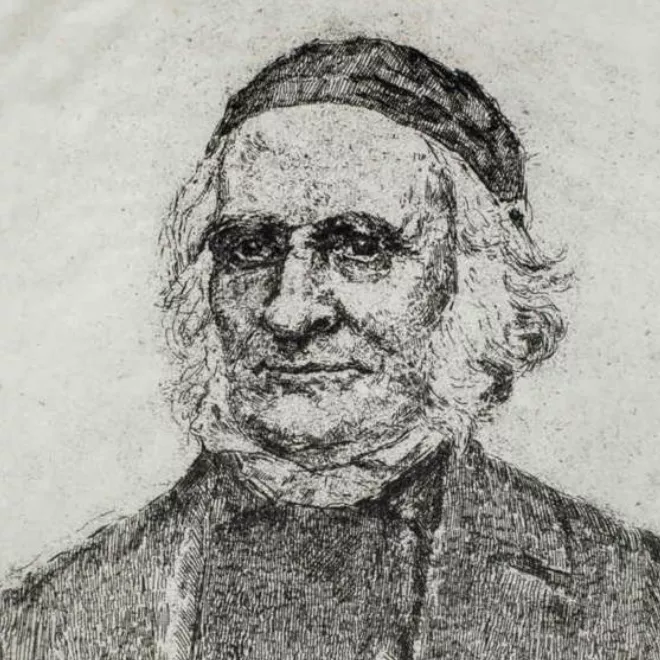
Focus on the cover painting by James Ensor
In this singular work by James Ensor, we are immediately struck by the strange confrontation between two skulls, frozen in a kind of silent duel. Here, the artist plays with the codes of the grotesque and allegory, a style he is particularly fond of.
Skulls, classical symbols of vanity and death, take on an almost theatrical dimension under Ensor's brush. This morbid face-off reminds us of the fragility of life, but with a touch of irony that often characterizes his paintings.
Color occupies a central place in the composition. The tones of the skulls are subtle, in shades of beige and ivory that stand out delicately against the pale blue sky. The sky, moreover, is treated with visible brushstrokes, giving the impression of light, almost airy movement.
In contrast, the red and green uniforms of the two figures bring an unexpected liveliness to a scene that, by nature, is rather dark. This color opposition helps to create a striking visual contrast and capture the viewer's attention.
Ensor thus immerses us in a scene that seems both macabre and absurd, with a touch of dark humor. The iconography of the skulls, here hijacked, reflects a meditation on death, but without the traditional seriousness.
The symbolic program, though intense, is made more accessible by the simplicity of the staging and the choice of bright colors. It is this lightness in the treatment of profound subjects that makes Ensor's work unique and captivating, at the crossroads of symbolism and the avant-garde.
James Ensor, The man behind the masks
The legacy of James Ensor
James Ensor's imprint on his era is undeniable. A key figure of Belgian Symbolism, he imposed his unique style, at once macabre, poetic and deeply critical.
At the beginning of the 20th century, when the artistic avant-garde was in full swing, Ensor distinguished himself by producing works that escaped the academic conventions of his time.
His often provocative canvases capture the essence of the social and spiritual concerns of his time, while pushing back the boundaries of traditional symbolism. He was one of those who helped broaden the scope of Symbolism, which in Belgium took a very particular turn, marked by a recurrent use of allegory and satire.
Belgian Symbolism, of which Ensor is a leading exponent, is characterized by a fascination with the strange, the mystical and the macabre. In this context, Ensor's works stand out for their bold, offbeat treatment of these themes.
Where other Symbolist artists explore mysterious beauty or spiritual visions, Ensor chooses to focus on more grotesque representations, criticizing society's hypocrisies, human vanity and fear of death.
His paintings populated with masks, skeletons and carnivalesque figures have become emblematic of this approach, where the absurd rubs shoulders with allegory.
Although widely recognized in his native country, it was abroad that James Ensor's reputation really blossomed, thanks in particular to American and German collectors who took an early interest in his work.
His oils on canvas, in particular, found a particular resonance in these markets, where his provocative style and technical mastery were greatly appreciated. Private collectors thus play a key role in preserving his work, particularly in countries where avant-garde art finds a receptive audience.
While some of his works are preserved in museums in Belgium, such as in Ostend, others circulate in private collections, ensuring the longevity of his artistic legacy.
Thanks to his atypical compositions and unique way of dealing with universal themes, Ensor continues to mark his era, influencing contemporary artists and leaving an indelible imprint on the history of modern art.
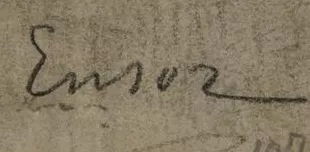
His signature
Not all James Ensor's works are signed.
Although there are variations, here's a first example of his signature:
Expertise your property
If you happen to own a work by James Ensor, request a free appraisal without delay via our form on our website.
A member of our team of experts and licensed auctioneers will contact you promptly with an estimate of the value of your work, not forgetting to send you ad hoc information about it.
If you are considering selling your work, you will also be accompanied by our specialists in order to benefit from alternatives for selling it at the best possible price.
Estimate in less than 24h
Discover in the same theme

Rating and value of works, drawings, paintings by Eugène Fro...
Eugène Fromentin was a twentieth-century Orientalist painter who produced drawings and oils on canvas that are highly prized on the auction market.
Learn more >

Rating and value of paintings by Leonora Carrington
Leonora Carrington is a surrealist artist who produced works that are highly valued at auction. 24h estimate.
Learn more >

Rating and value of Jane Poupelet's sculptures and drawings
Jane Poupelet was active in animal sculpture in the early 20th century. Today, her works are valued on the market.
Learn more >
Works from the same period sold at auction

Estimated 2 000 € - 3 000 €
Delphin ENJOLRAS (1857-1945) "A Midsummer Night's Dream", Oil on canvas

Estimated 4.000 - 6.000 €
EUGÈNE LEROY (1910-2000), Maison dans un sous bois, oil on canvas mounted on panel.

Estimated 500 - 800€
Pierre Adrien Dalpayrat (1844-1910), ceramic mask

Secure site, anonymity preserved

Auctioneer approved by the State

Free and certified estimates
Frequently asked questions
-
Who was James Ensor, and what was his artistic context?James Ensor (1860–1949) was a leading figure in Belgian Symbolism and the artistic avant-garde. Born in Ostend, he rejected academic dogmas to explore Symbolism, Pointillism, and a unique iconography blending masks, skulls, and carnival figures. As a co-founder of the Group of the XX, he established a macabre and critical style, influenced by the unique family environment of his mother, who owned a costume shop.
-
What is the price range for James Ensor's works based on the medium used?Prices vary considerably depending on the medium: prints sell for between €10 and €227,630, drawings and watercolors between €250 and €791,860, and oil paintings on canvas between €10 and €6,400,000. Oil paintings on canvas, Ensor’s preferred medium, are the most sought-after by collectors on the auction market.
-
How can you authenticate a work by James Ensor?To authenticate a work by James Ensor, request a free, no-obligation appraisal from Auctie's using our online form. A certified expert or auctioneer will examine your item and provide you with an accurate appraisal, along with detailed information on its authenticity and estimated value, within 48 hours.
-
Is this the right time to sell a work by James Ensor?Yes, now is a good time to sell a work by Ensor. His paintings are rare and highly sought after by international collectors, particularly those from the United States and Germany. The ongoing interest in Belgian Symbolism and the avant-garde ensures steady demand in the auction market.
-
How does the sales process work at Auctie's?Auctie's guides you from appraisal to auction. After a free, no-obligation appraisal by our experts and certified auctioneers, we’ll help you find the best ways to sell your artwork at the best possible price. Our specialists manage the entire process to ensure the best possible outcome.
