



Rating and value of paintings by Alphonse Osbert

Key takeaways
- Alphonse Osbert's works sell for between €330 and €42,000 at auction, with his landscapes fetching the highest prices.
- This Symbolist artist, born in 1857 in Paris, developed a distinctive style using shades of blue and purple to create mystical and contemplative atmospheres.
- His paintings, characteristic of Symbolism—particularly genre scenes and landscapes—are rare but highly prized by collectors.
If you own a work by or based on the artist Alphonse Osbert and would like to know its value, our state-approved experts and auctioneers will guide you.
Our specialists will carry out a free appraisal of your work, and send you a precise estimate of its value on the current market.
Then, if you wish to sell your work, we will direct you to the best possible arrangement to obtain the optimum price.
The artist's rating and value
On the auction market, works by Alphonse Osbert are uncommon, but for all that, they are highly prized by collectors.
The artist's characteristically Symbolist canvases, in which he used gradations of blue and violet, and in particular " osbert ", are the most highly rated on the market. The amounts at which his works sell range from €330 to €42,000 on the auction market.
As such, a painting signed Osbert can fetch tens of thousands of euros in the auction room, as evidenced by his painting In the evening's tranquility, adjudged €42,000 in 2017.
Order of value from the most basic to the most prestigious
Table type | Result |
|---|---|
Marine board | From €625 to €13,500 € |
Gender scene | From €490 to €30,000 |
Landscape painting | From €335 to €42,000 |
Estimate in less than 24h
Artist's style and technique
Alphonse Osbert develops a singular style, halfway between symbolism and impressionism, creating a deeply meditative universe with ethereal tones. He favors the technique of oil on canvas, where he deploys a soft palette of blues and purples, lending his works an almost mystical atmosphere.
His work is characterized by the depiction of lanky figures, often female, lost in idealized landscapes bathed in diffused light.
This delicately blurred treatment of light and shadow envelops her compositions in an aura of calm and serenity, recalling the mysteries of nature and the divine. His works, such as Les Chants de la Nuit or L'Âme des Étoiles, reveal inner worlds where natural elements seem to vibrate in silence.
Inspired by masters such as Puvis de Chavannes, he is interested in depicting cosmic harmony, seeking the essence of things through clean lines and stripped-down compositions.
This taste for purity is echoed in his use of subtle nuances, which he manipulates with great delicacy to create a soothing gentleness. Osbert is also close to the works of Maurice Denis and Odilon Redon, exploring themes of spiritual contemplation and harmony with nature.
Through this meditative aesthetic, he touches on a timeless dimension, where the viewer is invited to suspend time and plunge into a poetic and universal vision of the world.
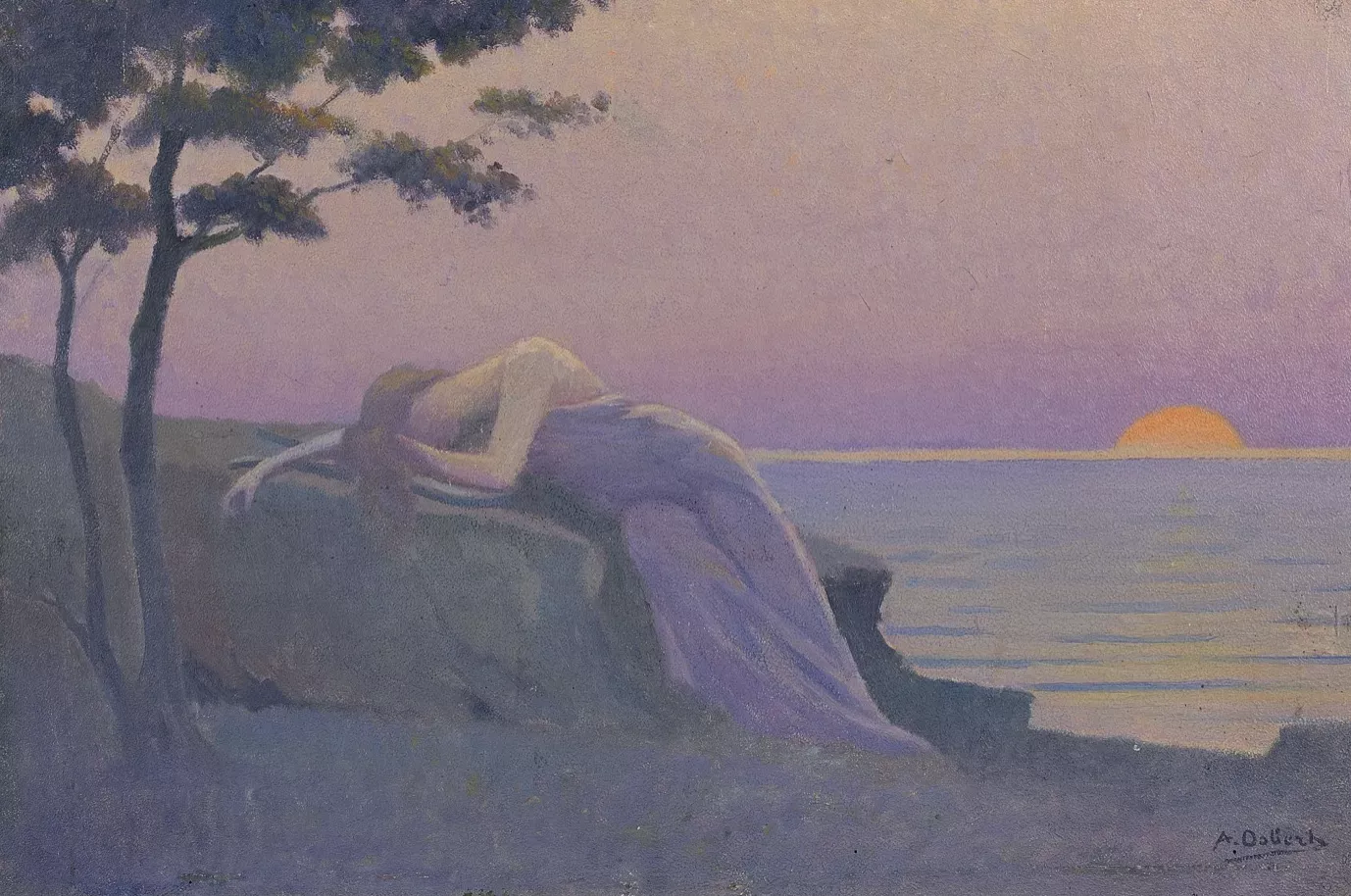
Alphonse Osbert's career
Alphonse Osbert's career was marked by an inner artistic quest, where symbolism and spirituality came together. Born in Paris in 1857, he turned to painting at an early age, initially studying at the Beaux-Arts under the academic influence of the masters of the time.
His encounter with Symbolist currents and the mystical art of Puvis de Chavannes, however, transformed his artistic path. Abandoning realist themes and academic influence, Osbert turned to a style that was all poetry and interiority, marking his works with an almost sacred aura.
He joined the circle of Symbolist artists and took part in the Salons de la Société nationale des Beaux-Arts, where his works attracted attention for their singularity and gentleness.
In the 1890s, Osbert truly found his style, which he described as "neo-impressionist", exploring landscapes bathed in moonlight and isolated figures in dreamlike scenes.
This style met with notable success at the Salon de la Rose-Croix, where his artistic language, imbued with mysticism and contemplation, resonated particularly well with Symbolist audiences.
Osbert was then recognized for his harmonious compositions and subtle use of color, which invited a form of introspection. The artist was also supported by art critics such as Charles Morice, who saw in him a painter of the soul, capable of transcending material appearances.
As the years went by, Osbert continued to exhibit, while evolving towards an increasingly stripped-down, almost meditative style of painting. He received major public commissions, including sets for institutions such as the Paris Observatory, where he painted monumental works inspired by mythology and astronomy.
These projects testify to his ability to capture the essence of human and cosmic nature in compositions of great simplicity and soothing depth.
Far from Parisian socialites, Osbert maintains a certain discretion throughout his career, preferring to devote his energies to the elaboration of a personal universe, marked by a profound spiritual quest.
His work, long unrecognized by the general public, was rediscovered in twentieth-century artistic and academic circles, who saw him as a precursor of mystical symbolism and an artist who transcended the boundaries of his time.
Today, Osbert is appreciated for the inner richness of his career and for his compositions imbued with a serene beauty, reminding us that art can be a place of recollection and harmony with the world.
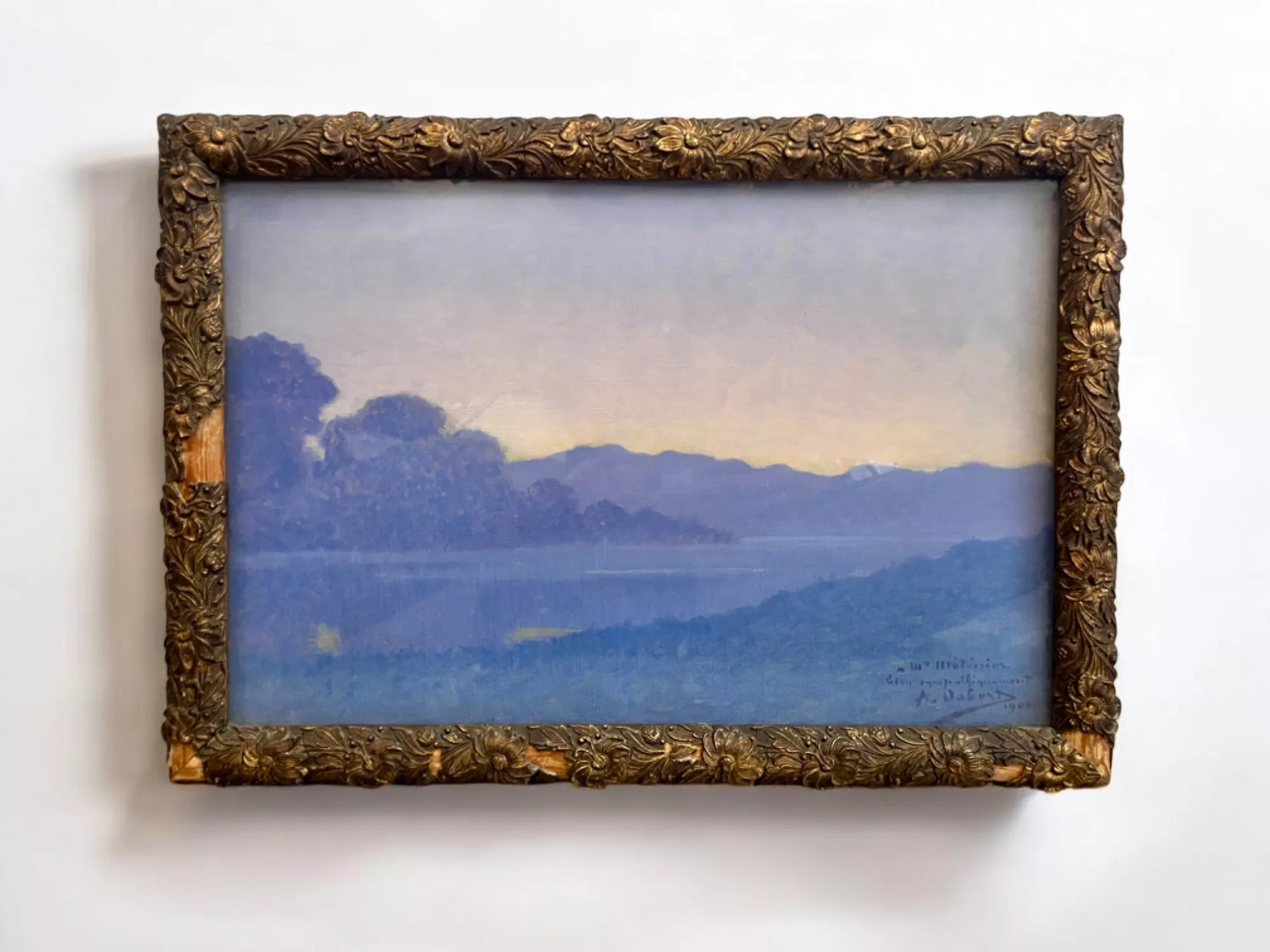
Focus on a mountainous landscape by Osbert
This painting by Alphonse Osbert transports us to a world where nature imposes itself as a sanctuary of calm and mystery.
By playing with soft, misty hues of blue and violet, Osbert constructs a twilight scene that invites contemplation, evoking a palette of colors carefully selected for their ability to move.
The lines of the mountains cut softly across the horizon, bathed in a diffuse light that seems to come from the last rays of daylight, while the surface of the water delicately reflects these shades, creating a harmonious dialogue between sky and earth.
The landscape unfolds in superimposed strata, each shot revealing a little more depth while maintaining a serene harmony.
The depiction of vegetation in shadowy silhouettes reinforces this sense of immensity and solitude, suggesting a world both tangible and ethereal.
The mastery of gradation and the choice of cool colors suggest a world suspended between reality and dream, where the blurred outlines of natural forms seem to fade into the ambient atmosphere.
This melancholy, almost mystical mood is accentuated by the absence of any human presence, as if to remind us of nature's solitary grandeur in the face of man's gaze, inviting deep introspection.
Osbert, true to his symbolist aesthetic, avoids superfluous detail and prefers to evoke a sensation, a state of mind, rather than a precise representation.
The finesse of his brushwork reveals a delicacy in the treatment of natural elements, each touch becoming visual poetry.
The ornate, finely crafted frame that surrounds the work also contributes to this timeless ambience, reinforcing the impression of a painting that is as much a window onto infinity as a fragment of a reinvented world.
By offering us this poetic vision, Osbert invites us to plunge into a reflection on the beauty of the landscape and man's place in a sublime universe, where silence and contemplation take on their full value.
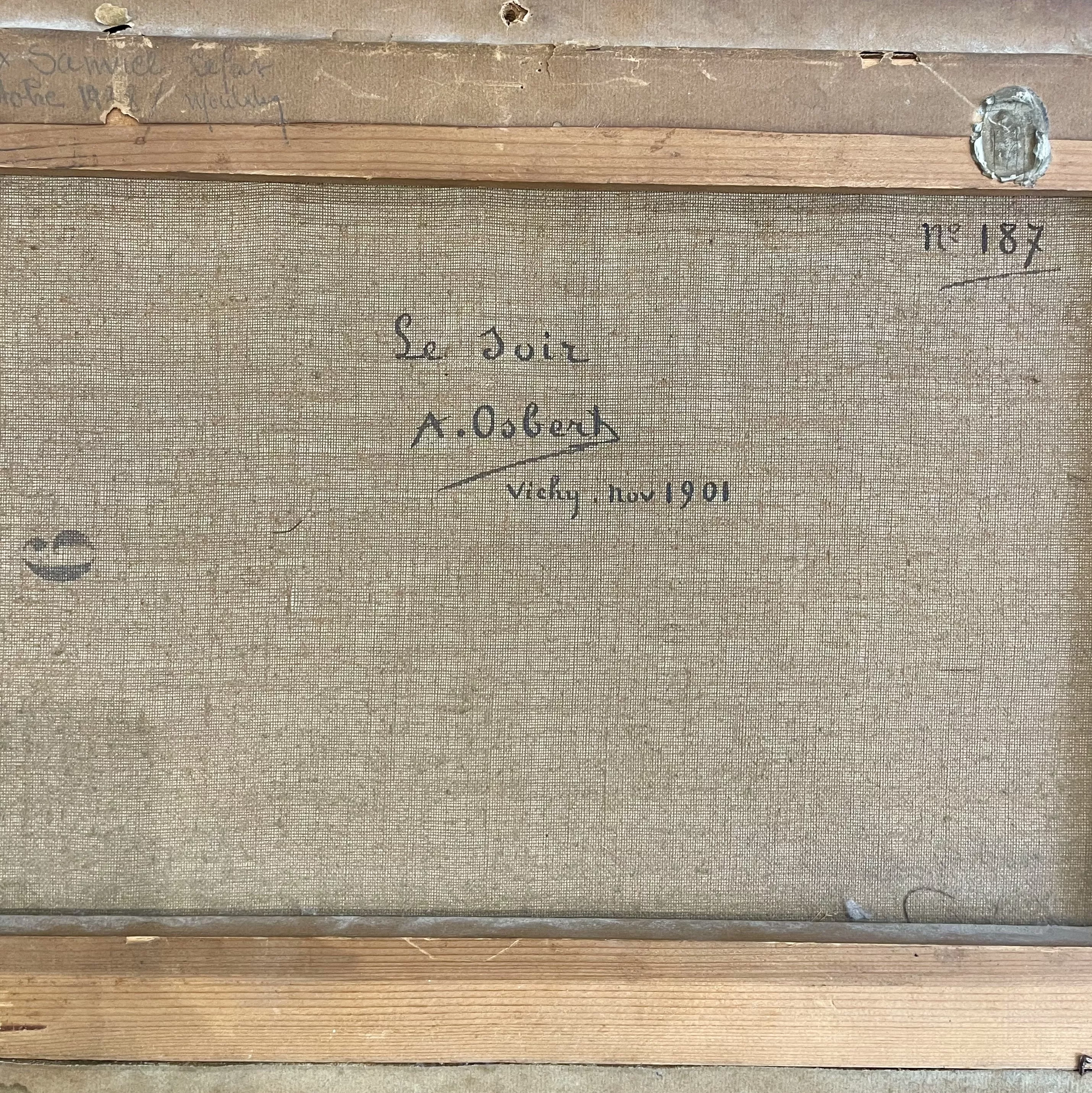
Alphonse Osbert's imprint on his time
Alphonse Osbert leaves a striking imprint on his time, when nature is transformed into a sanctuary of calm and contemplation.
In his works, he employs soft, misty hues, playing with shades of blue and violet to create mysterious atmospheres.
Each painting invites introspection, evoking twilight landscapes bathed in diffused light, as if the last rays of day were slowly fading.
Natural forms take shape with singular softness, while the silhouettes of trees and mountains blend harmoniously into the horizon. The surface of the water, delicately reflected, reinforces this dialogue between sky and earth, revealing strata of depth where the immensity of nature unfolds.
Osbert, true to his symbolist aesthetic, avoids superfluous detail and favors the evocation of a state of mind. His fine, delicate brushwork captures the essence of natural elements, each touch transforming into visual poetry.
The ornate frame that surrounds his works contributes to this timeless ambience, reinforcing the impression of a space both enclosed and open to infinity.
By offering us this poetic vision, Osbert prompts us to reflect on the beauty of the natural world and our place in it, where contemplation and silence reveal all their depth.
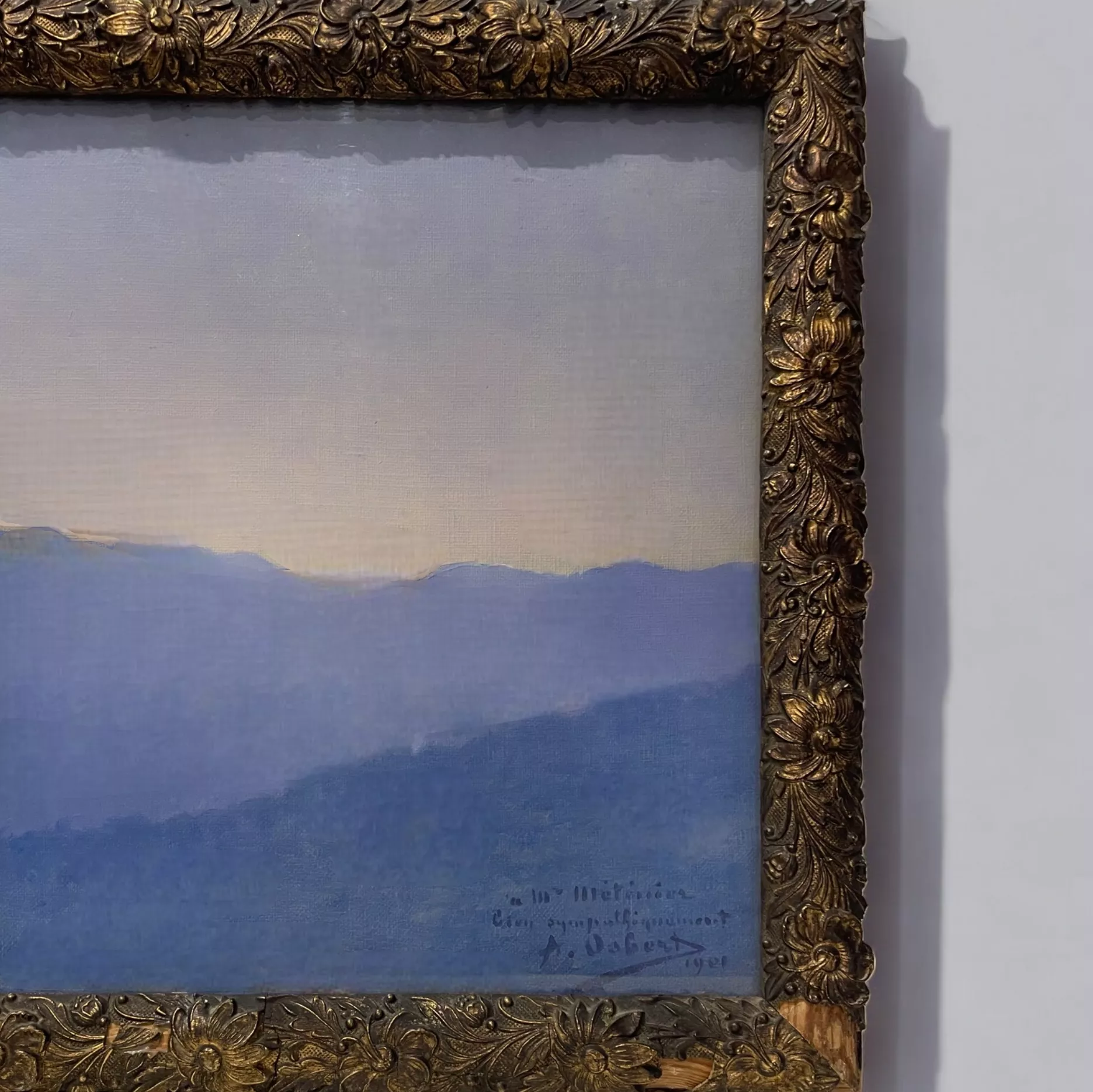
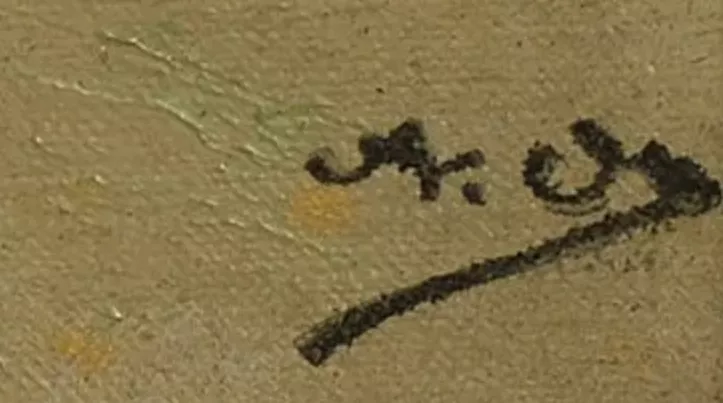
His signature
Not all of Alphonse Osbert 's works are signed.
Although there are variations, here is a first example of his signature:
Expertise your property
If you happen to own a work by Alphonse Osbert, request a free appraisal without further delay via our form on our website.
A member of our team of experts and auctioneers will contact you promptly to provide you with an estimate of the value of your work, as well as ad hoc information about it.
If you are considering selling your work, you will also be accompanied by our specialists in order to benefit from alternatives for selling it at the best possible price.
.Estimate in less than 24h
Discover in the same theme

Rating and value of paintings, oil on canvas, paintings by B...
Benjamin Netter was a 19th-century landscape painter who produced oils on canvas that were highly regarded and sought-after at auction.
Learn more >

Rating and value of paintings by Henry Moret
Henry Moret is a 19th-century Impressionist and Synthetic painter who produced works that are highly regarded and valued at auction.
Learn more >

Rating and value of paintings by Marie Guillemine Benoist
Marie Guillemine Benoist is a 19th-century neoclassical artist whose works are highly valued at auction.
Learn more >
Paintings from the same period sold at auction

Estimated 3.000 - 5.000
Raphaël DELORME (1885-1962), Le Bain au Harem, oil on isorel

Estimated 400 - 600
Pascal DAGNAN-BOUVERET (Paris 1852-1929 Quincey) La sieste du chat au seuil du grenier, Oil on cardboard

Estimated 2.000 - 4.000
Charles LACOSTE (1870-1959) Starry night, Oil on paper mounted on canvas

Estimated 5.000 - 8.000
Robert PINCHON (1886-1943) View of a port on the banks of the Seine, Oil on canvas

Estimated 400 - 800
Joan MIRO (1893-1983), Montroig II (M. 954), Lithograph

Secure site, anonymity preserved

Auctioneer approved by the State

Free and certified estimates
Frequently asked questions
-
Who was Alphonse Osbert, and what is his artistic style?Alphonse Osbert (1857–Paris) was a French Symbolist painter known for his deeply meditative and spiritual world. His work is characterized by a subtle use of blues and purples, the depiction of slender figures in idealized landscapes, and an oil-on-canvas technique in which the light is delicately softened. Influenced by Puvis de Chavannes, Maurice Denis, and Odilon Redon, Osbert developed a style that bridges Symbolism and Impressionism, inviting the viewer to contemplation and introspection.
-
What is the price range for Alphonse Osbert's paintings at auction?On the auction market, works by Alphonse Osbert sell for between €330 and €42,000. Landscape paintings, which command the highest prices, fetch amounts ranging from €335 to €42,000, while genre scenes range from €490 to €30,000, and seascapes from €625 to €13,500. A notable example is the painting “In the Evening’s Tranquility,” which sold for €42,000 in 2017.
-
How can you authenticate and appraise a work by Alphonse Osbert?To authenticate and appraise a work by Alphonse Osbert, we recommend that you request a free appraisal using the form on our website. An expert or auctioneer from our team will contact you shortly and provide you with an accurate estimate of your work’s market value, with no obligation on your part. You will receive a response within 48 hours.
-
Is this the right time to sell a work by Alphonse Osbert?Yes, now is a good time to sell a work by Alphonse Osbert. Although his paintings are rare on the market, they are highly sought after by collectors, particularly his Symbolist compositions in shades of blue and purple. The gradual rediscovery of this artist in art and academic circles is sustaining steady demand for his works.
-
How does the sales process work at Auctie's?At Auctie's, we provide end-to-end support throughout the sales process. Following a free, no-obligation appraisal conducted by our auctioneers and experts, we’ll guide you toward the best approach for selling your artwork at the highest possible price. We guide you from the appraisal through to the auction, providing you with all the necessary information about your item.
