



Rating and value of paintings by Rosa Bonheur

Key takeaways
- Rosa Bonheur, a 19th-century realist painter who specialized in animal paintings, has works valued between €200 and €592,800, depending on the technique used.
- Her oil on canvas painting “Émigration de bisons” (1897) sold for €592,800 in 2019, far exceeding the initial estimate of €449,500.
- As the first French female artist to receive the Legion of Honor (1865), her market value has been steadily rising at auction since her rediscovery in the 20th century.
If you own a work by or after the artist Rosa Bonheur, and would like to know its value, our state-approved experts and auctioneers will offer you their appraisal services.
Our specialists will carry out a free appraisal of your work, and provide you with an accurate estimate of its value on the current market.
Then, should you wish to sell your work, we will direct you to the best possible arrangement to obtain the optimum price.
Rosa Bonheur artist's rating and value
Rosa Bonheur is an important artist of 19th century animal painting. She was part of the realist movement as well as other movements. Now, prices for her works are rising under the auctioneers' gavel.
Her oil paintings are particularly prized, especially by French buyers, and the price at which they sell on the art market ranges from €200 to €592,800, a considerable delta but one that speaks volumes about the value that can be attributed to Rosa Bonheur's works.
In 2019, the oil on canvas Bison Emigration (America), dating from 1897 sold for €592,800, while it was estimated at between €269,000 and €449,500, twice the low estimate.
Order of value from a simple work to the most prestigious
Technique used | Result |
|---|---|
Estamp - multiple | From €20 to €9,900 |
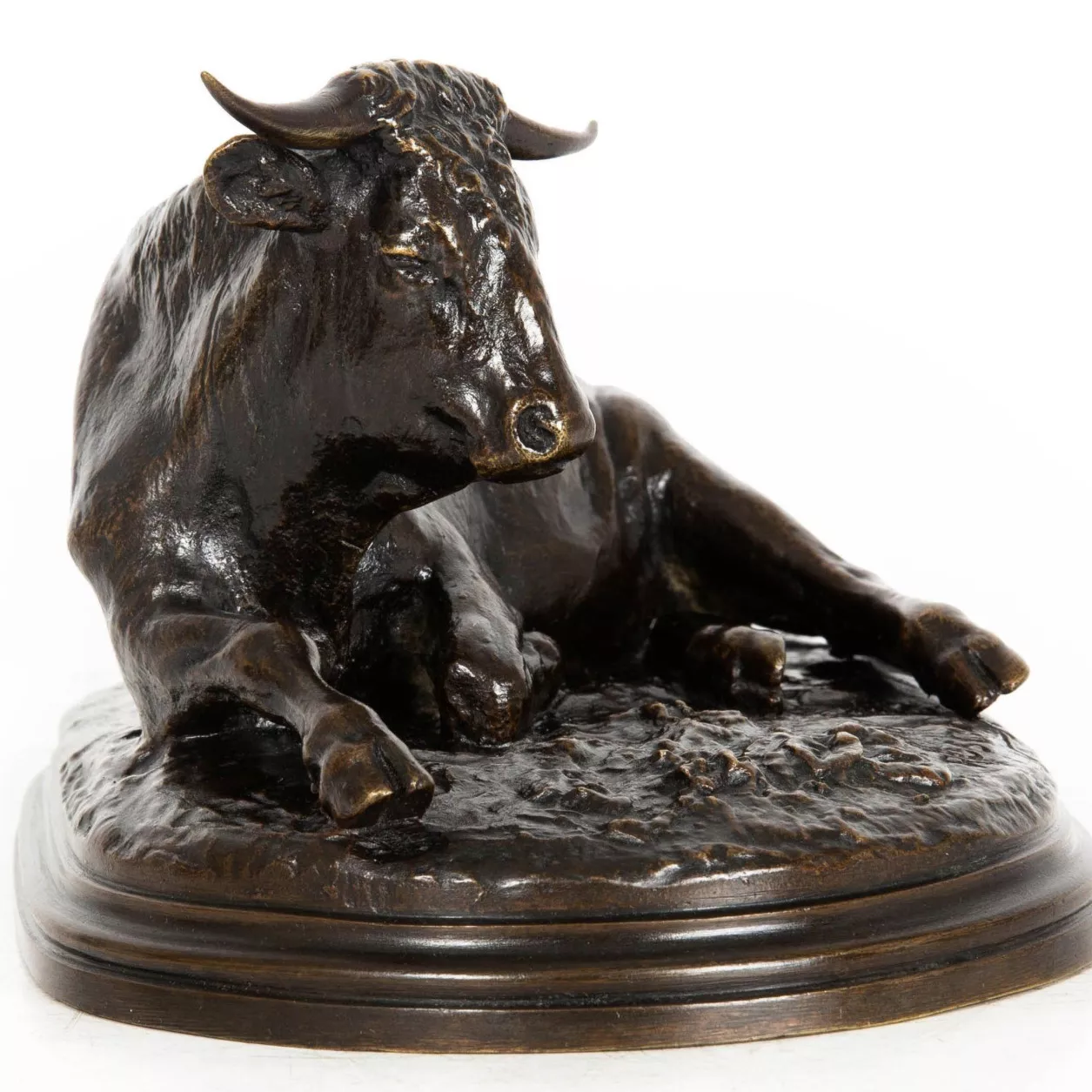
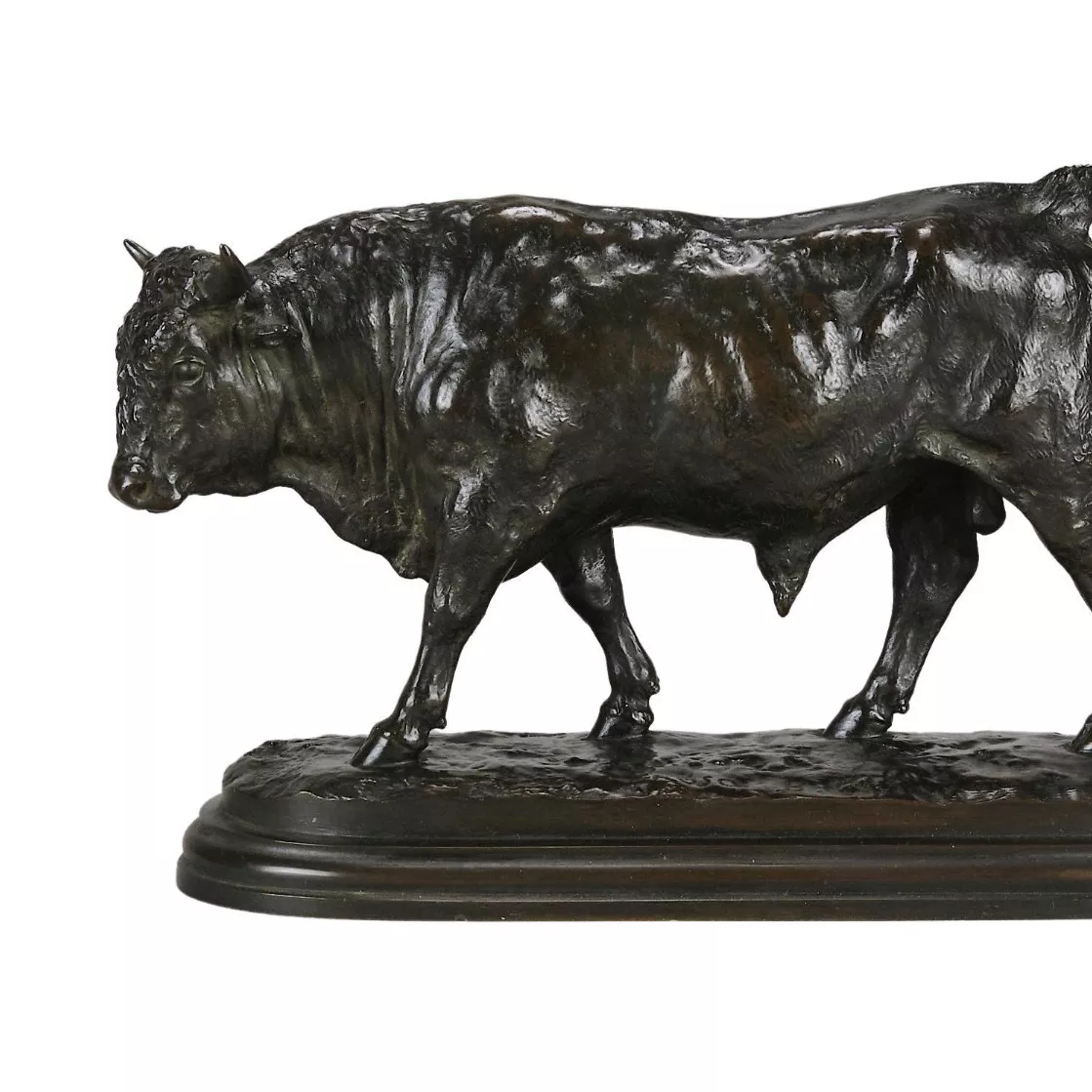
Sculpture - volume | From 90 to 37,090€ |
Drawing - watercolor | From €100 to €300,600 |
Oil on canvas | From €200 to €592,800 |
Estimate in less than 24h
Style and technique of the artist Rosa Bonheur
Rosa Bonheur (1822 - 1899), a major figure in animal and realist painting, has left us an abundant body of work that is seeing its value increase on the auction market.
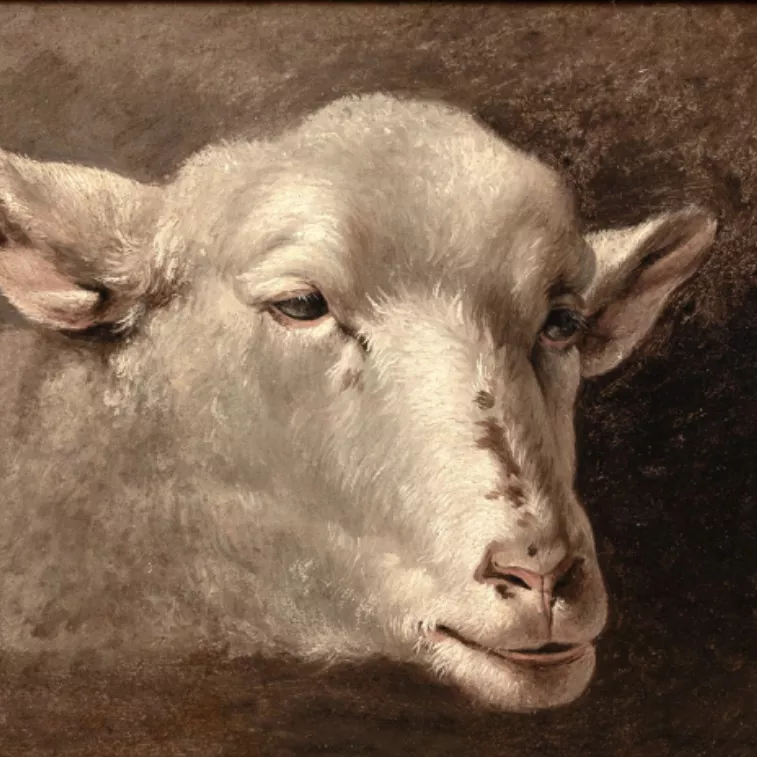
Considered one of the greatest animal painters of the 19th century, she meticulously observed the anatomy of her subjects (horses, oxen, lions) in order to capture their " individual physiognomy " (as she put it). She worked in the field, studying animals directly at fairs, slaughterhouses and farms.
She even obtained a special permit to wear pants and an apron so she could move among the butchers (which was totally forbidden at the time).
In her plein-air works, she applied a natural, vibrant light, close to Impressionism, particularly for her coastal or country landscapes.
She used large canvases (as for Le Marché aux Chevaux, 1852 - 55), which she made dynamic with bright, contrasting strokes, without resorting to pointillism. Her palette is nuanced : she employs natural tones (browns, grays, ochres, whites) that are enhanced by light accents to suggest the shine of the coat or atmospheric effects.
She creates vibrations by paying particular attention to the animals' coats. Every part of the animal seems alive thanks to a careful palette, which combines shadows and reflections in subtle ways.
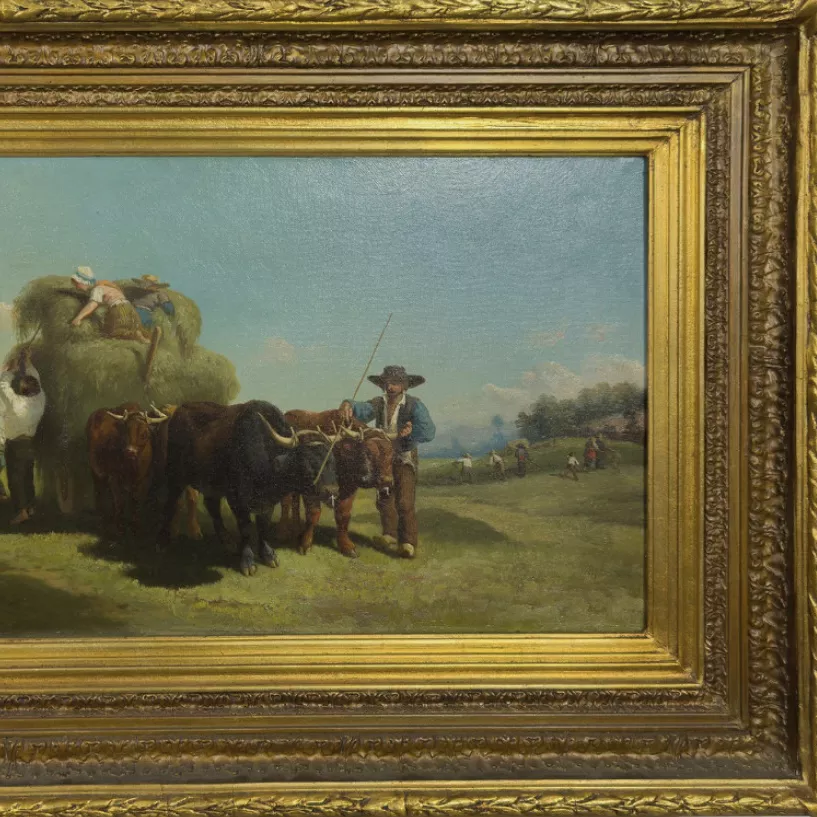
She refuses sentimentality in her compositions, and paints rural scenes such as Labourage nivernais, 1849, with a pragmatic realism that respects the subjects without embellishing them.
Her painting is far from seeking academic idealization, for the beasts have breath, the muscles are tense, enabling her to capture the animal's personality and raw power.
The life of Rosa Bonheur
Rosa Bonheur was born in Bordeaux in 1822, into a family of artists. Her father, Raymond Bonheur, was a painter and disciple of Saint-Simonism. She received an unconventional upbringing, as she was trained by her father in Paris from an early age, and frequented slaughterhouses, fairs and museums to observe and copy animals.
She refused traditional academic courses and enrolled as a free student at the Beaux-Arts, where she nevertheless forged a rigorous practical training.
She first made a name for herself with the painting Labourage nivernais (1849), then achieved even greater success with Le Marché aux chevaux (1852 - 55), which she exhibited at the Paris Salon.
She gained international recognition, the work being bought by the French state, then exhibited in London and New York. Rosa Bonheur became the most famous animal artist of her time.
The artist had the opportunity to work for wealthy patrons, including Queen Victoria. She exhibited regularly in Europe and the United States.
She led a fairly free life, never marrying, living successively with Nathalie Micas and then Anna Klumpke. Her assertive lifestyle broke with the norms of her time.
She was the first woman painter to obtain a transvestism permit (a name of the time), which materialized in a prefectoral authorization to wear pants in order to frequent fairs and slaughterhouses for her anatomical studies.
Rosa Bonheur's life embodied a pragmatic commitment, and encouraged the emancipation of women through work and artistic recognition, without any explicit militant commitment.
She was also the first woman artist to receive the Légion d'Honneur (chevalier in 1865, officier in 1894). She retired to her château in By (near Fontainebleau), which had become a studio-ménagerie where she continued to paint until her death.
She died on May 25, 1899 at the age of 77. Her work then went through a period of oblivion before being rediscovered in the 20th century. Her stock is now rising, as are other artists of her era such as Berthe Morisot, Mary Casatt or Blanche Odin.
Focus on Le Marché aux Chevaux, Rosa Bonheur, 1852 - 55
Le Marché aux chevaux is a monumental work (approx. 244 x 506cm) held at the Metropolitan Museum of Art (New-York) following a gift from Cornelius Vanderbilt). Painted between 1852 and 1855, it features a horse scene on the Boulevard de l'Hôpital in Paris, where the animals are shown trotting and galloping by grooms.
The artist chose a panoramic layout, the frieze format giving an impression of continuity, like a freeze-frame of a moving scene.
The scene is punctuated by horses galloping from left to right, with expressive postures, manes blowing in the wind and hooves raised.
The perspective is fluid, the background is lightly sketched (trees, architecture), leaving all the room for the central cavalcade.
The observation of the animals is scientific, as is the artist's wont, with each horse individualized by its coat and posture. Muscular tension, power and nervousness are rendered with spectacular realism.
Rosa Bonheur studied these horses at length in order to master their anatomy, in slaughterhouses and at fairs, hence the great precision that is rendered on canvas.
There is a total absence of idealization, these are not mythological horses but working animals that the artist wants to represent powerful and lively. The canvas is dominated by browns, grays and some blacks, and enlivened by touches of white (mane, men's pants), creating a balance between rigor and vibrancy.
The light is uniform, far from dramatic effects; natural light enhances the volumes and emphasizes the musculature.
This painting also has symbolic significance insofar as it is also a tribute to animal strength and human effort. Praised at the Salon of 1853, it is today considered one of the greatest animal paintings ever created.
This work sums up Rosa Bonheur's ambition to make animal painting a noble and monumental genre, on a par with History.
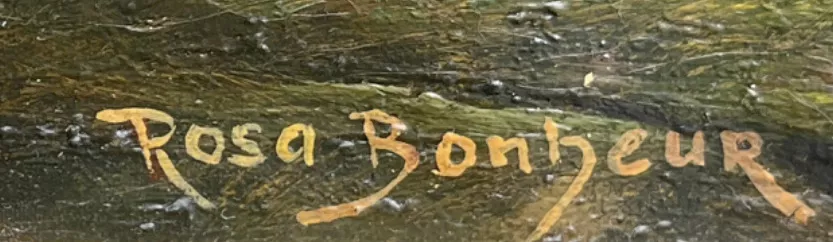
Recognizing Rosa Bonheur's signature
The artist often signs her full name in small at the bottom of her paintings. Copies may exist, which is why expertise remains important.
Knowing the value of a work
If you happen to own a work by or after Rosa Bonheur, don't hesitate to request a free appraisal using our form on our website.
A member of our team of experts and certified auctioneers will contact you promptly to provide you with an estimate of the market value of your work, as well as ad hoc information about it.
If you are considering selling your work, you will also be accompanied by our specialists in order to benefit from alternatives for selling it at the best possible price, taking into account the inclinations of the market.
.Estimate in less than 24h
Discover in the same theme

Rating and value of works, paintings by Baron François Gérar...
Baron François Gérard is a great historical painter of the 18th and 19th centuries. He is highly sought-after at auction.
Learn more >

Rating and value of Henryk Kossowski's sculptures, bronzes a...
Henri Kossowski was a Polish sculptor of the Belle Époque, who produced a number of highly-rated and highly-valued sculptures.
Learn more >

Rating and value of sculptures and bronzes by Isidore Bonheu...
Isidore Bonheur was a 19th-century animal sculptor who produced many highly-rated and highly-valued works.
Learn more >
Other similar works sold at auction

Estimated 15 000 - 20 000 €
Jean HENNINGER (1916-1994) Hunting scene.

Estimated 2.000 - 3.000
Georges Lucien GUYOT (1885-1972), Black bear lying down, Charcoal on paper

Estimated 1.500 - 3.000
Olivier Charles DE PENNE (1831-1897) The Pack, Oil on panel

Estimated 4.000 - 6.000
After Antoine Louis BARYE (1796-1875) Elephant of Senegal, Bronze with patina

Estimated 500 - 800
Edma MORISOT-PONTILLON (1839-1921) Spectatrice du crépuscule au bord de l'étang Oil on canvas

Estimated 10.000 - 15.000
ABBÉMA Louise, 1853-1927 Portrait of Mme ***, 1879 Oil and gold paint on canvas

Secure site, anonymity preserved

Auctioneer approved by the State

Free and certified estimates
Frequently asked questions
-
Who was Rosa Bonheur, and what was her artistic context?Rosa Bonheur (1822–1899) was a leading figure in 19th-century animal and realist painting. An internationally recognized pioneer, she was part of the Realist movement and meticulously observed the anatomy of animals (horses, oxen, lions) to capture their “individual characteristics.” As the first female painter to receive the Legion of Honor (1865, 1894) and a permit to dress as a man, she revolutionized the status of women artists through her work and the recognition she received.
-
What is the price range for Rosa Bonheur's works, depending on the medium?Rosa Bonheur’s works vary considerably depending on the medium. Prints range in price from €20 to €9,900, sculptures between €90 and €37,090, drawings and watercolors between €100 and €300,600, and oil-on-canvas paintings—her most sought-after works—range from €200 to €592,800. In 2019, the 1897 oil painting “Emigration of Bison (America)” sold for €592,800, more than double its initial estimate.
-
How can I have a work by Rosa Bonheur authenticated and appraised?Auctie's offers a free, no-obligation appraisal conducted by state-certified auctioneers and experts. Simply fill out an appraisal request form on the website, and a member of the team will contact you shortly to provide you with an accurate assessment of your artwork's market value.
-
Is this the right time to sell a work by Rosa Bonheur?Yes, this is an excellent time to sell a work by Rosa Bonheur. The artist’s value is currently on the rise in the auction market, as is that of other painters from her period, such as Berthe Morisot and Mary Cassatt. This upward trend makes this a favorable time to achieve the best possible price.
-
How does a piece sell at Auctie's?Auctie's supports sellers every step of the way: after a free appraisal by our experts, we guide you toward the best approach for selling your artwork at the highest possible price, taking market trends into account. Our specialists advise you on the options best suited to your situation right through to the auction.
