



Rating and value of paintings by Berthe Morisot

Key takeaways
- Berthe Morisot’s oil paintings on canvas sell for between €270 and €7.21 million, while her prints range from €10 to €4,000.
- A major 19th-century artist, Morisot was part of the Realist and Impressionist movements, using a light, airy technique to capture the fleeting moment.
- In 2013, her oil painting “After Lunch” (1881) fetched €210 million, far exceeding its initial estimate of €36,000 to €59,000.
If you own a work by or after the artist Berthe Morisot, and would like to know its value, our state-approved experts and auctioneers will offer you their appraisal services.
Our specialists will carry out a free appraisal of your work, and provide you with an accurate estimate of its value on the current market.
Then, should you wish to sell your work, we will direct you to the best possible arrangement to obtain the optimum price.
Rating and value of the artist Berthe Morisot
Berthe Morisot is an important artist of 19th century painting. She was part of the Realist, Impressionist and other movements. Now, prices for her works are rising at the auctioneers' gavel.
Her oil paintings are particularly prized, especially by Canadian buyers, and the price at which they sell on the art market ranges from €100 to €75,000, a considerable delta but one that speaks volumes about the value that can be attributed to Berthe Morisot's works.
In 2013, the oil on canvas Après le déjeuner, dating from 1881 sold for €210,000,000, while it was estimated at between €36,000 and €59,000, twice the low estimate.
Order of value from a simple work to the most prestigious
Technique used | Result |
|---|---|
Estamp - multiple | From €10 to €4,000 |
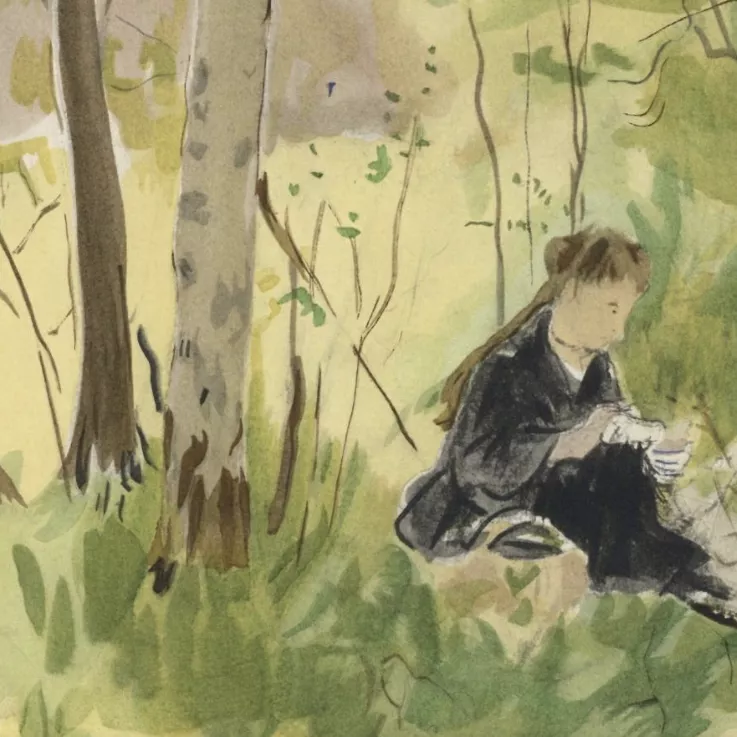
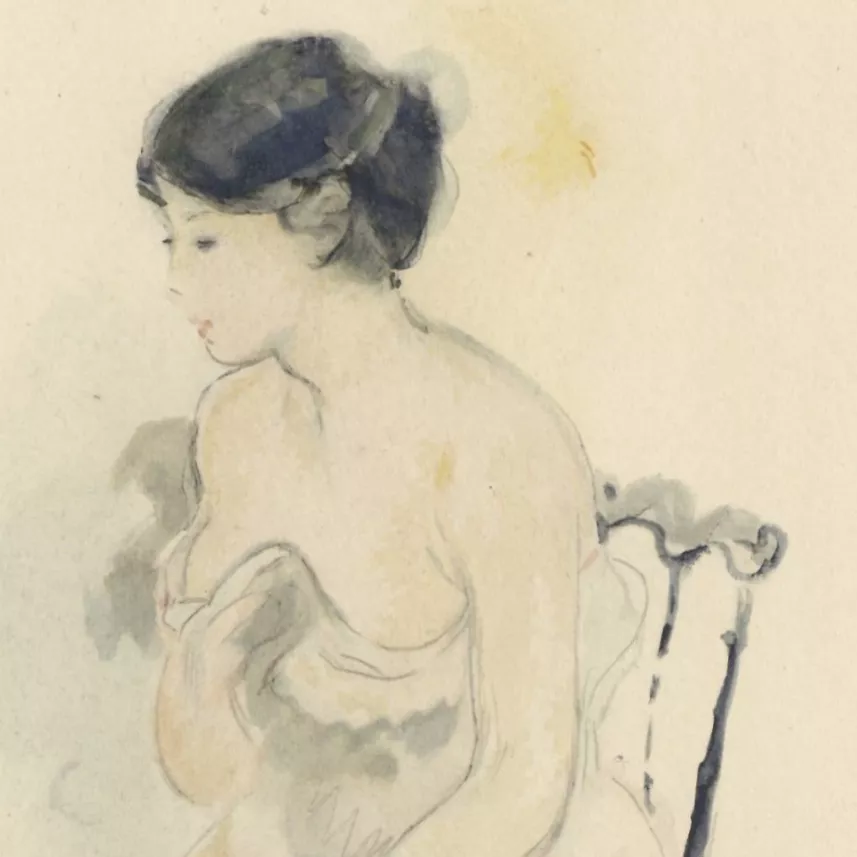
Drawing - watercolor | From €230 to €480,000 |
Oil on canvas | From €270 to €7,210,000 |
Estimate in less than 24h
Style and technique of the artist Berthe Morisot
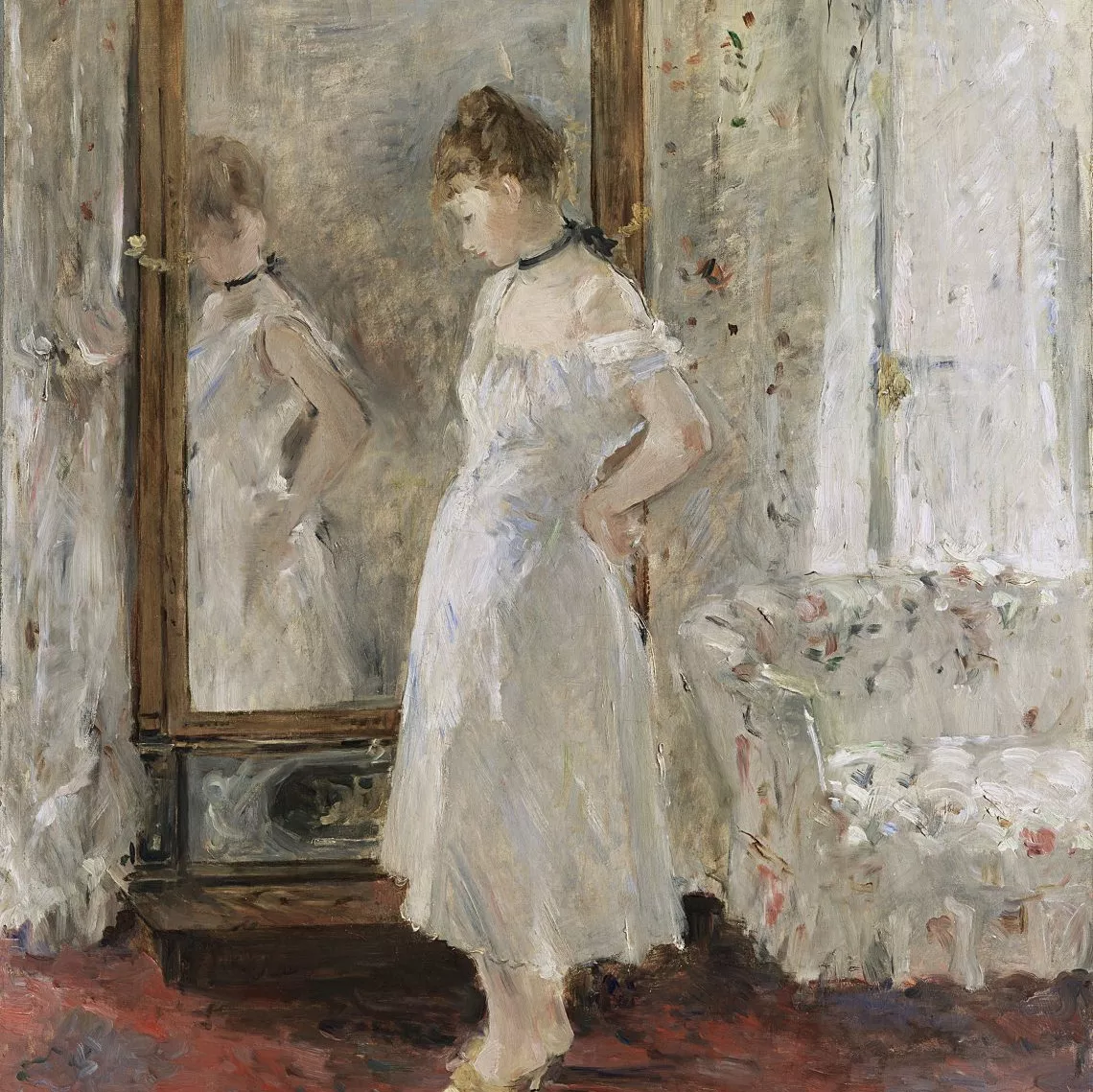
The question of the brushstroke, with Berthe Morisot, seems to be posed in terms of immediacy and lightness.
We know her attachment to a painting where the gesture translates fleeting sensation - flashes of light and chromatic vibrations - to the detriment of precise contours and academic rigor.
"You have to paint what you feel, not what you see exactly", she declared, marking her belonging to a modernity where vision mingles with emotion.
By the 1870s, her technique had become more refined, and her brushstrokes almost transparent, grazing the canvas to better capture the fluidity of the moment.
In place of the solid structure of the male compositions of the time, Morisot substitutes an airy lightness, where forms seem to dissolve in diffused light.
This manner of painting, which finds echoes in the works of Renoir or Monet, nevertheless retains a singularity: an almost tactile intimacy, particularly in her portraits of women and children.
As Paul Valéry wrote, "she painted the air, that which circulates between things". This impalpable materiality of emptiness, which she mastered with audacity, made her a key figure in Impressionism, where the erasure of contours became the expression of a more subtle, almost vibrant presence.
Berthe Morisot and Impressionism
The artistic current to which Berthe Morisot belonged, Impressionism, was defined by a revolution of the gaze and a liberation of gesture.
How, in an era marked by academicism and its constraints, did artists like Morisot manage to impose a style of painting in which light, immediacy and sensation took precedence over narrative and detail?
This movement, initiated in the 1860s by figures such as Monet, Renoir and Degas, rejected the rigidity of the official salons to embrace an aesthetic based on direct observation and the play of perception.
Morisot, fully embracing this approach, enriched its principles. To the dissolution of contours and vibrant brushstrokes, she adds a dimension of intimacy and grace, magnifying scenes of domestic life or female portraits.
Where Monet captures the transience of aquatic reflections and Renoir exalts the joy of bodies in light, Morisot sets out to reveal the soul of characters and the poetry of interior spaces.
This current, which redefined the boundaries of painting, rejected monumentality in favor of a relentless search for variations in atmosphere and sensation.
As a critic of the time pointed out, Impressionism transformed each canvas into an ephemeral fragment of life, transfigured by emotion.
Morisot, with his finesse and singularity, perfectly illustrates this innovative spirit, anchoring Impressionism not only in its century, but in a timeless modernity.
The life of Berthe Morisot
It is precisely in Berthe Morisot's trajectory that the essence of a singularly modern vocation is revealed: how can we explain, in a bourgeois milieu where expectations for a woman were limited to domestic intimacy, the audacity of an artistic career pursued within a movement as revolutionary as Impressionism?
Born in Bourges in 1841 into a cultured family, she and her sister Edma benefited from a rigorous artistic education, marked by apprenticeship with Corot.
From the 1860s, her work was part of a fruitful dialogue with landscape painting, between classical tradition and the quest for atmospheric truth.
Among the figures of the nascent modern movement, Morisot quickly made her mark with a subtle approach, exploring the nuances of light and the moment.
In 1874, her marriage to Eugène Manet, brother of the famous Édouard, did not mark a retreat but, on the contrary, an affirmation of her place in artistic circles.
She exhibited regularly with the Impressionists, becoming one of the few women to join this movement, not as an exception, but as an equal.
In the artistic landscape of her time, Morisot thwarted expectations. While Renoir or Monet captured crowds and lush gardens, she chose intimate scenes, everyday life illuminated by a silent poetry.
At the Belle Époque, her name quietly but authoritatively asserted itself as that of an artist capable of fusing life and art into a vibrant material, where each painting seems to whisper the radiance of a suspended moment.
With the first retrospectives organized after her death in 1895, her work appears as the link between the intimacy of the 19th century and the brilliance of the pictorial revolutions to come.
The works of the Morisot sisters: Berthe, Edma...
Unfortunately, the work is sometimes not signed by Berthe Morisot herself, but by her older sister, Edma,who doesn't have the same market value as her sister.
The Morisot sisters were born in nineteenth-century France, where certain reflections on female education were beginning to emerge.
In 1850, 2/3 of young French girls were allowed to go as far as the end of elementary school, but unfortunately this was still to learn a few rudiments necessary for running a household: knowing a few calculations, reading, writing, but above all mastering housework and child-rearing.
Edma Morisot, also a talented artist, was active during the Impressionist period and took part in several exhibitions alongside her sister and other renowned Impressionist artists.
Her paintings were often portraits and scenes of everyday life, with a style similar to Berthe's.
However, unlike Berthe, Edma chose to end her artistic career after her marriage in 1894, which limited recognition of her work.
Her paintings were often portraits and scenes of everyday life, with a style similar to Berthe's. However, unlike Berthe, Edma chose to end her artistic career after her marriage in 1894, which limited the recognition of her work.
A signed work by Edma Morisot could be estimated at 500 to 800 euros, subject to a nice surprise, with auction results sometimes exceeding 2,000 to 3,000 euros.
Focus on Le Berceau, Berthe Morisot
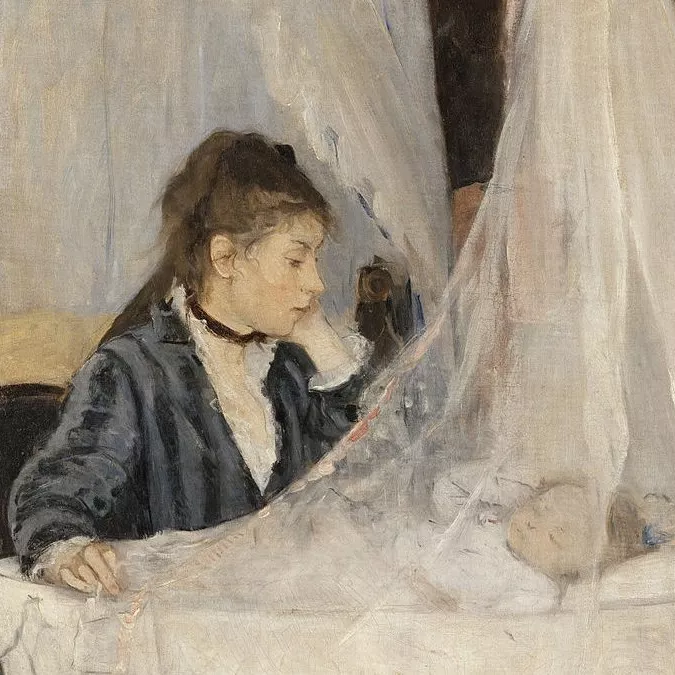
It is in Le Berceau (1872) that Berthe Morisot condenses the essence of a painting that is both intimate and resolutely modern: how to capture, in the apparent simplicity of a domestic scene, a universal truth about motherhood and affection?
This painting, which shows her sister Edma watching over her sleeping child, stands out as a silent manifesto, where tenderness becomes the heart of a pictorial quest.
Among Morisot's contemporaries, Monet or Renoir often explored outdoor subjects, bathed in natural light. Here, by contrast, the enclosed space provides a setting for the intensity of the visual exchange between mother and child.
The veil separating the maternal figure from the cradle becomes a filter, both barrier and link, conveying the fragility of this moment.
As with Degas in his interior scenes, the economy of composition invites the eye to penetrate a hushed atmosphere, but Morisot adds a vibrancy unique to her brush.
The touch, light and fluid, seems to skim the canvas, evoking more than it describes. Unlike Manet, in whom the material can be more assertive, Morisot favors an ethereal, almost diaphanous pictorial writing, which lends the painting a dreamlike quality.
The delicate tones - off-whites, soft pinks - capture a diffuse light, enveloping the figures in a palpable softness.
This approach is not unlike the work of Mary Cassatt, another Impressionist artist fascinated by maternal ties, but where Cassatt focuses on gestures, Morisot favors atmosphere.
In Le Berceau, it's not just maternity that's represented, but the very idea of protection and contemplation. Through this painting, Morisot elevates an everyday scene to the status of an Impressionist icon, transcending the private to touch the universal.
Berthe Morisot's imprint on her century
Berthe Morisot's imprint on her century rests on a double audacity: that of conquering a place in a male-dominated milieu and that of renewing painting with a sensibility of her own.
How, in the heart of the XIXᵉ century, could an artist impose such a singular gaze on everyday life, while breaking free from academic conventions?
Morisot's choices upended expectations: far from grand historical compositions or grandiose landscapes, she favored the intimacy of family scenes, the evanescence of a moment, the furtive brilliance of a light.
At a time when Monet, Renoir or Manet were redefining the rules of painting, she took an active part in Impressionist exhibitions, asserting a pictorial language in her own right.
Her light, vibrant touch, her concern to capture the impalpable, resonate with the research of her contemporaries, while bringing an unprecedented emotional depth.
If Degas explores the movements of dancers and Cassatt maternal relationships, Morisot inscribes her art in a more diffuse, almost introspective quest, where each canvas becomes a meditation on time.
Her influence extends far beyond her era: she opens up perspectives for future generations of female artists, offering them not only a model of success, but also a pathway to express their own vision of the world.
Morisot, in celebrating the fragility and beauty of the ordinary, bequeaths a legacy that transcends fashions and eras.
Recognizing Berthe Morisot's signature
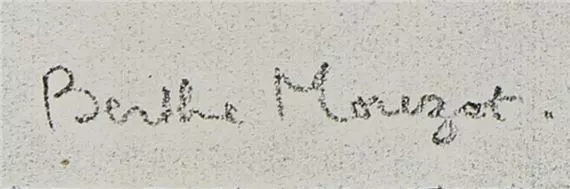
The artist often signs her full name small, at the bottom of her paintings. Copies may exist, which is why expertise remains important.
Knowing the value of a work
If you happen to own a work by or after Berthe Morisot, don't hesitate to request a free valuation using our form on our website.
A member of our team of experts and certified auctioneers will contact you promptly to provide you with an estimate of the market value of your work, as well as ad hoc information about it.
If you are considering selling your work, you will also be accompanied by our specialists in order to benefit from alternatives for selling it at the best possible price, taking into account the inclinations of the market.
.Estimate in less than 24h
Discover in the same theme

The value of works, paintings by Olivier Merson
Luc Olivier Merson is one of the last neoclassical historical painters. His works are still valued and quoted.
Learn more >

Rating and value of works, paintings, drawings by John Const...
John Constable was a romantic painter of the 19th century, who produced many paintings. His works are highly prized and worth a great deal of money.
Learn more >

Rating and value of sculptures and bronzes by Alexandre Léon...
Alexandre Léonard is a twentieth-century animal sculptor who produced animal sculptures that are highly prized and valued.
Learn more >
Some results of 19th century paintings sold at auction

Estimated 800 - 1.500
Antonin FANART (1831-1903), oil on canvas

Estimated 5.000 - 10.000
Victor Gabriel GILBERT (1847-1935), Le marché aux fleurs, oil on canvas

Estimated 3.000 - 5.000
Pascal DAGNAN-BOUVERET (Paris 1852-1929 Quincey) Portrait of a young woman with a rose in her bodice, oil on canvas

Estimated 1.000 - 2.000
French school, circa 1860 Presumed portrait of Églé Ney de la Moskowa (1832-1890), Duchess of Persigny

Estimated 20.000 - 30.000
Auguste RENOIR (1841-1919) Entrance to houses, circa 1895-1896, Oil on canvas.

Estimated 3.000 - 5.000
Alphonse OSBERT (1857-1939) "Le soir" Oil on canvas

Secure site, anonymity preserved

Auctioneer approved by the State

Free and certified estimates
Frequently asked questions
-
Who is Berthe Morisot, and what is her role in Impressionism?Berthe Morisot (1841–1895) was a major 19th-century artist and one of the few women to become a full-fledged member of the Impressionist movement. She is known for her intimate and poetic style, favoring domestic scenes and portraits of women over grand landscapes. Her light, vibrant brushwork, which captures the fleeting nature of light and emotion rather than precise details, perfectly embodies the innovative spirit of Impressionism.
-
What is the price range for Berthe Morisot's works, depending on the technique used?The value of Berthe Morisot’s works varies considerably depending on the medium: prints and multiples range from €10 to €4,000, drawings and watercolors from €230 to €480,000, and oil paintings on canvas from €270 to €7,210,000. These variations reflect the importance of the date, subject matter, condition, and provenance of the work.
-
How can you authenticate a work by Berthe Morisot and determine its value?To authenticate a work of art and obtain a reliable estimate, we recommend that you request a free appraisal from Auctie's. Our team of auctioneers and certified experts will examine your piece and provide you with an accurate assessment of its market value, with no obligation on your part.
-
Is this the right time to sell a work by Berthe Morisot?Yes, now is a good time to sell a work by Berthe Morisot. The market for her paintings is on an upward trend, with prices rising steadily at auction. The growing recognition of her role in Impressionism and the increased interest in 19th-century women artists are driving the continued appreciation of her works.
-
How does the appraisal and sale of a work of art take place at Auctie's?The appraisal is free, non-binding, and conducted by our experts. Once we receive your request, we will contact you within 48 hours to provide you with an appraisal of your artwork. If you wish to sell, we will guide you from start to finish, offering you the best possible strategy to achieve the highest possible price.
