



Rating and value of sculptures, bronzes and marbles by Mathurin Moreau

Key takeaways
- Mathurin Moreau's sculptures sell for between €40 and €502,240, with bronze works fetching up to €150,480 at auction.
- Bronze is the most highly valued medium (€100 to €150,480), followed by marble (€500 to €70,800) and watercolor drawings (€70 to €200).
- The artist, who trained at the École des Beaux-Arts and won the Second Prix de Rome in 1842, embodies the softened neoclassicism of the Second Empire with his harmonious and easily recognizable female figures.
If you own a work by or after the artist Mathurin Moreau, and would like to know its value, our state-approved experts and auctioneers will offer you their appraisal services.
Our specialists will carry out a free appraisal of your work, and provide you with a precise estimate of its value on the current market.
Then, should you wish to sell your work, we will direct you to the best possible arrangement to obtain the optimum price.
Rating and value of the artist Mathurin Moreau
Carpeaux is an artist from the Romantic group. His legacy includes sculptures, paintings, prints and drawings. At present, the prices of his works are exploding under the auctioneers' gavel.
His sculptures are particularly prized above all by French buyers, and the price at which they sell on the art market ranges from €40 to €502,240, a considerable delta but one that speaks volumes about the value that can be attributed to Moreau's works.
In 2013, a bronze statue, Oasis, sold for €150,480 while it was estimated at between €113,000 and €138,000. The artist's quotation is high and varies according to the quantity of works present on the auction market.
Order of value from a single work to the most prestigious
Technique used | Result |
|---|---|
Drawing - watercolor | From 70 to 200€ |
Lighting | From 90 to 50 000€ |
Marble | From 500 to 70,800€ |
Bronze | From 100 to 150,480€ |
Estimate in less than 24h
Style and technique by artist Mathurin Moreau
In Mathurin Moreau's sculpture, modeling retains this ability to suggest the softness of flesh, the suppleness of drapery, the fluidity of gesture.
But he doesn't limit himself to a faithful transcription of reality: he exalts its forms, ordering them according to an elegant, legible and immediately seductive grammar. The line undulates, following the body's movement without break, embracing curves with an almost musical regularity.
The bronze, often patinated in brown or green tones, catches the light without absorbing it, revealing the subtle transitions between planes, the passages from full to hollow, from gesture to attitude.
The figures, mostly female, are not captured in an instant; they embody a type, a harmony, an ideal of beauty inherited from Neoclassicism but softened by the taste of the Second Empire.
The serene faces, the open hands, the slightly swaying bodies obey a vocabulary that favors clarity, balance and immediate legibility.
The sculpture does not impose itself by its violence or rupture, but by its internal coherence, its ability to fit into an urban, domestic or monumental environment without assaulting it.
This attenuated classicism, tempered by the decorative requirements of the time, is reflected in Moreau's treatment of attributes, accessories, pedestals. Each element is integrated into the whole according to a logic of formal harmony, without overload, without effect.
Marble, sometimes used, extends this search for visual softness, but it is bronze that best carries this aesthetic of continuous line and contained volume.
Then, removed from any desire for rupture, Mathurin Moreau's sculpture is part of a tradition that values permanence, stability, grace.
This is not a work that questions or deconstructs: it is a work that asserts, with assurance, a certain idea of plastic elegance.
The life of Mathurin Moreau
In Mathurin Moreau's career, academic training retains this anchoring function in the rules of drawing, study, composition.
Trained at the École des Beaux-Arts in Paris, he learned early on the principles of an art founded on measure, balance and clarity of form. Born in Dijon in 1822 into a family of sculptors, he followed in his father's footsteps.
In 1842, he was awarded the second Prix de Rome, which established his reputation and put him firmly on the official circuit. He exhibited regularly at the Salons, where his female and allegorical figures met with great success.
From the 1850s onwards, he became a sought-after sculptor, both for public commissions and for publishing productions destined for the foundry.
This dual recognition, both institutional and commercial, was to become increasingly pronounced. A member of the jury for the Universal Exhibition, then mayor of the XIXᵉ arrondissement of Paris, Mathurin Moreau embodied a model of an artist integrated into public life without ever straying from the aesthetic canons of his time.
His work, closely linked to the decorative statuary of the second half of the XIXᵉ century, was widely distributed through the major art foundries.
It accompanied urban planning, adorning squares, squares, facades, responding to a demand for legibility, permanence, harmony.
Thus, without break or deviation, his career was part of an asserted continuity, where tradition became a stable framework, a repertoire of forms to be extended rather than called into question.
Focus on L'Ondine, Mathurin Moreau
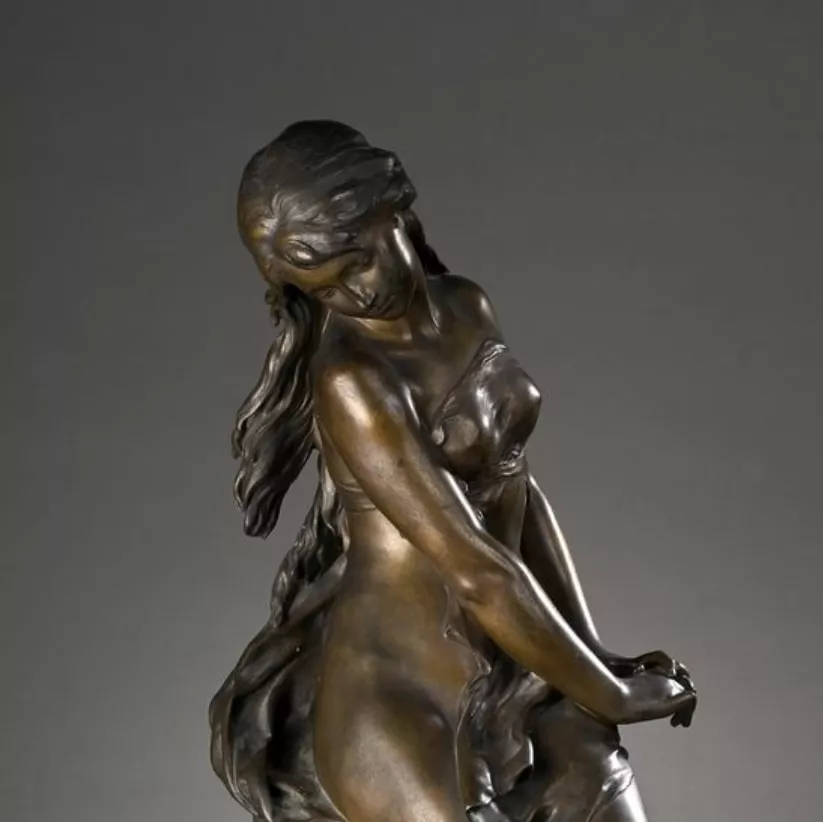
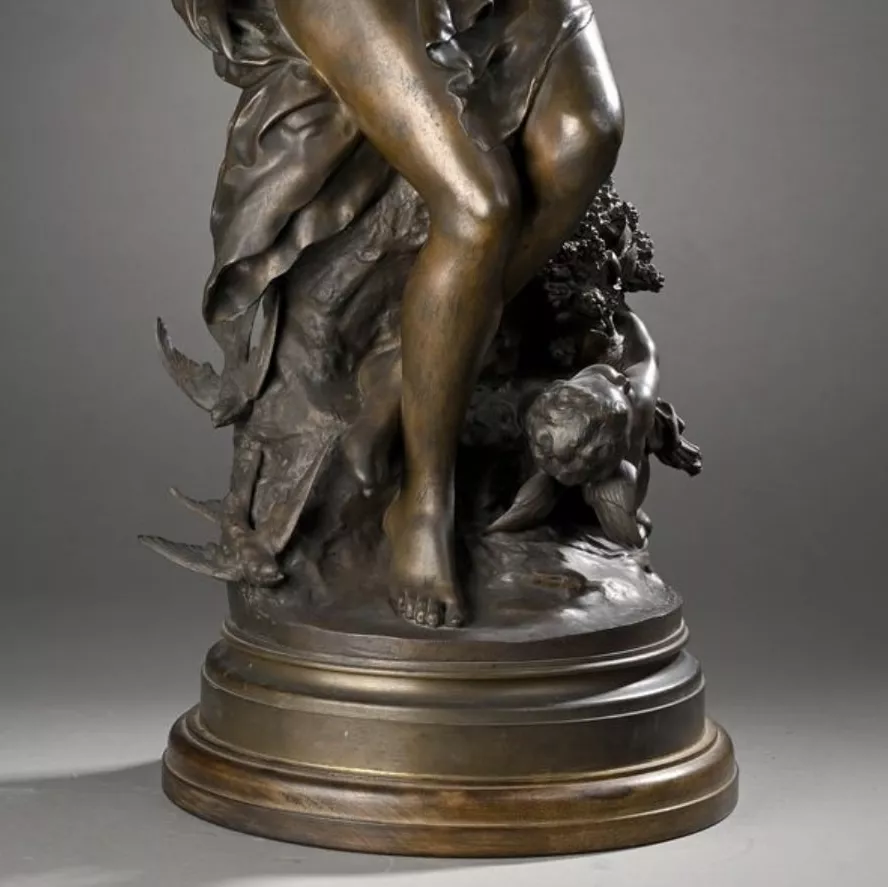
In L'Ondine (fig. 1), an iron casting produced by the Val d'Osne foundry, Mathurin Moreau retains the principles of smooth, continuous modeling, where the female body is integrated into a fluid sequence of curves and drapery.
But this treatment of form does not aim for anatomical exactitude: it tends towards idealization, a harmony constructed according to the academic codes of the XIXᵉ century.
The face, slightly tilted, eyes downcast, expresses a restrained gentleness; the arms, supple, prolong the general movement of the torso, without break, without tension.
The garment, barely sketched, hints at the volumes of the body without constraining them, in a constant balance between suggested nudity and maintained decency. The wavy hair blends in with the line of the shoulders, flowing down the back like a bronze waterfall.
The base, adorned with stylized plant motifs, is more than just a support: it is part of the composition, anchoring it in a symbolic environment. Water, nature and femininity are brought together here in a unified, clear, immediately legible form.
Nothing disturbs the reading of the whole: neither overload, nor rupture, nor effect. The light glides over the surfaces without a hitch, revealing the continuity of the sculptural gesture.
So, removed from any temptation to naturalism, L'Ondine embodies a regulated, constructed, stable beauty, where form does not confront reality but rises to the rank of allegory.
The legacy of Mathurin Moreau
In Mathurin Moreau's work, decorative statuary retains this function of ideal representation, of celebrating legible, harmonious, immediately accessible forms.
But this aesthetic, far from becoming fixed in repetition, becomes a model distributed on a large scale, carried by the art foundries and triumphant urbanism of the Second Empire and Third Republic.
Moreau's influence is exerted not through rupture, but through continuity: his female figures, allegories and ornamental compositions provide a stable, reproducible vocabulary, suited to monumentality as well as intimacy.
In public gardens, on fountains, facades or bourgeois salons, his works set the contours of a shared taste, made of restrained grace, formal clarity, measured elegance.
This legacy is less a part of plastic innovation than of cultural diffusion: it accompanies the beautification of towns, the democratization of art, the stabilization of a collective imagination.
Thus, removed from the nascent avant-gardes but faithful to the academic ideal, Moreau's sculpture marks its time by its ability to be seen, recognized, and repeated.
Mathurin Moreau's success on the art market
On the art market, Mathurin Moreau's sculpture retains this ability to arouse collectors' interest through the regularity of its results and the immediate recognition of its style.
But this appeal, far from being limited to decorative value, is reflected in solid auctions, often exceeding estimates, driven by a steady demand for period fonts, such as those by James Pradier, Charles Valton or Jean-Baptiste Carpeaux.
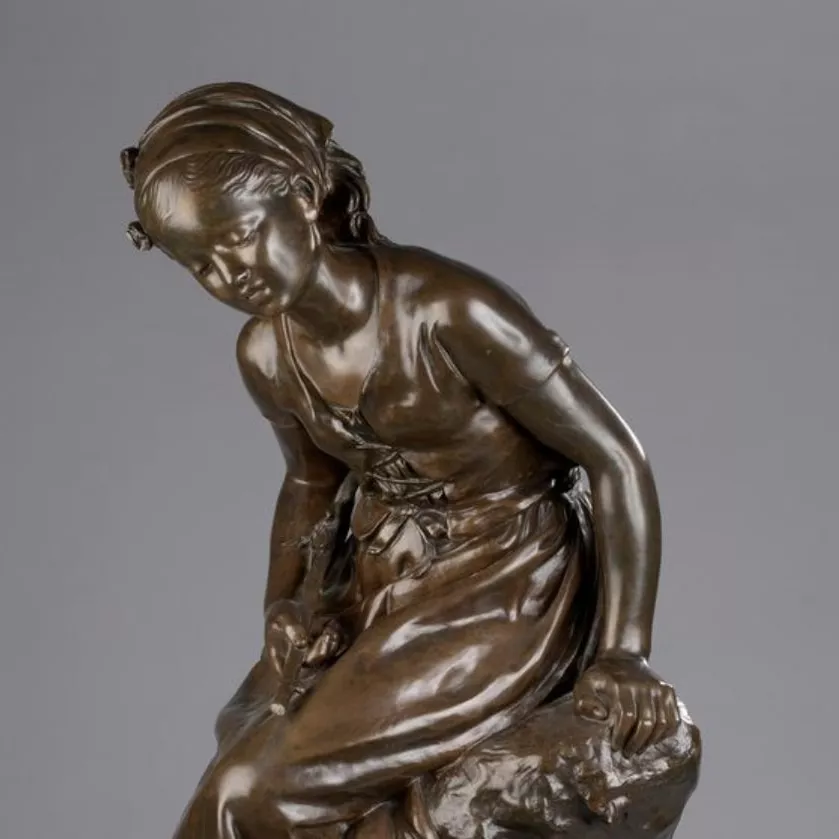
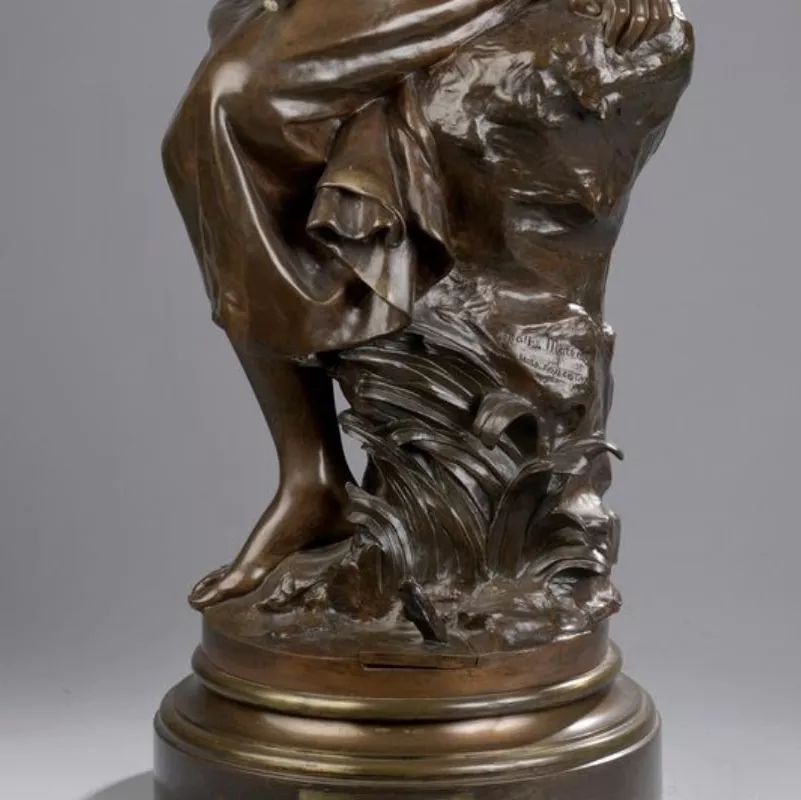
At auction, his iconic works -L'Ondine, La Fileuse, Le Génie des Arts - regularly fetch several thousand, sometimes tens of thousands of euros, depending on the quality of the cast, the patina, the provenance.
Collectors seek out pieces edited by the great houses - Val d'Osne, Durenne, Moreau frères - whose precision of execution and fidelity to the original model reinforce their value.
This success is based on a rare convergence: an immediately identifiable aesthetic, a significant historical distribution and a lasting insertion in the history of XIXᵉ century sculpture.
Then, removed from the effects of fashion but sustained by the constancy of taste for decorative academicism, Mathurin Moreau's work continues to appeal to an international public, attentive to quality, signature and heritage.
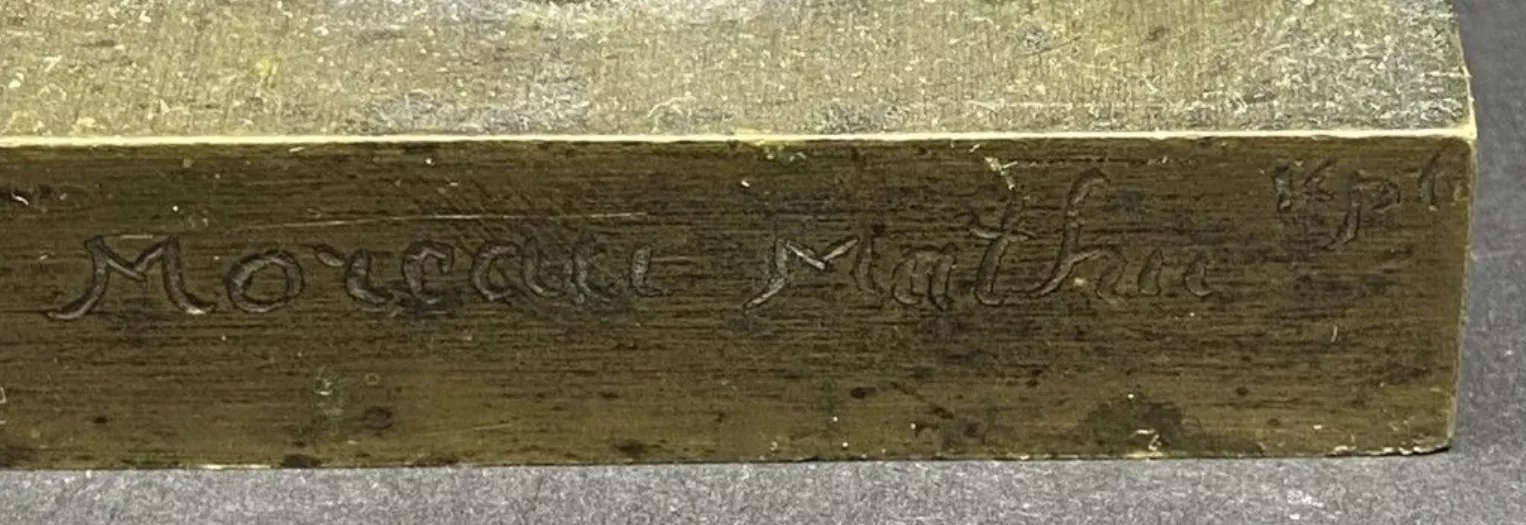
Recognizing Mathurin Moreau's signature
Mathurin Moreau doesn't always sign his works. If you think you own one, it's best to have it appraised. The signature may differ depending on the type of work: sculpture, drawing or painting. There are also copies, which is why expertise is important.
Knowing the value of a work
If you happen to own a work by or after Mathurin Moreau, don't hesitate to request a free appraisal using our form on our website.
A member of our team of experts and certified auctioneers will contact you promptly to provide you with an estimate of the market value of your work, as well as ad hoc information about it.
If you are considering selling your work, you will also be accompanied by our specialists in order to benefit from alternatives for selling it at the best possible price, taking into account market inclinations.
Frequently asked questions
-
Who is Mathurin Moreau, and what is his artistic background?Mathurin Moreau (1822–1897) was a French sculptor trained at the École des Beaux-Arts in Paris, working within the 19th-century academic tradition. Born in Dijon into a family of sculptors, he won the Second Prix de Rome in 1842 and quickly became a recognized artist, both for public commissions and for works intended for bronze casting. His work, closely linked to the decorative statuary of the Second Empire and the Third Republic, is characterized by harmonious forms, grace, and immediate clarity, remaining true to the academic tradition.
-
What are the prices and price ranges for Mathurin Moreau's sculptures?The prices of Mathurin Moreau’s works vary considerably depending on the medium and quality: drawings and watercolors range from €70 to €200, light fixtures from €90 to €50,000, marble sculptures from €500 to €70,800, and bronze sculptures from €100 to €150,480. His iconic sculptures, particularly period castings produced by leading foundries (Val d'Osne, Durenne), regularly fetch several thousand—or even tens of thousands—of euros at auction, depending on the quality of the casting, the patina, and the provenance.
-
How can you authenticate a work by Mathurin Moreau?Mathurin Moreau does not always sign his works, and copies do exist. To authenticate a work attributed to the artist or based on his style, we recommend that you request a free appraisal from Auctie's via our online form. A member of our team—composed of experts and state-certified auctioneers—will contact you promptly to examine your item and provide you with a detailed appraisal, with no obligation.
-
How does the appraisal process work at Auctie's?The appraisal is free and non-binding. Simply fill out our online form with information and photos of your artwork. A state-certified expert or auctioneer will contact you shortly to examine your item and provide you with an accurate assessment of its market value, along with relevant information about the artwork. You’ll receive a response as soon as possible.
-
When is the best time to sell a work by Mathurin Moreau?Now is the perfect time to sell a sculpture by Mathurin Moreau. Demand remains steady for his high-quality period castings, particularly those produced by major foundries such as Val d’Osne and Durenne. Auction results regularly exceed estimates, driven by sustained demand from French and international collectors who value the artist’s quality, signature, and academic legacy. Auctie’s will guide you from the initial estimate through to the final sale to ensure you achieve the best possible price.
