



Rating and value of works, sculptures, bronzes by Charles Valton

Key takeaways
- Charles Valton (1851–1918), a French animal sculptor who specialized in bronze works, collaborated with Antoine-Louis Barye and exhibited at the World’s Fairs of 1889 and 1900.
- Valton’s works sell for between €30 and €15,000 depending on the medium, with bronzes commanding the highest prices and works in other metals being the most affordable.
- In 2022, his sculpture “A Wolf on the Lookout” sold for €3,450, far exceeding its initial estimate of €985 to €1,870, confirming the recurring rise in his market value.
If you own a work by or after the artist Charles Valton, and would like to know its value, our state-approved experts and auctioneers will offer you their appraisal services.
Our specialists will carry out a free appraisal of your work, and provide you with a precise estimate of its value on the current market.
Then, if you wish to sell your work, we will direct you to the best possible arrangement to obtain the optimum price.
Rating and value of artist Charles Valton
Animal sculptor, Charles Valton produced sculptures in collaboration with Antoine Louis Barye. Now, prices for his works are rising recurrently at auctioneers' gavels.
His sculptures are prized above all by French buyers, and the price at which they sell on the art market ranges from €30 to €15,000, a considerable delta, which nevertheless speaks volumes about the value that can be attributed to Valton's works.
In 2022, one of his bronze sculptures, A wolf on the prowl following boot tracks, sold for €3,450 while it was estimated at €985 to €1,870.
Order of value from a simple work to the most prestigious
Technique used | Result |
|---|---|
Low relief | From 100 to 750€ |
Metal | From 30 to 300€ |
Golden bronze | From 445 to 1,770€ |
Porcelain | From €120 to €900 |
Bronze | From €80 to €15,000 |
Estimate in less than 24h
Style and technique of artist Charles Valton
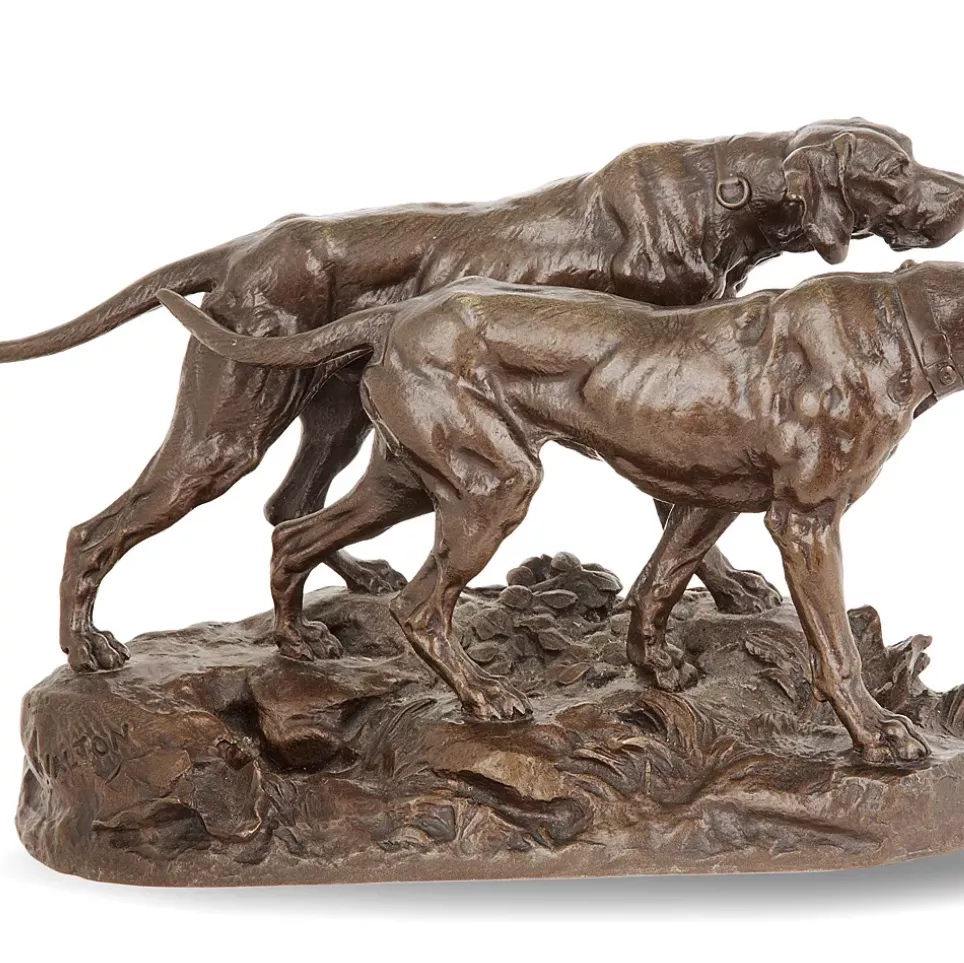
Charles Valton is distinguished by an impeccable academic technique, which emphasizes the quiet strength and elegance of animals. His approach is marked by a striking realism, based on careful observation of the living.
He sculpts with great precision, favoring sharp contours and volumes studied to capture the musculature and posture of his subjects. The textures of the coat, the suppleness of the forms and the tension of the bodies are rendered with an attention to detail that characterizes his style
Working mainly in bronze, he ensures a solidity and depth that sublimates every curve and shading.
Valton also masters the art of patination, giving his sculptures a subtle sheen that plays with light, accentuating relief and movement.
Like Paul Jouve with his drawings, Valton makes bronze a living material, where every stroke and shadow tells a story. His animals are never frozen; they seem ready to move, to soar or rest, in a constant dynamic.
His attachment to wild and domestic fauna shines through in each piece, which he treats with uncompromising academic fidelity.
Valton's rigorous, naturalistic approach places him among the great animal sculptors of his time, passionately celebrating the natural beauty of the animals he depicts with remarkable meticulousness.
Charles Valton and animal bronze
Charles Valton (1851-1918) was a French sculptor whose name remains relatively unknown to the general public, despite a rich artistic career and abundant output.
Born in Pau, in a family where art rubbed shoulders with teaching-his father was a teacher and his brother, Edmond Eugène Valton, a painter-Charles Valton grew up in Paris, a city that was to be the heart of his career.
At an early age, he developed a passion for the animal world and spent long hours at the Jardin des Plantes in Paris, observing wildlife with the same attention as Paul Jouve, another great name in animal bronze.
This fascination with animals was coupled with a solid training at the École des Beaux-Arts in Paris, where he became a pupil of Antoine-Louis Barye, the undisputed master of 19th-century animal sculpture.
Valton devoted his entire career to animal sculpture, specializing in bronzes of great finesse. His work quickly attracted attention: he exhibited regularly at the Salon des artistes français, where his works were appreciated for their precision and realism.
His creations were also found at the Salons des arts vivants and at the great Universal Exhibitions of 1889 and 1900, where he represented French sculpture with dignity.
In addition to bronze, Valton also explored other materials, creating several animal cookies in porcelain for the prestigious Sèvres factory, combining the delicacy of ceramics with the strength of animal imagery.
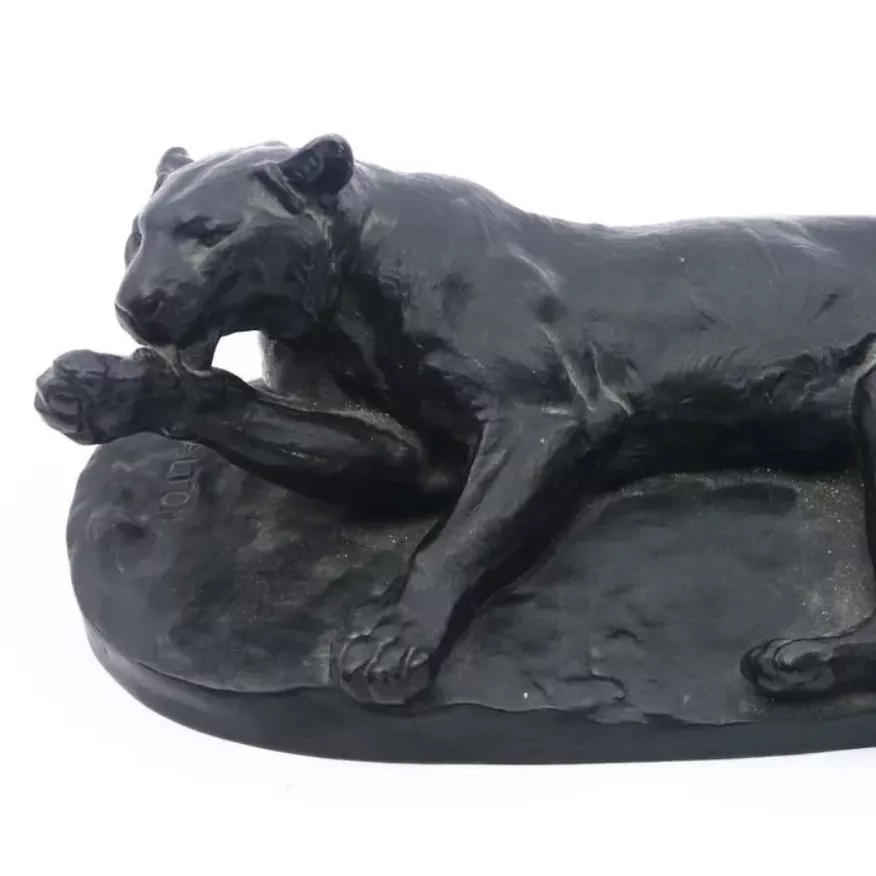
His favorite subject remained felines, which he declined in a multitude of postures and compositions. Like Édouard Marcel Sandoz, Valton is fascinated by the power and grace of these animals, which he captures with almost naturalistic meticulousness.
Over the course of his career, he sculpts hundreds of lions, tigers, and panthers, becoming one of the specialists in these majestic animals.
Among his public achievements, we note the creation of two animal groups for the Parc Monceau in Paris and the Jardin des Plantes in Nantes, two monumental works which testified to his mastery of bronze.
Unfortunately, these sculptures were melted down under the Vichy regime, erasing part of the artistic heritage he had bequeathed to posterity.
Focus on Le Tigre attaquant, Charles Valton
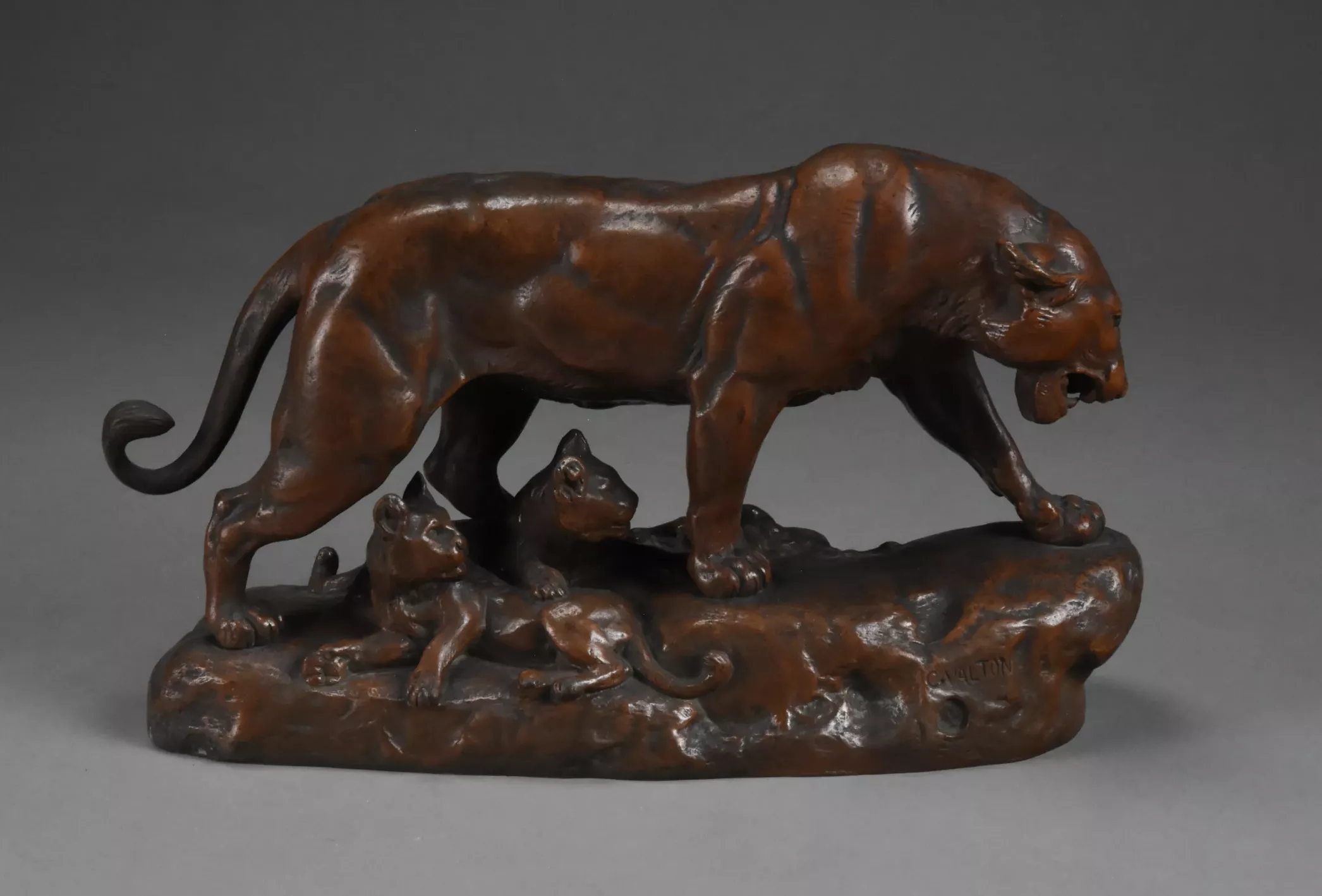
Le Tigre attaquant by Charles Valton is a sculpture that captures all the animal's power in a moment of suspended violence. In this bronze, Valton captures the precise moment when the tiger, ready to pounce, seems frozen in furious momentum.
The feline body, taut and powerful, is a true technical feat, muscles protruding and claws ready to sink into its prey.
Every detail of the animal is rendered with impressive precision, from the carefully modeled coat to the postures of the paws, as if the sculpture would come to life at any moment.
Valton, true to his fascination with felines, manages to render not only the form but also the energy of the animal, its raw, wild energy.
The tiger, in this work, is not content to be a mere representation of an animal; it embodies the majesty and violence of nature.
The artist, through his meticulous observation and talent, succeeds in creating a work in which the animal seems about to leap out of its pedestal.
The Attacking Tiger thus becomes a work full of tension, where movement and static blend to create an impression of life, strength and savage beauty.
Charles Valton's imprint on his period
Charles Valton's imprint on his period is measured by the recognition he achieved in the artistic milieu of the late 19th and early 20th centuries.
At a time when animal sculpture was booming, Valton stood out for his eye for detail and meticulous observation of the animal kingdom, a direct legacy of his master Antoine-Louis Barye.
His works, all strength and precision, capture the very essence of the animals he sculpts, bringing them almost to life in the eyes of the viewer.
Exhibited at prestigious salons and rewarded for his talent, Valton helped popularize a genre that blended both naturalism and artistic sensibility.
His work on bronzes, particularly felines, influenced a whole generation of animal sculptors who, like him, sought to capture the power and beauty of animals in realistic works.
In addition, his collaboration with the Manufacture de Sèvres made animal art accessible to a wider public, democratizing subjects long reserved for the elite.
Today, although some of his works have disappeared, the finesse of his animal bronzes remains a testament to the period's taste for the meticulous representation of nature and its creatures.
Charles Valton's artistic vein
Charles Valton, with his animal sculptures imbued with realism and dynamism, is stylistically close to several of the great names of his era.
Firstly, Antoine-Louis Barye, his master and main influence, remains an undisputed reference in the art of animal sculpture. Like Barye, Valton captures not only the animal's form, but also its character, vigor and power.
Their common work in animal representation shares an obsession with anatomical precision and a desire to convey life beyond bronze.
Valton also finds a stylistic affinity with Édouard Marcel Sandoz, who, like him, specialized in felines and other wild creatures.
Both managed to insert great sensuality and a form of poetry into the representation of the animal, while remaining faithful to a naturalistic approach.
The way Sandoz sculpts his subjects, particularly his feline studies, echoes the sensibility found in Valton, where every detail becomes an exploration of the animal's strength and grace.
Finally, there is a certain closeness to more modern animal sculpture, such as that of Rembrandt Bugatti, which, although more stylized and sometimes more expressive, shares with Valton a similar desire to translate animal character into an almost human dimension, while relying on great technical precision.
These artists, through their mastery of animal sculpture, form a group stylistically linked by their pursuit of a realistic aesthetic, but also by their ability to inject a strong emotional charge into their representations.
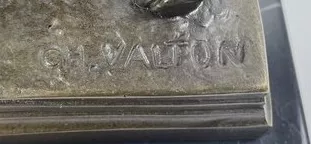
Recognizing Charles Valton's signature
Charles Valton sometimes signs his sculptures, most of the time. However, expertise remains paramount.
Knowing the value of a work
If you happen to own a Charles Valton work or one after the artist, don't hesitate to request a free appraisal using our form on our website.
A member of our team of experts and chartered auctioneers will contact you promptly to provide you with an estimate of the market value of your work, as well as ad hoc information about it.
If you are considering selling your work, you will also be accompanied by our specialists in order to benefit from alternatives for selling it at the best possible price, taking into account the inclinations of the market.
.Estimate in less than 24h
Discover in the same theme

Rating and value of works, drawings, paintings by Guillaume...
Guillaume Fouace was a 19th-century realist painter, best known for his still lifes. His paintings are successful at auction.
Learn more >

Rating and value of sculptures, bronzes by Paul Wayland Barl...
Paul Wayland Barlett was a 19th-century American sculptor who produced bronzes that are highly valued at auction.
Learn more >

Rating and value of paintings by Thomas Couture
Thomas Couture is a 19th-century painter whose works are highly valued at auction. Estimate in 24h!
Learn more >
Works from the same period sold at auction


Secure site, anonymity preserved

Auctioneer approved by the State

Free and certified estimates
Frequently asked questions
-
Who was Charles Valton, and what was his artistic background?Charles Valton (1851–1918) was a French sculptor who specialized in animal sculpture. A student of Antoine-Louis Barye, the undisputed master of the genre, he spent his career observing and depicting animals with meticulous realism, particularly at the Jardin des Plantes in Paris. His works were exhibited at the Salons des Artistes Français and at the World’s Fairs of 1889 and 1900, establishing him as one of the great animal sculptors of his time.
-
What is the price range for Charles Valton's sculptures and bronzes?Prices for works by Charles Valton range from €30 to €15,000, depending on the technique and rarity. Bas-reliefs range from €100 to €750, metal works from €30 to €300, gilded bronzes from €445 to €1,770, porcelain from €120 to €900, and bronzes from €80 to €15,000. For example, the sculpture “A Wolf on the Stalk Following Bootprints” sold for €3,450 in 2022, exceeding its initial estimate.
-
How can you authenticate a work by Charles Valton?To authenticate and appraise a work by Charles Valton, we recommend that you request a free estimate using the form on the Auctie's website. A state-certified expert or auctioneer will contact you promptly to examine the work, verify the signature, and provide you with an accurate estimate of its market value, with no obligation on your part.
-
Is this the right time to sell a work by Charles Valton?Yes, now is a good time to sell a work by Charles Valton. Prices for his sculptures are consistently rising at auction, and his animal bronzes are in growing demand, particularly among French buyers. The market for 19th-century animal sculpture remains vibrant and is highly regarded by collectors.
-
How does the appraisal and sales process work at Auctie's?Appraisals at Auctie's are free and non-binding. You fill out a form, and a certified expert or auctioneer will contact you within 48 hours to examine your piece and provide you with an estimate. If you decide to sell, our specialists will guide you through the entire process, offering you the best options to achieve the highest possible price based on current market trends.
