



Rating and value of paintings by Marie Raymond

Key takeaways
- Prices for Marie Raymond’s works range from €60 (prints) to €27,440 (paintings), showing steady growth since the 2010s.
- A major figure in postwar French abstract art, recognized for her compositions structured by color and chromatic vibrancy, without outlines or motifs.
- Since 2020, female artists of the 20th century have enjoyed growing success at auction, redefining the established hierarchies of modern art history.
If you own a work by artist Marie Raymond or based on her work and would like to know its value, our state-approved experts and auctioneers will guide you.
Our specialists will carry out a free appraisal of your work, and provide you with an accurate estimate of its value on the current market.
Then, should you wish to sell your work, we'll direct you to the best possible arrangement to obtain the optimum price.
Artist's rating and value
French artist Marie Raymond won over the art critics, dealers and collectors of her day. Since then, the artist's works have established themselves as sure values on the art market.
From the 2010s onwards, her quotation has exploded and shown steady growth, particularly for her works produced from the 1940s onwards.
As a result, the price at which Marie Raymond's works sell ranges from €60 to €27,440. An oil on canvas dating from 1946 entitled Composition en rose sold for 27,440€, whereas it was estimated at between 15,000 and 18,000€.
Order of value ranging from the most basic to the most prestigious
Technique used | Result |
|---|---|
Estamp - multiple | From 60 to 260 € |
Drawing | From 30 to €3,400 |
Painting | From €215 to €27,440 |
Estimate in less than 24h
The artist's work and style
In Marie Raymond's painting, the surface is not organized around an outline, but unfolds according to intensities. It doesn't structure a subject, it establishes a dynamic. Color, laid down in modulated flat tints, doesn't delimit a form, it circulates.
It doesn't separate, it connects. The composition is not based on a hierarchy of elements, but on a balance between chromatic tensions, field density and internal vibration. The gaze is not anchored, but traversed. The painting does not offer an image to be read, but a variation to be traversed.
The gesture, measured, inscribes each modulation in a continuous weft. The material is neither thick nor expressive: it is held, diffused and controlled. The pictorial space doesn't open up, it densifies. It doesn't seek depth, it affirms flatness.
With Marie Raymond, painting doesn't refer to an outside, it constructs an interior space, without landmark, without center, without narrative. She doesn't strive for brilliance, but imposes a silent presence. Form doesn't impose itself, it settles in. It activates a relationship between the gaze, the light and the surface.
Marie Raymond, her life, her work
Marie Raymond was born in 1908 in La Colle-sur-Loup, in the south of France. She trained as a painter in the 1930s, first at the Académie de la Grande Chaumière in Paris, then in contact with modern art, which she discovered between Paris and the Côte d'Azur. She is the mother of Yves Klein.
From the post-war years, she was an active participant in the Paris art scene. She exhibited alongside painters of the new abstraction, frequented avant-garde galleries and held a salon every Monday evening in her apartment on rue d'Assas, where critics, artists and collectors met. She supports, defends and guides.
Since 1946, she has exhibited with Colette Allendy, then Denise René. Her work is abstract, structured by color, rhythm and light. She took part in numerous group exhibitions in France and abroad, notably at the International Exhibition of Modern Art in New York in 1951.
She was awarded the Kandinsky Prize in 1949. After the 1960s, she gradually faded from the media scene, but continued to paint until her death in 1998.
Her trajectory remains associated with that of early post-war abstraction, in that moment when painting detached itself from the subject to construct an autonomous, tense, silent space.
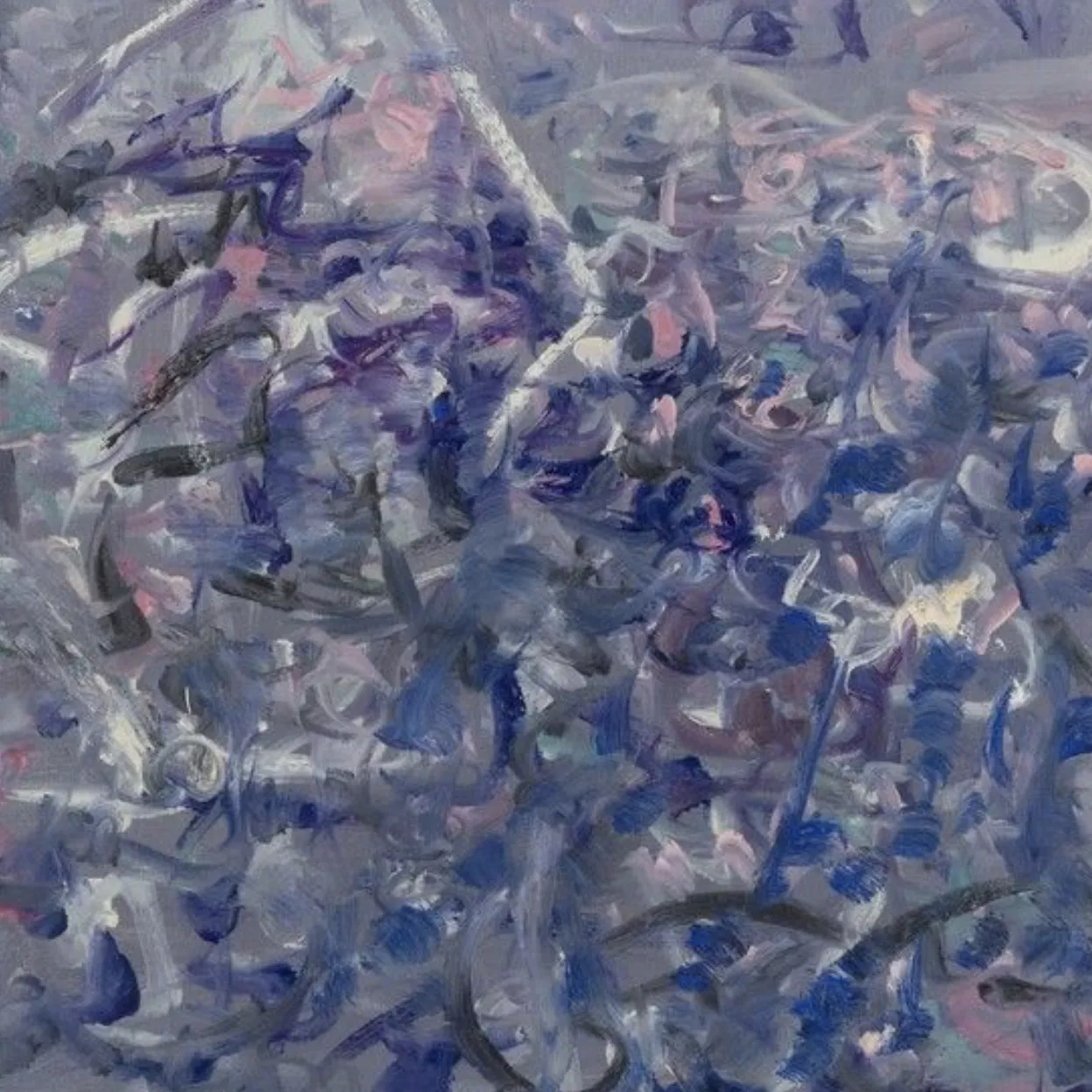
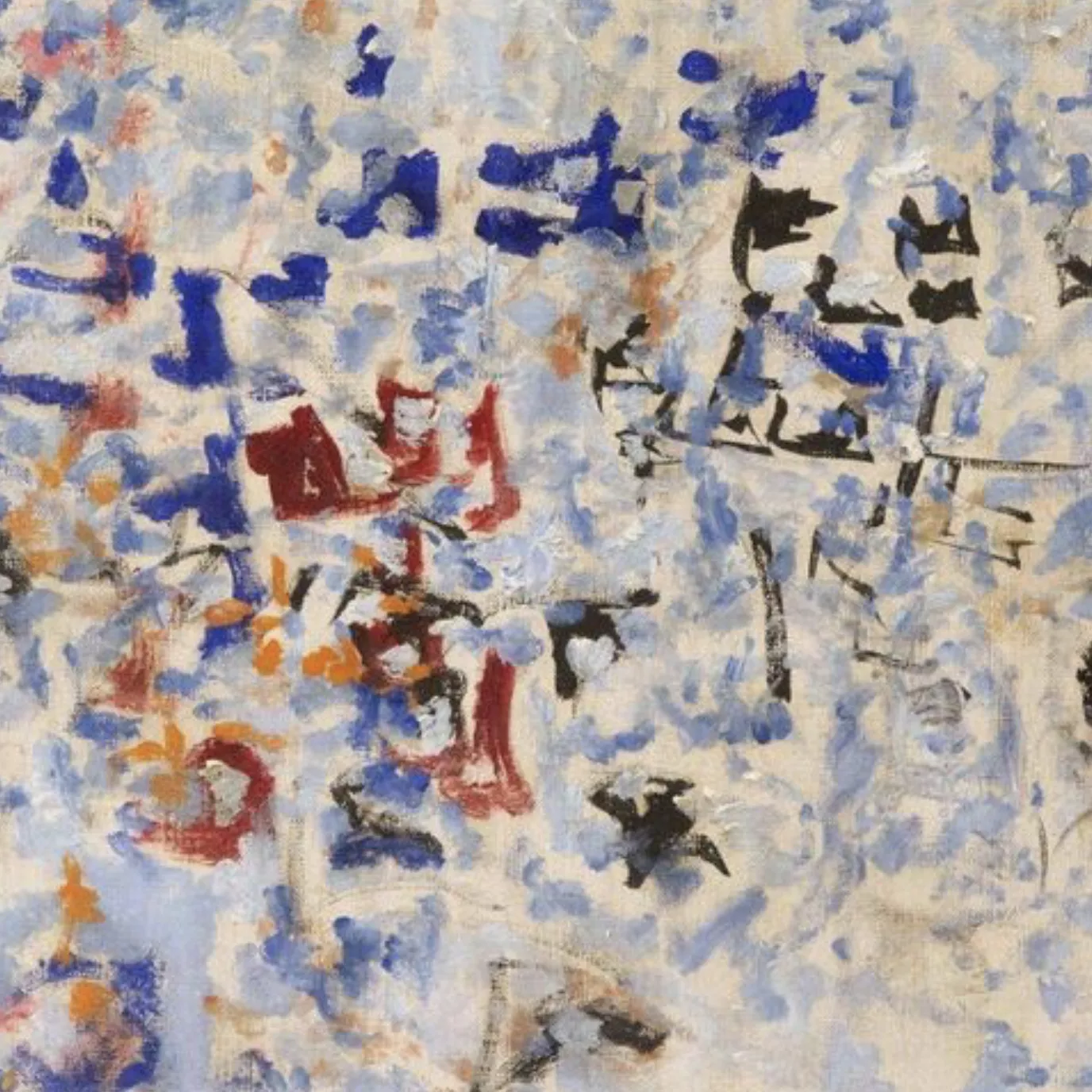
Focus on Composition lyrique, Marie Raymond, 1951
In Composition lyrique (circa 1951), the surface is not organized around a motif, it is distributed according to colored, irregular, moving zones. There is no central figure, no symmetry, no narrative. Color acts alone. It doesn't fill, it expands. It doesn't describe anything, it pulsates.
Each chromatic field seems to emerge from a controlled expansion, poised in an unstable equilibrium. The shapes have no clear outline; they emerge by contrast, by superposition, by vibration. The composition does not seek to stabilize the viewer's gaze, but rather engages in drifting.
The pictorial material is fine, almost transparent in places. No impasto, no overload. The gesture remains invisible, absorbed into the fabric of the painting. Light doesn't cut through, it inhabits the color. It doesn't come from outside, it seems diffused by the canvas itself.
In Marie Raymond, Composition lyrique doesn't propose an image, it produces a sensation. The painting does not illustrate a state, it contains it. It does not direct the reading, it creates a field of resonance, a visual space without fixed anchorage. It doesn't impose itself, it envelops. It shows nothing, but installs a presence.
Marie Raymond's imprint on her time
In Marie Raymond's work, the imprint is built over time, through the constancy of a work based on color, modulation, surface. She occupies a central position in the post-war years, at a time when abstraction is searching between several possible directions.
She develops a painting structured by chromatic fields, without contour, without motif, organized by the internal vibration of color and the density of silence. Through this organization, she imposes an autonomous pictorial space, without illusionistic depth, without hierarchy, based on a slow circulation of the gaze.
Her role goes beyond the production of works: she supports, writes, gathers. She organizes weekly meetings in her home where critics, artists and gallery owners meet. She enabled a scene to exist, positions to emerge.
This constant activity, discreet but decisive, inscribed her name in a broader history, that of abstraction in France after 1945.
Marie Raymond's imprint on her period rests on this double action: a painting constructed according to internal, measured, vibrant logics, and an active presence in the artistic field, made up of continuity, listening, demanding. A work that is held together, without deviation, based on the balance between light, surface and gaze.
Marie Raymond's stylistic influences
In Marie Raymond's painting, influences can be seen in the arrangement of surfaces, in the treatment of color, in the way she constructs space without depth. She looks to Matisse for the clarity of the plane, Bonnard for chromatic vibration, Delaunay for circular modulation. She is part of a French tradition of color as structure, without rupture, without fragmentation. Line doesn't dominate, it disappears in favor of hue, mass, chord. Unlike Nicolas de Staël, who builds his forms in tight blocks, she favors fluidity, openness, transparency.
She shares with Hans Hartung the refusal of narrative, but without resorting to violence of line. Where Hartung works with speed and impulse, she establishes a slower, more continuous, more interior rhythm. For her, composition is based on a silent distribution of forces, on a gentle dynamic.
She constructs space not by contrast but by slippage. For her, abstraction is not a break with reality, but a way of organizing an autonomous, coherent, sensitive world. An attentive, poised painting that absorbs her influences without citing them, and redistributes them in the form of colored chords, modulated fields, inhabited surfaces.
The success of twentieth-century female artists at auction
Since 2020, auction sales devoted to female artists have enjoyed steady growth, based on an active rereading of the market, a critical reappraisal of the works, a new structuring of demand.
The figures, published by the leading auction houses, confirm this dynamic: Yayoi Kusama, Joan Mitchell, Louise Bourgeois, Georgia O'Keeffe, Cecily Brown are reaching heights rarely equaled until now, not for conjunctural reasons, but because their works are now part of a broader reading of the history of modern and contemporary art.
The results do not merely reflect a phenomenon of belated correction, they translate a transformation of the gaze, a redefinition of value.
The multiplication of thematic sales organized by Sotheby's or Christie's, exclusively dedicated to women artists, is another indication: the market is not adjusting, it is reconfiguring. Works are extracted from the margins, presented in museum contexts, published, analyzed, integrated into mainstream narratives.
This recognition is neither marginal nor temporary; it alters established hierarchies. It imposes a new cartography, in which works by Tanning, Saint Phalle, Hepworth or Leonor Fini find their place, not as objects of rehabilitation, but as constitutive structures of another history.
Evolution is slow but steady: it doesn't correct an omission, it transforms the visible foundations of artistic recognition.
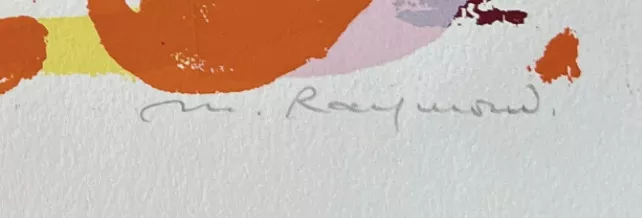
Her signature
Not all of Marie Raymond's works are signed, and copies do exist.
An example of her signature can be seen in the drawing below.
Expertise your property
If you own a work by Marie Raymond, don't hesitate to request a free appraisal by filling in our online form.
A member of our team of experts and certified auctioneers will contact you to provide an estimate of the market value of your work.
If you are considering selling your work, our specialists will also guide you through the various alternatives available to obtain the best possible price, taking into account market trends and the specific features of each object.
Estimate in less than 24h
Discover in the same theme

Value of Picasso Madoura ceramics, plates and vases
Picasso Madoura ceramics are sought-after worldwide. The value is climbing and the results are promising. Estimate in 24h
Learn more >

Rating and value of Charles Catteau's ceramics, vases, stone...
Charles Catteau is a Franco-Belgian ceramist of the Art Nouveau and Art Deco periods, who produced works of great value.
Learn more >

Rating and value of paintings by Auguste Herbin
Auguste Herbin is a painter and theoretician of abstraction who has produced works that are highly valued at auction.
Learn more >
D'autres tableaux abstraits vendus aux enchères

Estimated 2.000 - 4.000
Serge POLIAKOFF (1900-1969), Composition en rouge et bleu. 1965, Lithograph

Estimated Between €5,000 and €8,000
Jean MIOTTE (1926-2016), acrylic on canvas

Estimated 3.000 - 5.000
Roberto MATTA (1911-2002), Composition, Gouache on canvas

Secure site, anonymity preserved

Auctioneer approved by the State

Free and certified estimates
Frequently asked questions
-
Who is Marie Raymond, and what is her role in the history of modern art?Marie Raymond (1908–1998) was a pioneering French artist of the postwar abstract movement. She trained in the 1930s and played a central role in the Parisian art scene beginning in 1945, notably by exhibiting at avant-garde galleries such as Denise René and by hosting weekly art salons in her home. She received the Kandinsky Prize in 1949 and remains associated with early French abstraction, characterized by painting structured by color and chromatic vibration.
-
What is the price range for Marie Raymond's paintings?Marie Raymond's works range in price from €30 to €27,440. Paintings (oil on canvas, panels) are the most expensive works, ranging from €215 to €27,440, while drawings range from €30 to €3,400 and prints from €60 to €260. In particular, a 1946 oil on canvas titled “Composition en rose” sold for 27,440 €.
-
How can you authenticate a work by Marie Raymond?To authenticate a work by Marie Raymond, we recommend that you request a free appraisal from Auctie's by filling out our online form. A state-certified expert or auctioneer will examine your item and provide you with an accurate estimate of its market value. Please note: Not all works by Marie Raymond are signed, and there are copies in circulation.
-
Is this a good time to sell a work by Marie Raymond?Yes, now is a good time to sell a work by Marie Raymond. Since the 2010s, her market value has shown steady and consistent growth, particularly for her works created from the 1940s onward. Furthermore, the market for 20th-century female artists has seen growing recognition since 2020, transforming both the value and the public’s interest in these artists.
-
How does the appraisal process work at Auctie's, and how do I sell my artwork?Appraisals at Auctie's are free and non-binding: fill out our online form, and an expert will contact you for an appraisal within 48 hours. If you decide to sell, our specialists will support you from the appraisal through to the auction, guiding you toward the best strategy to achieve the highest possible price based on market trends and the unique characteristics of your artwork.
