



Rating and value of works, drawings, paintings by Hans Hartung

Key takeaways
- Hans Hartung (1904–1989), a pioneer of lyrical abstraction, has achieved exceptional prices, notably 2 million euros for his oil painting T1956-13 in 2017.
- His works vary considerably in price: prints range from €5 to €11,000, drawings from €350 to €179,890, and oil paintings up to €2.25 million.
- His most sought-after period began in the 1950s; his innovative techniques combine spontaneous brushwork with powerful contrasts on canvas.
German painter, photographer and architect Hans Hartung (1904-1989) is one of the most important exponents of abstraction and a precursor of spontaneous experimental techniques.
Also a member of the École de Paris, Hans Hartung employed a technique that encouraged spontaneity of gesture.
If you own a work by or based on the artist Hans Hartung and would like to know its value, our state-approved experts and auctioneers will guide you.
Our specialists will carry out a free appraisal of your work, and provide you with a precise estimate of its value on the current market.
Then, if you wish to sell your work, we will direct you to the best possible arrangement to obtain the optimum price.
Rating and value of the artist
Throughout his career, Hans Hartung produced a great deal. Nevertheless, his most prized period begins in the 1950s.
His international renown opened the doors of numerous museums in Paris and New York. Today, Hans Hartung retains his high standing and establishes himself as a safe bet on the art market.
A work signed by the artist can fetch millions of euros at auction, as demonstrated by his oil on canvas T1956-13, fetched over 2 million euros at Sotheby's in 2017.
Order of value from the most basic to the most prestigious
Technique used | Result |
|---|---|
Estamp | From €5 to €11,000 |
Photography | From €155 to €5,700 | Drawing - watercolour | From €350 to €179,890 |
Oil on canvas | From €250 to €2,250,000 |
Estimate in less than 24h
The artist's works and style
Style and technique of the artist Hans Hartung
Hans Hartung's works and style quickly stand out for a unique abstract language, ccentered on blobs of paint he describes as "calculated spontaneity".
His most renowned oils, marked by powerful contrasts, blend colorful backgrounds with intense black or brown solids.
Hartung also relies on the technique of scraping to create a striking industrial effect on his canvases, reinforcing the raw energy that emanates from his compositions.
This technical approach, combining precision and impulse, lends his works an unrivalled visual dynamic.
In parallel, he produces numerous drawings, in pastel and pencil, in which he applies these same spontaneous techniques, skilfully playing with color contrasts to accentuate the intensity of his abstract forms.
Always in search of experimentation, the German artist also excels in abstract photography, a medium he approaches with the same boldness, asserting his innovative visual approach through unprecedented textures and lighting effects.
Hartung, in a perpetual quest for innovation, constantly pushes back the frontiers of abstraction, consolidating his status as a pioneer in modern art.
He is stylistically close to the artists of lyrical abstraction, of which Georges Mathieu, Zao Wou-Ki, Pierre Soulages and Jackson Pollock.
Hans Hartung, father of tachism
The life of Hans Hartung
Hans Hartung was a French painter of German origin, born in Leipzig on September 21, 1904. After studying at the Beaux-Arts in Munich, Hartung left to explore Europe with his wife, the Norwegian painter Anna-Eva Bergman, before settling permanently in Paris.
His career was marked by the rich European artistic exchanges of the time. Witnessing the rise of Nazism, Hans Hartung, deeply opposed to the regime, volunteered to fight in 1939.
Arrested like many other Germans in France, he endured the horrors of detention.
After his release, driven by an unshakeable sense of duty, he joined the Foreign Legion, where he lost his right leg in a combat wound, an ordeal that would strengthen his determination and artistic commitment.
Throughout his career, Hans Hartung received numerous prestigious distinctions, including the Légion d'honneur and the title of Commandeur des Arts et des Lettres, rewarding a major contribution to abstract art.
As a child, he was already fascinated by photography and astronomy, two passions that nourish his work and shine through in certain plays of light and celestial compositions in his paintings.
As a child, Hartung taught himself to paint, reproducing and simplifying classical works, before turning to a bolder approach centered on color.
Inspired by masters such as Rembrandt, Goya and the German Expressionists, he quickly developed his own visual language through watercolors and abstract canvases, including the famous Ink Stains, which would become emblematic of his style.
Always seeking innovation, Hartung turned to acrylic paint, exploring new textures with unusual tools such as branches, combs or brooms, introducing a unique gestural quality to his works.
In 1968, he and his wife settled in Antibes in a house-studio he designed himself, a place conducive to creation and rest.
This is where he continued to work until his death in 1989, leaving behind him a considerable legacy in abstract art, marked by a constant quest for freedom and expression through ever more daring forms and techniques.
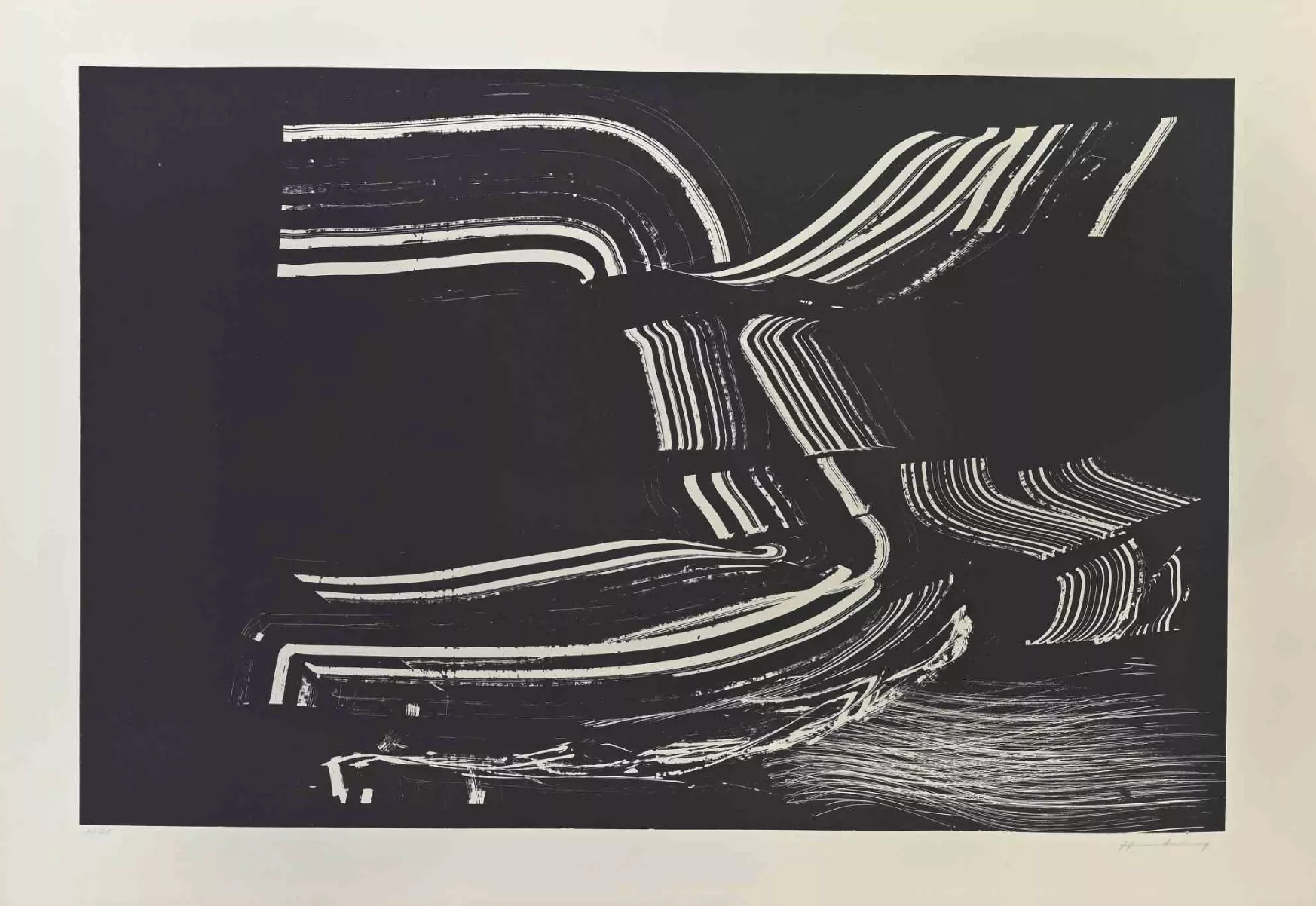
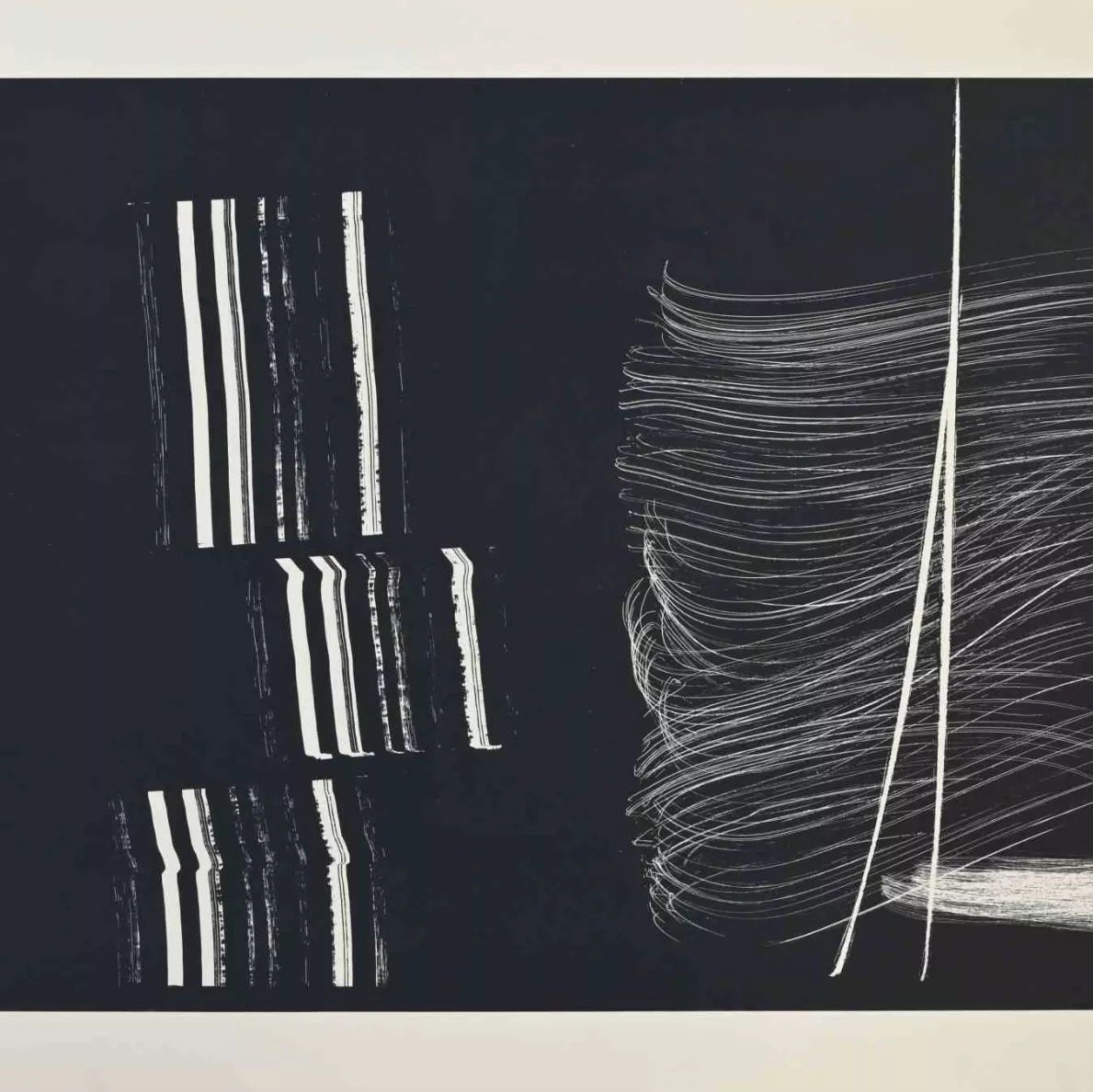
Focus on T. 1955-33, Hans Hartung, 1955
This work by Hans Hartung, with its intense gestures and sharp contrasts, wonderfully embodies the spirit of his work in the last years of his life. Here, we find the essence of his approach: a constant dialogue between movement and silence, between strength and lightness.
The broad black strokes, drawn with definite vigor, cut through the canvas like flashes of matter, recalling that primordial energy that inhabits the artist.
Each brushstroke seems to be the fruit of a spontaneous, almost violent gesture, but at the same time perfectly mastered, reflecting the inner tension that characterizes all her work.
The blue-gray background, faded and blurred, acts like a silent ecrin. It softens the agitation of the black strokes, giving the whole an almost cosmic depth. Here we sense Hartung's fascination with space and immensity, the quest for the infinite that has accompanied him from the very beginning.
This background, with its subtle variations, is not simply a support. It dialogues with the dark lines, as if absorbing part of their energy, creating a fragile balance between the material and the immaterial.
The black lines, of varying thickness, seem to spring from the canvas. Their movement is curved, sinuous, almost organic, as if it were a breath, a beat, a vital impulse. Here, Hartung manages to capture the essence of gesture, to freeze in matter what would otherwise be ephemeral.
The viewer feels this tension: the lines seem to want to step out of the frame, to continue their movement beyond the limits imposed by the canvas.
This pictorial gesture, so typical of Hartung, reveals a genuine liberation of form, a quest for pure expression, devoid of all artifice. The tools he uses, sometimes branches or brooms, are palpable here in the texture of the lines, their irregularity, their brutality.
The contrast between these black strokes and the background is accentuated by the touches of light that seem to radiate from within the canvas. This light, diffuse and subtle, brings an unexpected softness.
It recalls the interplay of light and shadow that fascinated Hartung from childhood, particularly through his interest in photography and astronomy. Here, this diffuse light seems to emanate from the canvas itself, as if the black lines were merely shadows cast by an invisible light source.
This subtle interplay between light and shadow lends the work an almost spiritual dimension, an impression of suspended movement in time and space.
The composition as a whole is balanced, despite the apparent anarchy of the strokes. Hartung masters his gesture to perfection, creating an almost musical harmony between the different elements of the work.
In this canvas, we perceive a quest for rhythm, for breathing, each black line becoming a note in a visual score. This relationship to rhythm is essential in Hartung's work, he who saw painting as a dance, an incessant movement between artist and canvas.
In conclusion, this work by Hans Hartung testifies to his unwavering commitment to freedom of gesture and expression.
It captures that raw yet mastered energy, that tension between strength and delicacy that makes his art so singular.
Through the simplicity of his means, Hartung succeeds in expressing complex emotions, a vision of the world where art becomes the reflection of existence itself, between movement and stillness, between shadow and light.
.
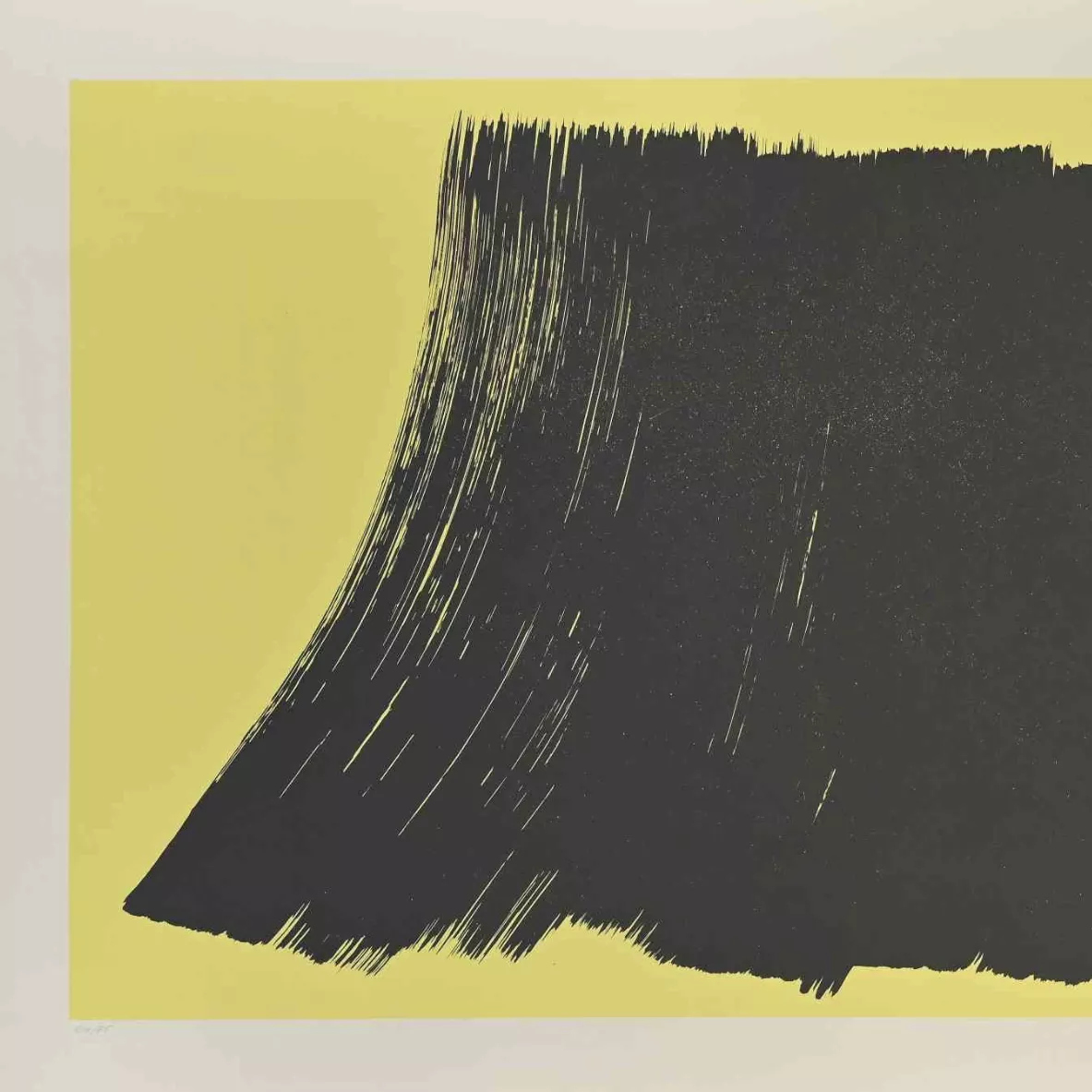
Hans Hartung's imprint on his time
Hans Hartung's imprint on abstract art is considerable and lasting. His bold exploration of color and form left its mark on a generation of artists.
Hartung, by integrating innovative techniques and varied tools into his practice, created a unique gesturality that shines through in his works. His famous Ink Stains testify to his ability to transform emotions into visual forms, establishing a dialogue between artist and viewer.
The artist also played a key role in promoting lyrical abstraction, a movement that values personal expression through color and gesture.
His influence is felt beyond his own creations, as many contemporary artists draw inspiration from his quest for freedom and his commitment to breaking conventions.
Hartung was able to establish links between his personal experience, marked by hardship, and his artistic vision, leaving behind a rich legacy that continues to nourish reflections on abstract art today.
His studio house in Antibes, where he created until his death in 1989, remains a symbol of his dedication to creation and experimentation.
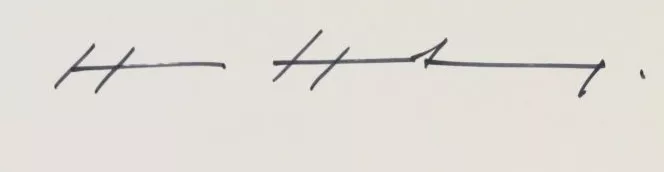
His signature
Not all of Hans Hartung's works are signed.
Although there are variations, here is a first example of his signature:
Expertise your property
If you own a Hans Hartung work, feel free to request a free appraisal by filling out our online form.
A member of our team of experts and licensed auctioneers will contact you to provide an estimate of the market value of your Hans Hartung work.
If you are considering selling your work, our specialists will also guide you through the various alternatives available to obtain the best possible price, taking into account market trends and the specific features of each work.
Estimate in less than 24h
Discover in the same theme

Rating and value of furniture, bindings and drawings by Pier...
Pierre Legrain is a twentieth-century decorator and bookbinder whose works are highly prized at auction.
Learn more >

Rating and value of paintings, drawings and sculptures by Je...
Jean Lambert-Rucki is a twentieth-century Cubist artist who produced paintings and sculptures with a high market value.
Learn more >

Rating and value of paintings by Marko Celebonovik
Marko Celebonovik is a Serbian figurative painter who has produced many works that are highly rated and valued at auction.
Learn more >
Works from the same period sold at auction

Estimated 4.000 - 6.000 €
GASTON CHAISSAC (1910-1964) Composition 1947, Gouache and Indian ink on paper.

Estimated 100-200€
Vassiliew Slavik, Oil on canvas

Estimated 15.000 - 20.000
ZAO WOU-KI (1921-2013) Composition, 1972, Brush and Indian ink on Asian paper.

Secure site, anonymity preserved

Auctioneer approved by the State

Free and certified estimates
Frequently asked questions
-
Who was Hans Hartung, and what is his role in the history of abstract art?Hans Hartung (1904–1989) was a German painter, photographer, and architect, one of the most important figures in abstract art and a pioneer of spontaneous experimental techniques. A member of the School of Paris, he is recognized as the father of Tachism and developed a unique visual language based on “calculated spontaneity,” exerting a lasting influence on lyrical abstraction alongside artists such as Georges Mathieu, Zao Wou-Ki, and Pierre Soulages.
-
What is the price range for Hans Hartung's works based on the medium used?Prices vary considerably depending on the medium: prints range from €5 to €11,000, photographs from €155 to €5,700, drawings and watercolors from €350 to €179,890, and oil paintings on canvas from €250 to €2,250,000. Works from the 1950s onward are the most sought-after on the market, with major pieces fetching several million euros at auction.
-
How can you authenticate a work by Hans Hartung and determine its exact value?To authenticate a work by Hans Hartung and obtain a reliable estimate, contact Auctie's by filling out our online form. A certified expert or auctioneer will contact you to conduct a free, no-obligation appraisal and provide you with an accurate assessment of your work’s market value within 48 hours.
-
Is this a good time to sell a work by Hans Hartung?Yes, now is a good time to sell a work by Hans Hartung. The artist continues to command high prices and is considered a safe bet in the art market. His international recognition—particularly for his prolific period beginning in the 1950s—ensures sustained interest from collectors and museums.
-
How does the process of selling a work of art at Auctie's work?Auctie's supports sellers from the appraisal stage through to the auction. After a free appraisal by our experts and certified auctioneers, we guide you through the various sales options available to help you achieve the best possible price, taking into account market trends and the unique characteristics of your artwork.
