



Rating and value of works, paintings, drawings by George Mathieu

Key takeaways
- George Mathieu (1921–2012), a pioneer of French lyrical abstraction, has seen his market value rise steadily in the contemporary art market.
- The artist’s paintings fetch millions of euros at auction, such as his work *Tuz Gölü*, which sold for €1.67 million at Sotheby’s in 2021.
- The value of his works varies widely: prints range from €5 to €2,800, drawings from €60 to €47,218, and paintings from €300 to €1.67 million.
- Mathieu has mastered a sophisticated technique that combines spontaneous brushwork with absolute control, using broad brushes and paint squeezed directly from tubes onto the canvas.
French painter, George Mathieu (1921-2012) is considered the pioneer of lyrical abstraction.
If you own a work by or based on the artist George Mathieu and would like to know its value, our state-approved experts and auctioneers will guide you.
Our specialists will carry out a free appraisal of your work, and provide you with a precise estimate of its value on the current market.
Then, if you wish to sell your work, we will direct you to the best possible arrangement to obtain the optimum price.
Artist's rating and value
Considered the leader of lyrical abstraction, Georges Mathieu exhibited widely during his lifetime. He therefore already enjoyed a certain notoriety and presence on the art market.
Today, his stock continues to rise, the artist establishing himself as a sure bet on the art market.
A work by Mathieu can fetch millions of euros at auction, as demonstrated by his painting Tuz Gölü, which fetched €1,666,170 at Sotheby's in 2021.
Order of value from the most basic to the most prestigious
Technique used | Result |
|---|---|
Estamp | From €5 to €2,800 |
Drawing - watercolor | From €60 to €47,218 |
Sculpture - volume | From €10 to €5,800 |
Painting | From €300 to €1,666,170 |
Estimate in less than 24h
The artist's style and technique
This aspect of Georges Mathieu's work is rarely discussed. For while we readily associate his work with the dazzle of gesture and the explosion of color, we sometimes forget that his art rests on a skilfully mastered technique.
Mathieu, a major figure of lyrical abstraction, claimed a rejection of the traditional constraints of painting in favor of an almost musical spontaneity. But this spontaneity is not an abandonment to chance: it demands absolute control of movement and a perfect knowledge of the materials.
Painting on the floor or on vast vertical formats implied an amplified, rapid gesture, where every stroke, every splash found its place in a carefully orchestrated balance.
The technique, with Mathieu, goes beyond the traditional tool. The use of wide brushes, tubes of paint pressed directly onto the canvas, or the adoption of novel supports reflect a desire to explode conventional frameworks.
The artist also relies on a vibrant palette, where contrasts of vivid and metallic colors participate in a visual, almost theatrical dramaturgy. It is this marriage of raw energy and meticulous calculation that lends his compositions a unique intensity, halfway between impulse and reflection.
In this, Mathieu redefines not only the pictorial gesture, but the very place of the artist in front of his work, becoming both creator and actor of an art in perpetual motion.
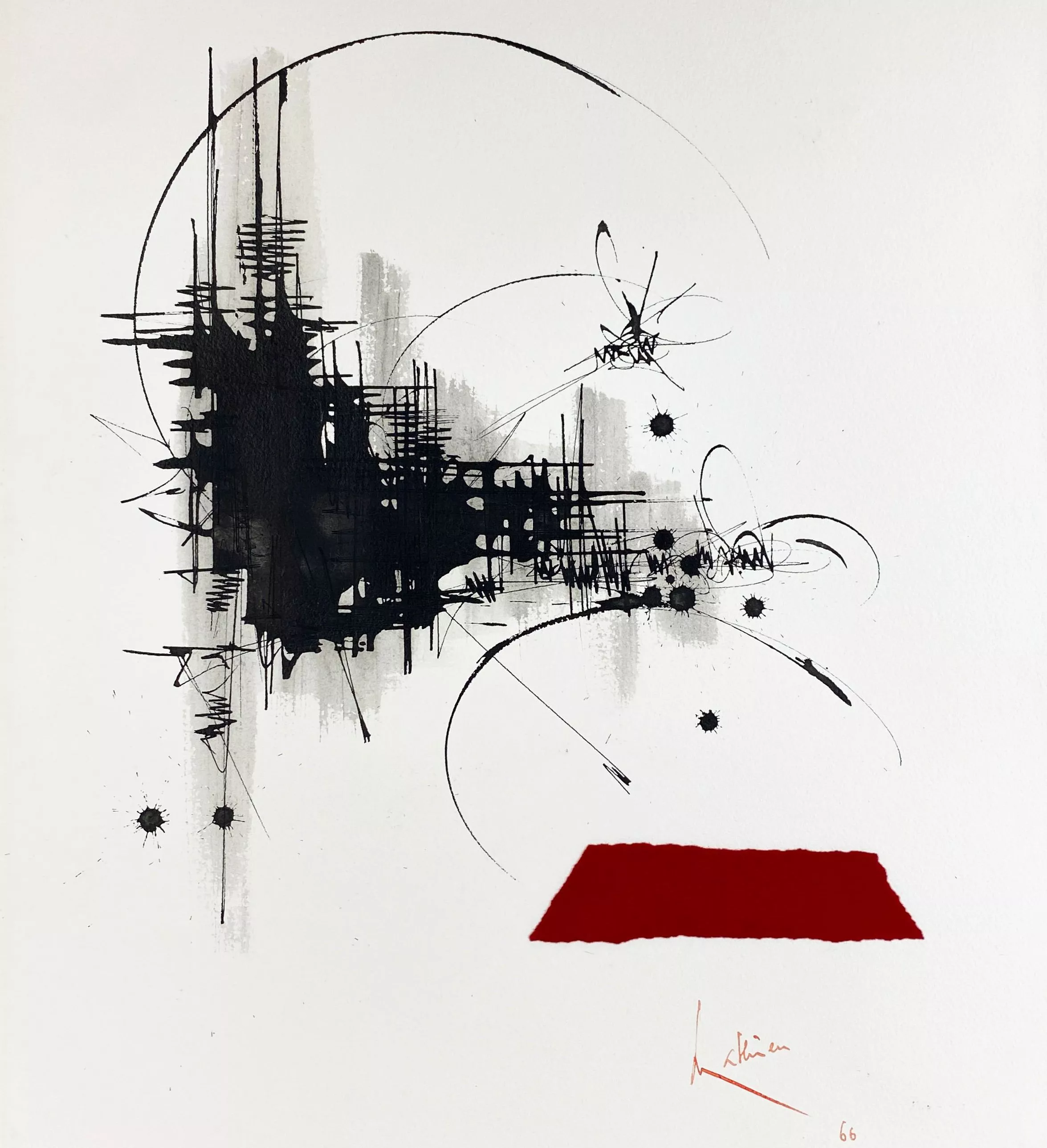
Georges Matthieu, master of lyrical abstraction
Georges Mathieu has often been presented as a paradoxical figure: both provocateur and theorist, he combined a rebellious spirit with a rigorous quest for aesthetics.
Born in 1921 in Boulogne-sur-Mer, he spent his childhood in a France in the throes of change, marked by the inter-war years.
However, it was in the university and not in the workshops that his career first took shape: with a degree in English literature, he began his career as a teacher and translator, an intellectual anchorage that would never leave his work.
It wasn't until the late 1940s that he turned fully to painting, driven by a fascination for pure abstraction and the potential of gesture. Resolutely independent, he rejected the dogmas of geometric abstraction in favor of lyrical freedom.
Visionary, from 1947 he organized manifesto exhibitions, in which he defended immediate, intuitive painting, which he opposed to the constraints of reason. Mathieu's boundless energy was not confined to the studio: he wrote, theorized and traveled.
As the ambassador of a reinvented French art, he made his mark on the international scene while cultivating a certain eccentricity, like his spectacular performances where he painted in public.
Until his death in 2012, he remains a fascinating, iconoclastic figure whose work and ideas continue to fuel artistic debate.
Georges Mathieu's stylistic influences
Georges Mathieu's influences could be said to lie at the crossroads of the twentieth century's great aesthetic ruptures, while at the same time brilliantly breaking free from them.
While American Abstract Expressionism is often evoked as an inevitable parallel, with Pollock or Rauschenberg as major figures, Mathieu himself claims a filiation far more rooted in European history.
The baroque energy of Rubens or the dramatic élans of Delacroix find an obvious resonance with him, reinterpreted in a gestural language where technical virtuosity vies with emotional intensity.
Moreover, his compositions seem to dialogue with the calligraphic aesthetics of the East, borrowing from Japanese and Chinese writing this subtle blend of discipline and instinctive impulse.
Mathieu also admired the boldness of the Italian Futurists, their exaltation of movement and speed, expressed in his own canvases by bursting lines and frenetic rhythms. Yet it is in a conscious rejection of narrative or figurative structures that his work takes root.
Through his immediate, almost performative approach to the pictorial gesture, he forges a style that transcends these references, claiming a resolutely personal modernity rooted in the immediacy of the creative act.
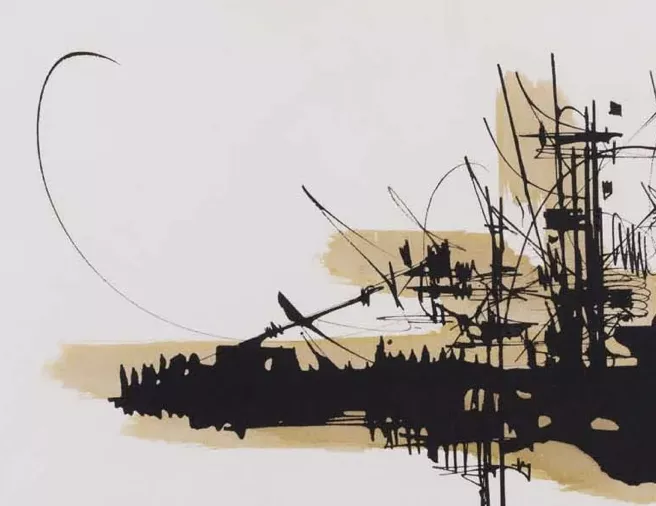
Georges Mathieu's place within lyrical abstraction
The place Georges Mathieu occupies within lyrical abstraction has rarely been questioned, so much so does he seem to be both its initiator and its most striking symbol.
While geometric abstraction favored the rigor of form and a certain intellectualization of the creative process, Mathieu took a diametrically opposed path, exalting pure emotion and the spontaneity of gesture.
He imposed a visual vocabulary in which color and line burst forth with an almost anarchic energy, capturing the moment with a rare intensity.
This gestural lyricism, which he sets up as a manifesto, makes him a figurehead, but also an exception, so much so that his approach goes beyond the very frameworks of this current.
While Mathieu claims a filiation with the great movements of European art, his influence quickly transcends borders, finding a particular echo in an era thirsting for renewal and formal freedom - forging an artistic filiation with artists such as Olivier Debré.
Where some saw lyrical abstraction as a mere counterpoint to American abstract expressionism, Mathieu inscribed his own identity, rooted in a flamboyant humanism.
His painting was not simply a response to the artistic tensions of his time, but an attempt to reconcile the chaos of the world with the beauty of the unexpected, a shard of eternity plucked from the tumult.
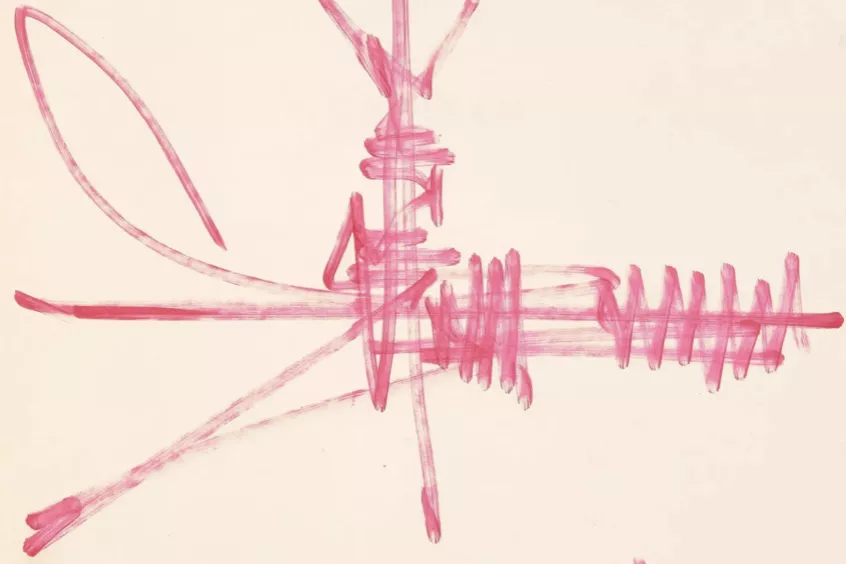
Focus on La Bataille des Bouvines, 1954
It would be impossible to overlook La Bataille de Bouvines, a monumental composition by Georges Mathieu painted in 1954.
This work, with its imposing dimensions and exaggerated theatricality, perfectly illustrates the painter's ambition to revive the great historical frescoes, while transposing them into the field of abstraction.
Here, the subject, the famous medieval battle that consecrated Philip Augustus, disappears beneath an explosion of lines and colors, as if the artist had wanted to translate the dramatic intensity of the event through the sheer force of gesture.
The canvas is shot through with frenzied, incisive strokes that tear the surface, while chromatic splashes - bright reds, deep blues, dazzling golds - evoke both the knights' armor and the violence of battle.
It's not a question of representing, but of evoking: Mathieu orchestrates here a veritable pictorial symphony where every brush movement seems to be a note.
The speed of execution, claimed by the artist, lends the whole a raw, almost electric energy, where emotion takes precedence over narrative.
This work, while asserting the autonomy of abstraction, is part of a paradoxical dialogue with tradition: it testifies to the desire of
Mathieu to make painting a total theater, capable of expressing the heroism, grandeur and tragedy of human history.
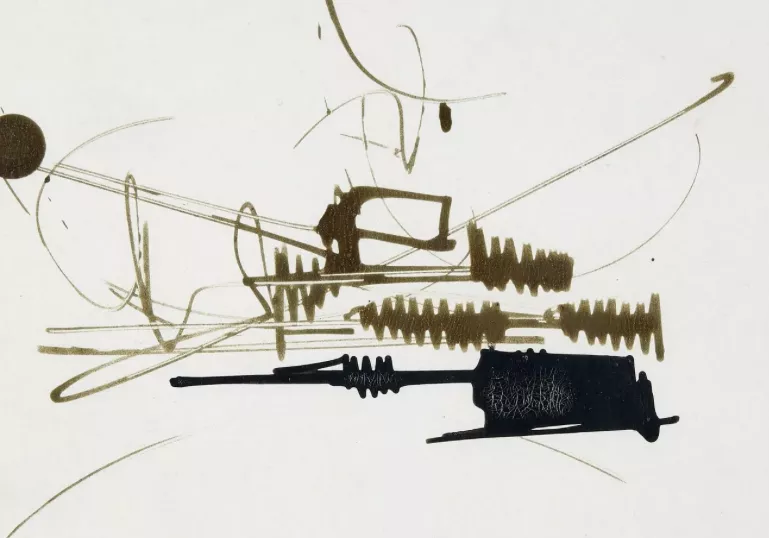
Georges Mathieu's imprint on his period
It's rarely considered how Georges Mathieu overturned the conventions of his time.
Far from conventional formats, his works stand out for their monumentality and dazzling execution, reinventing the very act of painting.
At a time when theoretical reflection dominated abstract art, he opposed a raw, immediate gestuality, like a living manifesto.
This exaltation of gesture was not just a technique, but a real statement, an opposition to the dominant influences from across the Atlantic, notably Abstract Expressionism.
What sets Mathieu apart is this ability to reconcile total freedom with a form of artistic heroism. His public performances, where he painted in front of an audience, gave the creative act an unprecedented theatrical, almost liturgical dimension.
It wasn't just about producing images, but embodying an idea: that of a vibrant European art, capable of competing with international schools and reviving an ancestral gestural tradition, sometimes evoking oriental calligraphy.
Every movement, every burst of color became an affirmation, a challenge to the rigid frameworks of academicism.
This posture marked a generation of artists and intellectuals in search of landmarks in a world turned upside down by modernity.
Mathieu's audacity lay as much in the spontaneity of his creations as in their ambition to push back the boundaries of European art, reinscribing it in a universal history.
His imprint, beyond his canvases, can be read in this desire to elevate art to the level of ritual, a total experience where immediacy and intuition surpass any method, thus inscribing his gesture in a quest for transcendence.
His signature
Although there are variations, here's a first example of his signature :
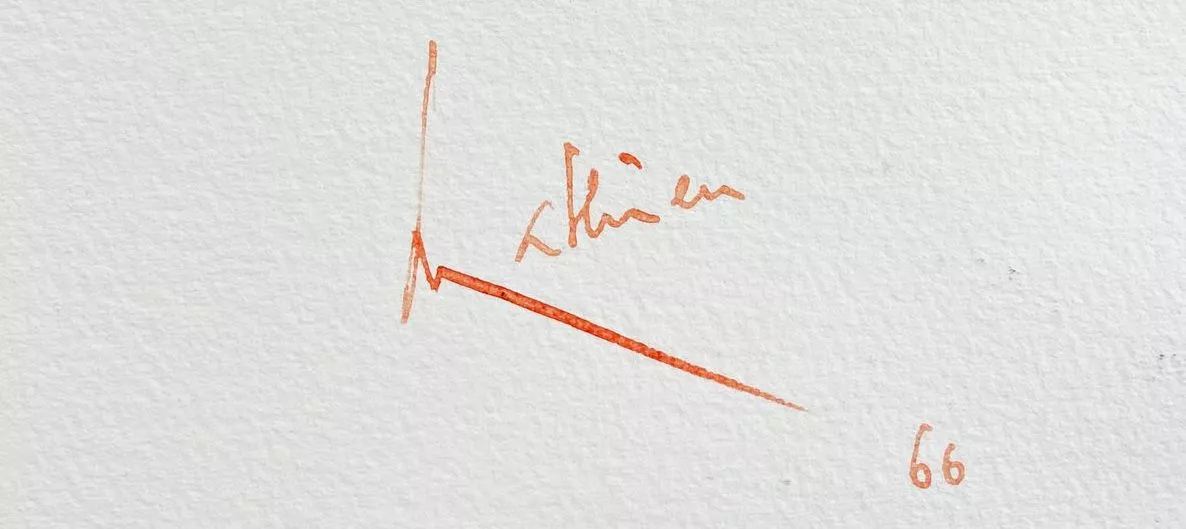
Our team remains at your disposal to identify your works.
Expertise your property
If you own a work by Georges Mathieu, don't hesitate to request a free appraisal by filling in our online form.
A member of our team of experts and licensed auctioneers will contact you to provide an estimate of your work's market value.
If you are considering selling your work, our specialists will also guide you through the various alternatives available to obtain the best possible price, taking into account market trends and the specific features of each work.
Estimate in less than 24h
Discover in the same theme

Rating and value of works, paintings, drawings by Louis Valt...
Louis Valtat was a Fauvist painter who produced many valuable paintings and drawings, which are highly prized at auction.
Learn more >

Cote and value of paintings by Jean Dupas
Jean Dupas is a twentieth-century artist whose Art Deco works are highly valued at auction.
Learn more >

Rating and value of Hubert Yencesse's drawings, sculptures a...
Hubert Yencesse is a French sculptor who worked with Maillol, producing works whose prices soar at auction.
Learn more >
D'autres tableaux abstraits vendus aux enchères

Estimated 2.000 - 4.000
Serge POLIAKOFF (1900-1969), Composition en rouge et bleu. 1965, Lithograph

Estimated Between €5,000 and €8,000
Jean MIOTTE (1926-2016), acrylic on canvas

Estimated 3.000 - 5.000
Roberto MATTA (1911-2002), Composition, Gouache on canvas
Estimate in less than 24h
Frequently asked questions
-
Who is George Mathieu, and what is his artistic movement?George Mathieu (1921–2012) was a French painter considered the pioneer of lyrical abstraction. A leading figure in this movement, he rejected the traditional constraints of painting in favor of an almost musical spontaneity, combining raw energy with meticulous calculation. He established himself as an iconoclastic figure who redefined the pictorial gesture and the artist’s relationship to his work.
-
What are the price ranges for George Mathieu's works based on the medium used?Mathieu’s prints are estimated at between €5 and €2,800, his drawings and watercolors at between €60 and €47,218, his sculptures at between €10 and €5,800, and his paintings at between €300 and €1,666,170. His most prestigious paintings can fetch several million euros at auction, as evidenced by his painting *Tuz Gölü*, which sold for €1,666,170 at Sotheby’s in 2021.
-
How can you authenticate and appraise a work by George Mathieu?To authenticate and appraise a work by George Mathieu, contact Auctie's to request a free, no-obligation appraisal. Our team of experts and state-certified auctioneers will examine your item and provide you with an accurate estimate of its market value within 48 hours. This step is required prior to any planned sale.
-
Is this the right time to sell a work by George Mathieu?Yes, now is a good time to sell a work by George Mathieu. The artist’s market value continues to rise, and he has established himself as a safe bet in the contemporary art market. His international recognition and the steady demand for his paintings and drawings ensure strong sales potential.
-
How does the sale of a work by George Mathieu at Auctie's work?Auctie's supports you from start to finish: a free appraisal by an expert, followed by guidance on the best sales approach tailored to your artwork. Our specialists guide you by taking into account market trends and the specific characteristics of your piece to help you achieve the best possible price at auction.
