



Rating and value of paintings by Otto Manigk

Key takeaways
- Works by Otto Manigk, a 20th-century German painter (1902–1972), sell for between €300 and €18,000 at auction, with his paintings commanding the highest prices.
- His surrealist painting *Fischerfrau* (1950/51) sold for €18,000, exceeding its initial estimate of €12,000–14,000.
- Manigk favored a rigorous geometric approach and a limited color palette, influenced by the Cubism of Picasso and Braque, eschewing direct emotional expression.
If you own a work by or based on the artist Otto Manigk and would like to know its value, our state-approved experts and auctioneers will guide you.
Our specialists will carry out a free appraisal of your work, and provide you with an accurate estimate of its value on the current market.
Then, should you wish to sell your work, we will direct you to the best possible arrangement to obtain the optimum price.
Artist's rating and value
On the art market, Otto Manigk's rating is quite high. His most prized works are his surrealist canvases, whether portraits or landscapes.
The artist is quite prized among 20th-century German painters and draughtsmen. For example, Otto Manigk's works sell for between €300 and €18,000 at auction.
His painting Fischerfrau (oil on canvas), dating from 1950/51, went for €18,000, whereas it was estimated at between €12,000 and €14,000.
Order of value from the most basic to the most prestigious
Technique used | Result |
|---|---|
Estamp - multiple | From 300 to 320€ |
Drawing - watercolor | From €300 to €600 |
Painting | From €1,000 to €18,000 |
Estimate in less than 24h
Style and technique of Otto Manigk
In his works, Otto Manigk chooses a simple, geometric structure, often dominated by angular shapes, which appear as direct borrowings from the rigor of geometric abstraction.
In 1935, in Formes en mouvement (Museum of Modern Art, Berlin), Manigk employs a reduced palette, echoing Picasso's Cubist exploration or Braque's use of the straight line, forsaking the sparkle of Fauvism and the fluidity of Art Nouveau.
Like the latter, he seems to turn away from pathos in favor of a more methodical, analyzed approach to form, aiming to render the very essence of the object without any lyricism interfering.
In his compositions, it's not a question of a simple figure standing out against the background, but of a composition in which forms merge into space almost indistinctly.
The rigorous, unified facture marks a stage when the artist, far from expressing his emotions, seems to prefer a search for pure visual substance.
This movement, already perceived in Picasso's work in 1911, when he declared to Kahnweiler a "Signac-like methodical facture", seems to be reflected in Manigk, who, like his predecessors, does not seek to express a personal feeling but rather to dissolve the boundary between figure and background.
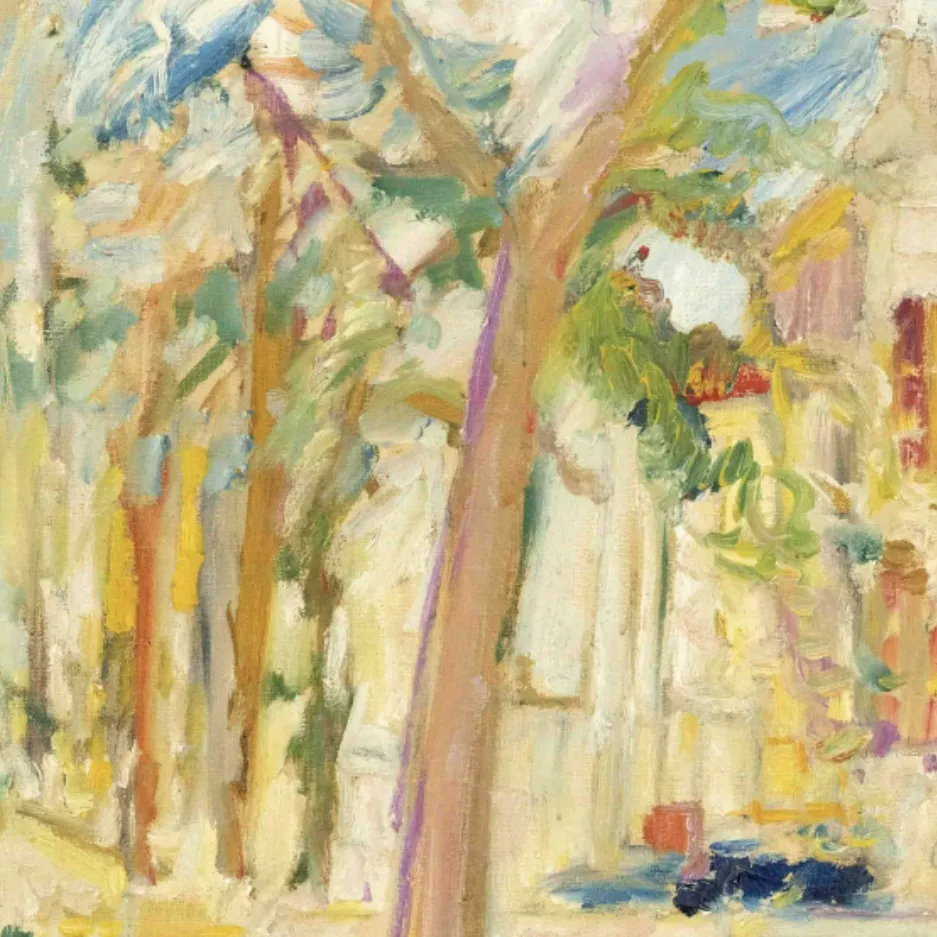
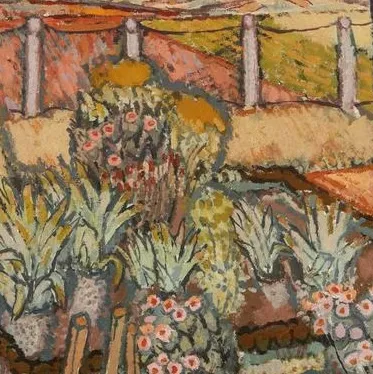
The life of Otto Magnigk
Otto Manigk (1902 - 1972) was a 20th-century German painter. Born in Breslau, Poland, to a lawyer father. Before deciding to become an artist, he apprenticed as a carpenter - which led him to attend the Breslau School of Decorative Arts.
There, he first studied interior architecture, before moving on to sculpture. Today, however, only paintings and drawings can be found for sale on the auction market.
He befriended Herbert Wegehaupt, an artist and teacher with whom he exchanged and worked throughout his career.
From 1924, he attended the Berlin Charlottenburg State School and completed his academic training at the Académie Ranson, alongside Roger Bissière.
From 1930, he set up his studio in Berlin, where he worked as a freelance artist. Every summer, he worked in residence in Ückeritz on Usedom, where he produced both personal works and gave painting lessons.
From 1941, he was forced to stop painting as he was called up for military service and then taken prisoner of war. Very few of the works he produced before this period are known, as his studio was bombed, so all the production inside was destroyed.
In 1947, he moved to Ückeritz - and was asked to exhibit his work at the Schwerin State Museum the following year. In the 50s, he returned to architecture, where he oversaw mural and stained glass projects.
Such projects included the Marchin cultural center and the Wolgast nurses' residence. Towards the end of his career, he held a number of important cultural positions in his region. He died in 1972, leaving two children who also became artists.
Focus on Shapes in Motion, Otto Manigk, 1935
In his works, Otto Manigk chooses a simple, geometric structure, often dominated by angular shapes, which appear as direct borrowings from the rigor of geometric abstraction.
In 1935, in Formes en mouvement (Museum of Modern Art, Berlin), Manigk employs a reduced palette, echoing Picasso's Cubist exploration or Braque's use of the straight line, thus forsaking the sparkle of Fauvism and the fluidity of Art Nouveau.
Like the latter, he seems to turn away from pathos in favor of a more methodical, analyzed approach to form, aiming to render the very essence of the object without any lyricism interfering.
In his compositions, it's not a question of a simple figure standing out against the background, but of a visual organization where shapes merge into space almost indistinctly.
The central element is no longer the object as such, but its place and relationship to the whole, as a balancing factor in a rigorous geometric system.
The rigorous, unified facture marks a stage when the artist, far from expressing his emotions, seems to prefer a search for pure visual substance.
This work on form and space leads to a total abstraction, where emotion and illusion are sacrificed in favor of a distilled representation of reality.
There is no longer any room for fluidity, for movement; only pure, essential lines and forms have a function in this rational organization of space, whose aim is to reinvent the image through simplification and order.
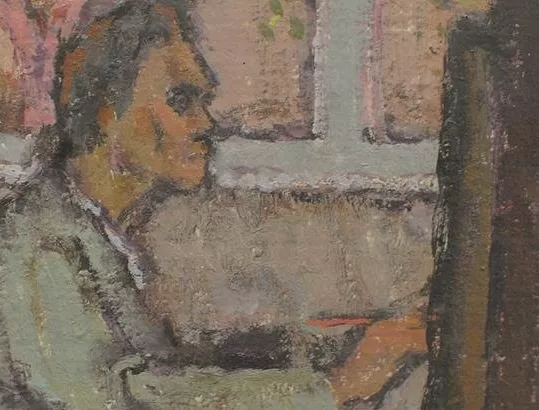
Otto Manigk's imprint on his period
Manigk seeks neither spectacular affirmation nor manifest rupture, but installs a silent presence, an imprint that acts without apparent clashes.
His compositions claim nothing, oppose nothing, but subtly displace visual reference points, inscribing each form in a structure where balance takes precedence over direct expression.
In a context where late Expressionism prolongs its outbursts and Modernism attempts its last syntheses, he moves away from subjective impulses in favor of a rigorous ordering, where form and space organize themselves in a measured dialogue.
This is not a confrontation between mass and color, but a gradual absorption of elements into a construction thought out with implacable precision.
This approach, with no violent contrasting effects or overt claims, imposes another reading of the image, where the structure itself becomes the real issue.
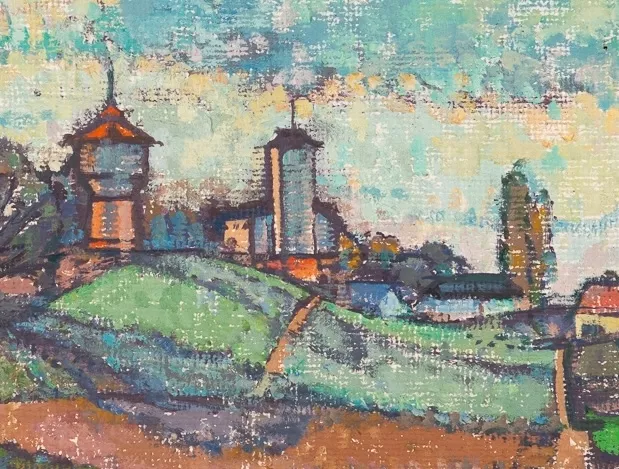
Otto Manigk's stylistic influences
Far from an obvious filiation, Manigk's influences are part of a continuity where each borrowing seems to fade behind its own logic. He seeks neither to reproduce the expressive vigor of the Austrian Expressionists, nor to fully embrace the geometric rigor of abstraction.
Rather than a clash of heritages, he favors a quiet assimilation, where references to Schiele or Kokoschka but also Fritz Schwarz-Waldegg or Max Oppenheimer can only be perceived in the underlying tension of the compositions.
The forms don't clash, they organize themselves in a measured relationship, devoid of all emphasis, as if balance were to be found not in gesture, but in patient construction, free of all affect.
Through this approach, Manigk does not seek to capture a momentum or impulse, but to establish an order in which each element fades into the background in favor of an overall balance.
Far from spontaneous expression and liberated gesture, he imposes an organization in which pictorial matter, reduced to its strictest necessity, never gives itself away as an assertion, but as a methodical articulation of space.
Nothing disturbs this silent construction, where forms respond to each other without ever colliding, where every tension is absorbed into an almost impassive rigor.
The image, stripped of all overload, exists only through the precision of its internal relationships, where the presence of one element is defined only by its relationship to the others, in a calculated balance that seems to abolish all subjective intervention.
His signature
The artist signs his works most of the time, however it may happen that the signature is on the back of the painting. In all cases, it's best to have your work appraised to ensure its originality.
Expertise your property
If you happen to own a work by Otto Manigk or after the artist, don't hesitate to request a free appraisal by filling in our form on our website.
A member of our team of experts and certified auctioneers will contact you promptly to provide you with an estimate of the value of your work, as well as ad hoc information about it.
If you are planning to sell your work, you will also be accompanied by our specialists in order to benefit from alternatives for selling it at the best possible price, taking into account market inclinations and its specificities.
Estimate in less than 24h
D'autres tableaux expressionnistes vendus aux enchères


Discover in the same theme

Ratings and values of paintings by Jean-Paul Riopelle
Jean-Paul Riopelle is a 20th-century Surrealist painter whose works are highly regarded and quoted on the auction market.
Learn more >

Rating and value of paintings by Marie Aimée Lucas Robiquet
Marie Aimée Lucas Robiquet is an Orientalist artist who produced a large body of work that is highly valued and appreciated.
Learn more >

Rating and value of drawings and paintings by Nicolas Eekman
Nicolas Eekman is an original painter from Brussels whose style defies categorization. His work is reminiscent of the School of Paris and is highly va...
Learn more >

Secure site, anonymity preserved

Auctioneer approved by the State

Free and certified estimates
Frequently asked questions
-
Who was Otto Manigk, and what was his artistic style?Otto Manigk (1902–1972) was a 20th-century German painter born in Breslau. His style is characterized by a rigorous geometric and abstract approach, influenced by the Cubism of Picasso and Braque. He favored a methodical organization of forms and space, seeking to dissolve the boundary between figure and background rather than to express direct emotions.
-
What is the price range for Otto Manigk's works at auction?Prices for works by Otto Manigk range from €300 to €18,000 at auction. Prints and watercolors sell for between €300 and €600, while paintings fetch between €1,000 and €18,000. His painting *Fischerfrau* (1950/51) sold for €18,000, exceeding its initial estimate of €12,000–14,000.
-
How can you authenticate a work by Otto Manigk?To authenticate a work by Otto Manigk, we recommend that you request a free appraisal from Auctie's by filling out our appraisal form. Our experts and certified auctioneers will examine the artwork and verify its authenticity, paying particular attention to the signature (usually on the front, but sometimes on the back of the painting).
-
How does the appraisal process work at Auctie's?Appraisals at Auctie's are free and non-binding. Simply fill out our online form with information and photos of your item. A certified expert or auctioneer will contact you promptly to provide an accurate estimate of your item's market value within 48 hours.
-
If I own a work by Otto Manigk, is this the right time to sell it?Yes, now is a good time to sell a work by Otto Manigk. The artist commands a fairly high price on the art market, particularly for his surrealist paintings. Our specialists will guide you from the appraisal to the auction to help you achieve the best possible price, taking into account current market conditions.
