



Rating and value of paintings by Oskar Kokoschka

Key takeaways
- Kokoschka’s works fetch prices ranging from €10 to €15,832,000 at auction, with painting being the most highly valued medium.
- His Expressionist paintings, particularly his intense psychological portraits, dominate the Austrian art market of the 20th century.
- His political activism against Nazism and his exile after 1938 cemented his status as a major figure in humanist Expressionism.
If you own a work by or based on the artist Oskar Kokoschka and would like to know its value, our state-approved experts and auctioneers will guide you.
Our specialists will carry out a free appraisal of your work, and provide you with an accurate estimate of its value on the current market. Then, if you wish to sell your work, we will guide you towards the best possible arrangement to obtain the optimum price.
Artist's rating and value
On the art market, Oskar Kokoschka's rating is extremely high. His most prized works are his expressionist canvases, both portraits and landscapes. The artist is particularly prized among 20th-century Austrian painters and draughtsmen. Thus, the price at which Oskar Kokoschka's works sell ranges from €10 to €15,832,000 at auction.
In 2018, his painting Joseph de Montesquiou-Fezensac (oil on canvas), dating from 1910, sold for €15,832,000, while it was estimated at between €13,342,000 and €17,788,000.
Order of value from the most basic to the most prestigious
Technique used | Result |
|---|---|
Sculpture - volume | From 400 to 7 600€ |
Estamp - multiple | From €10 to €104,000 |
Drawing - watercolor | From €20 to €630,000 |
Painting | From €600 to €15,832,000 |
Estimate in less than 24h
The artist's style and technique
Oskar Kokoschka, a leading figure of Expressionism, produced works that bear witness to the turmoil and upheaval of the first half of the 20th century.
Born in Vienna, this painter was influenced by the great masters of his time, notably Gustav Klimt and Carl Otto Czeschka, with whom he acquired a solid training. His art, however, soon took a very distinct direction.
Contrary to his Viennese contemporaries, Kokoschka did not seek to flatter, but to reveal, which earned him a reputation as a provocateur. His portraits, often commissioned by the Viennese elite, reflect a ruthless gaze on his models, whom he did not hesitate to depict with disarming brutality.
Early on, his works are marked by intense colors, bold contrasts and frequent use of black, which he applies in broad flat tints, lending his canvases a dramatic and sometimes oppressive dimension.
Arnaud Schönberg sums up this approach perfectly when he says that Kokoschka favors truth over beauty. Indeed, the artist seems intent on capturing not only the appearance but also the tormented soul of his subjects, revealing their flaws and anxieties with a sincerity that baffles.
This quest for authenticity is reflected in a dark palette, dominated by cold, earthy tones, often enhanced by touches of bright red or yellow, as if to better underline the tension that inhabits his compositions.
His brushstrokes, nervous and energetic, convey a form of restrained violence, as if he wanted to extract from reality the suffering that lurked within.
Kokoschka's style evolved over the years, however, influenced by the political and social events of his time. Faced with the rise of Nazism, he adopted an attitude of defiance and resistance.
His refusal to conform to the expectations of official, regime-controlled art made him a favorite target of the Nazi authorities.
His works, deemed too subversive, were exhibited in 1937 at the famous Degenerate Art Exhibition in Munich, where they rubbed shoulders with the creations of other artists rejected for their non-conformism.
Far from being intimidated, Kokoschka pursued his critique through paintings that forcefully denounced the brutality and absurdity of totalitarian regimes. The artist showed unwavering audacity, using his brush as a weapon against oppression, refusing any concession to a system he deemed dehumanizing.
Thus, Oskar Kokoschka's career remains marked by an inseparable aesthetic and political commitment, where each painting becomes a space for combat, a revolt against lies and compromise.
His work, deeply marked by the dramas of his time, remains a poignant testimony to the tormented history of the 20th century, oscillating between light and shadow, between beauty and raw truth.
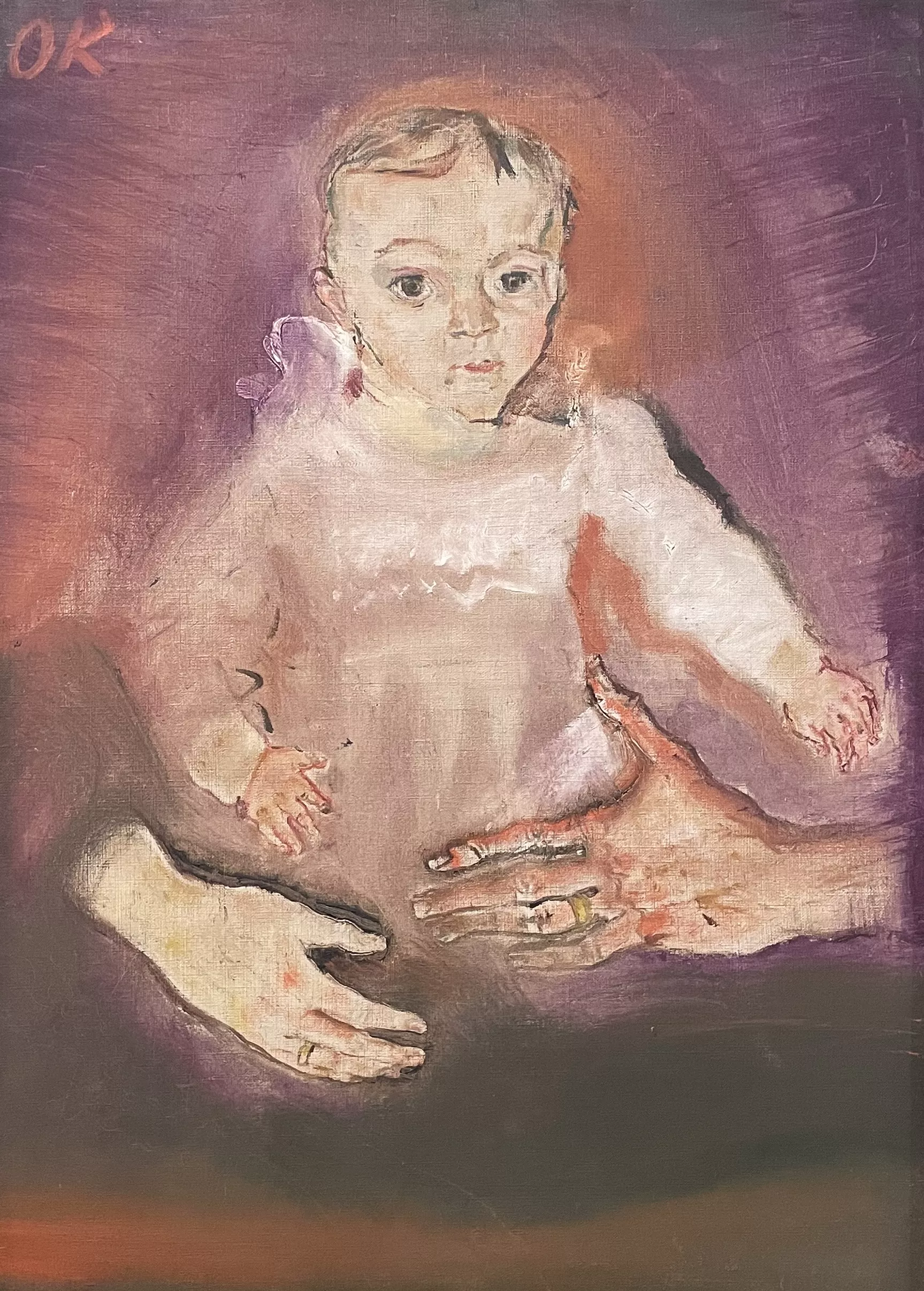
Oskar Kokoschka, humanist painter of anguish
Oskar Kokoschka (1886-1980) was a 20th-century Austrian painter and dramatist, renowned for his unique expressionist style.
Born into a modest family in Pöchlarn, he was encouraged by his mother to take early classes at the Academy of Fine Arts in Vienna, where he quickly distinguished himself for his bold technique and intense, psychological approach to portraiture.
Heavily influenced by the Viennese art movements of his time, he met Gustav Klimt, who exerted a major influence on his work, particularly in his use of color and form.
From 1909, Kokoschka became a central figure in the Viennese Secession, a group of artists who rejected academic conventions in favor of freer, more personal expression.
His art is distinguished by a profound psychological vision of his subjects, which he translates into his portraits through vigorous brushstrokes and vivid colors, often used to translate the soul of his models.
His relationship with Alma Mahler, whom he paints in a famous portrait, marks a particularly intense period in his work. This portrait is one of Kokoschka's most emblematic, capturing the complexity of his sitter with such expressive force that the image seems almost alive.
Kokoschka's involvement in the First World War was a major turning point in his career. After being severely wounded, he returned to painting with a new rage, exploring physical and emotional suffering in his works.
His creative process resembles that of Otto Dix, Geroges Rouault or Amedeo Modigliani, all war-scarred - these three artists needed, through painting, to express their suffering and their vision of war.
It was during this period that he created the Les Fantômes series, a body of work marked by distorted figures and dark colors, representing the pain and debris of war. His work, now more tormented, explores themes of loss, memory and human violence.
Exiled to Prague and then London after the Anschluss in 1938, Kokoschka continued his artistic work outside Austria. Far from his native land, his art became more introspective, marked by a sense of isolation and nostalgia.
His portraits, often large-scale, continue to reflect his quest for psychological truth, while his landscapes become increasingly allegorical, exploring themes of exile and absence.
Kokoschka's work, both tumultuous and deeply human, makes him a major figure of Expressionism. His unique approach to color, form and psychology enables him to capture the emotional intensity of his subjects and offer us a radical vision of the human condition in the 20th century.
Oskar Kokoschka - Humanist painter of anguish
Focus on The Wind Bride, 1913, Oskar Kokoschka
Intense in its sensuality, Oskar Kokoschka's The Wind Bride immediately plunges the viewer into a whirlwind of contradictory emotions.
This work depicts Alma Mahler, the artist's passionate love, in a posture both gentle and unsettling, where the beauty of her face seems to rocket through the air like a fleeting vision.
The features of her face, accentuated by bold, lively brushstrokes, are shrouded in an aura of mystery, as if the artist were trying to capture the very essence of being, while leaving an element of inaccessibility hanging in the air.
The texture of the skin, almost palpable, seems to vibrate under the tension of the colors, a mixture of warm reds and yellows that evoke both passion and suffering.
The background of the painting, all in gradations of blues and greens, contrasts powerfully with the central subject. This blurred, almost ethereal setting reinforces the impression of floating, as if Alma's portrait were suspended between the earthly world and the beyond.
This blur, as it were, lends the work a dreamlike, almost unreal dimension, echoing the painter's inner torments.
The posture of the central figure, eyes barely open, seems both serene and tragic. The image of Alma Mahler becomes a symbol of desire, aspiration and flight.
Kokoschka, through this portrait, captures the essence of his tumultuous love and doomed relationship, while providing space for the female figure to dissipate into the air, like a light but inexorable mist.
The artist's gaze seems to pierce beyond appearance, highlighting a profound psychological fragility. The intensity of the warm colors juxtaposes the coldness of the background, accentuating the tension between carnal love and the pain inherent in a relationship marked by loss.
Every brushstroke seems, in reality, an inner struggle to grasp and hold what cannot be possessed, to freeze a fleeting, elusive beauty.
Through this work, Kokoschka invites us to explore the intricacies of the human soul, the illusion of possession and the fragility of desire. The treatment of light, at once intense and diffuse, seems at times to efface the individuality of the model, transforming her into a universal symbol of love and sorrow.
This work by Kokoschka ends in a silent breath, confronting us with a painful truth: the intensity of passion, however beautiful, can only be ephemeral, doomed to vanish in the wind.
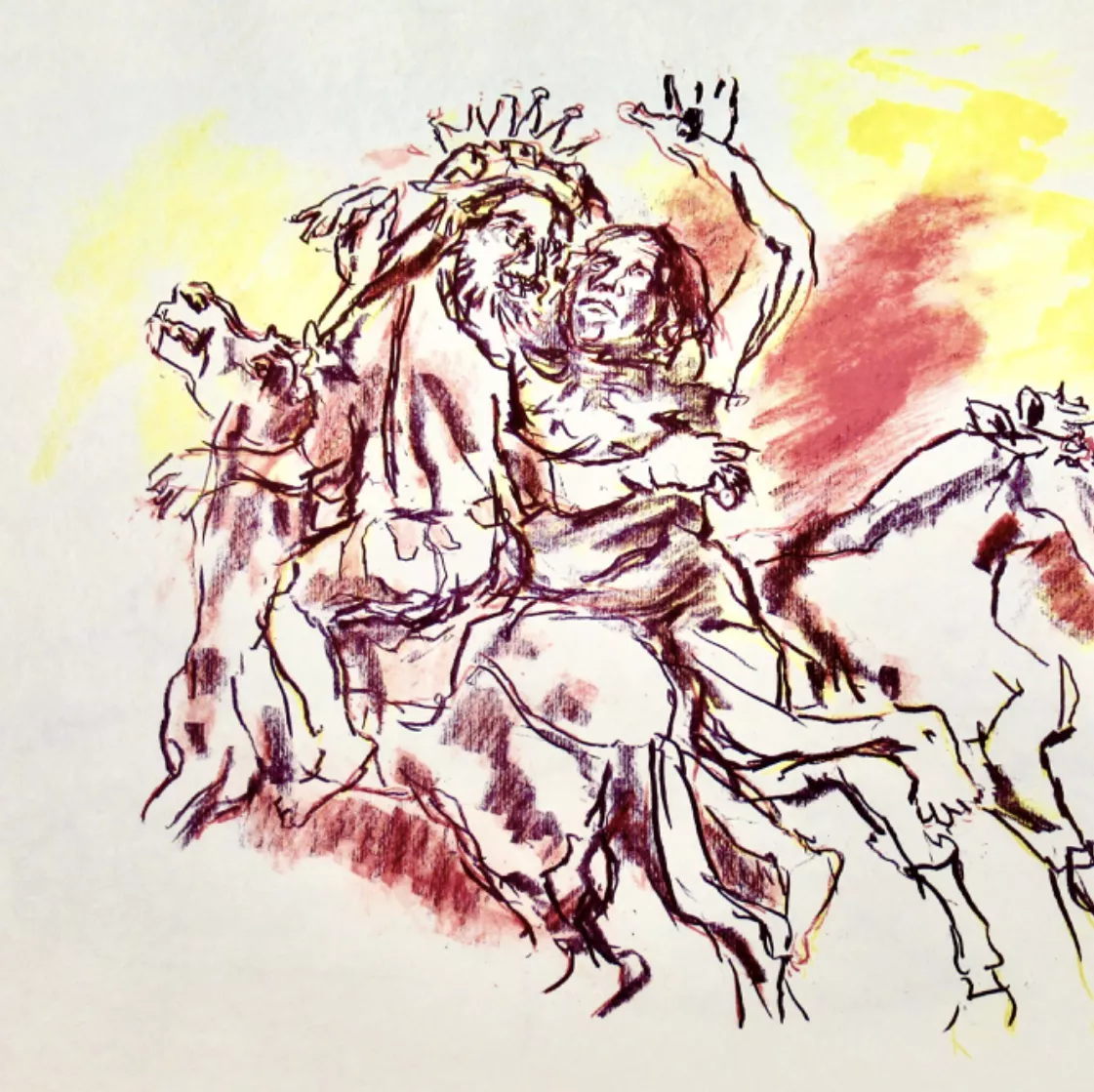
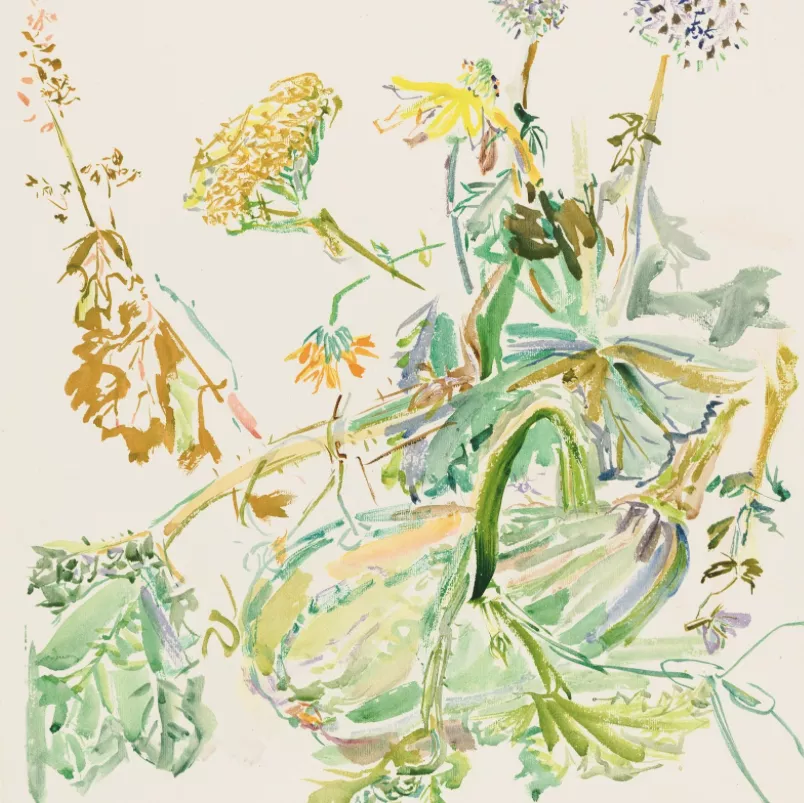
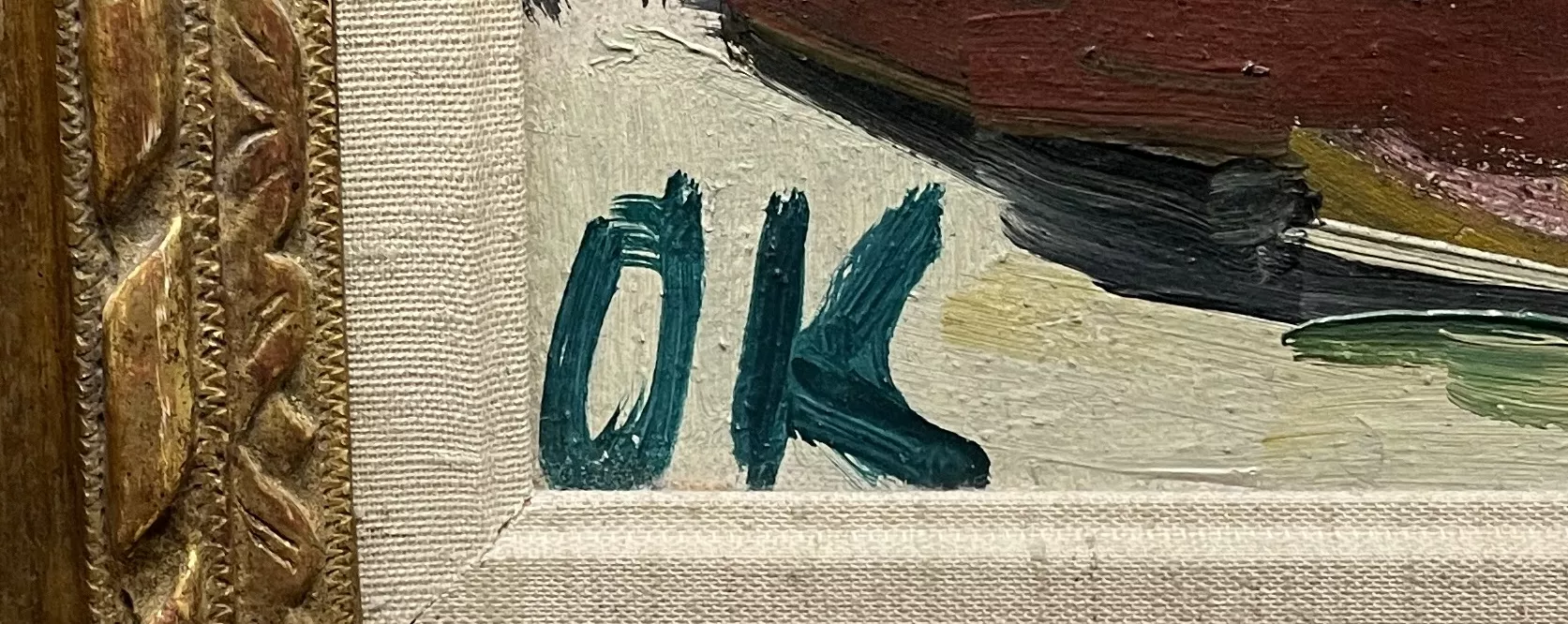
His signature
Although there are variations, here's a first example of his signature:
Expertise your property
If you happen to own a work by or after Oskar Kokoschka, don't hesitate to request a free appraisal by filling in our form on our website.
A member of our team of experts and licensed auctioneers will contact you promptly with an estimate of the value of your work, not forgetting to send you ad hoc information about it.
If you're thinking of selling your work, our specialists will also be on hand to provide you with alternatives for selling it at the best possible price, taking into account the inclinations of the market and its specific features.
Estimate in less than 24h
Discover in the same theme

Rating and value of the works, Alexandra Shchekotikhina-Poto...
Alexandra Shchekotikhina-Pototskaya is a twentieth-century Russian artist who mainly produced paintings on porcelain, which are highly valued.
Learn more >

Rating and value of paintings by Émile Aubry
Émile Aubry is a French muralist who produced many works that are highly valued at auction. 24H estimate.
Learn more >

Rating and value of Baya Mahieddine's paintings and drawings
Baya Mahieddine is an Algerian artist who influenced Picasso and Matisse. She has produced a number of highly-prized works.
Learn more >
Works from the same period sold at auction

Estimated 8.000 - 15.000
Maurice de VLAMINCK (1876-1958), Still life with jugs and leeks, oil on canvas

Estimated 800 - 1.500
André DEVAMBEZ (1867-1943) Little Red Riding Hood, Gouache and watercolor on paper

Estimated 1.000 - 2.000
Georges Hanna SABBAGH (1887-1951), Portrait of a woman in a red tunic, Oil on cardboard

Estimated 1.000 - 2.000
Leonor FINI (1907-1996), Figure study

Estimated 1.000 - 2.000
Jean FUSARO (b. 1925), A gust of wind by the sea in the south of France

Estimated 3.000 - 5.000
Wladimir de TERLIKOWSKI (1873- 1951), Roulotte dans un paysage, oil on canvas

Secure site, anonymity preserved

Auctioneer approved by the State

Free and certified estimates
Frequently asked questions
-
Who is Oskar Kokoschka, and what is his significance in art history?Oskar Kokoschka (1886–1980) was a major Austrian painter and playwright of 20th-century Expressionism. Trained in Vienna under Gustav Klimt, he distinguished himself through an intensely psychological approach to portraiture, prioritizing truth over beauty. A leading figure of the Vienna Secession, he denounced totalitarian regimes through his art, which led to his exile after 1938. His inseparable aesthetic and political commitment makes him a humanist painter of anguish, whose work bears witness to the tragedies of the 20th century.
-
What is the price range for Oskar Kokoschka's works?Prices for Kokoschka’s works vary considerably depending on the type of piece: sculptures sell for between €400 and €7,600, prints between €10 and €104,000, drawings and watercolors between €20 and €630,000, and paintings between €600 and €15,832,000. In 2018, the painting *Joseph de Montesquiou-Fezensac* (1910) fetched €15,832,000 at auction. His most sought-after works are his Expressionist paintings, particularly his portraits of Viennese figures.
-
How can you authenticate a work by Oskar Kokoschka?To authenticate a work by Kokoschka, we recommend that you request a free appraisal from our state-certified experts and auctioneers. Our team will examine your item and provide you with an accurate estimate of its current market value, with no obligation. This appraisal will allow you to determine the authenticity and true value of your artwork.
-
Is now a good time to sell a work by Oskar Kokoschka?Yes, now is a good time to sell a work by Kokoschka. This artist’s market value remains extremely high on the international art market, with sustained demand for his Expressionist paintings and drawings. Collectors are actively seeking out his portraits and landscapes, which ensures that your piece will fetch the best possible price. Our specialists will guide you toward the best sales strategy to maximize your return.
-
How does the appraisal process work at Auctie's?Appraisals at Auctie's are free and non-binding. Simply fill out our online form, and a member of our team of experts and licensed auctioneers will contact you shortly to appraise your artwork. We will then provide you with an accurate estimate of its current market value. If you decide to sell, we will work with you to offer the best options for getting the highest possible price.
