



Rating and value of paintings by Louise Desbordes Jonas

Key takeaways
- Louise Desbordes Jonas (1848–1926) was an Impressionist artist who specialized in portraits and still lifes; her oil-on-canvas paintings sell for between €50 and €5,200.
- Her works are characterized by a classical figurative style that combines bourgeois realism with an intimate sensibility, featuring a refined technique and a subtle, harmonious color palette.
- Although she received little media attention during her lifetime, her paintings remain rare at auction and are currently being rediscovered as part of research on overlooked female painters.
If you own a work by or after the artist Louise Desbordes Jouas, and would like to know its value, our state-approved experts and auctioneers will offer you their appraisal services.
Our specialists will work to carry out a free appraisal of your work, and provide you with an accurate estimate of its value on the current market.
Then, if you wish to sell your work, we will direct you to the best possible arrangement to obtain the optimum price.
Rating and value of the artist Louise Desbordes Jonas
Louise Desbordes Jouas is an artist known to lovers of impressionist canvases and still lifes of flowers. Now, prices for her works are rising at the auctioneers' gavel.
Her oils on canvas are particularly prized, especially by French buyers, and the price at which they sell on the art market ranges from €50 to €5,200, a significant delta but one that speaks volumes about the value that can be attributed to the artist's works.
In 2020, his oil on canvas Anémone de mer, was sold for €5,200, while it was estimated at between €400 and €600 at the time. Its value is stable.
Order of value from a simple work to the most prestigious
Technique used | Result |
|---|---|
Oil on canvas | From €50 to €5,200 |
Estimate in less than 24h
Style and technique of the artist Louise Desbordes Jonas
Louise Alexandra Desbordes Jonas (1848 - 1926) developed a painting style that is still little documented, but known for her portraits. She was the originator of a resolutely figurative style of painting, halfway between bourgeois realism and a more intimate sensibility.
She focused on depicting everyday subjects and portraits, with great attention to psychological character and expressive restraint. Her style remains classical in construction, but is distinguished by a discreet refinement in the observation of faces and attitudes.
The artist favors oil on canvas, with a fine material, applied in glazes or transparent layers, close to academic portrait techniques. Contours are sharp but not hard, and volumes are gently modeled, without spectacular effect.
Her brushstrokes are invisible or almost so, in the service of a faithful, interiorized representation. She uses a moderate, subtle range (beiges, pinkish browns, muted blues, soft greens) in fairly calm tonal harmonies.
Light is often diffuse, latent and unspectacular, giving her works a peaceful, almost domestic atmosphere. All her compositions are based on a measured chromatic balance, never garish or artificial.
Whether portraits or genre scenes, she paints absorbed, meditative figures, often turned inward. Her poses are simple, her figures often seated, bent over or in restrained gesture.
She captures the unspoken, silences and modesty in a pictorial tradition close to that of a Louise Breslau or a Marie Bashkirtseff. Her approach moves away from large historical or religious scenes to focus on suspended moments, faces and presences.
She thus contributes to proposing a feminine and interiorized vision of reality, at a time when women artists still have to deal with the limits imposed by official genres. Her painting is distinguished by its constancy, silence and psychological finesse, without ever yielding to illustrative anecdote.
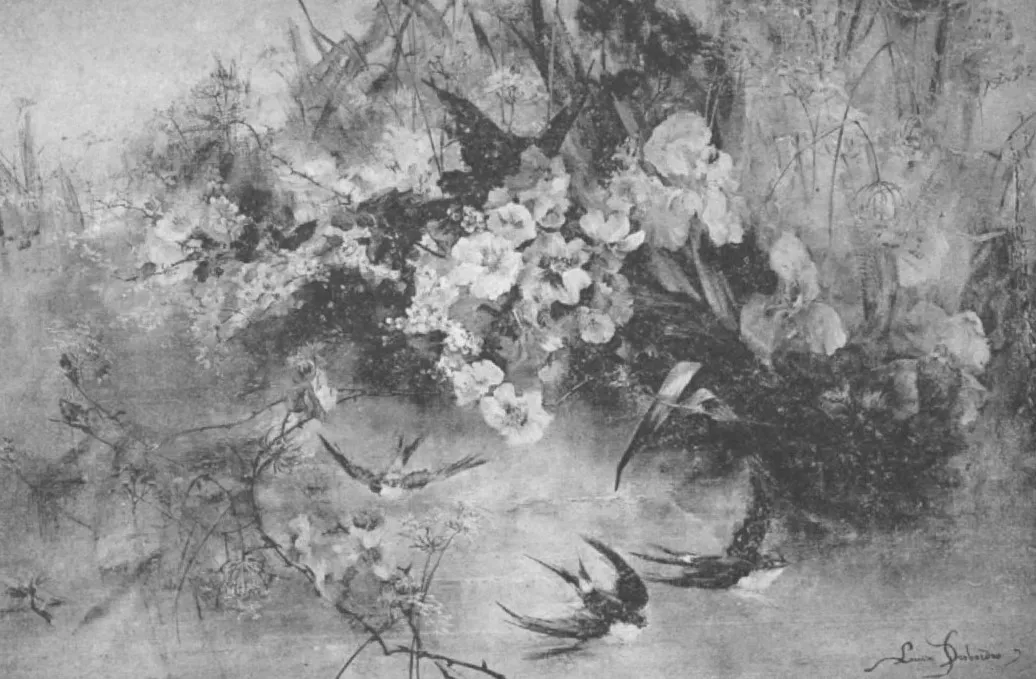
The career of Louise Desbordes Jonas
Born in Paris in 1848, Louise Desbordes Jonas came from a background conducive to artistic learning. Like many women of her generation, she was unable to enter the Beaux-Arts (training was forbidden to women at the time), but received private training, probably in an academic painter's studio.
She was part of the movement of women painters trained on the bangs of official institutions, but active on the Parisian art scene. She began exhibiting at the end of the 19th century, notably in the Parisian Salons de peinture, where she presented portraits, interior scenes and figure studies.
Her name appears in the catalogs of women's or mixed salons, sometimes with favorable mentions from the critics, underlining her accuracy of observation and the sensitivity of her style. Louise Desbordes then pursued her career in relative discretion, without scandal or avant-gardism, but with regular exhibitions and recognition from her peers.
Little is known today about her life (marriage, family, artistic entourage), which is common for female artists of this period with little media coverage. She seems to have led a discreet, independent life, concentrated on her pictorial work, in an artistic context still largely dominated by men.
Louise Desbordes belongs to that generation of women who, without breaking with academic forms, asserted a singular voice in genres deemed minor, such as portraiture or genre scenes.
Her career declined at the turn of the 20th century, like many figurative artists confronted with modern aesthetic upheavals. After his death in 1926, his work fell into relative oblivion, for want of a critical relay or curators.
Now rediscovered as part of research into women artists whom the world has invisibilized, she emerges as a representative figure of an art of the intimate, silent but deeply mastered.
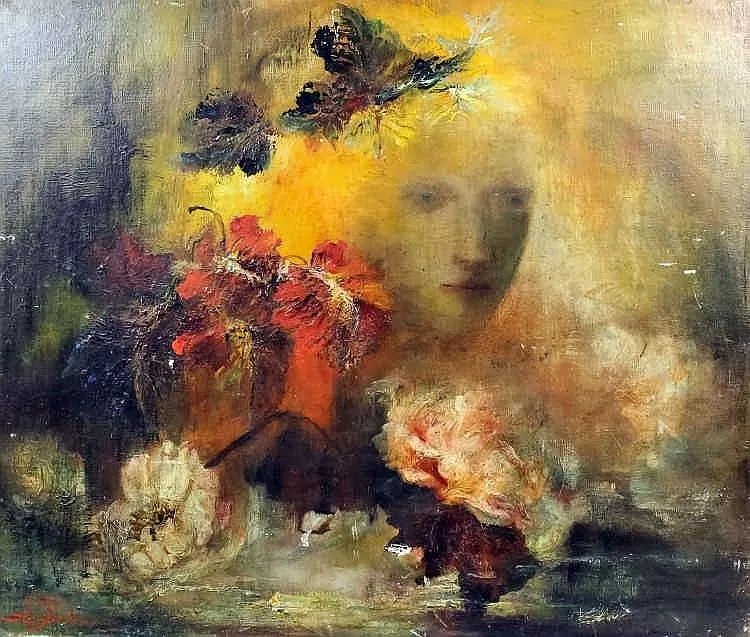
Focus on Jeune femme cousant, Louise Desbordes Jonas, circa 1900
Desbordes creates this work on a medium format, vertical portrait type on oil on canvas. It depicts a young woman seated in profile, absorbed in her work, installed in a simple, silent interior.
The painting illustrates a peaceful domestic scene, without anecdote, a moment that is nothing exceptional in a woman's day. The figure is set slightly back, without looking at the viewer no staging, but a discreet, concentrated presence.
The environment is reduced to essentials : a chair, a table and soft light coming from the left. The brushstrokes are smooth, with no apparent material effects, in the service of the legibility of the forms.
The modeling of the face and hands is subtle, rendered by very slight gradations of warm hues. Hair and clothing are treated with delicacy, but without a fetish for detail.
The artist works with a restricted range of browns, beiges and grayed blues, creating a hushed, calm atmosphere. The light is diffuse, latent and without marked shadows, ideal for suggesting concentration and interiority.
The painting as a whole is based on a gentle harmony, with no break in tone. This painting is part of a tradition of poeticized everyday life, close to certain scenes by Berthe Morisot or Louise Breslau.
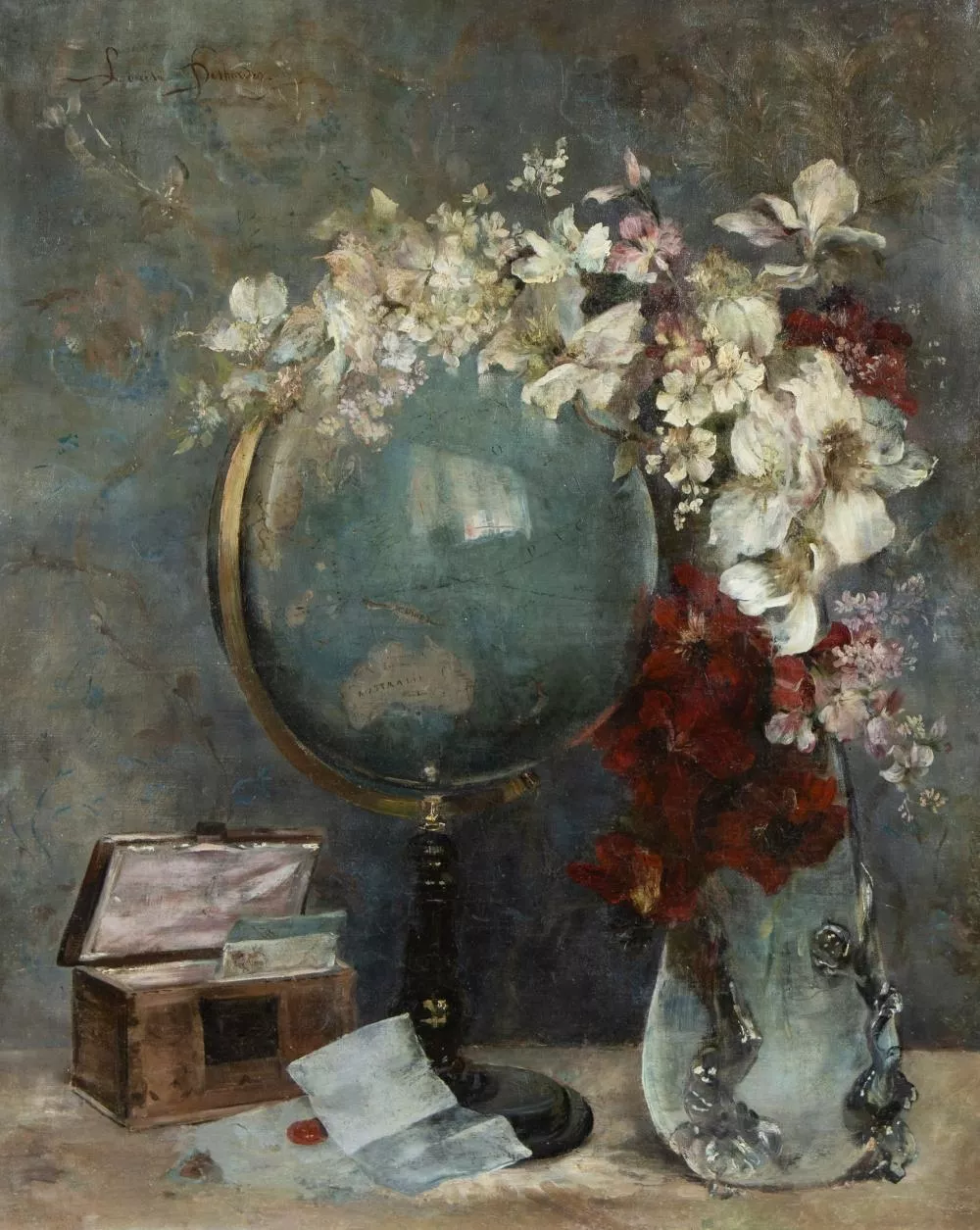
This is not a psychological portrait, but a discreet praise of attention, humble gesture and voluntary withdrawal. The painting thus valorizes a form of suspended time in which the subject's interiority resonates with the simplicity of the frame.
Young Woman Sewing thus illustrates Desbordes' discreet but valuable contribution to feminine painting without artifice, in a pictorial world often dominated by large historical machines.
This type of work also bears witness to a feminine gaze, without fetishization or affectation, where the dignity of everyday life becomes an artistic subject in its own right.
It thus participates in a revaluation of ordinary gestures, at a time when women artists were confined to minor formats.
Louise Desbordes Jonas's imprint on her period
Louise Desbordes Jonas makes her mark on 19th-century art, and is today a little-known butdemanded artist.
Her works are quite rare at auction and could therefore reach unprecedented amounts.
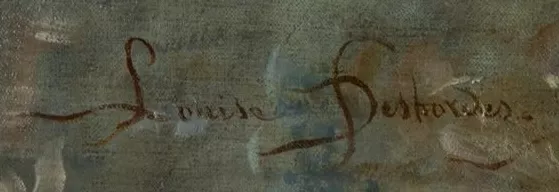
Recognizing the artist's signature
Louise Desbordes Jonas does not necessarily sign her works. Copies may exist, which is why expertise remains important.
Knowing the value of a work
If you happen to own a work by Louise Desbordes Jonas or after the artist, don't hesitate to request a free valuation using our form on our website.
A member of our team of experts and certified auctioneers will contact you promptly to provide you with an estimate of the market value of your work, as well as ad hoc information about it.
If you are considering selling your work, you will also be accompanied by our specialists in order to benefit from alternatives for selling it at the best possible price, taking into account the inclinations of the market.
.Estimate in less than 24h
Discover in the same theme

Rating and value of paintings and drawings by Jean-Joseph We...
Jean-Joseph Weerts is a 19th-century neoclassical painter. His paintings are appreciated on the art market and have a stable value.
Learn more >

Market Value and Pricing of Sophie Allart's Paintings, Drawi...
Sophie Allart is a 19th-century artist whose oil paintings are currently unlisted on the auction market.
Learn more >

Market Value and Pricing of Henri Rousseau's Paintings, Draw...
Henri Rousseau is a painter of 19th-century naive art, whose works are extremely highly valued.
Learn more >
Other similar works sold at auction

Estimated 1.000 - 2.000
Virginie Demont-Breton (1859-1935): Carrying donkey in an alley. Oil on panel.

Estimated 10.000 - 15.000
ABBÉMA Louise, 1853-1927 Portrait of Mme ***, 1879 Oil and gold paint on canvas

Estimated 1000€ - 2000€
Vladimir de TERLIKOWSKY (Poland, 1873-Paris, 1951) Woman and...

Estimated 800€ - 1500€
Surroundings of Jean-Baptiste Isabey (Nancy 1767-1855 Paris) Portrait of...

Estimated 600€ - 1000€
Entourage by Paul Huet (Paris 1803-1879 Paris) View...

Estimated 1800€ - 2500€
Attributed to Thomas Couture (Senlis 1815 - 1879...

Secure site, anonymity preserved

Auctioneer approved by the State

Free and certified estimates
Frequently asked questions
-
Who is Louise Desbordes Jonas, and what is her artistic style?Louise Desbordes Jonas (1848–1926) was a 19th-century Parisian painter who specialized in portraits and intimate interior scenes. Her figurative style, halfway between bourgeois realism and an intimate sensibility, is characterized by great psychological subtlety, an invisible brushstroke, and a subtle palette of muted tones. As a female artist trained outside the official institutions (which were off-limits to women at the time), she followed in the tradition of discreet and deeply masterful women’s art, akin to that of Louise Breslau or Marie Bashkirtseff.
-
What is the price range for works by Louise Desbordes Jonas?Louise Desbordes Jonas’s oil-on-canvas paintings sell for between €50 and €5,200, depending on the size and quality of the work. For example, the oil on canvas painting *Sea Anemone* fetched €5,200 in 2020, even though it had been estimated at between €400 and €600 prior to the sale. Her market value remains stable, and since her works are rare at auction, they could potentially fetch unprecedented prices.
-
How can you authenticate a work by Louise Desbordes Jonas?To authenticate a work by Louise Desbordes Jonas, we recommend that you request a free appraisal using the form on the Auctie's website. A state-certified expert or auctioneer will examine your artwork and provide you with an accurate estimate within 48 hours. This step is particularly important because the artist did not always sign her paintings, and copies may exist.
-
Is this a good time to sell a work by Louise Desbordes Jonas?Yes, this is a good time to sell a work by this artist. Louise Desbordes Jonas is currently being rediscovered as part of research on women artists, and her paintings are rarely available at auction, which is driving up demand for them. The stability of her market value and the growing interest in 19th-century women’s painting make this a good time to consider a sale.
-
How does Auctie's go about appraising and selling a work of art?Appraisals at Auctie's are free and non-binding: simply fill out a form, and a certified expert or auctioneer will contact you shortly to examine your piece and provide you with an estimate of its market value within 48 hours. If you’d like to sell, we’ll guide you through the process from appraisal to auction, offering you the best options to achieve the highest possible price based on current market trends.
