



Rating and value of paintings by Jules Lefebvre

Key takeaways
- Jules Lefebvre was a French academic painter (1836–1911) known for his oil-on-canvas paintings, which sell for between €50 and €135,800.
- *Morning Glory* (1879) sold for €135,800 in 2008, far exceeding the initial estimate of €53,000 to €68,000.
- A master of the nude and the female portrait, he taught at the Académie Julian and trained a generation of artists, notably Georges Rouault.
If you own a work by or after the artist Jules Lefebvre, and would like to know its value, our state-approved experts and auctioneers will offer you their appraisal services.
Our specialists will carry out a free appraisal of your work, and provide you with a precise estimate of its value on the current market.
Then, if you wish to sell your work, we will direct you to the best possible arrangement to obtain the optimum price.
Rating and value of the artist Jules Lefebvre
Jules Lefebvre is a French painter and draughtsman, recognized in this case under the Second Empire and the Third Republic.
His most prized works are his oils on canvas, and the price at which they sell on the market ranges from €50 to €135,800, a substantial range but one that speaks volumes about the value that can be attributed to Jules Lefebvre's works.
In 2008, an oil on canvas entitled Morning glory, dating from 1879, sold for €135,800, while it was estimated at between €53,000 and €68,000.
Order of value from a simple work to the most prestigious
Technique used | Result |
|---|---|
Drawing - watercolor | From 50 to 6 400€ |
Estamp - multiple | From €100 to €9,900 |
Painting | From €200 to €135,800 |
Estimate in less than 24h
The artist's style and technique
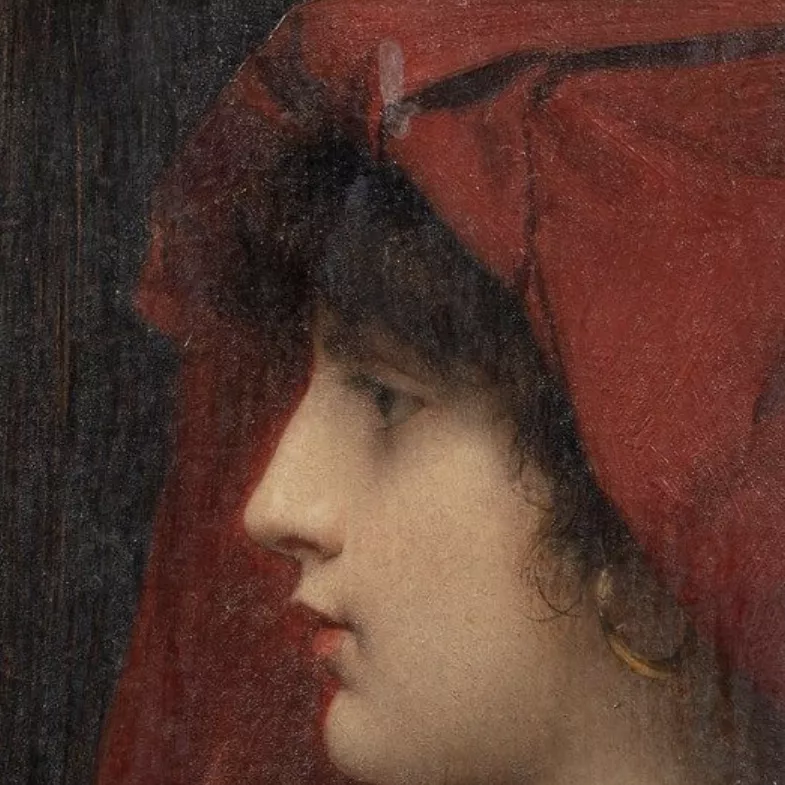
With Jules Lefebvre, academic painting found one of its most fervent defenders. His style is based above all on rigorous drawing, where the line is impeccable and precise, sculpting forms with a limpidity that evokes the Ingresque heritage.
To this graphic exactitude is added a science of modeling, all in blended gradations, giving skin tones a pearly, almost unreal softness. The light, carefully controlled, caresses the volumes smoothly, enveloping the figures in a diffused glow, without brutality or sharp contrasts.
It is not a light that dramatizes, but a light that reveals, emphasizing the idealized perfection of female bodies, the central theme of his work.
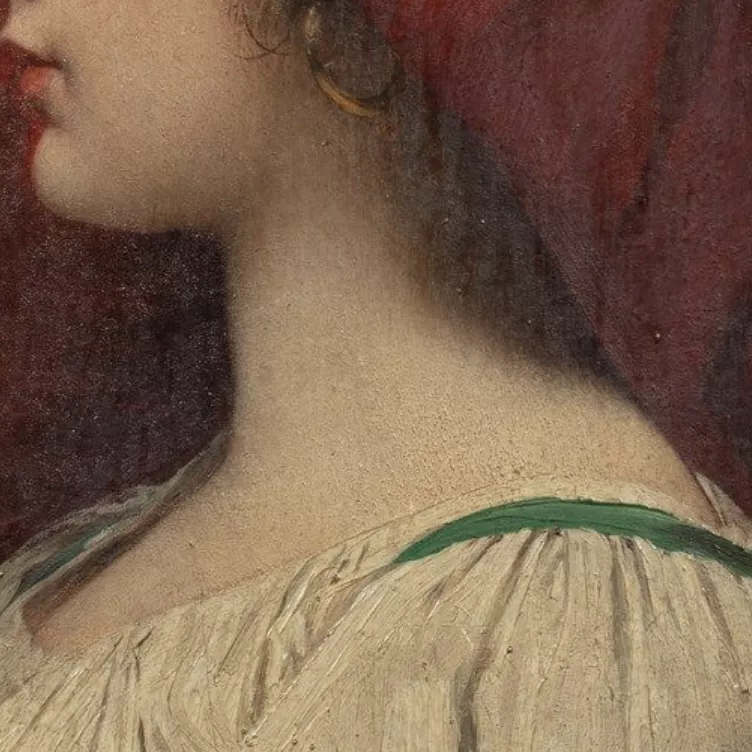
The treatment of drapery, for its part, is distinguished by a finesse of execution that extends the lesson of the classical masters: supple folds, skilfully ordered, integrated into the composition with impeccable logic.
The composition itself follows strict principles of balance and weight, where each element is arranged with mathematical clarity, avoiding the anecdotal, rejecting the unexpected. Lefebvre does not give in to the audacities of his time.
Where others seek the vibration of the brushstroke or the explosion of form, he perfects, polishes and elevates. His art, rooted in tradition, pursues an ideal of timeless beauty, where technical precision is combined with a tireless quest for harmony.
The life of Jules Lefebvre
In 1836, Jules Lefebvre was born in Tournan-en-Brie, Seine-et-Marne. He belonged to this generation of painters who, after Ingres and Flandrin, perpetuated an ideal of formal perfection, rooted in the academic tradition.
As a student of Léon Cogniet at the École des Beaux-Arts, he was trained in the rigor of drawing and the demands of modeling, a direct legacy of neoclassicism. The Prix de Rome, which he won in 1861 with La Mort de Priam, opened the doors to the Villa Medici.
There, he studied the Renaissance masters, honed his science of volume and developed the smooth, precise craftsmanship that would characterize all his work.
Returning to France, he quickly established himself at the Salon. The success of La Vérité, in 1870, sealed his reputation. The female figure is idealized to the extreme, the modeling impeccably smooth, the drawing almost sculptural in its exactitude.
Lefebvre masters the art of the nude with a meticulousness that brings him close to Bouguereau, but his brushwork, more subtle, seeks grace rather than virtuoso brilliance.
The Académie, seduced by this painting of unfailing purity, elevates him to the rank of master. His mythological and allegorical figures, marked by an austere elegance, found their way into official collections.
At the same time, his influence spread through teaching. A professor at the Académie Julian, he trained an entire generation of painters, anxious to preserve the academic ideal in the face of the onslaught of naturalism and impressionism.
His teaching was based on the primacy of drawing, the clarity of form and the rigorous study of the human body. A member of the Académie des Beaux-Arts since 1891, he embodies this fidelity to the principles inherited from the great century. He died in 1911, at a time when academic art, eclipsed by the avant-garde, was in decline.
Focus on La Vérité, Jules Lefebvre
With La Vérité (1870), Jules Lefebvre delivers a manifesto of the academic ideal. A standing nude woman, holding a mirror that she raises above her head, emerges against a vaporous background. Her body, diaphanously white, seems bathed in light.
The impeccably precise drawing sculpts the forms with almost classical exactitude. The infinitely soft modeling lends the figure a controlled sensuality, without ever sinking into anecdote.
Lefebvre excels in the art of the nude, but here he goes beyond mere technical virtuosity. The hieratic posture, the haughty bearing, the impassive gaze give this Truth an allegorical dimension.
The mirror, the traditional attribute of Truth, becomes here an instrument of the absolute: it reflects nothing other than the very idea of clarity and knowledge. The composition, sober and uncluttered, reinforces this impression of a transfigured body, detached from reality.
Everything is balance, purity and mastery. If Lefebvre follows in Bouguereau's footsteps, he distinguishes himself by a certain restraint. Far from immediate seduction, he favors the nobility of gesture and formal perfection.
La Vérité thus embodies the apogee of an academicism which, at the end of the 19th century, was reaching its ultimate refinement before the audacities of modernity overturned the artistic landscape.
.
Jules Lefebvre's imprint on his time
Jules Lefebvre established himself in his time as an influential academic master. He was one of those figures who embodied the ideal of academic art in the 19th century. The artist quickly established his mastery of classical painting techniques and portraiture.
Acknowledged as a painter, he influenced a whole generation of artists through his pupils. His career as Professor at the Ecole des Beaux-Arts de Paris enabled him to make a lasting mark on artists from all horizons and, more generally, on art education in the 19th century.
He notably trained Georges Rouault, who would later take much more expressionist and abstract paths, but also Louis Anquetin and Paul Landowski.
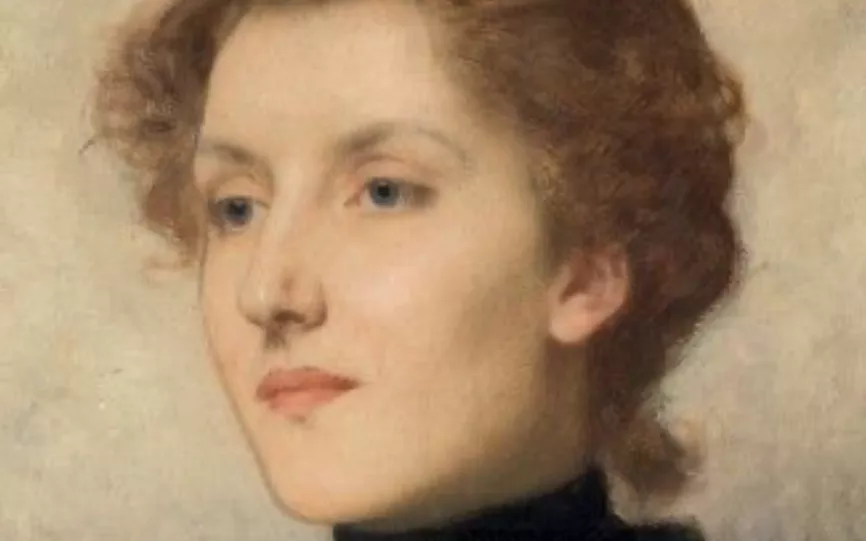
Lefebvre is famous, among other things, for his portraits and his work around the female figure. Female portraiture is indeed an important milestone in his achievements, and he treats his subjects with great finesse - especially in the rendering of drapery.
His near-perfect mastery of drawing (from an academic point of view) and light lends the subjects he depicts a timeless grace. In the 19th century, his work was seen as an ideal of beauty, blending sensuality and balance.
These characteristics made him an undisputed specialist in nudes and female portraits. His approach, although academic, remains open : the artist is also interested in the trends of his time, notably those of realism and impressionism.
He demonstrates an ability to combine tradition and modernity in some of his works, proving his open-mindedness despite the label assigned to him, always maintaining a rigorous technique in his work.
Although his art remains firmly rooted in the academic tradition, he also plays a role in the transition to more modern art forms (he was Rouault's master, for example).
As a result, Jules Lefebvre stands out as a privileged witness to the artistic evolution of the 19th century, his career spanning a period when academic art competed with new avant-gardes.
While remaining committed to teaching and figurative art, Lefebre witnessed the profound changes that restructured the art world in the 19th century, marking both the end of an era and the beginning of a new artistic era.
Today, some of his works can be seen in public collections, in Paris museums and elsewhere, but the majority of his work is held by private collectors, who play the greatest role in preserving his work.
At auction, his work is particularly appreciated by lovers and collectors of figurative art. His value peaked in the 2010s, but there has been considerable upside potential in recent auctions, suggesting that Jules Lefebvre's works will do well in the future.
Recognizing the artist's signature
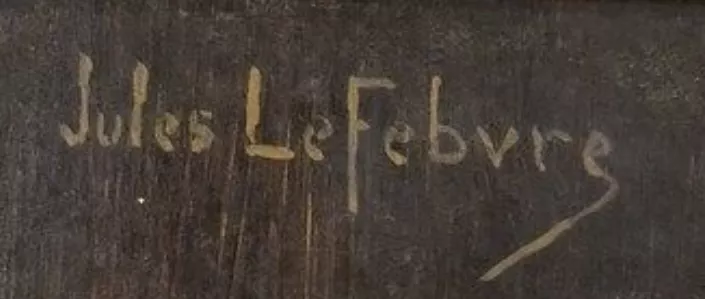
Jules Lefebvre doesn't necessarily sign his works. If they are, here's an example of his signature :
Knowing the value of a work
If you happen to own a work by Jules Lefebvre, request a free appraisal without further delay via our form on our website.
A member of our team will contact you promptly to provide you with an estimate of the value of your work, not forgetting to send you ad hoc information about it.
If you are considering selling your work, you will also be accompanied by our specialists in order to benefit from alternatives for selling it at the best possible price.
.Estimate in less than 24h
Discover in the same theme

Rating and value of paintings by Wilfrid Gabriel de Glehn
Wilfrid Gabriel de Glehn was a British Impressionist painter who produced paintings that are highly rated and valued at auction.
Learn more >

Rating and value of sculptures and bronzes by Jean-Jacques F...
Jean-Jacques Feuchère is a Symbolist and Romantic artist whose atypical output has met with great success at auction.
Learn more >

Rating and value of aquarelles and paintings by William Call...
William Callow is a painter who primarily created watercolors that command high prices at auction. 100% free appraisal
Learn more >
Other paintings from the same period sold at auction

Estimated 1.500 - 3.000
Jean VANDEN EECKHOUDT (1875-1946), Basket of persimmons, Oil on canvas

Estimated 2.000 - 4.000
Ramiro ARRUE (1892-1971,) Landscape in front of the Rhune, Oil on panel

Estimated 4.000 - 6.000
Ary Scheffer (Dordrecht 1795-1858 Argenteuil) One of the three holy women (meditating on Christ's resurrection after the vision in the tomb?) Oil on canvas

Estimated 800 - 1.500
DAUBIGNY Charles François (1817-1878) Les carrières de Clamart Oil on panel

Estimated 1.500 - 2.500
Odilon REDON (1840 - 1916) Ear cell. 1894 Lithograph on china paper applied to vellum

Estimated 2.000 - 3.000
Wladimir de TERLIKOWSKI (Poraj, 1873 - Paris, 1951) L'entrée du village Oil on canvas, signed lower left in red.

Secure site, anonymity preserved

Auctioneer approved by the State

Free and certified estimates
Frequently asked questions
-
Who is Jules Lefebvre, and what is his historical context?Jules Lefebvre (1836–1911) was a leading French painter and draftsman of the Academic movement, who gained recognition during the Second Empire and the Third Republic. A student of Léon Cogniet and winner of the Prix de Rome in 1861, he established himself as the undisputed master of academic painting and an influential professor at the Académie Julian and the École des Beaux-Arts in Paris, training a generation of painters, including Georges Rouault.
-
What is the price range for Jules Lefebvre's works?Prices for Jules Lefebvre’s works vary considerably depending on the medium and quality: drawings and watercolors range from €50 to €6,400, prints from €100 to €9,900, while oil paintings, which are more prestigious, range from €200 to €135,800. The famous painting “Morning Glory” (1879) sold for €135,800 in 2008, far exceeding its initial estimate.
-
How can you authenticate a work by Jules Lefebvre?To authenticate a work by Jules Lefebvre, we recommend that you request a free, no-obligation appraisal from our state-certified experts and auctioneers via our online form. Our team will contact you promptly and provide you with an accurate appraisal based on the work’s technical analysis, provenance, and condition.
-
Is this the right time to sell a work by Jules Lefebvre?Yes, now is a good time to sell a work by Jules Lefebvre. Although his market value peaked in the 2010s, recent auction results show significant upside potential, suggesting strong future results. Interest in his works among collectors of figurative art remains strong.
-
How does the appraisal process work at Auctie's, and how do I sell my artwork?Appraisals at Auctie's are free, with no obligation, and are conducted by our experts within 48 hours. If you decide to sell, our specialists will guide you every step of the way—from appraisal to auction—offering you the best options for selling your artwork at the best possible market price.
